True friends are solid rock under your feet. Those who befriend for personal gain are shifting desert sands.
You’re born into a family. There’s a bond there; sometimes warm, sometimes strained, but it exists whether you asked for it or not. Friends are different. Friends are chosen. You choose them, and more importantly, they reciprocate that choice.
Some friends come from our reckless, impetuous youth. Some from our careers. Some from neighborhoods, teams, projects, and the accidents of geography. Time and distance shuffle the cast, but the real ones don’t become strangers. They steady you. They don’t demand a performance. They can disagree without turning you into a defendant. You remember them fondly, and when you see them again after years, you can still pick up mid-sentence, as if time never got a vote. That’s friendship. Not constant contact. An unshakable bond. These are the people you brought into each other’s lives, not for gain but for mutual support.
But there are others. People who orbit you for their own advantage. Their support is there—until it costs them something. Their loyalty is conditional. Their kindness comes with a receipt. They keep score, question motives, and disappear when you’re inconvenient or irrelevant. These relationships can be helpful, even mutually beneficial, but they’re transactions, not friendships. The difference between them is where people get hurt. With transactional allies, trust is offered in exchange for leverage.
Choose wisely, not selfishly. Choose friends for support, and benefits will often follow. Choose people for benefit, and deception shouldn’t surprise you. NeverFearTheDream simplebender.com
NeverFearTheDream simplebender.comStand For Truth
Please consider following simplebender, you’re reading makes my writing more fun..…
Comments and thoughts are always welcome and feel free to re-post …..
People who stop overanalyzing the past have better odds at a successful future.
There is value in embracing the past and looking to the future simultaneously—to practice the philosopher’s “Janusian mindset”—while staying present in the moment. Yet, as we age, whether as individuals or nations, we tend to focus more on our past. We romanticize times when we felt invincible—periods of vitality, learning, and growth. We were finding our strengths, supporting and hiding our weaknesses, all the while learning to see the same in everyone around us.
Now, here we are—a little older, slower, and weaker, but much wiser. And therein lies the key to our future. The secret is not to dwell on who we were, but to leverage our accumulated knowledge and experience for the good of those around us. Greatness is not measured by what we’ve done, but by how we uplift others. As individuals, it’s in how we help our communities; as a nation, it’s in how we inspire global respect for democracy and human dignity. This is the message that philosophers, teachers, and prophets throughout history have conveyed. Greatness was never about personal glory—it was about collective well-being.
Let’s focus less on what we were and more on what we can become, using our experiences to encourage, not oppress. Let’s leverage those experiences not to oppress but to encourage and uplift. The sacrifices of the “Greatest Generation” showed us that we should stand up for those who suffer and support the vulnerable, both locally and globally. We, too, can inspire by looking back as we move forward, coaching the next generation to be better. We must be mindful of what we teach and how we act; the next generation and the world are watching — everything. Our ability to influence and guide them is directly related to our credibility.
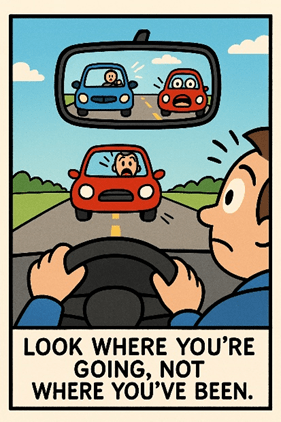
Staring in the rearview mirror is a great way to have a wreck while driving forward. As this year ends and we begin another lap around the sun, glance back with gratitude, acknowledging the memories, but keep your eyes focused on the future—for all of us. NeverFearTheDream simplebender.com
First published in Bend Bulletin 1/7/26
NeverFearTheDream simplebender.comStand For Truth
Please consider following simplebender, you’re reading makes my writing more fun..…
Comments and thoughts are always welcome and feel free to re-post …..
Religion has always walked a knife-edge between faith and power. Religion is best when it brings comfort and worst when it becomes a tool of politics. Within our lifetime, there are two salient examples of the twisting of religion and state power: Iran and Russia. Two very different nations illustrate how this symbiotic relationship unfolds and precisely why our founders wisely established a separation between the church and the state. Spoiler alert—the walls are crumbling.
Iran: Mosque as State—Under the Shah, Iran’s clerics were suppressed, their influence diminished as the monarchy rushed to modernize. In 1979, the pendulum swung violently back. Ayatollah Khomeini and the mosque became the state itself. For decades, sermons dictated law, dissent was heresy, and the Revolutionary Guard enforced both politics and piety. Religion achieved supremacy at the cost of freedom.
Today, Iran’s youth — connected, progressive, impatient — are no longer persuaded by clerical authority. Protests after the death of Mahsa Amini revealed the fracture: religion wielded as control is no longer seen as sacred. The bargain that once restored the mosque’s power has hardened into a straitjacket, hollowing faith even as its institutions endure.
Russia: Saints for Soldiers—For most of the 20th century, the Russian Orthodox Church was brutalized under communism. Priests executed, cathedrals destroyed, believers silenced. When the Soviet Union collapsed, the Church sought revival — but revival required allies. Putin offered protection, prestige, and funding. In return, Patriarch Kirill and his bishops sanctified not only his rule, but his wars. Each branch of the Russian military is assigned a patron saint, and these are displayed as soldiers march—icons and rifles in hand. And mosaics of saints standing beside tanks and missiles—faith stitched into firepower.
It is a mutual, parasite-host alliance for survival. The Church props up the empire; the empire props up the Church. Orthodoxy regains prestige after decades of persecution, while the Kremlin secures sacred legitimacy for its conquests.
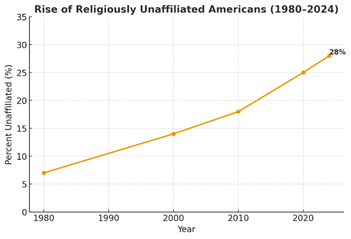
United States: Are Pulpits the Next Podiums?—Judeo-Christianity has influenced our national culture from its founding. Currently, church attendance is shrinking, younger generations walk away, scandals erode credibility, and the religiously unaffiliated approaches 30% of the population (PRRI). We are evolving into a secular nation of diverse beliefs. In this decline and transition, political power has become a lifeline for some of the more radical to guard against the nightmare of irrelevance becomes a reality.
Some fringe religious leaders now align with vocal politicians who promise to “fight for them,” to restore an age and influence gone by. In exchange, some of their pulpits have become podiums. Political leaders boast, “I hate my enemies,” and vow to “beat the hell out of them,” these words juxtaposed to:” do good to those who hate you, bless those who curse you, pray for those who mistreat you.” The contrast is crisp —aggressive pulpits now espouse vengeance rather than pleading for understanding. Rhetoric that contradicts the very teachings once held sacrosanct. The threat of pulpits becoming podiums is a genuine concern.
Lessons: Learn the Lessons—The parallels are clear. In Iran, religion became the state. In Russia, the Church promotes the empire for its own security. In America, the mainstream is often overshadowed by extremists who cling to authoritarian strongmen for cultural relevance and power—trading faith’s essence for influence.
When religion becomes a weapon of politics, the backlash is not revival but rebellion. These bargains may preserve institutions for a generation, but they ultimately lead to decay.
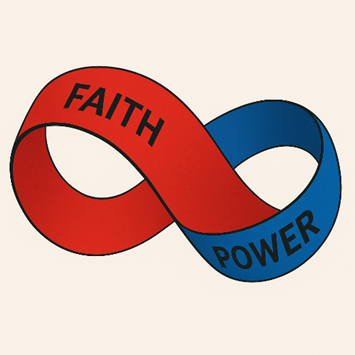
Like a Möbius strip, the inside and outside of faith and power continuously trade places, with no true end and no certainty. The loop is endless, the inversion unending — a path where faith loses its soul and nations lose their way, twisting around and around until revolt. The American founders understood this and wisely built institutional walls between state and church to prevent their blighted bonding, but now the walls are crumbling. #NeverFearTheDream
First published in Bend Bulletin 10/29/25
Always feel free to re-post—anywhere, anytime, to anyone—share freely.
NeverFearTheDream simplebender.comStand For Truth
If you’re looking for daily thoughts and insights you will want to start the morning with:
Lap Around the Sun: Daily Steps Forward
If you know someone who is facing any facet of Alzheimer’s they might gain some insight from:
Joy in Alzheimer’s: My Mom’s Brave Walk into Dementia’s Abyss
Please consider following simplebender, you’re reading makes my writing more fun..…
Comments and thoughts are always welcome and feel free to re-post …..
The old man sat on the porch, the autumn wind stirring the fallen leaves. His grandson, an impatient teen, leaned against the rail and sighed heavily.
“Opportunity for everyone—what a joke,” the boy muttered. “Not for us anymore. Maybe for someone else—they’ve taken everything.”
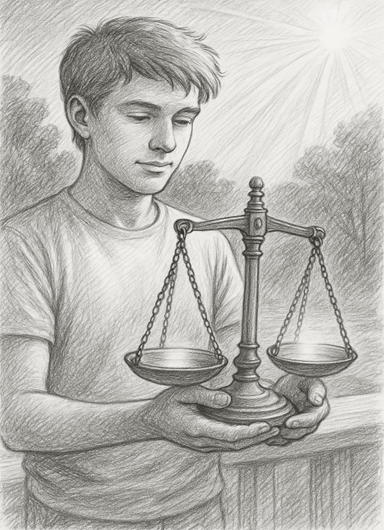
The grandfather didn’t answer. He reached for a small, rusted balance scale on the railing—an heirloom from his own father.
“You know this scale?” he asked. “Your great-grandad was a miner. He used it to weigh ore, but he said it measured something greater than metal—justice. Not everything weighs the same, but a good scale makes sure the measure is fair.”
He dropped a pebble on one pan. “This is what you think you’ve lost.” Then another. “And this, what someone else gained.”
The boy watched, his arms crossed, curiosity overtaking his frustration.
The old man added a third pebble, heavier than the rest. “This one’s the story you were told—that if their side rises, yours must fall. That story was sold by the same people who bent the beam and called it balance.”
The boy frowned. “What do you mean?”
“When I was your age,” said the grandfather, “we believed hard work guaranteed the climb. For a while, it did. Then markets changed and factories closed, machines got smarter, and those who owned the levers of money built taller ladders while the rest of us argued over who deserved the bottom rung. Now they feed you anger because angry men don’t notice the hands at the top pressing on the scale. They treat us like puppets—because too many dance when they pull the strings.”
He flipped the scale over; the pebbles scattered. The arms hung limp, like broken marionettes. “They’ve convinced you the problem is the person climbing beside you. But look closer—the scale isn’t even anchored to the ground anymore. The fight isn’t for equal weight; it’s for honest measure. Equity means measuring every stone’s, every person’s, its true worth.”
The boy’s jaw tightened. “So what do I do with that?”
The grandfather smiled. “Simple. Stop counting other people’s pebbles and start measuring their worth. Fix the scale. Learn, build, vote, speak, stand—not for the side you were born on, but for the fairness your great-grandad believed in. Opportunity isn’t gone, son. It’s just been disguised by those who need you too angry to see the game.”
The boy turned the scale in his hands. It felt lighter than he’d imagined—and suddenly, so did he. He set it on the railing, and as the arms found their balance, the old man said softly, “Remember, life’s not meant to be equal—it’s meant to be just.”#NeverFearTheDream
Equality assumes sameness, but nature has never been equal. No two stones weigh alike, no two lives start level. Equity is the art of fair measure — adjusting the balance so that justice, not uniformity, prevails. It asks that we see worth in context, not in comparison. The world doesn’t need everyone to carry the same load; it requires each of us to bear our share with integrity and pride. The lesson of the scale is simple: fairness isn’t about equal weight, but about honest measure — the foundation of any just and enduring society.
54% of Black men born in the bottom income quintile remain there as adults, compared to 22% of White men.1
Hispanic children are more likely than Black children but less likely than White children to move up from the bottom 20% into the middle or top 40%.2
Black boys earn less than White boys in 99% of U.S. neighborhoods.1
Among children from low-income households, only 17% of White children remain in the bottom decile as adults versus 42% of Black children.3
Between cohorts born in 1978 and 1992, the racial mobility gap shrank by about 27%, yet Black men and Native Americans remain twice as likely as White men to experience downward mobility.4
1:(Brookings, 2018; Chetty et al., Opportunity Insights, 2018)
2:(Chicago Fed, 2023; Opportunity Insights, 2018)
3:(Equitable Growth, 2022; Pew Research Center, 2022)
4: (Equitable Growth, 2023; U.S. Census Bureau, 2024)
Always feel free to re-post—anywhere, anytime, to anyone—share freely.
NeverFearTheDream simplebender.comStand For Truth
If you’re looking for daily thoughts and insights you will want to start the morning with:
Lap Around the Sun: Daily Steps Forward
If you know someone who is facing any facet of Alzheimer’s they might gain some insight from:
Joy in Alzheimer’s: My Mom’s Brave Walk into Dementia’s Abyss
Please consider following simplebender, you’re reading makes my writing more fun..…
Comments and thoughts are always welcome and feel free to re-post …..
As a child, I wore pinhole glasses with side shields. I had Coats’ Disease and was one of the youngest patients to undergo pre-laser photo-coagulation, where swollen blood vessels on my retina were burned into place. As their youngest and most active patient, the specialists feared that even slight eye movement might breach the scars and leave me blind. Their solution was to narrow and control my vision to protect it. To see more, I had to move my head, mentally stitching fragments into a larger, coherent picture.
Today, too many choose to live this way—peering at the world not only through pinhole glasses but through pinhole windows in houses of self-imposed isolation.
We are fortunate to have the ability to see both panorama and detail. Yet many deliberately confine themselves to the narrowest slits of vision. They call it principle, but it is often blindness. When you see only fragments, you are not informed—you are managed. Critical thinking can change this. It helps us see beyond fragments, connect the dots, and make informed decisions.
Life is messy, confusing, thrilling and interconnected. To reduce it to one grievance, one tribe, or one slogan is not clarity; it is surrender. Families and communities depend on us to see beyond personal outrage. Narrow vision produces narrow outcomes—divisive politics, social inequality, and environmental degradation. Such outcomes almost always serve those in power, not those staring through the pinhole.
Isolation breeds fragility. Fragile citizens are the easiest to rule. People who see only what they want soon treat alternative views as offensive rather than essential. That is a weakness, not a strength. And it plays into the hands of those who designed the house, who placed the windows exactly where they want you to look. They don’t want you to see the horizon. Their concern is not you—it never was.
As a child, I had no choice; my parents and doctors demanded the glasses. As an adult, I do. And so do you. To widen your view does not mean agreeing with every perspective, but it does mean choosing to understand rather than accept without question.
My treatments gave me two things: the gift of sight in one eye, and an appreciation for looking beyond monocular perspectives. Life is not a snippet or a shard. It is a mosaic. Each tile taken in isolation is meaningless, maybe even deceptive. But the whole is magical. The choice is stark: stitch together the fragments, or let others decide what you see. Choose depth and insight. Never surrender your vision. Step out of the pinhole window house, discard the pinhole glasses, and turn your head on a swivel to absorb the beauty of a limitless world. #NeverFearTheDream
Always feel free to re-post—anywhere, anytime, to anyone—share freely.
NeverFearTheDream simplebender.comStand For Truth
If you’re looking for daily thoughts and insights you will want to start the morning with:
Lap Around the Sun: Daily Steps Forward
If you know someone who is facing any facet of Alzheimer’s they might gain some insight from:
Joy in Alzheimer’s: My Mom’s Brave Walk into Dementia’s Abyss
Please consider following simplebender, you’re reading makes my writing more fun..…
Comments and thoughts are always welcome and feel free to re-post …..
An older man, with an air of superiority, left his opulent, gilded house and strolled into a bustling marketplace surrounded by his fawning, obedient minions. He proudly carried a polished, reflective, framed glass. His head held high, he admired his own reflection as he weaved through the crowd. The crowd could see him, but he could only see himself, and he was thoroughly pleased. He barely noticed those on either side of him as his minions pushed them aside out of his view. When he did catch a fleeting glimpse, he compared himself to them—the merchants, the homeless, the travelers, the artists, and the minorities—with his arrogance, ignorance, and bombast on full display, he declared, “I am far superior to them all, and they should be forbidden from saying otherwise.”
But as the day wore on, dust gathered on the glass. His reflection grew dim and distorted. He frowned, exclaimed how unfair and unacceptable the conditions were. He lifted his feeble arm and wiped it with his soiled sleeve. Raising it again, he loudly demanded that the crowd see him as he saw himself, even through the grime. Some ignored him, some laughed, and the braver, at great peril, mocked him. His anger rose, and his threats of retaliation grew robust and offensive.
At last, an old immigrant woman left the row of unpicked crops and approached him, offering nothing but silence in her weary eyes. With her weathered hands, she took the glass gently from his manicured fingers, turned it around, and asked, “What do you see now?” The mirrored glass, once a tool for self-admiration, now became a symbol of understanding and empathy as he viewed the world rather than himself.
The old man was initially taken aback but remained self-absorbed. In the mirror was no longer his own face, but the faces of the people around him—each one bearing burdens, scars, joys, and pride of their own which he had never truly seen or bothered to comprehend.
The old woman’s voice was a gentle, refreshing breeze: “The glass is not for self-worship but for understanding. Turn it outward and you’ll see the truth: you are not the center, only a small part. Your ego makes the glass a prison; humility makes it a window.” Her words carried a profound truth that seemed to resonate in the old man’s heart.
The old man, humbled by her wisdom, lowered his head. For the first time, the marketplace seemed vast and vibrant, filled not just with his own reflection but with the dreams of real people. He left the market, dusty and disheveled, and a question lingered for all who watched: Will he remember what the mirror revealed, or will he brush away the dust of human humility and return to the prison of his own reflection? As the old woman returned to the field, she turned and said: “We should all look into our own reflective glass and ask ourselves, how much of him are we?” #NeverFearTheDream
Always feel free to re-post—anywhere, anytime, to anyone—share freely.
NeverFearTheDream simplebender.comStand For Truth
If you’re looking for daily thoughts and insights you will want to start the morning with:
Lap Around the Sun: Daily Steps Forward
If you know someone who is facing any facet of Alzheimer’s they might gain some insight from:
Joy in Alzheimer’s: My Mom’s Brave Walk into Dementia’s Abyss
Please consider following simplebender, you’re reading makes my writing more fun..…
Comments and thoughts are always welcome and feel free to re-post …..
A shared vision and a sound strategy can shape that change.
Everyone must help make a difference.
No one is free of responsibilities.
Re-read those slowly. These truths have outlived generations because they work—alone or together. Like people, they stand stronger when connected.
Change is never still. It may be welcome or feared, but it will come. When we craft a common vision and act with purpose, change can be shaped instead of endured. That means leaning in—not leaving the work to “them,” whoever they are, nor just to yourself. Those who only watch from the sidelines end up resenting the outcome. Those excluded will also be resentful and work to sabotage the effort. Find a way to have a shared vision or the vision will eventually fail.
Being part of change means being accountable: creating, planning, and carrying some of the weight yourself. If everyone contributes, no one is left out—and no one is left behind.
The work never truly ends. When one change is complete, we pause, assess, and begin again. Done well, change builds its own momentum and draws people forward. Done poorly, it collapses under its own weight—because one or more of these truths was ignored or broken.
Bring everyone along. Let everyone contribute to their capacity. Share both the burden and the credit, but never the blame, that’s on you—and then—and only then will you change more than you ever imagined. #NeverFearTheDream
Always feel free to re-post—anywhere, anytime, to anyone—share freely.
NeverFearTheDream simplebender.comStand For Truth
If you’re looking for daily thoughts and insights you will want to start the morning with:
Lap Around the Sun: Daily Steps Forward
If you know someone who is facing any facet of Alzheimer’s they might gain some insight from:
Joy in Alzheimer’s: My Mom’s Brave Walk into Dementia’s Abyss
Please consider following simplebender, you’re reading makes my writing more fun..…
Comments and thoughts are always welcome and feel free to re-post …..
Hope is stubborn. It is resilient. It is also fragile, and often, it isn’t self-sufficient. Sometimes it needs a little help. It survives in a world that holds both the best and the worst of us—breakthroughs and backslides, mercy and malice—often on the same day.
When hope thins, we don’t need slogans; we need help. Sometimes that help is borrowed from others. Sometimes we loan it to ourselves. It can be as simple as noticing the ground we’ve gained, not just the mud we’re stuck in. Much remains broken—violence, injustice, genocidal aggressors, and loneliness—but much has moved forward: more cures, more voices heard, more tools to repair what we once accepted as incurable, unrepairable, and unbelievable. Progress for many is not yet progress for all. Both truths can stand. As does the truth that hope can be easily lost, but there is help.
Help for hope usually arrives in small packages: a neighbor’s knock, a hand on a shoulder, a laugh that breaks a hard silence. Tidal art scribbled in seaweed and sand dollars. The warm, unjudging eyes of a favorite pet. A child’s cheering as the lopsided sandcastle dares the next wave. The constant roll of the ocean or the low thrum of a river reminds you that motion exists even when you feel still.
If you’re carrying more night than daylight, don’t ignore or romanticize it—and don’t accept or surrender to it. Ask for help. Offer some. Build tiny structures of meaning you can reach without a ladder.
Many say these are dark days; others say they’re a dawn. Either way, morning keeps its appointment. There will be a sunrise tomorrow, even if it is behind the storm clouds. Let it be the HELP your HOPE needs—and let your hands make the most of the light. Speak up and Stand up for yourself and those who can not. Be your own help if you can, and be the help others may seek. You may not be able to initiate hope’s growth, but you can certainly start removing what inhibits it. #NeverFearTheDream
NeverFearTheDream simplebender.com@simplebender.bsky.socialStand For Truth
If you’re looking for daily thoughts and insights you will want to start the morning with:
Lap Around the Sun: Daily Steps Forward
If you know someone who is facing any facet of Alzheimer’s they might gain some insight from:
Joy in Alzheimer’s: My Mom’s Brave Walk into Dementia’s Abyss
Please consider following simplebender, you’re reading makes my writing more fun..…
Comments and thoughts are always welcome and feel free to re-post …..
Can you be free without liberty or have liberty without freedom?
When freedoms are being challenged, coerced, and twisted to fit ideologies—as they are now- this isn’t a rhetorical question. It is an essential one. Because freedom and liberty are not the same thing. You can be free without liberty; however, you cannot have liberty without freedom.
Freedoms are what everyone is born with. They are innate. The freedom to speak, roam, think, and express yourself. Liberty is the social contract, a framework that defines those rights and protects them from government overreach, ideology, mob rule, and individual abuse.
Freedoms can exist in isolation; liberty requires a society. You can escape to the wilderness and be as free as you like. Liberty exists to balance the tensions between individual freedoms and the responsibilities of societal citizens coexisting in a communal environment. There will always be tension between them as social norms and technologies continue to evolve. But it is our liberty that will guide us, allow us to protect it, and our freedoms. Liberty protects our rights to do what we ought to do, not the power to do what we want to do.
Liberty is guarded and protected; freedom is what you assert and claim. And yet, liberty’s role is to protect your freedoms if others impinge on yours and vice versa. Liberty is for everyone and must be protected by everyone. Because freedom can be absolute, liberty must be conditional. Without setting civil boundaries within the construct of liberty, freedom will run amok. Everyone believing and acting as if they have no responsibilities or accountability is the recipe for chaos and anarchy, making humans no better than any other social animal. Freedom untethered isn’t freedom at all.
Liberty is created when people agree to limit certain freedoms. Ironic as that may seem. Liberty is a civilized form of freedom. It is the civil contract we live by. It allows the freedoms we agree upon. Freedom of speech, but not speech that incites violence. Freedom of the press, but not a deceptive, manipulated media. Freedom to worship and assemble without fear of retribution by worshiping a minority religion or assembling to support, or protest, what may be viewed as unjust or a violation of liberty. Within the context of our liberty, we should pause before yielding to the temptation to trade freedoms for perceived security. Once lost, those freedoms are hard to regain, just as yielding civil authority to the government.
While Patrick Henry decried, “Give me Liberty or give me Death“; Thomas Paine opined, “Government, even in its best state, is but a necessary evil; in its worst state an intolerable one.” Their’s wasn’t a cry for freedom, but for a governing system that protected the agreed-upon freedoms of all. We may not like the clamorous protests demanding action, or the ideas and opinions espoused by others—just as much as they may not appreciate ours—but in our Liberty we have agreed to allow them, and that Liberty is worth defending. Without it, the saber of perceived justice can and will cut both ways, depending upon who yields it. The Liberty we should protect, our Liberty, must sheath the sword and allow the voices of freedom to be boldly, openly, and freely expressed.
NeverFearTheDream simplebender.com@simplebender.bsky.socialStand For Truth
If you’re looking for daily thoughts and insights you will want to start the morning with:
Lap Around the Sun: Daily Steps Forward
If you know someone who is facing any facet of Alzheimer’s they might gain some insight from:
Joy in Alzheimer’s: My Mom’s Brave Walk into Dementia’s Abyss
Please consider following simplebender, you’re reading makes my writing more fun..…
Comments and thoughts are always welcome and feel free to re-post …..
“Love thy neighbor as thyself.” That wasn’t a suggestion. It wasn’t conditional—based on citizenship, health, or ideology. It was a commandment. And it’s not a value exclusive to Christianity. In Islam, the Prophet Muhammad declared, “None of you truly believes until he loves for his brother what he loves for himself.”(Sahih Muslim 45).
Yet here we are—deporting the desperate, dismantling Medicaid, trimming food assistance—while proclaiming Judeo-Christian values and shouting “God bless America.” If “faith without works is dead”(James 2:17), then what is belief without basic compassion? Are we still our brother’s keeper—were we ever?
All major world religions share a call to love, share, and care. To walk with the downtrodden. To clothe the naked, feed the hungry, and welcome the stranger. These aren’t metaphors. “I was a stranger, and you welcomed me.”(Matthew 25:35). But today we build legal walls and bureaucratic barbed wire, often in the name of sovereignty or security. It’s hard to square that with the Quran’s instruction: “Do good to parents, relatives, orphans, the needy, the near neighbor, the distant neighbor, the companion at your side…”(Quran 4:36).Neither scripture suggests checking someone’s documentation before offering mercy. In Hinduism: “The best way to find yourself is to lose yourself in the service of others.”(Bhagavad Gita 3:19, interpreted)
And what of the sick? Medicaid—flawed, but vital—was designed to catch those who would otherwise fall. Yet many leaders now seek to shrink it, as if health were a luxury item. Would Jesus have denied healing because of a lack of insurance? Would the Prophet have charged the sick? “Whatever you did not do for the least of these, you did not do for me.”(Matthew 25:45). Moral clarity doesn’t get much plainer.
The same goes for hunger. SNAP isn’t charity—it’s survival. Reducing it isn’t fiscal responsibility—it’s spiritual failure. “He who oppresses the poor shows contempt for their Maker.”(Proverbs 14:31). And Islam reminds us: “He is not a believer whose stomach is filled while his neighbor to his side goes hungry.”(Sunan al-Kubra). If we take these words seriously, cutting food aid isn’t just bad policy—it’s hypocrisy.
Meanwhile, the rhetoric hardens. Hate has grown bold—voiced not only on fringe platforms but from seats of power. Immigrants are labeled as invaders. The LGBTQ+ community is cast as a threat. People experiencing poverty and the foreign scapegoated for systemic failure. The Bible warns: “The tongue has the power of life and death.”(Proverbs 18:21). Islam teaches: “A kind word is charity.”(Sahih Bukhari). Words are not just sounds—they are signals of the soul, or sledgehammers to the weak.
Some maintain that compassion is a private duty, not a governmental one. But when our policies punish the very people our faiths command us to protect, what exactly are we defending? Government doesn’t stand apart from morality—it reflects it. And right now, the reflection is disturbing. You cannot wave a Quran, Bible, or any other religious doctrine in one hand and slam the door on the vulnerable with the other. You cannot preach abundance and legislate scarcity and discrimination. If we are to be judged by how we treat the least among us—and all major faiths, say we are—then we are not just falling short. We are failing. We can be better.
*This was first published in the Bend Bulletin 7/25/25
NeverFearTheDream simplebender.com@simplebender.bsky.socialStand For Truth
If you’re looking for daily thoughts and insights you will want to start the morning with:
Lap Around the Sun: Daily Steps Forward
If you know someone who is facing any facet of Alzheimer’s they might gain some insight from:
Joy in Alzheimer’s: My Mom’s Brave Walk into Dementia’s Abyss
Please consider following simplebender, you’re reading makes my writing more fun..…
Comments and thoughts are always welcome and feel free to re-post …..






 SimpleBender.....W. C. Barron