ponderings on the world we live in…….Nothing is known to be absolute…some thoughts may touch you others may not…take what is useful and ponder the rest …..Never Fear The Dream
When presented with facts, we accept them, like them or not. People are facts, and so are you—accept them and yourself. Everyone has a bright and a dark side. Controlling your dark while enjoying their light takes practice. Showing your light while exposing their darkness comes naturally, but it should be avoided. 25.10.5
NeverFearTheDream simplebender.comStand For Truth
If you’re looking for daily thoughts and insights you will want to start the morning with:
Lap Around the Sun: Daily Steps Forward
If you know someone who is facing any facet of Alzheimer’s they might gain some insight from:
Joy in Alzheimer’s: My Mom’s Brave Walk into Dementia’s Abyss
Please consider following simplebender, you’re reading makes my writing more fun..…
Comments and thoughts are always welcome and feel free to re-post …..
“Saving” someone isn’t your responsibility or obligation. But if they ask, you owe them your best. Witness or be witnessed—lead by example. Don’t talk about it. Be it. Show it. Live it. And know—you can’t truly lead until you’ve truly lost. 25.10.4
NeverFearTheDream simplebender.comStand For Truth
If you’re looking for daily thoughts and insights you will want to start the morning with:
Lap Around the Sun: Daily Steps Forward
If you know someone who is facing any facet of Alzheimer’s they might gain some insight from:
Joy in Alzheimer’s: My Mom’s Brave Walk into Dementia’s Abyss
Please consider following simplebender, you’re reading makes my writing more fun..…
Comments and thoughts are always welcome and feel free to re-post …..
As a child, I wore pinhole glasses with side shields. I had Coats’ Disease and was one of the youngest patients to undergo pre-laser photo-coagulation, where swollen blood vessels on my retina were burned into place. As their youngest and most active patient, the specialists feared that even slight eye movement might breach the scars and leave me blind. Their solution was to narrow and control my vision to protect it. To see more, I had to move my head, mentally stitching fragments into a larger, coherent picture.
Today, too many choose to live this way—peering at the world not only through pinhole glasses but through pinhole windows in houses of self-imposed isolation.
We are fortunate to have the ability to see both panorama and detail. Yet many deliberately confine themselves to the narrowest slits of vision. They call it principle, but it is often blindness. When you see only fragments, you are not informed—you are managed. Critical thinking can change this. It helps us see beyond fragments, connect the dots, and make informed decisions.
Life is messy, confusing, thrilling and interconnected. To reduce it to one grievance, one tribe, or one slogan is not clarity; it is surrender. Families and communities depend on us to see beyond personal outrage. Narrow vision produces narrow outcomes—divisive politics, social inequality, and environmental degradation. Such outcomes almost always serve those in power, not those staring through the pinhole.
Isolation breeds fragility. Fragile citizens are the easiest to rule. People who see only what they want soon treat alternative views as offensive rather than essential. That is a weakness, not a strength. And it plays into the hands of those who designed the house, who placed the windows exactly where they want you to look. They don’t want you to see the horizon. Their concern is not you—it never was.
As a child, I had no choice; my parents and doctors demanded the glasses. As an adult, I do. And so do you. To widen your view does not mean agreeing with every perspective, but it does mean choosing to understand rather than accept without question.
My treatments gave me two things: the gift of sight in one eye, and an appreciation for looking beyond monocular perspectives. Life is not a snippet or a shard. It is a mosaic. Each tile taken in isolation is meaningless, maybe even deceptive. But the whole is magical. The choice is stark: stitch together the fragments, or let others decide what you see. Choose depth and insight. Never surrender your vision. Step out of the pinhole window house, discard the pinhole glasses, and turn your head on a swivel to absorb the beauty of a limitless world. #NeverFearTheDream
Always feel free to re-post—anywhere, anytime, to anyone—share freely.
NeverFearTheDream simplebender.comStand For Truth
If you’re looking for daily thoughts and insights you will want to start the morning with:
Lap Around the Sun: Daily Steps Forward
If you know someone who is facing any facet of Alzheimer’s they might gain some insight from:
Joy in Alzheimer’s: My Mom’s Brave Walk into Dementia’s Abyss
Please consider following simplebender, you’re reading makes my writing more fun..…
Comments and thoughts are always welcome and feel free to re-post …..
Encourage ethical living through four simple principles
Religions and philosophies have long sought to distill the principles of life into something memorable and enduring. The story goes that Moses ascended the mountain to retrieve the Ten Commandments for his people. Ten was supposed to be simple. Yet if today’s headlines are any measure, ten is too many for too many. So let’s cut to the core—four principles that are not bound by any specific belief system, but are universal and can be practiced by anyone:
Act with reverence to all. Cultivate generosity. Be considerate in relationships. Tell the truth with care.
Act with reverence to all. The key phrase is to all. Reverence means respect, grace, and honor—offered not just to friends or allies but to those who oppose, insult, or dismiss you. You don’t have to like or agree with someone to treat them with dignity. Doing so shows moral maturity, honors both of you, and sets an example—even if it isn’t returned.
Cultivate generosity. Generosity isn’t about giving away everything. It is a practice of timely kindness—offering what is needed, when it is needed, to whomever needs it. Like any skill, generosity grows through practice until it becomes second nature.
Be considerate in relationships. Every intimate relationship carries hope and vulnerability. To honor that is to see beyond the carnal into the emotional and intellectual—embracing another’s fears and dreams without violating them. That takes openness and courage. And once you learn it in intimacy, extend it outward—adjusting the degree, but carrying consideration into every human interaction.
Tell the truth with care. Truth matters—but it can wound. Some truths people bury, rewrite, or try to cancel because they hurt. Still, the truth must surface. The key is how we share it: directly, yet not cruelly, honestly, yet not demeaning. Speak truth the way you would want to hear it yourself. And remember, truth is rarely black and white; perspective adds the shades of gray that make it whole.
Headlines are filled with destruction, hatred, and division. We can’t stop it all. But each of us can live by these four guardrails. They are not lofty commandments carved in stone, just four simple principles to practice every day. Because ten may be too many, but we can manage four:
Reverence. Generosity. Consideration. Truth.
Always feel free to re-post—anywhere, anytime, to anyone—share freely.
NeverFearTheDream simplebender.comStand For Truth
If you’re looking for daily thoughts and insights you will want to start the morning with:
Lap Around the Sun: Daily Steps Forward
If you know someone who is facing any facet of Alzheimer’s they might gain some insight from:
Joy in Alzheimer’s: My Mom’s Brave Walk into Dementia’s Abyss
Please consider following simplebender, you’re reading makes my writing more fun..…
Comments and thoughts are always welcome and feel free to re-post …..
Commitment is the spark of a beginning; discipline is the strength to see it through. Knowledge can be a barrier to understanding. Never be afraid to ask—anything. 25.10.2.1
NeverFearTheDream simplebender.comStand For Truth
If you’re looking for daily thoughts and insights you will want to start the morning with:
Lap Around the Sun: Daily Steps Forward
If you know someone who is facing any facet of Alzheimer’s they might gain some insight from:
Joy in Alzheimer’s: My Mom’s Brave Walk into Dementia’s Abyss
Please consider following simplebender, you’re reading makes my writing more fun..…
Comments and thoughts are always welcome and feel free to re-post …..
King Wannabe stood before the crowd of people, his back hunched, too feeble to be erect, his greying, bushy eyebrows raised, his face twisted in contempt. The people would not chant his name nor bow to his image. “Rabbits,” he scoffed. “Nothing but rabbits. They eat, they breed, they exist for my pleasure. Especially the young ones—for my pleasure. Everyone must love Wannabe, everyone, especially these rabbits.” His entourage knelt in obedience, fearful of his rage.
One brave advisor dared to whisper, “But sir, no one is loved by everyone, and they are more than rabbits. They are people, with minds, with hopes and dreams.” In a buffoonish manner, Wannabe waved the thought aside, clutching a handful of pamphlets. “Look at these. Lies! All lies! Their words are filth. Take their paper and their pens. Silence them, cancel their culture.” He signed an Order, and the dutiful minions obeyed, seizing what they could.
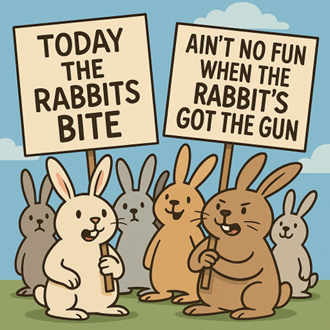
Yet the words did not stop. Thought traveled without ink. Discontent spread without parchment. And so Wannabe tightened his grip. In a tyrannical rage, he yelled, “We will control the news. We will make them pay to speak. We will force them to listen. We will tell them what books to read. We will be their favorite, the one they love; they will love Wannabe.” Again, with trepidation, the advisor leaned close: “But sir, even without paper, they have found their voices. They still have minds. And even rabbits, when cornered, will bite. Not today, perhaps—but one day the rabbits will bite. Remember this if you remember nothing at all. And heed the hunter’s satire.” The Wannabe dismissed him with a bitter laugh and a sneer. “Nonsense. They are only rabbits. They are for my pleasure; their only care is to eat and breed.” He arrogantly sneered. “And as to the satirical, I hate comics: ‘ain’t no fun when the rabbit’s got the gun’ is just silly. It’s for the weak and timid; not for Wannabe because Wannabe controls all and fears nothing.” He laughed, but his laugh was uneasy, and the silence from his minions was unmistakable and deafening.
Seasons passed. The whisper and wisdom of the sage advisor lingered. The people—mocked as useless, underestimated lagomorphs—grew weary of abuse and felt more cornered yet bolder. The self-serving advisors, sensing doom, scurried away with whatever spoils they could steal. At last, Wannabe stood alone, his armies and decrees powerless against a multitude no longer afraid, but resolute and united.
And from the crowd, like sparks catching fire, came the clamorous chants:
“Today the rabbits bite.” “Ain’t no fun when the rabbit’s got the gun.”
The chants rolled through the streets, half warning, half laughter, but all serious. It was no threat of violence, but a proverb of irony. These people, these ‘rabbits’, had never needed literal guns because they had found something much more lethal—strength in their numbers, in their unified ideas, in their memory, dreams, and words, and now in their collective refusal to bow. The chant was their laughter, their truth, their declaration that the world had turned and change was in the offing. And the wise sage smiled a subtle, small, sly smile, always knowing and anticipating the power of their unity.
Civil society thrives only when none are treated as beasts, but as human beings with voices, hopes, and dreams. Wise leaders understand that thought is stronger than chains and the pen is stronger than the sword. The silencing of truth and thought control is always temporary; revolt begins the moment words are stifled, and action follows when endurance breaks.
If you have a gun—put it down, and put it away, we rabbits don’t need them.
Instead, pick up your pen and write your thoughts and dreams. Raise your voice and speak your mind. Open your ears and listen to others. Kings, Emperors, and wannabes are mortal. But thoughts endure. Words endure. And yours are essential. #NeverFearTheDream #Ain’tNoFun #RabbitsBite
Always feel free to re-post—anywhere, anytime, to anyone—share freely.
NeverFearTheDream simplebender.comStand For Truth
If you’re looking for daily thoughts and insights you will want to start the morning with:
Lap Around the Sun: Daily Steps Forward
If you know someone who is facing any facet of Alzheimer’s they might gain some insight from:
Joy in Alzheimer’s: My Mom’s Brave Walk into Dementia’s Abyss
Please consider following simplebender, you’re reading makes my writing more fun..…
Comments and thoughts are always welcome and feel free to re-post …..
Milestones measure your past. The future is unmarked and uncharted; so, set your own rhythm, cadence, and pace—it’s your journey, not anyone else’s. A journey in which you alone are accountable. There’s no one else to blame—or to credit. Above all else—relish every step. 25.10.1
NeverFearTheDream simplebender.comStand For Truth
If you’re looking for daily thoughts and insights you will want to start the morning with:
Lap Around the Sun: Daily Steps Forward
If you know someone who is facing any facet of Alzheimer’s they might gain some insight from:
Joy in Alzheimer’s: My Mom’s Brave Walk into Dementia’s Abyss
Please consider following simplebender, you’re reading makes my writing more fun..…
Comments and thoughts are always welcome and feel free to re-post …..
Strip the politics and twisted morality from the equation and look at the ledger. Detain-and-deport is a bad deal, a bad business model. It is a capital-intensive, low-yield operation that consumes cash upfront and erases future revenue streams. ICE’s reports estimate 2024 detention at ~$152 per person per day, and Alternatives to Detention (ATD/ISAP) run less than $4.20/day. With an average detention time of ~47 days, costs are roughly $7,100 before airfare or litigation. The ATD analogue costs approximately $200. The ATD option is significantly more cost-effective. No operator would choose a bloated workflow over one that accomplishes the compliance goals, unless driven by ideology. [1][2][3]
What are the “savings” from deportation? They are mostly phantom fiction. Undocumented immigrants are largely ineligible for means-tested benefits (Medicare & SNAP) but do pay taxes—$96.7 billion in 2022. Every removal wave eliminates the systematic recurring cash flow to Social Security, Medicare, and state/local treasuries. That’s not ideology; it’s real revenue loss, which U.S. taxpayers must now cover. [4]
Scale it to policy. FY2024 removals: 271,484. Apply the per-diem and dwell time above, and you’re in multi-billion direct outlays—before transport—plus foregone taxes compounding each year that workers would have remained employed. The CBO is explicit and clear: higher immigration raises revenues faster than outlays and lowers deficits over the 2024–2034 period—those are good things. Shrinking the workforce via deportation pushes the other way—those are bad things. [5][6][7]
Now consider and add the 2025 capex binge. Florida’s “Alligator Alcatraz” chomped up $245M+ in contracts, faces $15–$20M in immediate shutdown costs, and could leave taxpayers with approximately $218M if closure holds. In Texas, the Fort Bliss complex is a $1.2–$1.26B build for a 5,000-bed camp. None of this produces tradable output; it locks in fixed costs for an already established inferior business model. [8][9][10][11]
Deportation supporters claim enforcement frees jobs for U.S. citizens. Reality check: key sectors (agriculture, construction, and manufacturing) depend on immigrant labor. In agriculture, roughly 42% of hired crop workers lack work authorization. Remove that labor at harvest and you don’t get higher yields; you get unpicked fields and lost revenue—exactly what state-level crackdowns have shown. Construction and parts of manufacturing tell similar stories: persistent vacancies and delayed projects don’t resolve themselves without labor—but look, ICE just booked another flight. [12]
Crucially, there’s a proven substitute. Case-management ATD programs deliver 97–99% court-appearance compliance at a fraction of detention costs. If the goal is rule-of-law compliance, ATD wins on both price and performance. Detention should be the exception for demonstrably high-risk cases. [13][14][15]
If you’re genuinely fiscally conservative, the decision tree is simple. Each detained-then-deported worker carries:
a high acquisition cost (detention, transport, litigation, facilities),
negative NPV from lost tax receipts, and
sector-level output losses when crops aren’t picked or projects slip.
In contrast, ATD + lawful work authorization during proceedings flips the script:
minimal custody costs,
(2) continued tax payments, and
(3) fewer supply-side shocks.
Even hard-line models concede that mass deportation shrinks GDP by the trillions. The Penn Wharton Budget Model, a conservative economic model, concedes that mass deportation shrinks GDP by trillions—that’s a bad thing—and projects primary deficits of approximately $862–$987B over 10 years under mass deportation scenarios. That’s the destruction of U.S. shareholder value.[16][17]
If this were optimizing a business, you’d terminate detention first, scale case management ATD, and reserve deportation for the narrow slice where public safety benefits justify the expenditure. Anything else is a bad deal and taxpayer-subsidized ideology—that’s not a good thing. #NeverFearTheDream
Footnotes
[1] U.S. Immigration and Customs Enforcement, “Alternatives to Detention (ATD)” — < $4.20/day ATD vs ~$152/day detention. ICE [2] ICE, Fiscal Year 2024 Annual Report — average length of stay 46.9 days. (PDF) ICE [3] American Immigration Council, “Alternatives to Immigration Detention: An Overview.” American Immigration Council+1 [4] Institute on Taxation and Economic Policy (ITEP), “Tax Payments by Undocumented Immigrants” — $96.7B in 2022. ITEP [5] ICE news release (Dec. 20, 2024): 271,484 removals in FY2024. ICE [6] Congressional Budget Office, “Effects of the Immigration Surge on the Federal Budget and the Economy” — higher immigration lowers deficits via revenues > outlays. Congressional Budget Office+1 [7] ICE, “FY2024 Annual Report” companion release. ICE [8] AP News, “Florida may lose $218M on empty ‘Alligator Alcatraz’ as judge orders shutdown.” AP News+1 [9] CBS Miami, “Florida taxpayers could be on the hook for $218 million … ‘Alligator Alcatraz.’” CBS News+1 [10] Yahoo News round-ups on court-ordered shutdown and wind-down. Yahoo+1 [11] The Texas Tribune, “Feds plan to build nation’s biggest migrant detention center at Fort Bliss” — $1.26B, 5,000 beds. The Texas Tribune [12] U.S. Dept. of Labor, NAWS 2021–2022 (Report No. 17) — ~42% of hired crop workers lack work authorization; summary page. DOL+1 [13] Human Rights First, “Proven Alternatives to Mass Incarceration of Families” — programs with ~97% appearance; cost far below detention. (PDF/brief) Human Rights First+1 [14] Women’s Refugee Commission, Family Case Management Program — ~99% compliance with ICE and court. (Report/summary) Women’s Refugee Commission+1 [15] National Immigrant Justice Center, “The Real Alternatives to Detention.” (Policy brief) National Immigrant Justice Center [16] American Action Forum, “The Budgetary and Economic Costs of Addressing Unauthorized Immigration” & “A Costly Immigration Policy” — $400–$600B federal cost; −$1.6T GDP. AAF+1 [17] Penn Wharton Budget Model, “Mass Deportation of Unauthorized Immigrants: Fiscal and Economic Effects” — revenues −$300.4B (2025–2034); primary deficits +$862B pre-feedback, +$987B with feedback. (Brief & PDF) Penn Wharton Budget Model+1
Always feel free to re-post—anywhere, anytime, to anyone—share freely.
NeverFearTheDream simplebender.comStand For Truth
If you’re looking for daily thoughts and insights you will want to start the morning with:
Lap Around the Sun: Daily Steps Forward
If you know someone who is facing any facet of Alzheimer’s they might gain some insight from:
Joy in Alzheimer’s: My Mom’s Brave Walk into Dementia’s Abyss
Please consider following simplebender, you’re reading makes my writing more fun..…
Comments and thoughts are always welcome and feel free to re-post …..




 simplebender