Posted in Favoites

Accountability Gunned Down

and Credibility Mortally Wounded…..
The first videos weren’t clear. They were chaotic—grainy clips, partial frames, shouting without context. But the official messaging arrived before evidence was gathered, witnesses interviewed, or a timeline stitched together, the verdict was delivered. Heroic officers. Clear self-defense. Thwarted mass terror. The dead were “deranged domestic terrorists,” and the valiant officers had barely survived and saved many.

That’s narrative warfare—not investigation.

This is the modern media playbook: speak first, speak loudly, and force everyone else to prove you wrong. Flood the zone with ‘certainty,’ half-facts, and righteous adjectives. Let supporters do the rest. If later evidence complicates the story, it won’t matter; the first impression has already been welded into identity. And if you can manufacture images, clips, or “context” with AI, you can make doubt look like proof while you stall, bury, and obscure the real record.

What makes the lie persuasive is that it rides on a few fragments of truth. A legal concealed-carry permit becomes a justification for killing. A photo of a holstered firearm becomes “brandishing.” A moment of chaos becomes “attempted assassination.” A tender snapshot of agents “helping” a frightened child becomes moral cover for whatever came before or happens after. The lifestyle of one is used to instill moral judgment and question motive. Just enough ‘truth’ to make the rest feel plausible to the true believers.

We’re told to relax. Trust the regime and its process. Wait for the facts they want to show us. The rest of the facts arrive late and edited—while the narrative sprints ahead, unchallenged and amplified by officials who treat accountability as optional.

There’s a deeper fatal wound: credibility. Bullets may have killed Renee Good and Alex Pretti, but the words that followed targeted something larger—the public’s ability to discern what is real. When institutions train citizens to doubt their eyes and distrust every correction as “spin,” they aren’t governing; they’re conditioning. They are self-serving protectionists maximizing propaganda’s bullhorn.

So we should ask, without hysteria or naiveté: Was a five-year-old used as bait or as a shield? Was Good’s death justified or convenient? Was Pretti killed because he believed in the 2nd Amendment or because zealous masked bullies lost control of themselves? If we can be pushed to accept a finished story before an investigation even begins, what else have we been trained to swallow—about elections, wars, enemies, or the files that power keeps sealed? Move along, citizen. Nothing to see here.   NeverFeartheDream   simplebender.com

Joy in Alzheimer’s
W.C. Barron
Lap Around the Sun
Daily Steps Forward — W.C. Barron
Posted in NeverFeartheDream

Never Fear The Dream…

Mindfulness is about awareness and acceptance—of yourself and everything around you. 26.01.8

Joy in Alzheimer’s
W.C. Barron
Lap Around the Sun
Daily Steps Forward — W.C. Barron
Posted in Current Events

Operation Wetback 2.0: America’s Immigration Purgatory

(Except for First Nations….Lest we forgot, we are all immigrants, lest we forget.)

America’s immigration history has two defining bookends—both failures that masquerade as solutions: brute force and endless procedure. In the 1950s, the United States chose force—regionally and aggressively. Today, it chooses process—nationally, diffusely, and with targeted intensity. Both claim legitimacy. Both avoid responsibility. Both are unapologetic for failure and death. Neither deserves moral cover; both merit condemnation.

In the late 1950s, Operation Wetback was panic impersonating as policy. It treated human beings as a problem, refuse, to be flushed from the system—quickly, cruelly, and visibly. Across the Southwestern United States, Texas, California, Arizona, and New Mexico became enforcement zones. Farms, towns, and cities were swept with little regard for documentation or citizenship. The only thing that mattered was ethnicity. Its defenders praised its “effectiveness,” even calling it “a model,” collapsing ethnics into numbers. Humans were caged. Deportations were swift. Fear spread quickly—along with the erosion of constitutional restraint and human dignity. Citizens were caught up. Families were broken. People died.

For all its cruelty, Operation Wetback held one principle firm: deportation meant returning people to their country of origin, typically Mexico. Removal was brutal, but the destination was at least coherent. The state expelled people to a homeland, not into geopolitical limbo.

Condemning that era is easy. The more demanding task is confronting the present.

Today’s ICE-DHS enforcement regime operates as a nationwide system, shaped by discretion, delay, and unequal impact. Enforcement now extends coast to coast, embedded in courts, databases, detention centers, and subcontracted detention abroad. Deportation no longer guarantees return ‘home.’ Individuals may be transferred to third countries not because of their origin but because corrupt, weak governments are willing to accept detainees in exchange for compensation or a diplomatic concession—transactional detention, prisons for hire.

There are hearings now, maybe. Appeals, maybe. Paperwork, surely. Shockingly, today’s violence is less and more isolated, but still vile, unnecessary, and with bystanders being provoked and killed. Actions outsourced to undertrained enforcement at the direction of uninformed and opportunistic bureaucracy. Masked agents, hide their faces, names, and affiliation, are brandishing weapons and using unwarranted force without accountability. Families are not always torn apart in a single raid; instead, more perversely, they unravel over months or years of detention, uncertainty, and displacement.

Operation Wetback was cruelty without due process. Today’s enforcement is often one-size-fits-all, due process without courage. One system expelled people brutally but directly. The other disperses suffering nationally and indefinitely. America’s most infamous mass deportation campaign reveals a shift not from cruelty to compassion, but from visible brutality to managed, indefinite human limbo and indifference.

Immigration laws should be followed by everyone and every organization. We need immigration control and enforcement, but not draconian brutalization. The tragedy is not that America once chose force. It is that, decades later, it still refuses to choose honesty. This is the immigration purgatory we now live in and may die in.   NeverFearTheDream · simplebender.com

Joy in Alzheimer’s
W.C. Barron
Lap Around the Sun
Daily Steps Forward — W.C. Barron
Posted in NeverFeartheDream

Never Fear The Dream…

Compassion is closer to reality than love. Love is blinded by fascination and lust—compassion accepts and supports. 26.01.07

Joy in Alzheimer’s
W.C. Barron
Lap Around the Sun
Daily Steps Forward — W.C. Barron

Posted in Favoites

Recognition Heals—and Then Hustles

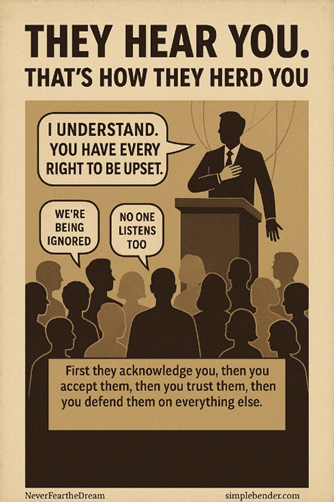
a leader extolls people by acknowledging their plight...only to gain their loyalty
NeverFearTheDream   simplebender.com

We like to think facts, arguments, and data persuade us. But we are fooling ourselves. We are moved by something much simpler and more primitive: being seen —being acknowledged.

When someone with power looks out at a frustrated crowd and says, “You’ve been ignored, dismissed, and lied to—and you’re right to be angry,” they’ve already won half the battle and most of the crowd. No policy yet, no cost, no trade-offs. Just an acknowledgement. And for people who feel they have been treated as invisible for years, those words are not just drunk, but we bathe in them.

This is the benevolent side of acknowledgment. It’s the foundation of honest dialogue. When people feel genuinely heard, they experience a sense of dignity and respect. They can tolerate imperfect outcomes if they trust the process and believe their concerns are genuinely recognized. Acknowledgment restores a sense of worth: I exist in this system. I matter.

The subsequent step is where things get murky and sticky. First comes acceptance: “At least this one is listening.” Then, subconsciously, we yield our trust: “If they hear me on this, they must be on my side in general.” Give it a little more time and constant repetition, and that trust quietly turns into loyalty. Not because the leader has delivered, but because the follower feels psychologically indebted: “Everyone else ignored us; this one didn’t. This one understands us, believes in us. We owe them a chance.” That shift is dangerous—moving from judging leaders based upon results to unquestioningly defending them because they once made us feel heard and important. This is precisely where healthy acknowledgement can harden into uncritical allegiance. Your ego has been played.

Once someone in authority is branded as “the only one who really understands us,” they can cash that emotional credit almost anywhere. They can stay vague on solutions. They can peddle simple stories for complex problems. Anything can be solved on ‘day one.’ Leaders may use hollow acknowledgment to manipulate, shifting blame and redirecting anger while still being applauded—because they’ve anchored themselves to identity, not performance. Questioning becomes essential to avoid falling for theater rather than reality.

At this point, the line between leadership and chicanery gets very thin and easily crossed. The leader doesn’t need to heal the wound; they need to keep poking it, refusing to let it heal, wanting it to fester. Keep naming the grievance, keep feeding the resentment, keep pointing at new enemies. Distracting you from seeing what is really happening. The followers’ loyalty is no longer about what’s actually being done; it’s about who stands with “people like us.”

Suppose the feeling of being acknowledged matters more to us than the reality of what is actually being done on our behalf. How long will it be before we become willing accomplices in our own manipulation, or have we already crossed that bridge?

Whenever a leader spends far more time jabberwocking and mirroring your pain than functionally measuring their results, don’t be flattered that they “see you”—check your wallet, your rights, and your future. NeverFearTheDream    simplebender.com

Joy in Alzheimer’s
W.C. Barron
Lap Around the Sun
Daily Steps Forward — W.C. Barron

Posted in Favoites

Political Soteriology: The Desperate Search for a Political Messiah

Soteriology is the study of salvation, traditionally rooted in religious contexts. Political soteriology shifts this concept from spiritual change to public action by relocating salvation from the inner life to the public square; to a leader, a movement, or a state treated as the saving agent, a political messiah. An agent not for peace, care, and order, but a means of deliverance: win power, cleanse the enemy, restore our world.

Political soteriology comes with a familiar liturgy. True believers begin with diagnosis: we are oppressed, humiliated, betrayed. Then blame is assigned, and vilification begins: they did this to us, the elites, outsiders, immigrants, or those who are just different; pick your villain. Next comes self-identity: we are the chosen people, the rightful heirs, those whose voices have been stolen. And then the yearning for, seeking, and anointing the savior. The political messiah: the only one who can restore what was taken, punish what was done, and reverse the shame. After the savior is anointed, purification follows. The system must be “cleansed.” Norms and laws become nuisances to be ignored. Anything can be justified if it’s done in the name of the lost cause. Victory is described in pseudo-religious terms: once we win, order, justice, and our greatness return.

This type of soteriology provides what ordinary politics cannot. It gives meaning: your pain has a cause. It offers immediate hope: you can finally do something—vote, march, expose, punish, purge—making you feel empowered and motivated to act. Through this association, it creates the delusion that something can be done about the perceived injustice and plight, even if that entails retribution and purification. The ‘believers’ are normal people convinced they are suffering a chronic threat to culture, morality, demographics, and becoming irrelevant. But they are your neighbors and family members, desperately grasping for someone to defend them because they feel helplessly inept in the current ‘corrupt’ system; they are us, and we are them.

Spiritual salvation is slow, demanding, esoteric, nebulous, and often ambiguous. Political salvation feels immediate and muscular. It doesn’t ask for patience; it demands loyalty. It doesn’t promise transformation; it espouses reversal. In that climate, religion itself can be conscripted—its language, symbols, and institutions repurposed as fuel for political deliverance.

The result is moral nearsightedness: salvation now, consequences later. This isn’t a new choice. A similar one occurred when the mob chose Barabbas, changing the course of history. A choice for the man of action, the insurrectionist and murderer, over the one offering a different kind of eternal kingdom. When a society chooses the “rescuer” who breaks rules to save “us,” it quietly trains everyone that law is optional and freedom is whatever our side declares it to be.

So, who will we choose? Who will you stand behind and support? A liberator who will reclaim what we believe we’ve lost, by any means necessary; or one who refuses the easy thrill of vengeance for the more complex work of long-term good? If political soteriology is chosen, what exactly is being saved? Is it our country, or an appetite for conquest and control dressed up as freedom? NeverFearTheDream   simplebender.com

Joy in Alzheimer’s
W.C. Barron
Lap Around the Sun
Daily Steps Forward — W.C. Barron

Posted in NeverFeartheDream

Never Fear The Dream…

Societies don’t collapse from being too fair, equitable, or caring—they collapse because of greed, bias, and intolerance. 26.01.4

Joy in Alzheimer’s
W.C. Barron
Lap Around the Sun
Daily Steps Forward — W.C. Barron
Posted in NeverFeartheDream

Never Fear The Dream…

Awakening means observing what truly is—not what you wish it to be—over and over until the truth becomes obvious. Awake from your dreamy slumber and embrace life’s reality. 26.01.3

Joy in Alzheimer’s
W.C. Barron
Lap Around the Sun
Daily Steps Forward — W.C. Barron
Posted in Current Events, Political

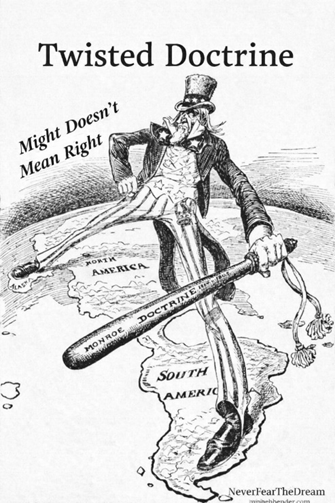
American Hypocrisy: Twisted Doctrine

The Monroe Doctrine was meant to be a shield for a fledgling country: no European empires in the Americas, no more carving up this hemisphere by outside powers. It sounded like a defense of sovereignty and self-determination. Two centuries later, that shield has been reforged into something else—a license to police the hemisphere and enforce an American Hemispheric Order on our terms.

We claim to oppose foreign domination, yet we have become the dominant foreign power in other sovereign countries. When a government in the region dares to stray from our economic dogma or security script, we don’t send in Redcoats—we threaten and impose sanctions. Loans are conditioned. Sanctions are tightened. Diplomats whisper, intelligence agencies “assist,” and suddenly regime change appears not as an invasion but as a “restoration of democracy.” The vocabulary is polite; the outcome is familiar. Governments that cooperate survive. Governments that don’t are labeled unstable, extreme, or illegitimate. It isn’t about drugs, oil, or national security—it is about ego, power, and distraction from domestic failures and salacious files.

Flip that. Imagine a coalition of Latin American nations deciding that our politics are too corrupt, our inequality too obscene, and our elections too tainted by money. Imagine they declare an “Inter-American Responsibility Doctrine” and openly call for regime change in Washington to protect “hemispheric stability.” Picture them funding opposition groups, manipulating our media, freezing our assets, and threatening intervention—“for the sake of democracy,” of course. We would be apoplectic. We would call it aggression, pure and simple.

The hypocrisy deepens when you look at security. We pressure neighbors to crack down on crime, migration, and drugs, as if their failures are the source of our problems. Yes, trafficking networks and corrupt officials exist everywhere. But the demand, the guns, and much of the money flow from our side of the border. Rather than confront the discomfort of our own consumption, our own political greed-induced paralysis, and our own profit structures, we cast the neighbors as the problem and ourselves as the savior sheriff.

We insist on the right to shape their regimes while insisting no one has the right to shape ours. We dress intervention in the language of freedom while guarding our own system—flawed, gridlocked, and heavily purchased—as untouchable. It’s a double standard that everyone can see, whether we admit it or not. So here’s the uncomfortable mirror: if the rest of the hemisphere treated us exactly as we treat them—economically, politically, and rhetorically—would we still call it “promoting stability,” or would we finally call it what it feels like to them: unwelcome domination dressed as doctrine for ego and power?   NeverFearTheDream   simplebender.com

Joy in Alzheimer’s
W.C. Barron
Lap Around the Sun
Daily Steps Forward — W.C. Barron
Posted in Political

Parable: When King’s Divide—People Unite

Chairs of absent kings trying to divide while the people join hands and unite
NeverFearTheDream   simplebender.com

In weary corners of the world, three elder kings sat in their gilded castles, polishing medals they’d never earned. Their peasants staggered through hunger, cheap drugs, and endless funerals, but the kings were busy with more important matters—like drawing new lines on old maps and wallowing in opulence.

One dark, cold winter, the kings gathered at a marble table and decided that ruling their own crumbling kingdoms wasn’t enough. They would divide the whole world into “areas of influence,” like carving a roast they hadn’t paid for. Each slice came with rights: to plunder, to threaten, to “stabilize” by force. Responsibilities, however, were deemed inefficient. One would gain the Orient, one would be allowed, unfettered, to restore their former Empire, and the last would gain a vast Western Hemisphere. They embraced, shook hands, winked, made the deal, and secretly crossed their fingers behind their backs.

Their longtime allies—small kingdoms that had stood by them through storms and wars—were called into the throne rooms and, in ungracious tones, scolded; they were now “on their own.” It was dressed up as tough love, of course. “You must learn to defend yourselves. You must be strong, not weak,” the kings said, while quietly moving their troops, their money, and their promises elsewhere.

The peasants, meanwhile, noticed something awkward: the kings always seemed richest after a war, and safest after a crisis. So the villages began whispering across borders. Farmers traded grain instead of insults. Healers crossed checkpoints to treat strangers. Workers in different lands realized they were all being squeezed by the same velvet-gloved hands.

Soon, small alliances of towns and regions formed—not to conquer, but to refuse. They refused to buy the king’s fear, refused to send their sons and daughters to die for “influence,” and declined to hate people who were just as tired and broke as they were.

When the three kings tried to enforce their New World Order, they found something inconvenient: the world had quietly ordered itself, not into empires, but into bonds of mutual survival. They found that the sovereigns they had harassed and attacked, out of vanity and spite, had aligned against them. The small sovereignties had forged strength by joining together. The weakened kings found that by trying to be dominant, they had become feeble and irrelevant. And then, to their horror, each discovered the other king had made secret trade deals and alliances outside their spheres. Each cheated on the other because they thought they could get away with it.

It turns out, when rulers isolate and divide, the people eventually learn the oldest truth of all: if we don’t lift each other, no one is coming to save us. It turns out that failing, deceptive, greedy kings cannot divvy up the world and forge a lasting new world order. They lie, cheat, and steal for their own prosperity, not the betterment of the people, and the people finally know the truth. NeverFearTheDream simplebender.com

For Every Problem...A Solution...
Lap Around the Sun: Daily Steps Forward
Joy in Alzheimer’s: My Mom’s Brave Walk into Dementia’s Abyss