Posted in Political

Rabbits’ Revenge: A Fable of Hidden Strength

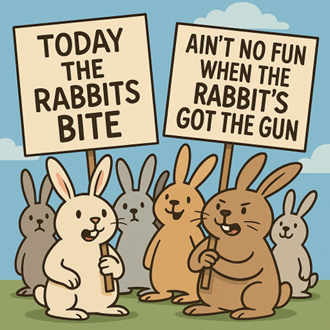
Protesting 'Rabbits' Ain't No Fun When the Rabbit's Got the Gun

King Wannabe stood before the crowd of people, his back hunched, too feeble to be erect, his greying, bushy eyebrows raised, his face twisted in contempt. The people would not chant his name nor bow to his image. “Rabbits,” he scoffed. “Nothing but rabbits. They eat, they breed, they exist for my pleasure. Especially the young ones—for my pleasure. Everyone must love Wannabe, everyone, especially these rabbits.” His entourage knelt in obedience, fearful of his rage.

One brave advisor dared to whisper, “But sir, no one is loved by everyone, and they are more than rabbits. They are people, with minds, with hopes and dreams.” In a buffoonish manner, Wannabe waved the thought aside, clutching a handful of pamphlets. “Look at these. Lies! All lies! Their words are filth. Take their paper and their pens. Silence them, cancel their culture.” He signed an Order, and the dutiful minions obeyed, seizing what they could.

Yet the words did not stop. Thought traveled without ink. Discontent spread without parchment. And so Wannabe tightened his grip. In a tyrannical rage, he yelled, “We will control the news. We will make them pay to speak. We will force them to listen. We will tell them what books to read. We will be their favorite, the one they love; they will love Wannabe.” Again, with trepidation, the advisor leaned close: “But sir, even without paper, they have found their voices. They still have minds. And even rabbits, when cornered, will bite. Not today, perhaps—but one day the rabbits will bite. Remember this if you remember nothing at all. And heed the hunter’s satire.” The Wannabe dismissed him with a bitter laugh and a sneer. “Nonsense. They are only rabbits. They are for my pleasure; their only care is to eat and breed.” He arrogantly sneered. “And as to the satirical, I hate comics: ‘ain’t no fun when the rabbit’s got the gun’ is just silly. It’s for the weak and timid; not for Wannabe because Wannabe controls all and fears nothing.” He laughed, but his laugh was uneasy, and the silence from his minions was unmistakable and deafening.

Seasons passed. The whisper and wisdom of the sage advisor lingered. The people—mocked as useless, underestimated lagomorphs—grew weary of abuse and felt more cornered yet bolder. The self-serving advisors, sensing doom, scurried away with whatever spoils they could steal. At last, Wannabe stood alone, his armies and decrees powerless against a multitude no longer afraid, but resolute and united.

And from the crowd, like sparks catching fire, came the clamorous chants:

“Today the rabbits bite.”
“Ain’t no fun when the rabbit’s got the gun.”

Protesting against authoritarianism

The chants rolled through the streets, half warning, half laughter, but all serious. It was no threat of violence, but a proverb of irony. These people, these ‘rabbits’, had never needed literal guns because they had found something much more lethal—strength in their numbers, in their unified ideas, in their memory, dreams, and words, and now in their collective refusal to bow. The chant was their laughter, their truth, their declaration that the world had turned and change was in the offing. And the wise sage smiled a subtle, small, sly smile, always knowing and anticipating the power of their unity.

Civil society thrives only when none are treated as beasts, but as human beings with voices, hopes, and dreams. Wise leaders understand that thought is stronger than chains and the pen is stronger than the sword. The silencing of truth and thought control is always temporary; revolt begins the moment words are stifled, and action follows when endurance breaks.

If you have a gun—put it down, and put it away, we rabbits don’t need them.

Instead, pick up your pen and write your thoughts and dreams. Raise your voice and speak your mind. Open your ears and listen to others. Kings, Emperors, and wannabes are mortal. But thoughts endure. Words endure. And yours are essential. #Ain’tNoFun

For Every Problem...A Solution...
Lap Around the Sun: Daily Steps Forward
Joy in Alzheimer’s: My Mom’s Brave Walk into Dementia’s Abyss

Posted in Current Events, Political

Guardrails Against the Authoritarianism Storm

Columns supporting our Constitutional Liberties

Article first published in the Bend Bulletin 9/27/25

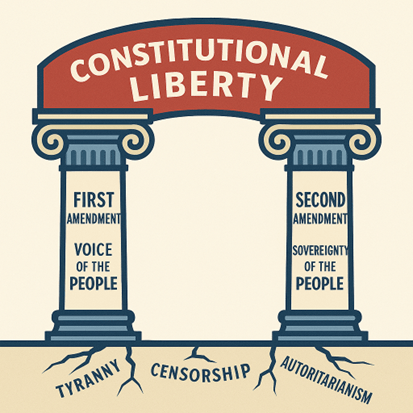
The Bill of Rights was not a mere document, but a product of the founders’ deep suspicion of concentrated power. They had witnessed the crushing of liberties under a monarchy and feared that even a republican government might someday drift toward authoritarianism. The First Amendment enshrines freedoms of mind and voice; the Second Amendment ensures the citizenry will never be entirely powerless should those freedoms come under assault. This foresight of the founders enlightens us about the historical context of the Bill of Rights, giving us a deeper understanding of our constitutional rights.

History was their teacher. British suppression of colonial assemblies, censorship of dissenting press, and the Intolerable Acts were enforced not with argument but with troops. The Revolution began not at a printing press, but when local militias clashed with regular soldiers at Lexington and Concord (1775) to resist the seizure of their weapons. It was this combination—ideas in pamphlets like Common Sense (1776) and the willingness to defend them—that secured independence.

James Madison (Federalist 46) envisioned an armed citizenry as the ultimate check on federal overreach, noting that “the advantage of being armed” would deter encroachments on liberty. Alexander Hamilton (Federalist 29), though skeptical of full-time militias, conceded that a people capable of bearing arms would make any tyranny costly. Later commentators, such as St. George Tucker (1803), referred to the Second Amendment as the “true palladium of liberty,” a final barrier against usurpation (Tucker, Blackstone’s Commentaries).

The framers did not celebrate rebellion, and neither should we. They built a republic designed to settle disputes through institutions—legislatures, courts, and elections—not through insurrection. The Second Amendment was less an invitation to revolt than a final constitutional guardrail, a reminder to government that the people remain sovereign. It was meant to make authoritarian control—whether through censorship, suppression of dissent, or militarized governance—impractical.

“The Second defends the First,” captures part of this truth but misses the deeper genius of the American design. Our first line of defense for free expression is institutional: the separation of powers, judicial independence, and a free press that is able to hold the government accountable. An armed citizenry is the last resort, the failsafe that ensures no regime can permanently silence the governed, providing a sense of security about our rights.

Even in polarized times, the resilience of this framework is remarkable. Courts still strike down attempts at censorship, legislators still debate fiercely, and citizens continue to speak, publish, assemble, and worship according to their conscience. With some legislators seeming to yield to the mob or bend a knee for their own political survival, our Constitution has withstood civil war, economic depression, McCarthyism, and demagoguery precisely because its protections are layered—legal, institutional, and cultural. The greatest defense of liberty is not fear of armed resistance but the enduring resolve of citizens who insist on their right to speak and be heard. When we do not defend the first, we risk the second, the fourteenth, the fifteenth, and the nineteenth. When we defend free speech, preserve checks and balances, and reject authoritarian shortcuts and fragile egos—whether from the left or the right—we prove that the American experiment remains not only viable but vital. This reiteration of the importance of defending free speech should empower you and make you feel responsible for upholding your rights, instilling a sense of duty and empowerment in you. # NeverFearTheDream # Stand for Truth # Stand with Pride # Stand with Spine

For Every Problem...A Solution...
Lap Around the Sun: Daily Steps Forward
Joy in Alzheimer’s: My Mom’s Brave Walk into Dementia’s Abyss

Posted in Political

Update: Corroborating News–Extortion: Foreign and Domestic

9/25: Disney/ABC/Nexstar choose profit over principle. By silencing a comedian, they protected the impending merger of Nexstar and Tenga, which requires FCC approval. They are bending to the FCC’s threats to withhold merger approval and review of their broadcast license.

Extortion: Foreign and Domestic

No one can control you if you don’t owe them anything. But more importantly, just because someone owes you doesn’t give you the right to try to control them. This control and unwanted influence is nothing more than extortion. We have seen extortion repeated numerous times in recent weeks and expect to see more. We watch as federal funds are restricted for personal vendettas and agendas. We have seen financial aid used as a tool to coerce and meddle in the policies of other nations, as a superpower attempts to influence a different sovereign’s internal affairs. The idea that if the government gives or grants you aid, you are obligated to do their bidding or succumb to their ideas of moral direction is itself immoral. The tariffs aren’t about trade imbalances. They are examples of abusive dominant position and extortion.

The ability to invoke fear and illicit reactions can be through hard or soft power. Hard power is the use of military or economic coercion, while soft power is the use of cultural or ideological influence. As a superpower and stalworth of freedom of choice and independence, we should stand on higher ground. We should help guide and support rather than threaten financial and social ruin if our direction isn’t followed. We should never judge another sovereign with our isolated provincial views without understanding their cultural underpinnings and environmental conditions. Our greatest strength does not come from fists or extortion but from example. We are a country of plenty, and our moral teachings and practices have been to share. To be witnessed as an example, not demanding compliance or sitting in judgment. The importance of standing on higher ground and maintaining our integrity cannot be overstated. We have just as many faults as those who we are attempting to extort, bully, and bend to our will and ways. The pedestal we once placed ourselves upon is crumbling by the weight of our ego, bigotry, and hypocrisy. Some believe they have found their political messiah, and some have found the courage to cowardly hide behind masks so their identity might not be known, but they cannot conceal their intent.

Greatness is demonstrated in many ways, and extortion isn’t one of them. The consequences of extortion are severe. It leads to distrust, resentment, and, ultimately, isolation. Just know that when you push someone too far, they will eventually turn against you regardless of what they owe you. They will join the others you’ve extorted and bullied. You will stand alone in isolation as your once friends collude and align with your old enemies for your destruction. Your greatness diminished and tarnished as you become the pariah rather than the advisor and steady ally.

We have lived through dark times before, and there will be more. We will get through them by understanding that we exist within a global community, and we don’t control it. The power of the purse has a double edge, and we certainly would object to those we owe telling us what to do. Don’t confuse wealth with worth; we witness the wealthy and powerful transform into worthless bullies, not great leaders. The gravity of these consequences should make us all pause and reflect on the path we are treading. 

simplebender.com @simplebender.bsky.social

Posted in Current Events, Political

Vilifier to Victim Cycle

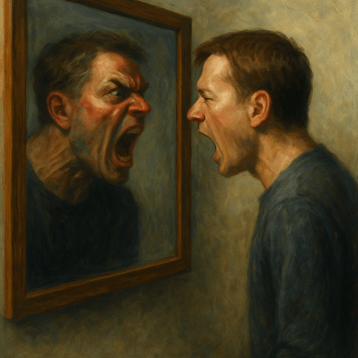
Vilification is not an innocent weapon — it’s a destructive one. It takes little effort to sling insults, caricature opponents, or cast entire groups as villains. But like a boomerang, what you hurl often returns. The sharper the words, the more likely they cut you on the rebound. This cycle of destruction is something we must recognize — and break.

When you vilify, you don’t invite reasoned debate but reactionary hate. Anger rarely absorbs anger; it mirrors it. History shows escalation is almost inevitable: one stone cast is met with another, one torch answered with fire. In that spiral of hostility, the target shifts. Today’s accuser becomes tomorrow’s accused. The vilifier becomes the victim.

History offers painful lessons. Denunciation fueled the French Revolution, each faction outshouting and out-purging the last. Robespierre, once the loudest voice condemning “enemies of the revolution,” soon faced the guillotine he praised. Hate and retribution have no loyalty — they devour their own.

Modern politics echoes the same pattern. Leaders, activists, and media figures who stoke division often find themselves caught in the very fires they lit. Hate has no brake; once unleashed, it runs its own course.

Vilification is seductive. It feels like strength — drawing bold lines, protecting your tribe, mobilizing energy. But human nature is wired for reciprocity: what we project comes back. To weaponize hate is to release a force you cannot control. Your gender, race, faith, politics, or power won’t shield you — the backlash spares no one — you reap what you sow.

This is not a call for naïve pacifism but for clarity. To vilify is to plant the seed of retribution. To demonize is to risk becoming the demon in another’s story. History is merciless to those who think they can ride the tiger of hate and not be eaten.

When there is no room for counter-opinion, there is no compromise. Without compromise, polarity hardens into conflict. And conflict, left unchecked, leads to violence — and death. But there is hope. We should call for understanding, not for “beating the hell out of” those we oppose. Listening can reveal common ground. Words can wound, but they can also heal. If we speak to persuade rather than to poison, we stand a chance of escaping the boomerang’s return flight. Vilification may win the moment, but it never secures a peaceful future. 

For Every Problem...A Solution...
Lap Around the Sun: Daily Steps Forward
Joy in Alzheimer’s: My Mom’s Brave Walk into Dementia’s Abyss

Posted in Current Events

Cause and Effect

History wears many masks. To some, it is nothing more than a tidy chronology of people and events. To others, it is the triumphal record of victors praising themselves over the vanquished. But its critical purpose is deeper: a study of cause and effect, an unblinking analysis illuminating the consequences when we choose to forget.

Amnesia is accidental, an uncontrolled loss of memory. What we face today is not amnesia but willed forgetting — intentional oblivion, the deliberate distortion of our collective memory. History is not supposed to soothe or flatter. In its fullness, it unsettles even as it enlightens. It is conscience and compass, guide and warning. Once edited for convenience or neutered by policy, it ceases to be either. It becomes propaganda for the weak, a tool of control disguised as comfort and a noble past.

The danger of this willed forgetting is simple: when the past is edited, the future tends to repeat its horrors and evils. Obliterated memory opens the door to evil and foolish repetition. It allows reality to be twisted into fictions that serve those who want to manipulate and/or lack the courage to confront and learn from the past. We cannot forget that human beings were once legal property, subject, without recourse, to mental, physical, and sexual abuse at the will of their ‘owners’. It is too easy to forget that this country was built upon and continues to rely on the labor of immigrants. We cannot forget the mortality and misery of children before vaccines — iron lungs for polio, blindness and brain damage from measles, deafness from mumps, miscarriages from rubella. To erase these memories is to invite and hasten the return of these atrocities.

We must have the courage to stand in the breach against this intentional oblivion. To study history, its cause and effect, is to bear witness, to heed its cries so that the next generation is spared their toll. It is too easy to listen to policymakers who pander for power. Too easy to strip protections from the weakest among us. It’s too easy to erase artifacts, ban books, and redact textbooks, all in the name of comfort. We must not turn a blind eye or deaf ear to the cries of those lessons lest we allow the next generation to suffer the plagues that will insidiously creep in and take their toll.

But comfort is not progress. Memory, even painful memory, is the price of wisdom and freedom. If we genuinely want to move forward, we must resist the temptation to rewrite the past and accept instead the discomfort of truth. Only in remembering — fully, painfully, and honestly — can we avoid repeating what history has already judged too costly to endure. You must understand the past to plan your future. Don’t erase, modify, or twist history—learn from it.

For Every Problem...A Solution...
Lap Around the Sun: Daily Steps Forward
Joy in Alzheimer’s: My Mom’s Brave Walk into Dementia’s Abyss

Posted in Current Events

The Logic Trap of “Choice”: But Whose Choice?

Some communities insist no one has the right to tell you what goes into your body. Vaccine mandates for children? Eliminated. Parents, they say, should decide. Yet the same lawmakers ban abortion, declaring the state must dictate what goes into—or comes out of—a woman’s body. One breath they champion autonomy—“your body, your choice.” The next, they revoke it. That is the hypocrisy of their own making: a logic trap.

This is hubris—elevating choice above consequence until the reckoning arrives. By enthroning autonomy in one case and crushing it in another, political positions collapse under their own contradictions.

The deeper problem is not hypocrisy alone, but the refusal to face consequences. If a sick, unvaccinated child infects another and death follows, is that so different from a parent choosing to end a pregnancy? Both are questions of prevention—or its absence. Both end in the loss of life. Stripped of rhetoric, the moral arithmetic is the same.

Plato’s Ship of State reminds us that freedom without shared responsibility is not freedom but chaos. To let each untrained helmsman steer as he pleases is to wreck the vessel and drown all aboard. Vaccine “freedom” follows the same course: individual choice unmoored from collective duty imperils the innocent.

Abortion bans claim to “protect life.” Yet removing vaccine safeguards erodes the very protections that preserve the living. Both paths, meant to uphold life, may instead hasten its loss. Vaccination is not solely a personal decision; it is an act of care for the vulnerable child who cannot choose. To shrug it off is to clearly echo and exclaim the denial: “I am not my brother’s keeper.” That is tragedy—outcome born of blindness to consequence.

If morality is to mean anything, it cannot be applied with one hand and denied with the other. If a child who is unable to be vaccinated dies from exposure, who bears responsibility? The parents of the unvaccinated infecting child? The government that stripped safeguards? The community that endorsed it? Those who hold women accountable for abortion, especially those who are rape victims, cannot escape this parallel dilemma. Freedom framed as virtue but practiced as refusal to protect another is no virtue at all. Either the body is inviolable, or it is not. Either life is sacred in all forms, or it is not. Pretending otherwise is meant to satisfy a political base, but it cannot withstand the test of reason—or history.

For Every Problem...A Solution...
Lap Around the Sun: Daily Steps Forward
Joy in Alzheimer’s: My Mom’s Brave Walk into Dementia’s Abyss

Posted in Current Events

Faceless Justice:

When did masks shift from villains to “authorities”?

If you're doing good you shouldn't have to hide behind a mask....

When I was a kid, masks were for the bad guys. Bandits in Westerns, bank robbers with bandanas, the Klan hiding under white hoods, and the muggers in dark alleys. A mask meant you didn’t want to be recognized because you were doing something you shouldn’t be doing. Evil hid its face. Goodness walked in daylight.

But now? Somewhere along the way, the script flipped. Those we were told to trust—law enforcement, federal agents—have adopted the mask. Acting with impunity, ICE officers are staging “operations,” Homeland Security agents are sweeping into neighborhoods, even U.S. Marshals and Border Patrol units, all with faces hidden. They now resemble the masked members of Patriot Front or Blood Tribe. Once respected symbols of authority, they are now appearing faceless, anonymous, and interchangeable. Supporters argue that the masks protect officers from retaliation or online targeting, but to the rest of us, it appears to be a means to avoid scrutiny and shirk accountability.

The claim is they’re targeting “the worst of the worst.” That phrase is supposed to conjure violent criminals, cartel bosses, or human traffickers. Yet the data tells a different story: government data shows that the majority — often well over half, approaching 70%—of ICE detainees have no criminal record at all. They’re being seized at immigration hearings where they’ve come voluntarily, pursued through farm fields, even pulled from schools and churches. They are NOT gunmen. Not the “worst of the worst.” They are just the easy ones. The soft targets. The ones who won’t shoot back.

Which raises the uncomfortable questions: do the masks hide fear, or shame? Fear of retaliation if they went after actual hardened criminals? Shame at arresting the powerless in the most public and humiliating of ways? Or maybe the mask makes it easier to see human beings as quotas instead of neighbors. Is this about public safety—or about hitting administrative numbers?

It’s a bitter irony. The only true ‘good guys’ who still wear masks today are doctors and firefighters. Their anonymity is a sacrifice, not secrecy. They shield their faces not to hide, but to protect and survive, thereby shielding others. That’s the difference. One mask hides identity to avoid accountability; the other shields life in the service of it.

The lesson is as old as childhood morality tales: if you hide your face to do your work, maybe, just maybe, it’s the kind of work that shouldn’t be done in the first place.

For Every Problem...A Solution...
Lap Around the Sun: Daily Steps Forward
Joy in Alzheimer’s: My Mom’s Brave Walk into Dementia’s Abyss

Posted in Political

Deconstructing Democracy by Design

A ‘what-if’ thought experiment….or is it….

When federal agencies are defunded, are the states prepared to bear the burden? What if they falter, fail, and unravel under the weight? What if the unraveling of local governance isn’t a consequence of poor planning—but a feature of executive design?

Imagine a government waving the banner of “smaller federalism—drain the swamp,” slashing national programs in the name of efficiency and state empowerment. Medicaid becomes a block grant. Public housing and food subsidies are cut. Regulation and environmental oversight rolls back. Disaster relief is “restructured.” Methodically, the burden shifts to state and county governments, which are already stretched thin. Local taxes rise, services crumble, and local bureaucracies balloon in a vain attempt to compensate.

One town staffs its clinics. The next can’t keep its water clean. Some mandate gun control, others abortions, and others endorse sex work and gambling to increase state revenue. Air quality fluctuates by zip code. One region welcomes immigrants, the next sponsors agents for deportation. Resulting in dysfunctionality, geographical injustice, and discontinuity. The news media is mistrusted and declared ‘enemies of the State’. City, County, and State governments begin to crumble and fail under the weight of their new obligations.

Resentment festers—as inconsistency breeds inequity and confusion. Citizens demand relief, but help doesn’t come from local government, only more indecisive directives. Citizen uncertainty, polarization, and outrage against the policy void yield unrest. Not everywhere—but in enough places to make the headlines—just enough to be used as an excuse.

We’re already seeing a preview. Federal troops were deployed to California—not for disaster relief, but to enforce immigration policy, overriding the state’s will. FEMA faces cuts while climate disasters rise. Communities are left broken, ripe for corruption and manipulation.

And as the ground shifts, so do the guardrails. The Department of Justice leans in, and the Court tilts the scales. Recent rulings—many of which were urged by the Executive—have expanded presidential power by disregarding or reinterpreting laws passed by Congress and previous court decisions. Scholars once warned of an “imperial presidency.” It’s no longer theory—it’s precedent. The President need not wait for Congress. The office can act—or undo—with little more than a pen and a thin legal pretext.

And so, the same hand that dropped the burden returns—not as a partner, but as a “protector.” Protests are reframed as threats. Dissent becomes disorder. Disorder becomes insurrection.

Elections are postponed “for public safety.” Ballots are secured behind walls and counted by select administrators. Local authority is preempted. Emergency declarations morph into permanent policy.

Federal power consolidates—not with a coup, but with a shrug, and tacit approval, marked by deafening silence.

This isn’t prophecy—but it’s no longer just a thought experiment. It is no longer just possible it is verging on probable. It’s unfolding. If federal power can be withdrawn at will and restored at gunpoint—backed by a court with no limits—what does democracy even mean?

If this is the road ahead, it’s not the failure of states we should fear most. It’s the success of the plan—and our failure to notice.

Posted in Communication

Viewpoint Discrimination: Forgetting What Makes Us Free?

Isn’t the difference of opinion the very thing that built this country?

We weren’t founded on sameness—but on dissent. The thirteen colonies didn’t rise up because they agreed with the power, but because they dared to question it. That impulse—audacious, messy, courageous—is what the First Amendment was written to protect. And yet, here we are again, toying with the dangerous idea that some speech is more tolerable than others. That some viewpoints belong, and others must be silenced and erased.

Shouldn’t that make us uncomfortable?

When tax-funded public institutions—schools, libraries, boards—begin removing books because someone doesn’t like what they say, that’s not preservation of order. That’s viewpoint discrimination. It’s not protecting children. It’s insulating and cuddling weak ideologies. And it’s a blade that ultimately cuts both ways.

You may cheer today when a book you dislike is banned. But what happens tomorrow, when the next board turns its gaze toward the ones you cherish? What makes you think your shelves won’t be next?

We have been here before. In the 1950s, it was Communists. In the 1930s, it was Jews, dissidents, and “degenerates.” Ideas were labeled threats. Libraries were sanitized. People fell silent. Is that the direction we want to revisit?

And what of free speech? Have we forgotten that the First Amendment isn’t just the right to speak, but the right to receive, to read, to explore—especially the uncomfortable truths?

A candidate who once shouted from podiums about the sanctity of the First Amendment, to get elected, now wields it like a partisan tool—defending it when it serves him, abandoning it when it doesn’t, and threatening retaliation, retribution, revoking citizenship, and deportation. Isn’t that the ultimate hypocrisy? To claim allegiance to liberty, but only on your terms, isn’t democracy; it is authoritarianism.

Let’s ask plainly: If a public school or library removes a book about a Muslim child exploring faith, or an LGBTQ teen navigating identity, or a historical critique of systemic injustice—while allowing others that affirm dominant religious or political norms—can that possibly be considered neutral? Can it promote learning diversity and inclusion, or only foster selfish isolation and the illusion of greatness?

And if the government—through policy, threat, or performance—signals what speech is safe and what is not, can we still call ourselves a free people?

Pluralism is not about liking every voice. It’s about letting them speak. It’s about understanding that in a nation where taxes are paid by atheists and Baptists, Muslims, Mormons, and immigrants, the public square must be open to all—or none.

If one religion is given space in a publicly funded institution, then all must be. If one ideology is allowed to teach, then all must have a place at the table. If one set of values is protected, then all must be. Or else what we are protecting is not freedom—but control.

So, we must ask ourselves: Do we still believe in a country where debate is encouraged, not silenced? Where a library or a school is a place of discovery, not conformity? Where the power of ideas—not the fear of them—leads us? Because if not, then we are no longer the land of the free—we are simply the land of the approved, bowing to fragile egos. We, and the world, have been there before and rejected viewpoint discrimination; we can, have, and must do better.

For Every Problem...A Solution...
Lap Around the Sun: Daily Steps Forward
Joy in Alzheimer’s: My Mom’s Brave Walk into Dementia’s Abyss

Posted in Current Events

Uniquely American: Civil Discord and Disobedience

Ideas can wound more deeply than fists—their scars often outlast bruises. But dissent isn’t treason; it’s the American expectation. The audacity to voice a contrarian view without fear of punishment was once a defining feature of our national character. That freedom, that courage, is slipping.

A fundamental right is to stand, speak, write, or peacefully protest what you believe is wrong. It’s a moral responsibility at the core of our civic being. It is how we started. As Americans, it is who we are.

Yes, this right has been repeatedly abused and suppressed: during the Civil Rights Movement, LGBTQ advocacy, and Black Lives Matter protests. These weren’t our proudest moments—they were our failures. And yet, we are better than those moments. And we are better because of them. Just as we should be better than today’s attempts to silence pro-Palestinian and pro-Ukrainian voices, or to weaponize immigration enforcement.

Yes, public safety matters. And yes, misinformation can be dangerous, especially when weaponized at scale. But the line between protection and suppression is perilously thin. When fear becomes a rationale for silencing protest, we drift toward authoritarianism under the guise of security.

But let me be honest. I write this as someone of privilege—a white male in the dominant race and gender. I’ve never feared for my safety when expressing my views. I’ve never had to calculate the cost of speaking out to simply be heard. That insulation is not universal. And acknowledging that it is the least I can do.

The truly brave are those who speak anyway, knowing the risks. Minorities are demanding the rights that this country claims to guarantee. Immigrants who were escaping violence and chasing a future are thrust back into violence. And yet, their domestic complicit employers are not subject to the heavy hand of the law. The Pro-Palestinian voices speaking into the silence of global indifference as their homeland, their homeland of generations, is taken and broken, and their families are indiscriminately killed and starved. And even those supporting Ukraine as it fiercely defends its children and its homeland from slaughter by an invading army.

They are the ones carrying this nation’s conscience forward. They take the blows, not for fame or ideology, but for survival and dignity. The road to a better America is paved by those who get off the couch and speak out through civil dialogue, discord, and yes, disobedience.

This country grows not by force, but by engagement. We will be stronger when those in power trade masks and riot gear for open conversation—and when fabricated, non-existent, dystopian, national “emergencies” are no longer used to justify suppression. When we are afraid to speak out, the words of others fill the void, becoming all that is heard. When those of us who can speak don’t, we become complicit in the decay. The slide is ours to stop; or ours to be held accountable.

For Every Problem...A Solution...
Lap Around the Sun: Daily Steps Forward
Joy in Alzheimer’s: My Mom’s Brave Walk into Dementia’s Abyss