Posted in Current Events

The Logic Trap of “Choice”: But Whose Choice?

Some communities insist no one has the right to tell you what goes into your body. Vaccine mandates for children? Eliminated. Parents, they say, should decide. Yet the same lawmakers ban abortion, declaring the state must dictate what goes into—or comes out of—a woman’s body. One breath they champion autonomy—“your body, your choice.” The next, they revoke it. That is the hypocrisy of their own making: a logic trap.

This is hubris—elevating choice above consequence until the reckoning arrives. By enthroning autonomy in one case and crushing it in another, political positions collapse under their own contradictions.

The deeper problem is not hypocrisy alone, but the refusal to face consequences. If a sick, unvaccinated child infects another and death follows, is that so different from a parent choosing to end a pregnancy? Both are questions of prevention—or its absence. Both end in the loss of life. Stripped of rhetoric, the moral arithmetic is the same.

Plato’s Ship of State reminds us that freedom without shared responsibility is not freedom but chaos. To let each untrained helmsman steer as he pleases is to wreck the vessel and drown all aboard. Vaccine “freedom” follows the same course: individual choice unmoored from collective duty imperils the innocent.

Abortion bans claim to “protect life.” Yet removing vaccine safeguards erodes the very protections that preserve the living. Both paths, meant to uphold life, may instead hasten its loss. Vaccination is not solely a personal decision; it is an act of care for the vulnerable child who cannot choose. To shrug it off is to clearly echo and exclaim the denial: “I am not my brother’s keeper.” That is tragedy—outcome born of blindness to consequence.

If morality is to mean anything, it cannot be applied with one hand and denied with the other. If a child who is unable to be vaccinated dies from exposure, who bears responsibility? The parents of the unvaccinated infecting child? The government that stripped safeguards? The community that endorsed it? Those who hold women accountable for abortion, especially those who are rape victims, cannot escape this parallel dilemma. Freedom framed as virtue but practiced as refusal to protect another is no virtue at all. Either the body is inviolable, or it is not. Either life is sacred in all forms, or it is not. Pretending otherwise is meant to satisfy a political base, but it cannot withstand the test of reason—or history. #NeverFearTheDream

For Every Problem...A Solution...
Lap Around the Sun: Daily Steps Forward
Joy in Alzheimer’s: My Mom’s Brave Walk into Dementia’s Abyss

Posted in Current Events

Faceless Justice:

When did masks shift from villains to “authorities”?

If you're doing good you shouldn't have to hide behind a mask....

When I was a kid, masks were for the bad guys. Bandits in Westerns, bank robbers with bandanas, the Klan hiding under white hoods, and the muggers in dark alleys. A mask meant you didn’t want to be recognized because you were doing something you shouldn’t be doing. Evil hid its face. Goodness walked in daylight.

But now? Somewhere along the way, the script flipped. Those we were told to trust—law enforcement, federal agents—have adopted the mask. Acting with impunity, ICE officers are staging “operations,” Homeland Security agents are sweeping into neighborhoods, even U.S. Marshals and Border Patrol units, all with faces hidden. They now resemble the masked members of Patriot Front or Blood Tribe. Once respected symbols of authority, they are now appearing faceless, anonymous, and interchangeable. Supporters argue that the masks protect officers from retaliation or online targeting, but to the rest of us, it appears to be a means to avoid scrutiny and shirk accountability.

The claim is they’re targeting “the worst of the worst.” That phrase is supposed to conjure violent criminals, cartel bosses, or human traffickers. Yet the data tells a different story: government data shows that the majority — often well over half, approaching 70%—of ICE detainees have no criminal record at all. They’re being seized at immigration hearings where they’ve come voluntarily, pursued through farm fields, even pulled from schools and churches. They are NOT gunmen. Not the “worst of the worst.” They are just the easy ones. The soft targets. The ones who won’t shoot back.

Which raises the uncomfortable questions: do the masks hide fear, or shame? Fear of retaliation if they went after actual hardened criminals? Shame at arresting the powerless in the most public and humiliating of ways? Or maybe the mask makes it easier to see human beings as quotas instead of neighbors. Is this about public safety—or about hitting administrative numbers?

It’s a bitter irony. The only true ‘good guys’ who still wear masks today are doctors and firefighters. Their anonymity is a sacrifice, not secrecy. They shield their faces not to hide, but to protect and survive, thereby shielding others. That’s the difference. One mask hides identity to avoid accountability; the other shields life in the service of it.

The lesson is as old as childhood morality tales: if you hide your face to do your work, maybe, just maybe, it’s the kind of work that shouldn’t be done in the first place.

For Every Problem...A Solution...
Lap Around the Sun: Daily Steps Forward
Joy in Alzheimer’s: My Mom’s Brave Walk into Dementia’s Abyss

Posted in Political

Deconstructing Democracy by Design

A ‘what-if’ thought experiment….or is it….

When federal agencies are defunded, are the states prepared to bear the burden? What if they falter, fail, and unravel under the weight? What if the unraveling of local governance isn’t a consequence of poor planning—but a feature of executive design?

Imagine a government waving the banner of “smaller federalism—drain the swamp,” slashing national programs in the name of efficiency and state empowerment. Medicaid becomes a block grant. Public housing and food subsidies are cut. Regulation and environmental oversight rolls back. Disaster relief is “restructured.” Methodically, the burden shifts to state and county governments, which are already stretched thin. Local taxes rise, services crumble, and local bureaucracies balloon in a vain attempt to compensate.

One town staffs its clinics. The next can’t keep its water clean. Some mandate gun control, others abortions, and others endorse sex work and gambling to increase state revenue. Air quality fluctuates by zip code. One region welcomes immigrants, the next sponsors agents for deportation. Resulting in dysfunctionality, geographical injustice, and discontinuity. The news media is mistrusted and declared ‘enemies of the State’. City, County, and State governments begin to crumble and fail under the weight of their new obligations.

Resentment festers—as inconsistency breeds inequity and confusion. Citizens demand relief, but help doesn’t come from local government, only more indecisive directives. Citizen uncertainty, polarization, and outrage against the policy void yield unrest. Not everywhere—but in enough places to make the headlines—just enough to be used as an excuse.

We’re already seeing a preview. Federal troops were deployed to California—not for disaster relief, but to enforce immigration policy, overriding the state’s will. FEMA faces cuts while climate disasters rise. Communities are left broken, ripe for corruption and manipulation.

And as the ground shifts, so do the guardrails. The Department of Justice leans in, and the Court tilts the scales. Recent rulings—many of which were urged by the Executive—have expanded presidential power by disregarding or reinterpreting laws passed by Congress and previous court decisions. Scholars once warned of an “imperial presidency.” It’s no longer theory—it’s precedent. The President need not wait for Congress. The office can act—or undo—with little more than a pen and a thin legal pretext.

And so, the same hand that dropped the burden returns—not as a partner, but as a “protector.” Protests are reframed as threats. Dissent becomes disorder. Disorder becomes insurrection.

Elections are postponed “for public safety.” Ballots are secured behind walls and counted by select administrators. Local authority is preempted. Emergency declarations morph into permanent policy.

Federal power consolidates—not with a coup, but with a shrug, and tacit approval, marked by deafening silence.

This isn’t prophecy—but it’s no longer just a thought experiment. It is no longer just possible it is verging on probable. It’s unfolding. If federal power can be withdrawn at will and restored at gunpoint—backed by a court with no limits—what does democracy even mean?

If this is the road ahead, it’s not the failure of states we should fear most. It’s the success of the plan—and our failure to notice.

Posted in Communication

Viewpoint Discrimination: Forgetting What Makes Us Free?

Isn’t the difference of opinion the very thing that built this country?

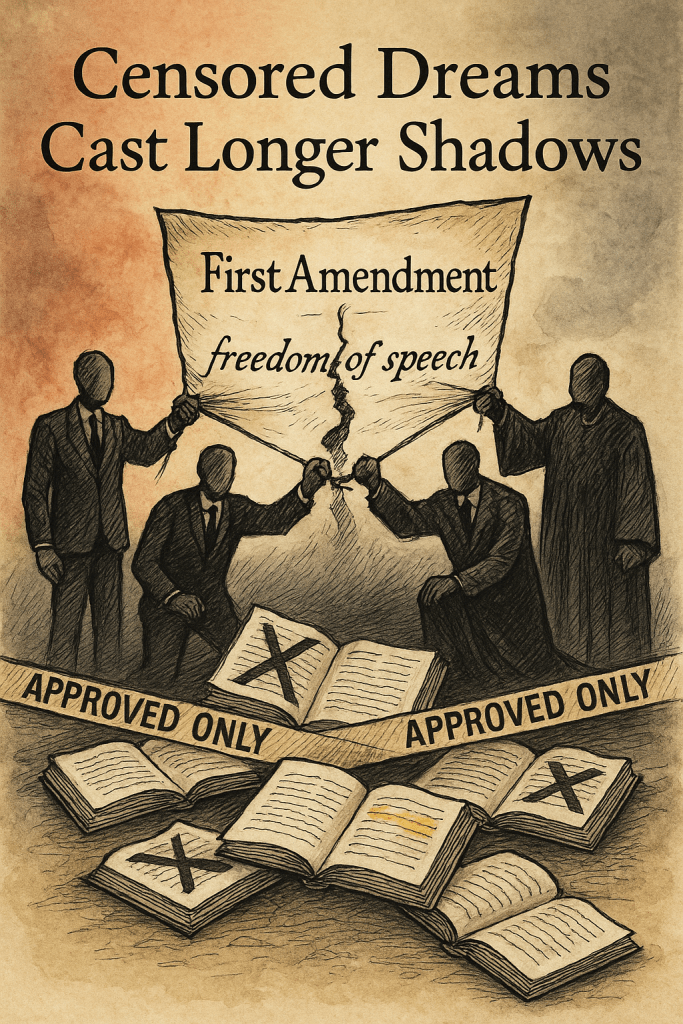
We weren’t founded on sameness—but on dissent. The thirteen colonies didn’t rise up because they agreed with the power, but because they dared to question it. That impulse—audacious, messy, courageous—is what the First Amendment was written to protect. And yet, here we are again, toying with the dangerous idea that some speech is more tolerable than others. That some viewpoints belong, and others must be silenced and erased.

Shouldn’t that make us uncomfortable?

When tax-funded public institutions—schools, libraries, boards—begin removing books because someone doesn’t like what they say, that’s not preservation of order. That’s viewpoint discrimination. It’s not protecting children. It’s insulating and cuddling weak ideologies. And it’s a blade that ultimately cuts both ways.

You may cheer today when a book you dislike is banned. But what happens tomorrow, when the next board turns its gaze toward the ones you cherish? What makes you think your shelves won’t be next?

We have been here before. In the 1950s, it was Communists. In the 1930s, it was Jews, dissidents, and “degenerates.” Ideas were labeled threats. Libraries were sanitized. People fell silent. Is that the direction we want to revisit?

And what of free speech? Have we forgotten that the First Amendment isn’t just the right to speak, but the right to receive, to read, to explore—especially the uncomfortable truths?

A candidate who once shouted from podiums about the sanctity of the First Amendment, to get elected, now wields it like a partisan tool—defending it when it serves him, abandoning it when it doesn’t, and threatening retaliation, retribution, revoking citizenship, and deportation. Isn’t that the ultimate hypocrisy? To claim allegiance to liberty, but only on your terms, isn’t democracy; it is authoritarianism.

Let’s ask plainly: If a public school or library removes a book about a Muslim child exploring faith, or an LGBTQ teen navigating identity, or a historical critique of systemic injustice—while allowing others that affirm dominant religious or political norms—can that possibly be considered neutral? Can it promote learning diversity and inclusion, or only foster selfish isolation and the illusion of greatness?

And if the government—through policy, threat, or performance—signals what speech is safe and what is not, can we still call ourselves a free people?

Pluralism is not about liking every voice. It’s about letting them speak. It’s about understanding that in a nation where taxes are paid by atheists and Baptists, Muslims, Mormons, and immigrants, the public square must be open to all—or none.

If one religion is given space in a publicly funded institution, then all must be. If one ideology is allowed to teach, then all must have a place at the table. If one set of values is protected, then all must be. Or else what we are protecting is not freedom—but control.

So, we must ask ourselves: Do we still believe in a country where debate is encouraged, not silenced? Where a library or a school is a place of discovery, not conformity? Where the power of ideas—not the fear of them—leads us? Because if not, then we are no longer the land of the free—we are simply the land of the approved, bowing to fragile egos. We, and the world, have been there before and rejected viewpoint discrimination; we can, have, and must do better.

For Every Problem...A Solution...
Lap Around the Sun: Daily Steps Forward
Joy in Alzheimer’s: My Mom’s Brave Walk into Dementia’s Abyss

Posted in Current Events

Uniquely American: Civil Discord and Disobedience

Ideas can wound more deeply than fists—their scars often outlast bruises. But dissent isn’t treason; it’s the American expectation. The audacity to voice a contrarian view without fear of punishment was once a defining feature of our national character. That freedom, that courage, is slipping.

A fundamental right is to stand, speak, write, or peacefully protest what you believe is wrong. It’s a moral responsibility at the core of our civic being. It is how we started. As Americans, it is who we are.

Yes, this right has been repeatedly abused and suppressed: during the Civil Rights Movement, LGBTQ advocacy, and Black Lives Matter protests. These weren’t our proudest moments—they were our failures. And yet, we are better than those moments. And we are better because of them. Just as we should be better than today’s attempts to silence pro-Palestinian and pro-Ukrainian voices, or to weaponize immigration enforcement.

Yes, public safety matters. And yes, misinformation can be dangerous, especially when weaponized at scale. But the line between protection and suppression is perilously thin. When fear becomes a rationale for silencing protest, we drift toward authoritarianism under the guise of security.

But let me be honest. I write this as someone of privilege—a white male in the dominant race and gender. I’ve never feared for my safety when expressing my views. I’ve never had to calculate the cost of speaking out to simply be heard. That insulation is not universal. And acknowledging that it is the least I can do.

The truly brave are those who speak anyway, knowing the risks. Minorities are demanding the rights that this country claims to guarantee. Immigrants who were escaping violence and chasing a future are thrust back into violence. And yet, their domestic complicit employers are not subject to the heavy hand of the law. The Pro-Palestinian voices speaking into the silence of global indifference as their homeland, their homeland of generations, is taken and broken, and their families are indiscriminately killed and starved. And even those supporting Ukraine as it fiercely defends its children and its homeland from slaughter by an invading army.

They are the ones carrying this nation’s conscience forward. They take the blows, not for fame or ideology, but for survival and dignity. The road to a better America is paved by those who get off the couch and speak out through civil dialogue, discord, and yes, disobedience.

This country grows not by force, but by engagement. We will be stronger when those in power trade masks and riot gear for open conversation—and when fabricated, non-existent, dystopian, national “emergencies” are no longer used to justify suppression. When we are afraid to speak out, the words of others fill the void, becoming all that is heard. When those of us who can speak don’t, we become complicit in the decay. The slide is ours to stop; or ours to be held accountable.

For Every Problem...A Solution...
Lap Around the Sun: Daily Steps Forward
Joy in Alzheimer’s: My Mom’s Brave Walk into Dementia’s Abyss

Posted in Current Events

History Is Screaming—To Be Heard

Never forget the long shadow of history….

The echoes of history serve as powerful lessons of the consequences of forgetting our past. Throughout time, humanity has faced recurring challenges that, when ignored, tend to repeat themselves in devastating ways.

History’s lessons are written in the experiences of those who came before us. The Holocaust victims’ voices scream to remind us that unchecked hatred and persecution can lead to unimaginable human suffering. And yet, some of their descendants are perpetrators of similar horror.

Similarly, the suppression of academic freedom, knowledge, and the rule of law under totalitarian regimes like those of Stalin, Mao, and Pol Pot warns us about the dangers of attacking educational systems, free thought, and the judiciary. Universities and professors aren’t the enemy–closed minds are. The constant drone of verbal assaults, threats, and misinformation is fueling the flames of unfounded fears, conspiracies, and vile responses. We, as a society, must value and protect our educational institutions. They play a key role in preserving the lessons of history and challenging minds with ideas they may have never considered. Each of us has a part to play in this preservation, making us all integral to the process.

Our democratic foundations were carefully crafted to balance power– to protect against excesses of powers by any of the three equal branches–and require constant vigilance to maintain. When we fail to understand or conveniently ignore these principles, we risk eroding constitutional values that have guided our nation. This becomes especially critical as we witness the rise of polarization, intolerance, and power grabs in modern politics, governance, and civil discourse. Our founders are screaming for us to pay attention and have the courage they had to stand up, speak out, and protect our representative republic, its Constitution, and the separation of powers. It’s our responsibility to uphold these values and engage in the democratic process.

Even in matters of public health, historical lessons prove invaluable. The victims of diseases like polio and measles are screaming to remind us of their pain and suffering, and why scientific advancement and vaccination programs are so crucial to public health. Forgetting these lessons puts us at risk of reversing decades of medical progress and witnessing once again the senseless spread of controllable illness.

Our global standing and leadership role depend upon our ability to learn from history. When we abandon our ideals and integrity for short-term self-interest, we risk losing our international influence and the core values that have defined us as a nation. The sacrifice of fallen soldiers for these values stands as a testament to what we stand to lose when we forget our history. Those who were injured or gave the ultimate sacrifice were never “losers” or “suckers”, they are heroes, and they too must be screaming in disgust at our division and loss of integrity. To those serving, those who served, and the families who lost loved ones, we should all say: ‘Thank you for our Freedom.’ Learning from history isn’t just about memorizing dates and events – it’s about understanding patterns, recognizing warning signs, and making informed decisions that prevent us from repeating past mistakes. Choose to forget and risk repetition, and the perpetuation of the retribution and retaliation cycle. When we ignore history’s lessons, we don’t just dishonor the past; we compromise our future.

For Every Problem...A Solution...
Lap Around the Sun: Daily Steps Forward
Joy in Alzheimer’s: My Mom’s Brave Walk into Dementia’s Abyss

Posted in Political

The Intoxicating Mirage of American Greatness

We are no better than Don Quixote as he chased the demons he saw in windmills as we become drunk on the hysteria and mirage of American greatness. While he blamed magicians for his confusion and failure, we blame minorities and immigrants. We are no different; only our delusion is different.

Neither the Constitution nor the Preamble ever professes any illusion of aspiring to greatness. The Founding Fathers’ writings in the Federalist Papers are silent on any desire for national greatness. These men, willing to risk everything openly professed a desire for an independent nation. A nation recognized and respected as an equal by all the world’s other nations. They weren’t so egotistical to wave the vain flag of greatness or superiority.

Yet today, we insanely strive to regain something we never had, were, or will be. We are drunk on our delusions and egos. Being ‘great’ is a fixation of one’s ego. It isn’t real. It is your fantasized view of yourself. Something which, when unachieved or perceived to be lost, we blame everyone, anyone, but ourselves. Like Don Quixote blaming mystics and magicians, we lash out at everyone but ourselves. Ironically, we blame them for something that never was and can never be.

We are a country with many admirable traits and traditions and rich in resources and intellect. We are like almost every other country in the world. We all have our national pride, but our national ego is more of a liability than an asset. When working internationally, the first and biggest hurdle to overcome is not being the ‘arrogant, ugly American’ as we are known worldwide.

How do you determine ‘greatness?’ Is our historic and persistent racism a measure of greatness? As a country of immigrants, whose foundational economy was built on the backs of slaves, should our measure of greatness be the number of immigrant families we disjoined and caged or how we showed compassion? Is our historic and persistent racism a criterion of greatness? Is the denigration of minorities and the perpetuation of our domestic caste system our yardstick? Is the benchmark the number of citizens in the wealthiest Causation country suffering in poverty? Is it the number of books and ideas we can ban or sequester? Is the measure the need for a nanny state because we don’t trust half of the population to make their own decisions on healthcare? Or maybe it is our growing affinity to authoritarians and dictators rather than democracies? Democracy isn’t dead but authoritarianism a growing plague. Democracy conquered communism and now seems focused on conquering itself. A country boasting about greatness should have addressed and resolved these inequities decades ago. However, what we have shown incredible greatness in is our ability to deflect, ignore, and our propensity to find a scapegoat for our failures.

While we are a blessed nation, no country is great at everything. They all have strengths, weaknesses, and blind spots. The pragmatic salient question might be, ‘Should America strive to be average or average at all things?’ If we are average, we acknowledge there are those better than us in some things, and we are better in others. By being average at all things, we surrender those areas in which we can be superior.

Our desire and aspiration to be Great should not cloud the realization that we are just one among many in this world. Our founders knew this, and they promoted internationalism, not isolation, to gain acceptance and influence. They didn’t strive for dominance but for mutually beneficial relationships. In our drunken, intoxicated state of euphoria, touting our Greatness, let’s hope we ultimately don’t drive ourselves to Mediocrity.

Maybe our Greatness is our ability to cast an eye over our shoulder to see how far we’ve come, accept where we are, and then turn to look forward and have a vision of where we should be. Sober love of country over drunken delusions. NeverFearTheDream……simplebender.com

This was first published in the Bend Bulletin 11/20/24

Posted in Philosophy

Assessing Leadership: The Search for Quality

How do you assess a leader, or maybe just maybe even yourself? What are the qualities which make any person a good leader or a good person? For each of us the criteria for determination will vary but have similar threads. These are critical times for each of us to evaluate and assess our leaders, want-to-be leaders, and frankly ourselves. A recent Marquette Law School survey showed fifty-seven percent of us have little to no confidence in Congress*. These are our elected representatives and leaders. We should assess them differently.

Think about a few characteristics which can be used to understand if they are making progress in pursuit of being better leaders. Characteristics which we can use to figure out if there is improvement rather than feeling good or feeling satisfied. Decisions on who should be a leader should not be about good feelings, but on tangible qualities.

Ask a few simple questions, these ten might be a good start:

  • Are they criticizing anybody?
  • Are they blaming anybody?
  • Are they accusing anybody?
  • Do they react to criticism and complements the same?
  • When they face obstacles do they find solutions or find fault?
  • When wrong, are they contrite or vengeful?
  • Do they demand loyalty over honesty?
  • Do they say the ‘right things’ or do the right things?
  • Do they look toward the future or dwell on the past?
  • Do they lead through hope or fear?

These are questions we should be asking about those who want to lead. We should be asking ourselves if they are more interested in promoting themselves or our county, state, and country. Are they leaders who bring out the best in all of us, or the worst?

Interestingly, the Greek stoic philosopher Epictetus during his life (50-185 AD) routinely asked many of these questions. He asked them to assess whether he and his students were making progress simply in becoming better people. We can still use them to assess the quality of ourselves and our future leaders.

Every election is an opportunity for each of us to look at the candidates, and ourselves, and ask some hard, yet basic, questions. Elections have consequences. There will not ever be a candidate who will satisfy all of us, on every subject. But there can be candidates who have standards of decency which most of us can appreciate and support. There are those who do lead with vision and recognize to be a world leader you must be an active player in world events and not an isolationist. There are those who do not parse and spin the words and facts for their personal gain or quest to retain power. There are those. We need to find them, support them, and dispose of those who do not genuinely satisfy, at least most of, our expectations of a leader. Never fear the dream of a better political and social system. Face the issues and constructively correct deficiencies, one at a time. #NeverFearTheDream

*MLSPSC18ToplinesRV.knit (marquette.edu)

This was first published in the Bend Bulletin 3/7/24

Posted in Political

Escape America’s Scaphism—WE CAN

America is suffering its own self-inflicted Scaphism torture. The body America is restrained and sandwiched between unyielding aspects of our political system. Our head, arms, and legs extended out of our encasement as misinformation is feed to us like milk and honey. We eagerly engorge ourselves on unfiltered and uncorroborated statements and political propaganda vilifying our opponents without ever clearly stating our own direction. As we, the body America are trapped, encased in our vessel the maggots, flies and birds begin to find our filth inviting and our defenselessness exciting. We, the greater populous are trapped and dying because of special self-interests, single issues, and greed.

This is an unusually cruel form of torture, humiliation, and death. The greater body trapped, unable to move as our extremities flail. Slowly succumbing to the attacks from the vermin outside and knowing it is our own fault that we cannot escape. Our enemies celebrate and make wagers on how long we can survive. Our allies look on as our great democratic republic, once the envy of the world, is reduced to a heap of rotting flesh. Able only to scream, curse, and cast blame on everyone else. It’s the extreme right, the progressives, the immigrants, it’s misinformation, it’s the mainstream media; it’s everything’s fault but ours. In factuality, we are the problem and our own cause for our pain and demise.

We listen to the attacks on our national institutions and the steady drumbeat of lies, steals, dishonor, witch-hunts, scapegoats, all of those believing they are being persecuted, and all the victims. Lies and propaganda are espoused to deflect blame and avoid accountability and responsibility. The once moral majority has lost its moral compass. Our elected representatives succumb to the threats of violence and the greed of self-interest for re-election. We have allowed ourselves to be imprisoned in our own horrific Scaphism.

Can we escape our own torture? Yes, we can. We must be willing to work toward the greater good and move forward not backwards. A nation of sons and daughters of immigrants shouldn’t belittle and vilify new immigrants, regardless of skin tone or religious background. Our religious communities should follow their own teachings and be accepting and supportive of those who are different and downtrodden. We should, without hesitation, embrace our unvarnished national history and acknowledge what we did right and what we’ve done wrong. We need to be unabashedly proud and uncomfortably ashamed at the same time.  We should welcome challenging ideas and ideals while respecting our neighbor’s individual preferences and orientations just like you want yours respected. Check and double check everything we see, read, and/or hear on the internet or media.

We don’t have to live in an all or nothing social and political system. If we don’t start listening and understanding all perspectives and compromising; our representative democratic republic we will perish a very public, humiliating, painfully slow, grotesque death and fall into a tyrannical autocracy. Unfortunately, there are a lot among us those who want nothing more. #NeverFearTheDream simplebender.com

This article was first published in the Bend Bulletin 1/24/24