Posted in NeverFeartheDream

Never Fear The Dream…

Responding to anger with anger perpetuates a cycle of generational hatred—a cycle nearly impossible to breach. 26.010.02

NeverFearTheDream………. W. C. Barron………. simplebender.com……….keystonecompact.org

Posted in Keystone

Government Should Know Its Job – and Its Limits

Limited government is not weak. It is disciplined.

The first three articles in this series established a sequence: citizens should retain their judgment, rights must belong to everyone, and peaceful personal liberty should be the default. Those principles raise a practical question that political groups prefer to avoid.

What is government actually for?

The usual debate poses a false choice. One side speaks as though government is the solution to nearly every social failure. The other speaks as though government itself is the enemy. The Keystone Compact rejects both. A government that tries to do everything eventually does many things poorly. A government that refuses to do its real job invites disorder, exploitation, and public distrust.

Limited government is not weak government. It is disciplined government: constitutional, competent, transparent, accountable, and focused on doing fewer things better.

The government has indispensable work. It must secure individual rights, protect public order, defend the country, enforce contracts, maintain fair rules, punish fraud and violence, preserve essential public goods, build and maintain critical infrastructure, and keep promises that citizens have reasonably organized their lives around. It must secure borders, administer justice, protect equal treatment, respond to genuine emergencies, and provide a stable framework in which families, communities, and markets can function.

These are not minor duties. A government that cannot perform them has not become limited. Rather, it has become negligent.

But power requires boundaries because even useful authority can be abused. Government should not manage private conscience, punish or censor peaceful dissent, subsidize irresponsibility, protect favored industries from competition, or mortgage the future for immediate applause. It should not federalize every local problem, turn temporary emergency powers into permanent habits, or hide costs behind noble language.

The distinction is not between government and no government. It is between disciplined government and undisciplined power.

Populists often call government tyranny until it seeks a stronger state directed at immigrants, protesters, universities, companies, media organizations, or cultural opponents. Progressives often call government compassionate while ignoring coercion, dependency, cost, administrative failure, and the limits of distant expertise. Both sides distrust concentrated power in theory but discover its virtues in practice when their own coalition holds the lever.

The Keystone Compact asks a different set of questions before that lever is pulled.

Does the policy protect liberty? Does it respect constitutional limits? Is it funded? Does it solve a real problem rather than merely address a concern? Does it avoid unnecessary coercion? Can the decision be made closer to the citizens affected? Does it reduce favoritism? Does it strengthen work, family, community, safety, reliability, or civic trust? Can ordinary people understand what government is doing, what it costs, and how success will be measured?

A policy that cannot withstand those questions is probably not serious governance. It is often tribal theater, dressed in official stationery.

A disciplined government can be firm. It can enforce laws consistently, secure the border, prosecute corruption, protect citizens from violence, keep infrastructure functioning, and demand honest accounting. It can also be humane. It preserves due process, protects the vulnerable, maintains legitimate safety nets, and recognizes that citizens sometimes face circumstances they cannot overcome alone. Strength and restraint are not opposites. Properly understood, restraint is what keeps strength legitimate.

The local evidence is familiar. Citizens encounter permitting systems that punish small operators while sophisticated insiders navigate them with ease. They watch agencies accumulate responsibilities without clear measures of success. They see public programs defended by intention rather than by outcome. They hear promises made without price tags and emergency language used for routine political convenience. Government grows larger yet often feels less capable of completing its most basic, original tasks.

Doing fewer things better is not an excuse for indifference. It is a call to competence.

The Keystone Compact is therefore neither anti-government nor government-first. It is pro-self-government. Public institutions should serve free citizens, not manage them; uphold equal rules, not dispense political favors; and solve real problems without claiming ownership of every part of life.

The government should know its job – and its limits.

The foundational question is whether power serves people or uses them. The next category applies that question to the place where political promises become measurable: the public ledger.

Once the government knows its role and its limits, the next question is unavoidable: who pays for the promises?

Next in the Keystone series: Category II: Fiscal Responsibility and Economic Stewardship- Debt Is Deferred Cowardice

NeverFearTheDream………. W. C. Barron………. simplebender.com……….keystonecompact.org

.-.. .. — .. – / –. — …- . .-. -. — . -. –


Lap Around the Sun: Daily Steps Forward
by WCBarron

Buy at Amazon Buy at Barnes & Noble Buy at Books2Read

Joy in Alzheimer’s: My Mom’s Brave Walk into Dementia’s Abyss
by WCBarron

Buy at Amazon Buy at Barnes & Noble Buy at Books2Read
Posted in Philosophy

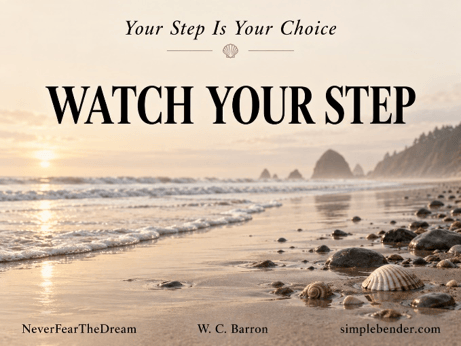
Your Step is Your Choice

Where you step matters more than how you step.

Walking along the rugged Oregon coast at low tide, I found the exposed sand smooth, firm, yet forgiving. I strode briskly, watching the surf and gulls and listening to waves breaking against the distant capes. I slipped off my sandals to feel the cool sand. My pace grew easy and carefree—until I stepped hard on the first stone.

Without noticing, I had wandered from smooth sand into a stretch peppered with stones, broken shells, and the discarded armor of crabs. My stride changed immediately. The beach hadn’t stopped me, nor had my destination changed, but suddenly where I placed my foot mattered more than how gracefully or quickly I walked. The journey remained the same distance. The experience and conditions had changed significantly.

I could have put my sandals back on and barged through. Protection was available to me. But something was interesting about staying barefoot. I had to pay attention. Every step required a small decision: sand, stone, shell, water. Being exposed without protection demanded awareness.

Life often offers us sandals. Money, position, privilege, education, experience, even simple good fortune can insulate us from terrain others must feel directly. There is nothing inherently wrong with wearing sandals. Sometimes wisdom demands them. But protection carries its own danger: eventually we may stop noticing what we are walking across—or what others are walking across without them.

That led me to another question. How much of our path do we actually choose? Some of it, certainly. Decisions accumulate beneath us like footprints in wet sand. But none of us selects the entire terrain. We inherit circumstances, encounter unexpected stones, climb hills we never intended to, and sometimes find ourselves on roads we would never have chosen. We may not be responsible for every path beneath our feet, but we remain solely responsible for the next step and its consequence.

Perhaps that is one of life’s quieter distinctions. The path is shaped by circumstance. The step is a choice. And the things we place between ourselves and the ground are protection. Wisdom lies in knowing which is which.

Life’s road is rarely narrow, straight, or smooth. It twists through roots and rocks, rises unexpectedly, and occasionally opens onto stretches of wonderfully firm sand. Sometimes we walk beside others; sometimes the path narrows, and we walk alone. Either way, attention matters. We should notice the hazards and opportunities along our path, but also recognize that the person beside us may be walking barefoot on entirely different ground.

Walk quickly if you wish. Walk slowly if you need to. Wear sandals when the terrain demands them, and take them off occasionally so you remember how the ground feels.

Watch where you step; your next one might land on someone else.

NeverFearTheDream………. W. C. Barron………. simplebender.com……….keystonecompact.org

-.– — ..- .-. / … – . .–. / -.– — ..- .-. / -.-. …. — .. -.-. .


Lap Around the Sun: Daily Steps Forward
by WCBarron

Buy at Amazon Buy at Barnes & Noble Buy at Books2Read

Joy in Alzheimer’s: My Mom’s Brave Walk into Dementia’s Abyss
by WCBarron

Buy at Amazon Buy at Barnes & Noble Buy at Books2Read
Posted in NeverFeartheDream

Never Fear The Dream…

Personal awakening is usually gradual as one finds oneself amongst everything and oneself. Yet, like emerging from deep sleep, even if the awakening seems gradual, it is sudden and frightening. 26.010.01

NeverFearTheDream………. W. C. Barron………. simplebender.com……….keystonecompact.org

Posted in Keystone

Personal Liberty Is the Default

In a free country, the government should need a reason to interfere. Citizens should not need a permission slip to live peacefully.

If rights are universal rather than political trophies, government cannot assume that citizens must justify their private lives. The burden must lie the other way.

In a free country, the government should need a reason to interfere. Citizens should not need authorization or permission to live peacefully.

That proposition sounds almost too obvious to debate. Yet governments have a recurring temptation to become a life manager. It goes beyond preventing harm and begins to police identity, sexuality, books, faith, speech, conscience, association, medical choices, and private conduct. The justifications vary. Sometimes control is sold as morality. Other times, it is sold as safety, fairness, inclusion, public health, or social progress. The label changes; the presumption of authority remains.

The Keystone Compact has a simple rule: a peaceful adult life belongs to the person living it; first and foremost.

Adults should be free to worship or not, marry, speak, associate, raise families, pursue work, make personal medical decisions, and live according to their conscience, as long as they do not violate others’ rights, safety, or property. Difference is not evidence of danger. Disapproval is not proof of harm. Offense is not coercion.

That final boundary matters because liberty is not license. Freedom is NEVER an excuse for violence, theft, fraud, abuse, exploitation, neglect, coercion, or public danger. A person cannot claim liberty as a shield to harm another. Government has a legitimate and necessary role when force is used, contracts are broken, children are endangered, property is taken, public order collapses, or one person’s conduct destroys another’s equal freedom.

The principle is maximum practical liberty and minimum necessary force. Neither half can be discarded.

Liberty without responsibility is raw selfishness. Responsibility without liberty becomes control. A mature public philosophy must resist both errors. Modern tribal politics rarely does. Populists often want government weak when regulating business or setting taxes, then suddenly powerful enough to punish cultural enemies, restrict intimate choices, or enforce a preferred moral order. Progressives often celebrate personal autonomy, then build administrative systems broad enough to regulate speech, compel language, manage risk, and engineer social outcomes. Each side recognizes the danger of power and becomes remarkably imaginative about its uses when in control.

The Keystone standard is not about whose values prevail. It is about whether strong-arming is necessary to protect another person’s rights.

Let’s consider ordinary life rather than ideological abstractions. A neighbor worships differently. An adult child chooses a life a parent never imagined. A family faces a complex medical decision. A worker wants to do the job without turning every workplace conversation into a political loyalty test. A bookstore carries material some residents dislike. A peaceful citizen owns a firearm, attends a protest, declines to attend one, raises children in a faith, or raises them outside one.

A free society does not require approval for these choices. It requires enough humility to distinguish personal disagreement from public harm. That distinction protects conservatives as much as liberals, religious citizens as much as secular ones, and majorities as much as minorities. Once government is authorized to regulate peaceful identity or conscience, no group can be certain it will remain the favored one. The rules crafted to discipline today’s opponent become tomorrow’s inheritance.

Personal liberty mandates civic obligation. Free people must tolerate frustration from one another. They must learn to persuade rather than compel, to live alongside differences they cannot reconcile, and to reserve the law for conduct that genuinely causes harm. Self-government is not the absence of moral judgment. It is the refusal to make every moral judgment a matter for the police.

The government should protect citizens from harm, not manage their private conscience.

So when did peaceful disagreement become a government problem? Usually, it happened when a political faction realized that persuasion and compromise were harder than wielding power.

If liberty is the default, government must know what it is for and what it is not for. That is the final foundational brick before the Keystone Compact turns to budgets, institutions, and policy.

Next in Category I: Government Should Know Its Job – and Its Limits

Posted in NeverFeartheDream

NeverFearTheDream…

The more conditions we place on love, the more it shrinks into a transaction; love grows as we loosen the terms and trust in giving. 26.09.09

NeverFearTheDream………. W. C. Barron………. simplebender.com……….keystonecompact.org

Posted in Current Events

When Power Destroys Strength

Strength is different than power. Power has the ability to compel. Strength is broader: it encompasses trust, credibility, influence, and reputation. It is shown in others’ willingness to stand beside you, even when they are free to walk away.

America possesses enormous power, but our international strength is weakening as we increasingly confuse coercion with leadership. The world is adapting through trade agreements, defense relationships, financial decisions, and more independent, divergent foreign policies. By demonstrating our dominance too aggressively, we are making ourselves less indispensable.

After World War II, the United States helped build an international order grounded in collective security, trade, sovereignty, and mutual interest. Broader postwar institutional systems gave countries reasons to align with us beyond fear or dependency. Our strength grew not merely because our power increased, but because America was widely seen as useful, dependable, and trustworthy.

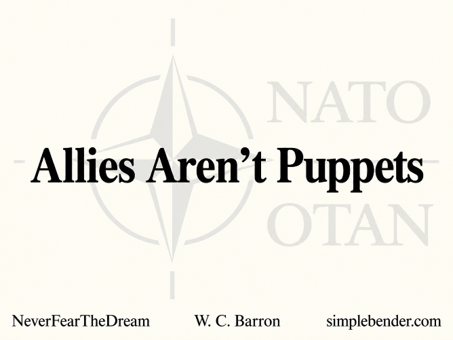
Our allies were never mere satellites. They were sovereign nations that sometimes disagreed with us, yet they justified their partnership with the United States as strengthening their security and prosperity. That voluntary, symbiotic, and beneficial alignment was a foundation of American power and influence.

Today, we are eroding our trustworthiness and losing their confidence. Tariffs, economic threats, unilateral military actions, demands for conformity, and public criticism of governments that resist American preferences turn partnership into subordination. Even when some demands are justified, such as greater defense burden-sharing, the method matters. A critical difference exists between asking an ally to carry a larger share and condemning resistance as disloyalty that warrants retribution.

Our allies notice and recognize the difference. European governments are expanding their defense industries and pursuing greater strategic autonomy. Canada has joined European defense procurement arrangements. Traditional U.S. partners are expanding trade relationships beyond American-centric structures, including with our economic rivals. Central banks are reassessing where they hold strategic reserves and their share of federal bonds. These actions do not mean our allies are abandoning us. They mean they have lost faith in us and are choosing to diversify risk and security rather than tolerate increasing uncertainty.

A sovereign nation does not need to become our enemy to diminish American influence. It only needs more choices and a reason to choose. Alternative markets lower the cost of resisting American tariffs. Independent defense production reduces reliance on American weapons. New security relationships reduce dependence on American guarantees. Diversified reserves reduce exposure to American jurisdiction.

Each step creates optionality, and optionality reduces leverage. Each option taken erodes America’s influence and economy.

The emerging world may not divide neatly into allies and adversaries. Instead, countries may remain allied with the United States while building the capacity to oppose us when their interests diverge. That is not hostility. It is strategic independence. It is being an independent sovereign, not a territory.

The contrarian argument matters. Some of this adjustment is healthy. Europe should spend more on defense. Nations should diversify their trade and financial exposure. Russia and China provide independent reasons for allies to strengthen themselves. A more capable alliance system could ultimately strengthen the West.

But there is a critical difference between allies becoming stronger because we encouraged partnership and allies becoming more independent because they fear dependence and are tired of threats and insults. Power can force compliance for a time. Strength makes cooperation worth choosing.

America may not lose all its allies. Something more consequential is unfolding. They may remain allies even as they learn to function without us. We could still possess extraordinary military and economic power while losing the structural advantage that defined the postwar era—the belief that America was THE indispensable partner. Our own actions, demands, and ego are making them stronger at our expense.

We need to reconcile: Are we stronger when sovereign nations obey because resistance is costly, or when they choose us because the partnership is valuable? Overlords have historically been overthrown by peasants, but these aren’t peasants or serfs; they are independent sovereigns.

NeverFearTheDream………. W. C. Barron………. simplebender.com……….keystonecompact.org

… – .-. . -. –. – …. / — …- . .-. / .–. — .– . .-.


Lap Around the Sun: Daily Steps Forward
by WCBarron

Buy at Amazon Buy at Barnes & Noble Buy at Books2Read

Joy in Alzheimer’s: My Mom’s Brave Walk into Dementia’s Abyss
by WCBarron

Buy at Amazon Buy at Barnes & Noble Buy at Books2Read
Posted in Keystone

Rights Are Not Tribal Trophies

CATEGORY I: FOUNDATIONAL PHILOSOPHY  |  Article 2 OF 4  |  WHY WE NEED THIS DISCUSSION

A right that survives only when your side approves is not a right. It is a permission slip.

The first essay in this series (America Does Not Need Another Tribe) rejected the party bargain that asks citizens to trade judgment for belonging. That refusal has consequences. Once no party owns our conscience, no party can ever claim ownership of our rights.

A right that survives only if your side approves is not a right. It is a permission slip.

American politics routinely praises liberty in the abstract and negotiates it away in practice. Free speech is deemed sacred until the speaker becomes contrarian or countercultural. Due process is indispensable until the accused is despised or destitute. Privacy matters until surveillance targets the other side. Religious liberty is celebrated when it protects familiar beliefs and dismissed when it protects unfamiliar ones. Equal protection is invoked as a principle, then narrowed to a benefit for the politically favored.

Every tribe is eloquent when it feels threatened. The real test comes when it holds power.

Rights are not rewards for good behavior, respectable opinions, or approved identities. Their purpose is most evident when they protect the critic, the dissenter, the unpopular speaker, the accused, the religious minority, the disliked neighbor, and the political opponent. A system that protects only agreeable people does not need a Bill of Rights.

The Keystone Compact therefore treats free speech, religious liberty, due process, privacy, equal protection, property rights, bodily autonomy, and peaceful disagreement as part of a single moral framework. These protections do not belong to the right, the left, the center, the religious, the secular, the majority, the marginalized, or the compromised. They belong to all people because political power is too dangerous to be used to distribute them selectively.

That universality will make nearly everyone uncomfortable at some point. It means defending the right of a small-town church to worship without harassment and the right of a gay couple to live openly under the same law. It means protecting a gun owner’s lawful property and a pro-choice woman’s bodily autonomy. It means ensuring due process for an immigrant facing removal and for a police officer accused of misconduct. It means allowing a controversial speaker to speak and peaceful protesters to protest. It means respecting the conscience of a religious doctor while ensuring that public policy does not erase a patient’s lawful access to care.

These cases are not identical, and policy details matter. The principle that unites them is that the government may not change the rules merely because the person seeking protection has become unpopular.

Selective rights create a predictable civic disaster. When citizens believe the law will be applied differently depending on who controls the institutions, they lose trust in the law itself. Politics then becomes a race to seize the weapon before the opposing tribe can wield it. Elections feel existential. Courts become prizes. Agencies become instruments of revenge. Every transfer of power breeds fear because restraint has been replaced by an expectation of retaliation.

That is how constitutional government decays: not usually through a single dramatic decree, but through a thousand exceptions, each defended as necessary at the time.

The defense of universal rights is sometimes mistaken for moral indifference. It is the opposite. It requires moral discipline. We can condemn a person’s words without asking the government to silence them. We can oppose a person’s choices without denying equal protection. We can demand accountability while preserving due process. We can hold strong beliefs without using public power to force peaceful neighbors to live by them.

Pluralism is not agreement. It is the constitutional maturity to accept that disagreement does not erase citizenship.

The Keystone Compact offers no tribal exemption. The same standard must apply when power changes hands, when headlines turn ugly, and when the person invoking a right makes us angry. Otherwise, rights are merely temporary permissions granted by whoever won the last election.

Here is the practical test: would you defend the same right for someone whose bumper sticker makes your blood pressure rise?

If the answer is no: the problem is probably not the ‘right’ but our desire to control who deserves it.

Once rights belong to everyone, another question becomes unavoidable. What should government presume when peaceful adults make private choices? The Keystone answer is not supervision. Personal liberty is the default.

Next in Category I: Personal Liberty Is the Default

NeverFearTheDream………. W. C. Barron………. simplebender.com……….keystonecompact.org

– .-. .. -… . … / -.. — -. .—-. – / -.-. — -. – .-. — .-.. / -.– — ..- .-. / .-. .. –. …. – …


Lap Around the Sun: Daily Steps Forward
by WCBarron

Buy at Amazon Buy at Barnes & Noble Buy at Books2Read

Joy in Alzheimer’s: My Mom’s Brave Walk into Dementia’s Abyss
by WCBarron

Buy at Amazon Buy at Barnes & Noble Buy at Books2Read
Posted in NeverFeartheDream

NeverFearTheDream…

Self-reflection and your thoughts are tools for improvement—not for self-deification or self-chastisement. Neither overvalue nor dismiss them. 26.09.08

NeverFearTheDream………. W. C. Barron………. simplebender.com……….keystonecompact.org

Posted in NeverFeartheDream

NeverFearTheDream…

Life is not for waiting but for living. 26.09.07

NeverFearTheDream………. W. C. Barron………. simplebender.com……….keystonecompact.org