Posted in NeverFeartheDream

NeverFearTheDream…

The world around us, and ourselves, is in balance between pleasure and pain, winning and losing, ecstasy and disaster—awakening to this balance of extremes doesn’t entice us to give up but to try harder to embrace the totality. 26.07.04

.–. .-. — — .. … .

Posted in Current Events, Philosophy

Kodachrome America on US2


Road Tripping along US2- Our Northern Most Highway Mirror

Traveling US2 reminded me of some things easily forgotten from a couch, a cable-news chair, or the algorithmic cave we now mistake for public discourse and life.

America is Kodachrome, not monochrome.

It is not one color, story, tribe, flag, grievance, joy, anger, or one carefully rehearsed slogan. It is a long, uneven road running through farm fields, forests, high plains, small towns, county seats, and metropolises. Yet, US2 barely touches political power at all, which feels about right for a road more interested in citizens than rulers. It touches the Great Lakes and crosses the Rocky Mountains. It passes poverty, pride, fresh paint, boarded windows, new diners, old dreams, and people trying to get through the day without losing their minds, humor, decency, or pride.

US2 is not polished America. It is not brochure America. It is not the America politicians sell when they need applause. It is better than that. It is real.

There were simple homes and extravagant ones. Fancy shopping centers and flea markets. New businesses with flashing banners announcing someone’s fresh shot at the American dream. And there were uncountable hollowed-out buildings, closed storefronts, ruined signs, tattered flags, and boarded windows reminding us that not every dream survives. Hope and wreckage share the same street.

The road itself seemed honest to. US2 shifted from single-lane “take your turn” stretches to four-lane, divided-lane confidence, from rough, rutted pavement to smooth sailing. That felt about right. America has always been part pothole, part promise.

Along the way, diversity was not a slogan. It was simply present. Greeted, helped, waved at, and politely served by people of multiple races, genders, orientations, accents, and backgrounds—Black, Native American, Hispanic, Asian, white, and everyone in between. Fellow campers and travelers chatted without demanding a political affidavit or proof of citizenship. People waved because waving still works. They smiled because not every human exchange has to be a tribal transaction.

Near one town, modern tricked-out equipment rolled through the same landscape where Amish oxen plows tilled the soil, and family carriages filled with four to five family members trotted toward Sunday evening service. Every face seemed eager to wave. Modern machinery and horse-drawn faith shared the road, not as enemies, not as symbols in someone else’s culture war, but as neighbors moving through the same evening light. That is America when we let it breathe.

And yes, the American ego rode along too. Somewhere in North Dakota, a place without a hospital, advertised world-class spinal services. Every mascot of every team in every town was the ‘world’s best; go figure. And, every other town seemed to claim world-class pancakes. I cannot say whether any other country makes pancakes, but we have apparently perfected them nine hundred times between the Great Lakes and the Rockies. This country may be divided, but no one has surrendered our breakfast supremacy.

Then came the names: Pleasant, Superior, and others that sounded less like towns and more like national therapeutic goals. Maybe we need more Pleasant in our politics and lives, and a little less self-declared Superior in and from our leaders. A country does not heal by shouting louder. It heals when enough ordinary people decide the neighbor is not the enemy, the stranger is not a threat, and disagreement is not treason.

One of the most refreshing parts of the route was how pleasantly devoid it was of cult political banners and flags. Not devoid of belief. Not devoid of opinion. Just free from the need to turn every porch, truck, fence, and field into a loyalty test. After years of national shouting, quiet felt amazingly patriotic.

The warm evening, outside an Irish pub, blues and alternative rock shared the stage at a block party. People smiled and danced. No one checking party registration or citizenship before tapping a foot and having a beer. For a few hours, the country remembered that rhythm is older and better than ideology.

US2 showed me real America in all its diversity—not singularity, not uniformity, not forced sameness. Maybe that is what makes us great, and shows us how and when we are great.

Not our boastfulness. Not our need to be the world’s overlord or policeman. Maybe America’s better role is partner, not ruler. Maybe being “number two” would not be humiliation. Maybe it would teach us to try harder, listen better, brag less, and build more, back to our roots and strength.

US2 gave me hope. Not naive hope. Hope with rust on it. Hope with a cracked windshield, a Dollar General at every crossroads, and every state somehow claiming Sasquatch as a local resident. But hope nonetheless.

Because beneath the noise, most people were doing what people have always done: working, serving, driving, cooking, repairing, praying, camping, building, failing, starting again, and trying to keep their families safe and well.

That is the America worth defending.

Not monochrome America. Not purified America. Not a fantasy where everyone thinks, looks, votes, worships, or eats pancakes alike. But, a Kodachrome America. Bright, faded, scratched, beautiful, uneven, funny, heartbreaking, generous, stubborn, and still—despite everything—moving forward together even when we agree to disagree. NeverFearTheDream simplebender.com

-.- — -.. .- -.-. …. .-. — — . / .- — . .-. .. -.-. .-


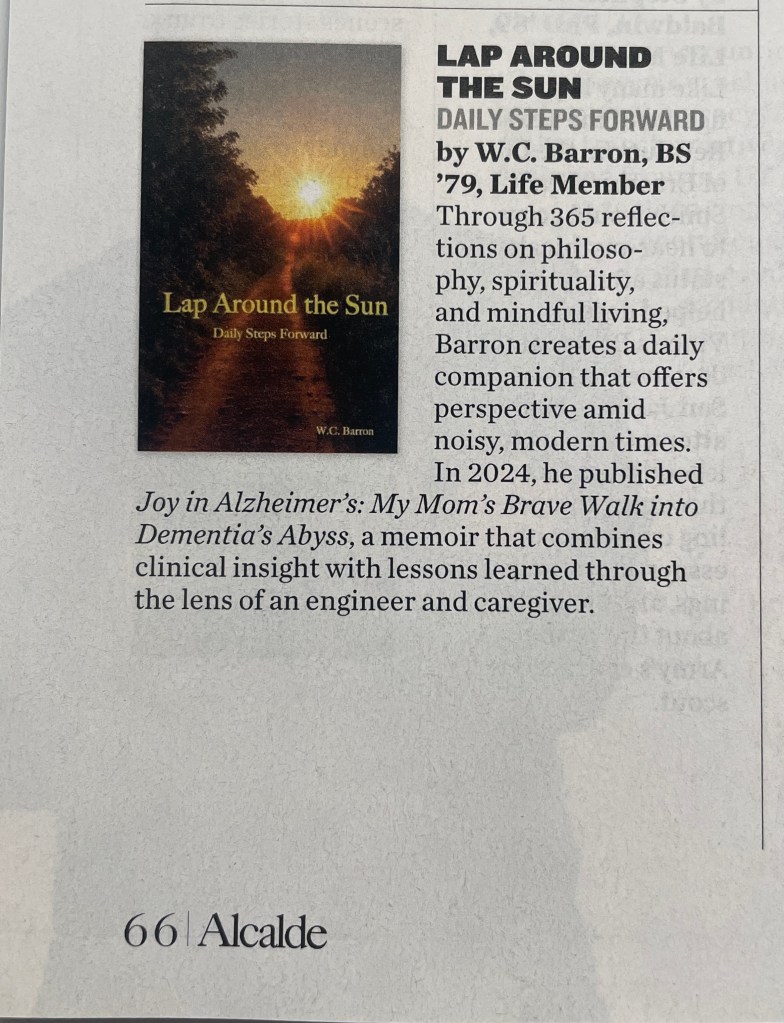
Lap Around the Sun: Daily Steps Forward
by WCBarron

Buy at Amazon Buy at Barnes & Noble Buy at Books2Read

Joy in Alzheimer’s: My Mom’s Brave Walk into Dementia’s Abyss
by WCBarron

Buy at Amazon Buy at Barnes & Noble Buy at Books2Read
Posted in NeverFeartheDream

NeverFearTheDream…

When independent agencies lose their independence, they simultaneously lose their credibility. 26.07.03

-… ..- .. .-.. -.. / ..-. .-. — — / … …. .- .-. . -.. / .. -.. . .- .-.. …

Posted in Current Events

Our National Midlife Crisis

Everyone ages, though few like to admit it. We prefer the glow of our youth—when everything felt strong, certain, and inevitable—yet we recoil from the mirror’s reflection that reveals a harsher truth. The United States, now, as an aging adult, is staring down its own midlife crisis: restless, nostalgic, anxious about declining vitality, and unsure of its purpose. And like any midlife crisis, it is largely self-inflicted.

As a fledgling republic, we leaned heavily on foreign counsel and support, learning to stand on principles whose ink was still wet. We quarreled with the empire that birthed us, a restless adolescent convinced that independence alone equated to maturity. In our late teens, our Manifest Destiny carried us across a continent—eager, energized, and careless. We violated Indigenous sovereignty, claimed vast stretches of land, and seldom paused to reflect on the cost—youth rarely does.

Then came the moment we stepped beyond our borders to confront tyranny abroad. Isolation gave way to global responsibility, and in defeating fascism, we crowned ourselves the “leader of the free world.” That era—the Greatest Generation era—became our cultural mythology of peak performance. In economic terms, we hit our stride: strong, wealthy, and ambitious, so confident we assumed the world wanted our model replicated everywhere.

Adulthood matured us further. We recognized injustices at home and, imperfectly, pushed to correct them. We abolished poll taxes, dismantled legal segregation, expanded civil rights, and pursued gender equality—though we famously stumbled in ratifying the ERA. Still, we dreamed big. We mapped the ocean floor and walked on the lunar surface. We believed no frontier was beyond reach.

But adulthood also revealed strain. Our swagger crippled amid a string of grinding foreign conflicts in which overwhelming force could not overcome nationalist resolve. Regime-change efforts faltered. Confidence thinned. The armor dulled. The steps slowed. The world noticed.

We now resemble a nation in midlife denial. We want the prowess of our youth without the discipline, unity, or sacrifice that once produced it. We have become too large, internally conflicted, and politically stiff, unable to move with the nimble decisiveness we admire in our past. Instead of planning for the next horizon, we rummage through the attic of lost greatness and flirt with the symbolic trappings of monarchy—strongman fantasies, grievance crowds, and performative nationalism. These are not signs of renewed vigor; they are early symptoms of institutional cognitive decline.

The irony is painful: past generations always knew our shared mission. We debated the path but rarely the direction. Today, the direction itself is disputed, diluted, or abandoned. A country without a horizon behaves like a retiree with no hobbies—restless, resentful, and prone to delusion.

Yet midlife crises can be turning points if approached with humility and long-view statesmanship. Older nations endure by learning from their past without worshipping it, by building for the grandchildren rather than reconstructing their own adolescence. The future is not reclaimed by nostalgia but by vision. Let’s not just look back; let’s learn from our past, reflect on it, and use it to shape our future.

So let us do what adults do at their best: acknowledge our age, accept our limitations, but not be defined by them, and chart a path worthy of those who will inherit this place. Square our shoulders, and focus forward—not back. Our midlife crisis can be a descent or a rebirth. We choose which. Collectively, with a common focus, let’s reject the polarizing radical positions of the extreme amongst us. Let’s encourage the great masses of the middle to lead us forward toward new goals and our next horizon. Let’s remember, we are all in this together, and it’s our shared responsibility to shape the future of our nation.    NeverFearTheDream   simplebender.com

… – — .–. / .-.. — — -.- .. -. –. / -… .- -.-. -.-


Lap Around the Sun: Daily Steps Forward
by WCBarron

Buy at Amazon Buy at Barnes & Noble Buy at Books2Read

Joy in Alzheimer’s: My Mom’s Brave Walk into Dementia’s Abyss
by WCBarron

Buy at Amazon Buy at Barnes & Noble Buy at Books2Read

Posted in NeverFeartheDream

Never Fear The Dream…

Nothing in your life is pre-determined, not your personality, disposition, intelligence, physical prowess—nothing. You shape your destiny through the simple, every day, mundane choices you make. 26.06.09

…. ..- — .- -. / … .–. .. .-. .. – / .– .. -. …

Posted in Current Events

Real Court Reform: One Pick, Five Seats, Twenty Years

Court reform should not be driven by frustration, anger, or revenge. It should begin with reason, a belief in ‘what’s good for them will be good for me,’ and be simple to administer. The current system rewards timing, tribal fury, and biological chance. A serious republic should do better.

A Supreme Court, whether state or federal, should not be a political lottery. The system should not depend on actuarial luck, strategic retirement, or the medical endurance required to retain lifetime power. These factors create a system more akin to institutional gambling than to constitutional wisdom and public confidence. A system in which an executive inherits three vacancies and another none is inherently unfair and destined for manipulation.

A cleaner model should be considered: five justices, a twenty-year term*, and one appointment per executive term. Simply put, each executive receives one appointment per term. Justices serve twenty years, not for life, and no justice serves twice. Systematically, the bench stabilizes at five because the math is straightforward: one appointment every four years, paired with a twenty-year term, yields a predictable five-seat court.

Operationally, if any justice leaves early for any reason, the seat is filled to keep the Court at five. The replacement can serve only the remainder of that seat’s twenty-year term. This preserves the rhythm and prevents opportunism. The point is not to help Democrats or Republicans, conservatives or liberals. The point is to remove the jackpot and keep the Court dynamic by increasing turnover.

The transition would begin with the current justices and take sixteen years. In the first year of a new executive, the most senior justice with more than twenty years of service would step down and be replaced by the executive’s single-term selection. Each subsequent year, the most senior justice with more than twenty years of service would step down and not be replaced. This annual review would continue until all current justices with more than twenty years of service had retired from their seats. Going forward, all justices would be subject to the twenty-year limit.

This model would reduce nomination warfare and gamesmanship because every executive would have predictable influence. It would reduce gerontocracy because no seat would become a lifetime throne. It would reduce court-packing hysteria because the size would be fixed. It would strengthen legitimacy because citizens could understand the structure without a constitutional séance.

Five justices are enough for deliberation, dissent, and clarity. Twenty years is long enough for independence and not long enough for political immortality. The court’s direction naturally swings with the general elections. The court becomes more the people’s choice than the power brokers and political parties.

Reform should not ask, “Who benefits today?” or “Who will be the most loyal?” It should ask, “What structure would we trust if our side loses?” NeverFearTheDream…simplebender.com

.—- —… ….. —… ..— —– / … .. — .–. .-.. .


Lap Around the Sun: Daily Steps Forward
by WCBarron

Buy at Amazon Buy at Barnes & Noble Buy at Books2Read

Joy in Alzheimer’s: My Mom’s Brave Walk into Dementia’s Abyss
by WCBarron

Buy at Amazon Buy at Barnes & Noble Buy at Books2Read

*During the first 100 years of the Supreme Court, the average term of service for a Justice was less than 17 years. Since 1960, the average term of service has been 23 years.

Posted in NeverFeartheDream

Never Fear The Dream…

Life’s fullness should be viewed as a vast panorama, not as if we live in a house of pinhole windows—where we glimpse only a narrow view as we pass by each limited portal. 26.06.08

-.-. ..- .-. .. — … – .. -.–

Posted in NeverFeartheDream

Never Fear The Dream…

If you oppose nothing, you stand for nothing. 26.06.07

… – .- -. -.. / ..-. — .-. / – .-. ..- – ….

Posted in Philosophy

Denial: Affirmation Without Challenge

The Real TDS

Are we truly more in denial than previous eras, or does the abundance of information make denial more tempting and widespread?

That may be the uncomfortable question of our age. Human beings have always lived in a mixed atmosphere of truth, delusion, hope, fear, rumor, and self-protection. We hear what comforts us. We believe promises that flatter us. We reject bad news when it threatens the identity we have already bought.

The difference today is volume. Twenty-four-hour news, algorithmic outrage, curated feeds, and tribal media do not challenge our denial. They organize, affirm, and sell it back to us as courage.

Denial often starts with Avoidance, not peace. When facts threaten our identity, many choose silence over the courage of acknowledgment. It isn’t about conflict avoidance. We don’t want to have to talk about or acknowledge the problem, especially when the facts are stacking up against us.

Rather than face it, we earnestly struggle to find Justification. We find ways to rationalize behavior that is clearly outside our norms and moral window. We explain away behavior we would have condemned yesterday. The moral window shifts, but we pretend the house has not moved.

We quickly find scapegoats to Blame. We eagerly shift responsibility to other people, dehumanized organizations, or ‘unavoidable’ circumstances. Clearly, ‘fake news’ is reporting only the maleficence. The courts and elections are rigged. The experts are bought. The ‘enemy’ is mentally deranged. Once the scapegoat is chosen, conscience can go back to sleep.

Rather than exercising critical thinking, we look the other way when the behavior and comments show defiant Persistence. The pattern repeats, but repetition no longer alarms us. It numbs us. What once shocked us becomes background noise. What once disqualified a leader becomes “just how he talks.”

Then come the never-ending Promises. Ukraine will be resolved quickly. Affordability is coming. The debt will not matter. The files will be explained later. The war was necessary. The damage was total. And immigration enforcement will only target the “worst of the worst.” But even that phrase deserves scrutiny. If the policy is true, why do roughly 70% of people in ICE detention have no criminal conviction? That does not mean every detainee has a legal right to remain. It does mean the slogan is doing more work than the facts. “Worst of the worst” becomes less a standard of enforcement than a permission slip for public indifference, warrantless detainment, and deportation.

And when all else fails, we eagerly seek and are offered Distractions to turn our minds away from the uncomfortable truths being seen every day. We focus on unrelated activities to distract our minds from the problems. Another enemy. Another slogan. Another shiny bobble for our minds trained to ignore major failures.

Nations look away in installments. Not all at once. Not with one grand act of evil. But with a little silence here, a little rationalization there, and a little contempt for the suffering of people outside the tribe.

That is why Gaza matters. Whether one accepts the final legal label or not, credible international bodies have documented acts they characterize as genocide. That should be enough to stop moral people in their tracks. Instead, many ask which side benefits politically from saying it out loud, and many just say the claims are propaganda.

Yes, the Iran claims do matter. If a nuclear program is “obliterated,” but if ambition remains intact, does the threat remain? Does ambition alone warrant annihilation? The question is more of a moral one than a military one. Are we defending truth, or defending the story we were sold?

That is why threats toward Cuba, Greenland, and Venezuela matter. Not because every claim is equal, but because each tests whether we still evaluate power by principle, or merely by who is wielding it.

Yes, the national debt matters. Gross federal debt now exceeds the size of the entire U.S. economy, yet we still speak as if greatness can be financed forever on borrowed money and borrowed faith. We have tolerated elevated spending, tax-cutting, and political promises without demanding financial responsibility.

This is Truth Denial Syndrome — the real TDS — not the lazy dismissal of a so-called “derangement syndrome.” It is not confined to any one party, ideology, or tribe. It lives wherever loyalty becomes more important than reality. It grows wherever affirmation reigns supreme without challenge.

The cure is not outrage. Outrage is too easy. Instead, cultivating patience and critical thought can empower us to prioritize facts, country, and shared values first, and tribal loyalty a far distant third.

If we cannot face what is plainly in front of us, we will not solve our most pressing problems. We will merely keep applauding those who taught us not to see them. NeverFearTheDream   simplebender.com

.-. ..- – …. / -.. . -. .. .- .-.. / … -.– -. -.. .-. — — .


Lap Around the Sun: Daily Steps Forward
by WCBarron

Buy at Amazon Buy at Barnes & Noble Buy at Books2Read

Joy in Alzheimer’s: My Mom’s Brave Walk into Dementia’s Abyss
by WCBarron

Buy at Amazon Buy at Barnes & Noble Buy at Books2Read
Posted in NeverFeartheDream

Never Fear The Dream…

Sit quietly and listen for your inner voice that whispers, “Be quieter”—then let the stress melt away. 26.06.06

.–. . .- -.-. .