Posted in Philosophy

Escape the Prison of Reflection: A Parable of Ego and Humility

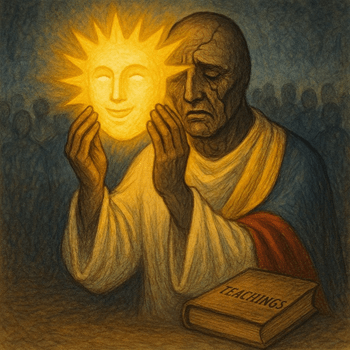
An older man, with an air of superiority, left his opulent, gilded house and strolled into a bustling marketplace surrounded by his fawning, obedient minions. He proudly carried a polished, reflective, framed glass. His head held high, he admired his own reflection as he weaved through the crowd. The crowd could see him, but he could only see himself, and he was thoroughly pleased. He barely noticed those on either side of him as his minions pushed them aside out of his view. When he did catch a fleeting glimpse, he compared himself to them—the merchants, the homeless, the travelers, the artists, and the minorities—with his arrogance, ignorance, and bombast on full display, he declared, “I am far superior to them all, and they should be forbidden from saying otherwise.”

But as the day wore on, dust gathered on the glass. His reflection grew dim and distorted. He frowned, exclaimed how unfair and unacceptable the conditions were. He lifted his feeble arm and wiped it with his soiled sleeve. Raising it again, he loudly demanded that the crowd see him as he saw himself, even through the grime. Some ignored him, some laughed, and the braver, at great peril, mocked him. His anger rose, and his threats of retaliation grew robust and offensive.

At last, an old immigrant woman left the row of unpicked crops and approached him, offering nothing but silence in her weary eyes. With her weathered hands, she took the glass gently from his manicured fingers, turned it around, and asked, “What do you see now?” The mirrored glass, once a tool for self-admiration, now became a symbol of understanding and empathy as he viewed the world rather than himself.

The old man was initially taken aback but remained self-absorbed. In the mirror was no longer his own face, but the faces of the people around him—each one bearing burdens, scars, joys, and pride of their own which he had never truly seen or bothered to comprehend.

The old woman’s voice was a gentle, refreshing breeze: “The glass is not for self-worship but for understanding. Turn it outward and you’ll see the truth: you are not the center, only a small part. Your ego makes the glass a prison; humility makes it a window.” Her words carried a profound truth that seemed to resonate in the old man’s heart.

The old man, humbled by her wisdom, lowered his head. For the first time, the marketplace seemed vast and vibrant, filled not just with his own reflection but with the dreams of real people. He left the market, dusty and disheveled, and a question lingered for all who watched: Will he remember what the mirror revealed, or will he brush away the dust of human humility and return to the prison of his own reflection? As the old woman returned to the field, she turned and said: “We should all look into our own reflective glass and ask ourselves, how much of him are we?” #NeverFearTheDream

For Every Problem...A Solution...
Lap Around the Sun: Daily Steps Forward
Joy in Alzheimer’s: My Mom’s Brave Walk into Dementia’s Abyss

Posted in Philosophy

Four Cascading Truths of Change

  • No situation is beyond change.
    • A shared vision and a sound strategy can shape that change.
      • Everyone must help make a difference.
        • No one is free of responsibilities.

Re-read those slowly. These truths have outlived generations because they work—alone or together. Like people, they stand stronger when connected.

Change is never still. It may be welcome or feared, but it will come. When we craft a common vision and act with purpose, change can be shaped instead of endured. That means leaning in—not leaving the work to “them,” whoever they are, nor just to yourself. Those who only watch from the sidelines end up resenting the outcome. Those excluded will also be resentful and work to sabotage the effort. Find a way to have a shared vision or the vision will eventually fail.

Being part of change means being accountable: creating, planning, and carrying some of the weight yourself. If everyone contributes, no one is left out—and no one is left behind.

The work never truly ends. When one change is complete, we pause, assess, and begin again. Done well, change builds its own momentum and draws people forward. Done poorly, it collapses under its own weight—because one or more of these truths was ignored or broken.

Bring everyone along. Let everyone contribute to their capacity. Share both the burden and the credit, but never the blame, that’s on you—and then—and only then will you change more than you ever imagined. #NeverFearTheDream

For Every Problem...A Solution...
Lap Around the Sun: Daily Steps Forward
Joy in Alzheimer’s: My Mom’s Brave Walk into Dementia’s Abyss

Posted in Philosophy

Sometimes HOPE Needs a Little HELP

Hope is stubborn. It is resilient. It is also fragile, and often, it isn’t self-sufficient. Sometimes it needs a little help. It survives in a world that holds both the best and the worst of us—breakthroughs and backslides, mercy and malice—often on the same day.

When hope thins, we don’t need slogans; we need help. Sometimes that help is borrowed from others. Sometimes we loan it to ourselves. It can be as simple as noticing the ground we’ve gained, not just the mud we’re stuck in. Much remains broken—violence, injustice, genocidal aggressors, and loneliness—but much has moved forward: more cures, more voices heard, more tools to repair what we once accepted as incurable, unrepairable, and unbelievable. Progress for many is not yet progress for all. Both truths can stand. As does the truth that hope can be easily lost, but there is help.

Help for hope usually arrives in small packages: a neighbor’s knock, a hand on a shoulder, a laugh that breaks a hard silence. Tidal art scribbled in seaweed and sand dollars. The warm, unjudging eyes of a favorite pet. A child’s cheering as the lopsided sandcastle dares the next wave. The constant roll of the ocean or the low thrum of a river reminds you that motion exists even when you feel still.

If you’re carrying more night than daylight, don’t ignore or romanticize it—and don’t accept or surrender to it. Ask for help. Offer some. Build tiny structures of meaning you can reach without a ladder.

Many say these are dark days; others say they’re a dawn. Either way, morning keeps its appointment. There will be a sunrise tomorrow, even if it is behind the storm clouds. Let it be the HELP your HOPE needs—and let your hands make the most of the light. Speak up and Stand up for yourself and those who can not. Be your own help if you can, and be the help others may seek. You may not be able to initiate hope’s growth, but you can certainly start removing what inhibits it. #NeverFearTheDream

For Every Problem...A Solution...
Lap Around the Sun: Daily Steps Forward
Joy in Alzheimer’s: My Mom’s Brave Walk into Dementia’s Abyss

Posted in Philosophy

Bound in Fragile Balance: Freedom and Liberty

Can you be free without liberty or have liberty without freedom?

When freedoms are being challenged, coerced, and twisted to fit ideologies—as they are now- this isn’t a rhetorical question. It is an essential one. Because freedom and liberty are not the same thing. You can be free without liberty; however, you cannot have liberty without freedom.

Freedoms are what everyone is born with. They are innate. The freedom to speak, roam, think, and express yourself. Liberty is the social contract, a framework that defines those rights and protects them from government overreach, ideology, mob rule, and individual abuse.

Freedoms can exist in isolation; liberty requires a society. You can escape to the wilderness and be as free as you like. Liberty exists to balance the tensions between individual freedoms and the responsibilities of societal citizens coexisting in a communal environment. There will always be tension between them as social norms and technologies continue to evolve. But it is our liberty that will guide us, allow us to protect it, and our freedoms. Liberty protects our rights to do what we ought to do, not the power to do what we want to do.

Liberty is guarded and protected; freedom is what you assert and claim. And yet, liberty’s role is to protect your freedoms if others impinge on yours and vice versa. Liberty is for everyone and must be protected by everyone. Because freedom can be absolute, liberty must be conditional. Without setting civil boundaries within the construct of liberty, freedom will run amok. Everyone believing and acting as if they have no responsibilities or accountability is the recipe for chaos and anarchy, making humans no better than any other social animal. Freedom untethered isn’t freedom at all.

Liberty is created when people agree to limit certain freedoms. Ironic as that may seem. Liberty is a civilized form of freedom. It is the civil contract we live by. It allows the freedoms we agree upon. Freedom of speech, but not speech that incites violence. Freedom of the press, but not a deceptive, manipulated media. Freedom to worship and assemble without fear of retribution by worshiping a minority religion or assembling to support, or protest, what may be viewed as unjust or a violation of liberty. Within the context of our liberty, we should pause before yielding to the temptation to trade freedoms for perceived security. Once lost, those freedoms are hard to regain, just as yielding civil authority to the government.

While Patrick Henry decried, “Give me Liberty or give me Death“; Thomas Paine opined, “Government, even in its best state, is but a necessary evil; in its worst state an intolerable one.” Their’s wasn’t a cry for freedom, but for a governing system that protected the agreed-upon freedoms of all. We may not like the clamorous protests demanding action, or the ideas and opinions espoused by others—just as much as they may not appreciate ours—but in our Liberty we have agreed to allow them, and that Liberty is worth defending. Without it, the saber of perceived justice can and will cut both ways, depending upon who yields it. The Liberty we should protect, our Liberty, must sheath the sword and allow the voices of freedom to be boldly, openly, and freely expressed.

For Every Problem...A Solution...
Lap Around the Sun: Daily Steps Forward
Joy in Alzheimer’s: My Mom’s Brave Walk into Dementia’s Abyss

Posted in Philosophy

When Hyperbole becomes Hypocrisy*

“Love thy neighbor as thyself.” That wasn’t a suggestion. It wasn’t conditional—based on citizenship, health, or ideology. It was a commandment. And it’s not a value exclusive to Christianity. In Islam, the Prophet Muhammad declared, “None of you truly believes until he loves for his brother what he loves for himself.” (Sahih Muslim 45).

Yet here we are—deporting the desperate, dismantling Medicaid, trimming food assistance—while proclaiming Judeo-Christian values and shouting “God bless America.” If “faith without works is dead” (James 2:17), then what is belief without basic compassion? Are we still our brother’s keeper—were we ever?

All major world religions share a call to love, share, and care. To walk with the downtrodden. To clothe the naked, feed the hungry, and welcome the stranger. These aren’t metaphors. “I was a stranger, and you welcomed me.” (Matthew 25:35). But today we build legal walls and bureaucratic barbed wire, often in the name of sovereignty or security. It’s hard to square that with the Quran’s instruction: “Do good to parents, relatives, orphans, the needy, the near neighbor, the distant neighbor, the companion at your side…” (Quran 4:36). Neither scripture suggests checking someone’s documentation before offering mercy. In Hinduism: “The best way to find yourself is to lose yourself in the service of others.” (Bhagavad Gita 3:19, interpreted)

And what of the sick? Medicaid—flawed, but vital—was designed to catch those who would otherwise fall. Yet many leaders now seek to shrink it, as if health were a luxury item. Would Jesus have denied healing because of a lack of insurance? Would the Prophet have charged the sick? “Whatever you did not do for the least of these, you did not do for me.” (Matthew 25:45). Moral clarity doesn’t get much plainer.

The same goes for hunger. SNAP isn’t charity—it’s survival. Reducing it isn’t fiscal responsibility—it’s spiritual failure. “He who oppresses the poor shows contempt for their Maker.” (Proverbs 14:31). And Islam reminds us: “He is not a believer whose stomach is filled while his neighbor to his side goes hungry.” (Sunan al-Kubra). If we take these words seriously, cutting food aid isn’t just bad policy—it’s hypocrisy.

Meanwhile, the rhetoric hardens. Hate has grown bold—voiced not only on fringe platforms but from seats of power. Immigrants are labeled as invaders. The LGBTQ+ community is cast as a threat. People experiencing poverty and the foreign scapegoated for systemic failure. The Bible warns: “The tongue has the power of life and death.” (Proverbs 18:21). Islam teaches: “A kind word is charity.” (Sahih Bukhari). Words are not just sounds—they are signals of the soul, or sledgehammers to the weak.

Some maintain that compassion is a private duty, not a governmental one. But when our policies punish the very people our faiths command us to protect, what exactly are we defending? Government doesn’t stand apart from morality—it reflects it. And right now, the reflection is disturbing. You cannot wave a Quran, Bible, or any other religious doctrine in one hand and slam the door on the vulnerable with the other. You cannot preach abundance and legislate scarcity and discrimination. If we are to be judged by how we treat the least among us—and all major faiths, say we are—then we are not just falling short. We are failing. We can be better.

*This was first published in the Bend Bulletin 7/25/25

For Every Problem...A Solution...
Lap Around the Sun: Daily Steps Forward
Joy in Alzheimer’s: My Mom’s Brave Walk into Dementia’s Abyss

Posted in Philosophy

No Place for Hate—Not Here

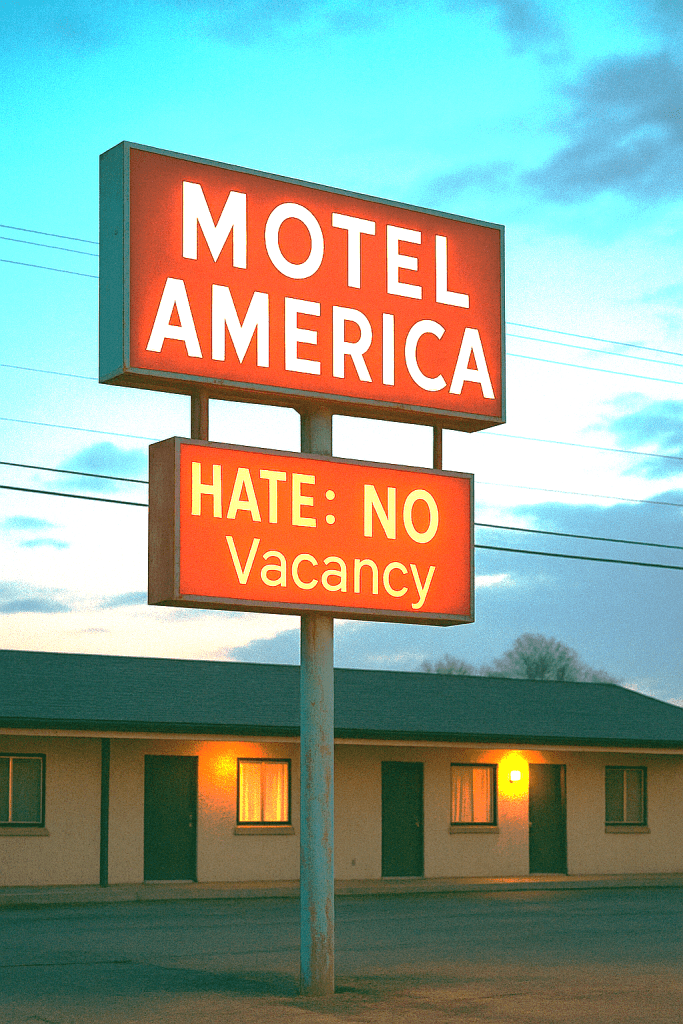
There is no room for Hate…NONE

There is no place for hate in our homes, our faiths, or our government—none. The grievances of Palestinians, Ukrainians, and displaced peoples around the world may be deep and justifiable—and may very well usher in generational hate. But we Americans have no excuse to let hate in. Not in our hearts, our homes, our places of worship—and definitely not in our policies.

Yet hate has become almost reflexive—normalized, even celebrated. It’s hoisted like a banner, waved by those clinging to lost causes and imagined enemies. It grows in minds and festers in rhetoric, often without genuine cause—and with no end goal beyond destruction and domination.

Those who lead or campaign on hate do so to divide, not to solve. Hate is a wedge—driven between communities to create illusionary superiority and incite rage. It doesn’t clarify; it confuses. It doesn’t elevate; it manipulates. When leaders resort to hate, they expose their inability to persuade, to unify, or to understand. Their bluster masks weakness. Their venom reveals fear. They seek the power of the mob, not the strength of dialogue or the courage of compromise.

Listen carefully: hate speech is no longer fringe. The denigration of individuals—by race, gender, belief, political group, or origin—has become a strategy. Its purpose is not discourse, but dominance. Not freedom, but control.

This country cannot be governed by contempt. We must reject those who exploit division. Hate has no place in a nation built on liberty—and none in a future worth striving for. America is stronger because of our diversity, not despite it. We are more mature—intellectually and emotionally—because of our historic willingness to understand and compromise.

Look neither backwards with anger nor forward with hate. Don’t give hate any space. Not here. Not now. Not tomorrow.

For Every Problem...A Solution...
Lap Around the Sun: Daily Steps Forward
Joy in Alzheimer’s: My Mom’s Brave Walk into Dementia’s Abyss

Posted in Philosophy

Universities and Ideas Aren’t the Enemy

Ideas Breach Barriers–They cannot be Constrained

Universities are not fortresses of indoctrination or cabals of conspiracy. They are incubators of ideas, innovation, and independence. Yet, in times of fear, they often become scapegoats. History has shown us what happens when knowledge becomes the enemy, when inquiry is suspect, and when education is seen as subversion. As M. Bormann (Hitler’s Head of Party Chancellery) and Reichsmarschall Goring routinely espoused to propagate class warfare and division while creating Nazi Germany:

“Education is dangerous—every educated person is a future enemy.”

Today’s attacks on colleges, universities, and professors echo darker past chapters. When public figures brand professors as “the enemy,” claim that universities are “hostile institutions” conferring “legitimacy to the most ridiculous ideas,” they step into rhetorical territory dangerously close to totalitarian dogma. These aren’t just criticisms of curriculum but efforts to discredit education and incite division.

Ideas are powerful. So powerful, in fact, that J. Stalin once said, “Ideas are more powerful than guns. We would not let our enemies have guns—why should we let them have ideas?” Fearful, weak regimes suppress thought. Secure, free societies cultivate it. Indeed, ideas can wound more deeply than fists—and their scars often outlast bruises.

University campuses are cauldrons of friction and growth. For many, this is their first encounter with people from different faiths, regions, and ideologies. That tension—uncomfortable as it may be—tempers conviction and sharpens perspective. Whether you come out with your views fortified or transformed, you come out thinking. That is the point.

These institutions are not perfect—no system is—but they are essential. Universities question assumptions, rewrite narratives, and challenge dogma. They are both repositories of history and laboratories for the future. Without them, our medical breakthroughs, technological advances, and understanding of ourselves would stagnate.

This is not just about liberal arts colleges or elite universities. The attack on higher education is part of a broader attempt to discredit education at all levels—trade schools included. There is a symbiosis between designers and builders, researchers and craftsmen. One imagines, the other realizes. We need both.

“The important thing is not to stop questioning. Curiosity has its own reason for existing.” A. Einstein

And yet, some would shut the doors on curiosity itself. Book bans. Mandated curricula. Politically driven defunding. These are not acts of fiscal prudence—they are acts of intellectual cowardice perpetrated by those who are the beneficiaries of those same institutions. Education should be supported, not to control ideas but to unleash them. To ensure that research is guided by truth, not tribalism. To ensure the historical records are studied and analyzed, in their fullness, to guide us away from past folly and despair.

“For an idea that does not first seem insane, there is no hope.” A. Einstein

The freedom to think dangerously, to imagine the impossible, has been the lifeblood of progress. Yes, bad ideas exist—but so do good ones, and ironically, some of the most outlandish were once thought heretical. That is the risk of liberty: the right to be wrong, and the space to grow into something right.

Universities are not enemies of the people. They are expressions of a free people. Critique them, yes. Improve them, certainly. But fear them? Only if you fear ideas themselves, which some have and apparently some still do.

Because without ideas, there is no democracy. Only dogma, perpetual fear, and misinformation. Maybe it would be better to espouse, as René Descartes did: “I think; therefore I am.” 

This article was first published in the Bend Bulletin 6/21/25

For Every Problem...A Solution...
Lap Around the Sun: Daily Steps Forward
Joy in Alzheimer’s: My Mom’s Brave Walk into Dementia’s Abyss

Posted in Philosophy

Victims Are Not Villains

Fiction portrays superheroes battling archetypal villains—Superman vs. Lex Luthor and General Zod, Batman vs. The Joker and Two-Face, and Buzz Lightyear vs. Emperor Zurg. But in reality, self-proclaimed “heroes” often manufacture enemies from vulnerable populations to justify their pursuit of personal power.

Throughout history, authoritarians and dictators have vilified specific groups to establish themselves as saviors: Pol Pot (Cambodia) targeted intellectuals and professionals to impose his radical agrarian vision, Saddam Hussein (Iraq) persecuted Kurds as part of a broader political and ethnic conflict, Idi Amin (Uganda) expelled Asians and Indians to consolidate power, Mao Zedong (China) targeted the wealthy and educated in his Cultural Revolution, and Joseph Stalin (Soviet Union) engineered famines and imprisoned political opponents to maintain control. Adolf Hitler (Germany) vilified and massacred Jewish people, while his protege Benito Mussolini (Italy) targeted ethnic minorities to strengthen his nationalist image. Benjamin Netanyahu (Israel) is in a genocidal quest against Palestinians. Vladimir Putin (Russia) has used both Chechen insurgents and Ukrainians as political scapegoats to justify military aggression and solidify power. Meanwhile, his United States counterpart, and admirer, has been scapegoating minorities and immigrants and demanding the persecution of political opponents to consolidate support.

These leaders rely on lies, unchecked narratives, and twisted pseudo-facts to sway the public and position themselves as national saviors. Repeating falsehoods and distorting facts, they endeavor to create the illusion that only THEY can protect society from fabricated threats.

Authentic leadership doesn’t create chaos to demonstrate value—it brings calm to existing turmoil. History ultimately judges these “saviors” as humanity’s supervillains, while vindicating their victims.

We don’t need self-proclaimed heroes dividing us against each other, and we don’t need someone victimizing groups to feel powerful. Today’s “villain” could be YOU tomorrow. When someone claims they alone can “save” society, their motivation is often self-interest, not public welfare. Progress comes through finding common ground and embracing differences, not through polarization and isolation. We are stronger united than divided by those who would name themselves our protectors.

NeverFearTheDream simplebender.com @simplebender.bsky.social Mundus sine ceasaribus

Posted in Philosophy

The Cosmic Treadmill: Time, Energy, and the Great Solar Lap

Imagine the Earth as a cosmic runner on a celestial treadmill, circling the Sun in its annual marathon. This cosmic racetrack spans about 940 million kilometers, and whether you are a newborn or a centenarian, the finish line arrives in precisely 365.25 days. Time, in its relentless march, does not care about the state of the runner – it is an impartial timekeeper in our universal stadium. Unless we drop out of the race, we all finish at precisely the same time every year.

Here’s where things get interesting: while the track remains constant, we, the runners, the individuals in the human race, change dramatically over time. The real mind-bender is that while we struggle to keep up with basic life, time keeps marching at the same relentless pace. The Earth does not slow down its cosmic dance just because your back hurts or your busted knees do not work either. Deadlines still loom, birthdays still sneak up on you, and somehow, it is always tax season again.

It is almost like the universe is playing some sick resource management game. “Here’s your annual allotment of time,” it says, “but we’re going to keep decreasing your energy levels. Good luck with that.” And we are left scrambling, trying to cram more into less, wondering how we ever had time for hobbies or, you know, a social life.

Imagine you are a shiny new car, fresh off the assembly line. Your engine purrs, your gears shift smoothly, and your fuel efficiency is at its peak. You zoom around the solar racetrack, accomplishing multiple tasks with minimal effort. This is you in your prime, a well-oiled machine capable of incredible feats within that 365-day lap.

Now, a few decades later. You are still making the same lap, but something is changed. Your once-pristine engine is now coughing and sputtering. Your gears grind a bit, and your fuel efficiency has taken a nosedive. This is the essence of aging – increasing entropy in our biological systems.

In terms of physics, we are dealing with the concept of mechanical efficiency. Our body’s ability to convert chemical energy (food) into mechanical work (actions) decreases as we age. It is like trying to power a Tesla with a steam engine – you will still move, but it won’t be pretty, and it certainly won’t be efficient.

Let’s quantify this with some napkin physics. Suppose you were young and could do 100 tasks per solar lap, requiring 1,000 units of energy. Your efficiency rating would be a respectable 0.1 tasks per energy unit. You can get several workouts in a day, along with your work, and raise your rambunctious young family.

Fast-forward 60 years. You’re lucky to manage 50 tasks with the same energy input. Your efficiency has halved to 0.05 tasks per energy unit. Now you are happy with one workout, a little reading time, and a little time of playing with the grandkids before your early bedtime.

This deterioration is akin to mechanical wear and tear. Just as a car’s engine loses compression over time, our cellular machinery accumulates damage. Mitochondria, our body’s power plants, become less efficient at producing ATP, the energy currency of cells. It is like trying to run a modern smartphone on a battery from the 1990s – technically possible, but woefully inadequate.

The cruel irony is that as our energy efficiency plummets, our energy demands often increase. Maintaining basic biological functions – the equivalent of a car’s idle speed – requires more fuel as we age. It is as if our personal gravitational field intensifies, making every movement an uphill battle against an invisible force.

Yet, the Earth keeps spinning, completing its solar lap with unwavering precision. The cosmic treadmill does not slow down or offer a gentler incline for its aging runners. This disconnect between our internal time – measured in declining energy and capability – and the unyielding external time creates the illusion of time speeding up as we age.

In essence, we are dealing with a fundamental mismatch between biological and astronomical timescales. Our personal energy graphs slope downward while the Earth’s orbital period stays stubbornly constant. It is a cosmic joke played on a universal scale – a reminder that while we may be star stuff, we are also subject to the unforgiving laws of thermodynamics.

As we continue our laps around the sun, remember: the race does not get longer, but the runner certainly gets slower. It is up to us to make each lap count, efficiency be damned. The Earth’s going to keep on spinning, and time is going to keep on flying, which we cannot change. We can change how we use the energy we have left. Maybe it is time to say “screw it” to the things that don’t matter and double down on what does. After all, even if you double down you are only going to achieve a tenth of what you want to….#NeverFearTheDream

Posted in Philosophy

Life’s Continuance

We all look at life, and death, differently. Some differences are subtle, others dramatic. Some lean heavily upon religious practices and beliefs to understand and cope with the unknown. Others seek solitude and find solace in nature’s quiet while they calm their minds to calm their souls. Neither approach is right nor wrong, inferior, or superior. They are simply different means to reconcile life, life’s end, and the unknown nature of life after death.

What if there was no death but only a continuance? What if there is an ‘after-life’ of soul and body? Indeed, there is an end to our physical manifestation, but is that the entirety of existence? Or do we continue through our families and the generations to follow? A never-ending continuing sequence in humankind.

Look at your hand, what do you see? Do you only see your hand, your skin, your blood vessels, your skin cells? Is that all you, see? Look closer, I see all those but also, I see my parents, and their parents, and theirs before them and farther still. I see a continuum of life. A never ending always building continuance. Every cell in my body has the genetic sequence of my family past. While unique, I am not new. I am a product of the infinite interactions of all my forebears and theirs.

Look at your child’s hand and the hands of their children. Look closely. There it is. There you are. And there is your family’s past. You are a part of them. You always have been and always will be. You will always be a part of the future generations to come as well.

While you are part of them forever, they are also part of you. You cannot separate yourself from a part of something of which you are integral. They will continue after your physical form is gone. They will carry your memories and your teachings, good and bad, and pass them on to others. More importantly, you will always be with them, a part of every cell within them.

Look at your children holding their children’s hands and know you are holding their hands as well. Even if you are not there physically, you are there and always will be. There is no passing, only a continuance. No death; as life goes on.

NeverFearTheDream