ponderings on the world we live in…….Nothing is known to be absolute…some thoughts may touch you others may not…take what is useful and ponder the rest …..Never Fear The Dream
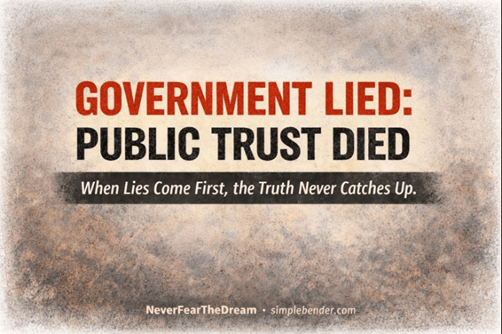
The first videos weren’t clear. They were chaotic—grainy clips, partial frames, shouting without context. But the official messaging arrived before evidence was gathered, witnesses interviewed, or a timeline stitched together, the verdict was delivered. Heroic officers. Clear self-defense. Thwarted mass terror. The dead were “deranged domestic terrorists,” and the valiant officers had barely survived and saved many.
That’s narrative warfare—not investigation.
This is the modern media playbook: speak first, speak loudly, and force everyone else to prove you wrong. Flood the zone with ‘certainty,’ half-facts, and righteous adjectives. Let supporters do the rest. If later evidence complicates the story, it won’t matter; the first impression has already been welded into identity. And if you can manufacture images, clips, or “context” with AI, you can make doubt look like proof while you stall, bury, and obscure the real record.
What makes the lie persuasive is that it rides on a few fragments of truth. A legal concealed-carry permit becomes a justification for killing. A photo of a holstered firearm becomes “brandishing.” A moment of chaos becomes “attempted assassination.” A tender snapshot of agents “helping” a frightened child becomes moral cover for whatever came before or happens after. The lifestyle of one is used to instill moral judgment and question motive. Just enough ‘truth’ to make the rest feel plausible to the true believers.
We’re told to relax. Trust the regime and its process. Wait for the facts they want to show us. The rest of the facts arrive late and edited—while the narrative sprints ahead, unchallenged and amplified by officials who treat accountability as optional.
There’s a deeper fatal wound: credibility. Bullets may have killed Renee Good and Alex Pretti, but the words that followed targeted something larger—the public’s ability to discern what is real. When institutions train citizens to doubt their eyes and distrust every correction as “spin,” they aren’t governing; they’re conditioning. They are self-serving protectionists maximizing propaganda’s bullhorn.
So we should ask, without hysteria or naiveté: Was a five-year-old used as bait or as a shield? Was Good’s death justified or convenient? Was Pretti killed because he believed in the 2nd Amendment or because zealous masked bullies lost control of themselves? If we can be pushed to accept a finished story before an investigation even begins, what else have we been trained to swallow—about elections, wars, enemies, or the files that power keeps sealed? Move along, citizen. Nothing to see here. NeverFeartheDream simplebender.com
NeverFearTheDream simplebender.comStand For Truth
Please consider following simplebender, you’re reading makes my writing more fun..…
Comments and thoughts are always welcome and feel free to re-post …..
(Except for First Nations….Lest we forgot, we are all immigrants, lest we forget.)
America’s immigration history has two defining bookends—both failures that masquerade as solutions: brute force and endless procedure. In the 1950s, the United States chose force—regionally and aggressively. Today, it chooses process—nationally, diffusely, and with targeted intensity. Both claim legitimacy. Both avoid responsibility. Both are unapologetic for failure and death. Neither deserves moral cover; both merit condemnation.
In the late 1950s, Operation Wetback was panic impersonating as policy. It treated human beings as a problem, refuse, to be flushed from the system—quickly, cruelly, and visibly. Across the Southwestern United States, Texas, California, Arizona, and New Mexico became enforcement zones. Farms, towns, and cities were swept with little regard for documentation or citizenship. The only thing that mattered was ethnicity. Its defenders praised its “effectiveness,” even calling it “a model,” collapsing ethnics into numbers. Humans were caged. Deportations were swift. Fear spread quickly—along with the erosion of constitutional restraint and human dignity. Citizens were caught up. Families were broken. People died.
For all its cruelty, Operation Wetback held one principle firm: deportation meant returning people to their country of origin, typically Mexico. Removal was brutal, but the destination was at least coherent. The state expelled people to a homeland, not into geopolitical limbo.
Condemning that era is easy. The more demanding task is confronting the present.
Today’s ICE-DHS enforcement regime operates as a nationwide system, shaped by discretion, delay, and unequal impact. Enforcement now extends coast to coast, embedded in courts, databases, detention centers, and subcontracted detention abroad. Deportation no longer guarantees return ‘home.’ Individuals may be transferred to third countries not because of their origin but because corrupt, weak governments are willing to accept detainees in exchange for compensation or a diplomatic concession—transactional detention, prisons for hire.
There are hearings now, maybe. Appeals, maybe. Paperwork, surely. Shockingly, today’s violence is less and more isolated, but still vile, unnecessary, and with bystanders being provoked and killed. Actions outsourced to undertrained enforcement at the direction of uninformed and opportunistic bureaucracy. Masked agents, hide their faces, names, and affiliation, are brandishing weapons and using unwarranted force without accountability. Families are not always torn apart in a single raid; instead, more perversely, they unravel over months or years of detention, uncertainty, and displacement.
Operation Wetback was cruelty without due process. Today’s enforcement is often one-size-fits-all, due process without courage. One system expelled people brutally but directly. The other disperses suffering nationally and indefinitely. America’s most infamous mass deportation campaign reveals a shift not from cruelty to compassion, but from visible brutality to managed, indefinite human limbo and indifference.
Immigration laws should be followed by everyone and every organization. We need immigration control and enforcement, but not draconian brutalization. The tragedy is not that America once chose force. It is that, decades later, it still refuses to choose honesty. This is the immigration purgatory we now live in and may die in. NeverFearTheDream · simplebender.com
NeverFearTheDream simplebender.comStand For Truth
Please consider following simplebender, you’re reading makes my writing more fun..…
Comments and thoughts are always welcome and feel free to re-post …..
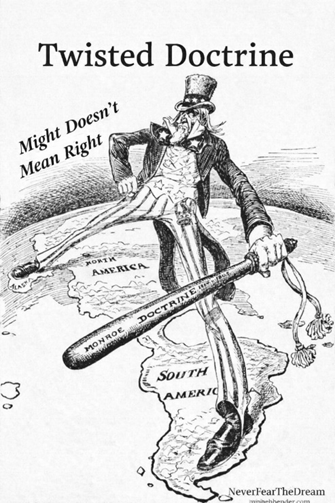
The Monroe Doctrine was meant to be a shield for a fledgling country: no European empires in the Americas, no more carving up this hemisphere by outside powers. It sounded like a defense of sovereignty and self-determination. Two centuries later, that shield has been reforged into something else—a license to police the hemisphere and enforce an American Hemispheric Order on our terms.
We claim to oppose foreign domination, yet we have become the dominant foreign power in other sovereign countries. When a government in the region dares to stray from our economic dogma or security script, we don’t send in Redcoats—we threaten and impose sanctions. Loans are conditioned. Sanctions are tightened. Diplomats whisper, intelligence agencies “assist,” and suddenly regime change appears not as an invasion but as a “restoration of democracy.” The vocabulary is polite; the outcome is familiar. Governments that cooperate survive. Governments that don’t are labeled unstable, extreme, or illegitimate. It isn’t about drugs, oil, or national security—it is about ego, power, and distraction from domestic failures and salacious files.
Flip that. Imagine a coalition of Latin American nations deciding that our politics are too corrupt, our inequality too obscene, and our elections too tainted by money. Imagine they declare an “Inter-American Responsibility Doctrine” and openly call for regime change in Washington to protect “hemispheric stability.” Picture them funding opposition groups, manipulating our media, freezing our assets, and threatening intervention—“for the sake of democracy,” of course. We would be apoplectic. We would call it aggression, pure and simple.
The hypocrisy deepens when you look at security. We pressure neighbors to crack down on crime, migration, and drugs, as if their failures are the source of our problems. Yes, trafficking networks and corrupt officials exist everywhere. But the demand, the guns, and much of the money flow from our side of the border. Rather than confront the discomfort of our own consumption, our own political greed-induced paralysis, and our own profit structures, we cast the neighbors as the problem and ourselves as the savior sheriff.
We insist on the right to shape their regimes while insisting no one has the right to shape ours. We dress intervention in the language of freedom while guarding our own system—flawed, gridlocked, and heavily purchased—as untouchable. It’s a double standard that everyone can see, whether we admit it or not. So here’s the uncomfortable mirror: if the rest of the hemisphere treated us exactly as we treat them—economically, politically, and rhetorically—would we still call it “promoting stability,” or would we finally call it what it feels like to them: unwelcome domination dressed as doctrine for ego and power? NeverFearTheDream simplebender.com
NeverFearTheDream simplebender.comStand For Truth
Please consider following simplebender, you’re reading makes my writing more fun..…
Comments and thoughts are always welcome and feel free to re-post …..
Democracies don’t die when people stop agreeing; they die when people stop dissenting. The loud, awkward, sometimes offensive voices are not a nuisance in a free society—they’re proof the system is still breathing.
We like to think “decency” means keeping things calm and polite. But genuine decency involves the courage to say, “This is wrong,” when power would rather you stay silent. The “decent” citizen who never questions authority isn’t truly decent; they’re just obedient.
That’s why dissent is always the first target of any controlling system. Not murderers. Not fraudsters. Not the genuinely dangerous. No, the temptation is to start with the inconvenient. Today, that often means immigrants, students, and visa holders. ICE and DHS don’t just police borders; they’re increasingly policing opinions—trawling social media, flagging protest, and turning lawful speech into a quiet risk factor for deportation.
On paper, the First Amendment belongs to “the people,” not just citizens. In practice, the easiest place to test new forms of control is with those who have the weakest political footing. If you can punish an international student for a tweet, you’ve just built a working model of speech control that can be scaled later. The laboratory is immigration; the product can be rolled out to everyone else.
That’s where the “protection of dissent” comes in. If decent people, like us, sit this out because they dislike the protesters’ slogans or hashtags, they’re missing the plot. The issue isn’t whether we agree with the content of dissent. The issue is whether the government can quietly attach a price and a punishment to dissent, leaving only the reckless or the desperate willing to speak.
History is blunt: once it becomes dangerous to disagree, it eventually becomes dangerous to be different.
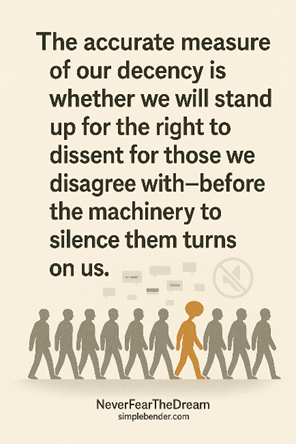
The accurate measure of our decency is whether we will stand up for the right to dissent for those we disagree with, before the machinery to silence them turns on us. NeverFearTheDream simplebender.com
NeverFearTheDream simplebender.comStand For Truth
Please consider following simplebender, you’re reading makes my writing more fun..…
Comments and thoughts are always welcome and feel free to re-post …..
Laws are supposed to be the bones of a society: neutral, structural, holding us upright. Law enforcement and the courts are meant to be the muscles that move those bones, not the fists of those who hold the throne or the majority. When that line blurs, when enforcement and justice become tools of power rather than its restraint, a nation quietly shifts away from a representative republic into a dystopian state.
We don’t have to look too far back in history for insight…
On the eve of the French Revolution, courts and law enforcement were not known for their impartiality. Judgeships were bought. Noble privilege was protected. Commoners knew they lived under one set of rules while the gilded lived under another. The Bastille didn’t fall because of seven prisoners; it fell because the building had become a cold stone symbol proclaiming that the law served the crown, not the people.
More recently, Nazi Germany carried this to an industrial scale. The regime did not usually act “outside” the law; it rewrote the law. Judges swore loyalty not to justice, but to Hitler. Police, courts, and camps formed a single pipeline: define enemies, demean them, label them criminal, process them through a legal machine designed to produce the same answer every time—guilty and repulsive. Decent people and law enforcement could tell themselves they were “following and upholding the law,” all the while the law itself had been converted into a weapon.
The pattern is always the same: two-track justice, selective enforcement, and a growing sense that legal outcomes can be predicted by status, ideology, race, ethnicity, or wealth before any evidence is heard. Power claims the language of order and safety, then quietly rigs the referees.
We should stop deceiving ourselves that “it can’t happen here.” Instead, we must ask: Are the laws and enforcement practices fair and impartial? Citizens need to question whether the justice system’s harshness is aimed downward and if mercy is truly reserved for the well-connected or like-minded. The uniforms, the architecture, and the slogans may differ. The logic does not. It may not be their intent, but their enforcement practices become a reality they must recognize. As many lose confidence in their independence, they lose support, which in turn leads to greater distrust and disdain.
A free society does not depend on the moral character of its rulers; it depends on the independence of its restraints. When those restraints are captured and controlled, the slide is already underway, even if the fragile skeletal forms of democracy remain.
So the uncomfortable question is this: Is law enforcement and justice beginning to tilt toward power? How long can ordinary citizens obey without quietly helping to destroy the very rule of law they claim to defend? When will they rise up, and will it be too late? Turn up the volume and blow your whistle loud and often. NeverFearTheDream simplebender.com
NeverFearTheDream simplebender.comStand For Truth
Please consider following simplebender, you’re reading makes my writing more fun..…
Comments and thoughts are always welcome and feel free to re-post …..
We are told the world is running out of everything: security, dignity, opportunity, patience. The message is constant—there is not enough to go around. And when people believe there is not enough, they do what humans have always done under threat: they turn on whoever is closest, whoever they think has what they should have.
This is manufactured scarcity—not a natural shortage, but a strategic one. The point is not merely to frighten us. The point is to redirect our fear sideways.
Horizontal hostility is far more useful to those in power than unity ever could be. If we are busy resenting each other, we are not examining the hands holding the power strings and who declared the scarcity to begin with.
Consider who benefits when workers distrust workers, when rural communities distrust urban ones, when generations resent each other, when racial and ethnic groups fight over scraps. At the same time, the banquet table is dragged into a gilded private room. The beneficiaries are not hard to identify. They are the ones who remain untouched by the conflict they provoke. They are the ones who used the distraction to fleece for their benefit.
Manufactured scarcity is a form of quiet governance. It makes control self-enforcing. No police state is needed when citizens police each other, when communities fracture themselves, when people become suspicious by default. But this civil fracture is used as an excuse to declare manufactured emergencies to seize more power.
But scarcity is not just political—it is psychological. Once trust is gone, every interaction becomes expensive. Friendship takes caution. Cooperation takes courage. Even hope feels dangerous. The fringe takes stronger hold as the masses in the middle scan the horizon for hope, while looking back in fear of cowardly aggression.
And yet, trust is not rebuilt by argument or persuasion. Ideology is a divider. No ideology has ever restored a broken community. Trust is rebuilt the oldest way humans have ever known: by doing things together, understanding that the most potent joining agents are dreams and suffering, not ideology.
When we work side-by-side—repairing a fence line, running a volunteer shift, restoring a riverbank, organizing a childcare co-op—we rebuild something deeper than agreement. We rebuild interdependence. We remember, through action, that we rely on one another to live.
This is the part those who profit from division fear most. They do not fear protest slogans. They do not fear outrage. They fear cooperation and communication.
Because cooperation makes scarcity visible for what it is: a story someone told us. A story that has authors and agents who have their own agenda.
The significant problems are only solved when the small ones are solved first. We do not need to solve the world’s problems before the nation’s, or the nation’s before we solve the ones on our street. We do not need to fix society before we rebuild the block we stand on. We don’t need to tear down the building to fix the windows.
When we choose to stand together and challenge the narrative, the manufactured scarcity loses its power. The illusion breaks. The wedge loses its edge. And the architects of division suddenly find themselves standing alone. Let’s start by turning away from face-to-face conflict toward shoulder-to-shoulder and side-by-side cooperation and community growth. #NeverFearTheDream simplebender.com
First Published in Bend Bulletin 12/2/25
NeverFearTheDream simplebender.comStand For Truth
If you’re looking for daily thoughts and insights you will want to start the morning with:
Lap Around the Sun: Daily Steps Forward
If you know someone who is facing any facet of Alzheimer’s they might gain some insight from:
Joy in Alzheimer’s: My Mom’s Brave Walk into Dementia’s Abyss
Please consider following simplebender, you’re reading makes my writing more fun..…
Comments and thoughts are always welcome and feel free to re-post …..
Every person ages, though few like to admit it. We prefer the glow of our youth—when everything felt strong, certain, and inevitable—we recoil from the mirror’s reflection that tells a harsher truth. The United States is now, as an aging adult, staring down its own midlife crisis: restless, nostalgic, anxious about declining vitality, and unsure of its purpose. And like any midlife crisis, it is largely self-inflicted.
As a fledgling republic, we leaned heavily on foreign counsel and support, learning to stand upright on principles whose ink was still wet. We quarreled with the empire that birthed us, a restless adolescent convinced that independence alone equaled maturity. In our late teens, our Manifest Destiny carried us across a continent—eager, energized, and careless. We violated Indigenous sovereignty, claimed vast stretches of land, and seldom paused long enough to reflect on the cost—youth rarely do.
Then came the moment we stepped beyond our borders to confront tyranny abroad. Isolation gave way to global responsibility, and in defeating fascism, we crowned ourselves “leader of the free world.” That era—the Greatest Generation era—became our cultural mythology of peak performance. In economic terms, we hit our stride: strong, wealthy, ambitious, so confident we assumed the world wanted our model replicated everywhere.
Adulthood matured us further. We recognized injustices at home and, imperfectly, pushed to correct them. We abolished poll taxes, dismantled legal segregation, expanded civil rights, and reached for gender equality—though we famously stumbled in ratifying the ERA. Still, we dreamed big. We mapped the ocean floor and walked the lunar surface. We believed no frontier was beyond reach.
But adulthood also revealed strain. Our swagger dimmed through a string of grinding foreign conflicts where overwhelming force could not overcome local pride or nationalist resolve. Regime change efforts faltered. Confidence thinned. The armor dulled. The steps slowed. The world noticed.
Now we resemble a nation in midlife denial. We want the prowess of our youth without the discipline, unity, or sacrifice that once produced it. We have become too large, internally conflicted, and politically stiff to move with the nimble decisiveness we admire in our own past. Instead of planning the next horizon, we rummage through the attic of lost greatness and flirt with symbolic trappings of monarchy—strongman fantasies, grievance crowds, and performative nationalism. These are not signs of renewed vigor; they are early symptoms of institutional cognitive decline and are affected by it.
The irony is painful: past generations always knew our shared mission. We debated the path but rarely the direction. Today, the direction itself is disputed, diluted, or abandoned. A country without a horizon behaves like a retiree with no hobbies—restless, resentful, and tempted by delusion.
Yet midlife crises can be turning points if met with humility and long-view statesmanship. Older nations that endure do so by learning from their past without worshipping it, by building for the grandchildren rather than reconstructing their own adolescence. The future is not reclaimed by nostalgia but by vision. Let’s not just look back; let’s learn from our past, reflect on it, and use it to shape our future.
So let us do what adults do at their best: acknowledge our age, accept our limitations, but not be defined by them, and chart a path worthy of those who will inherit this place. Square our shoulders, and focus forward—not back. Our midlife crisis can be a descent or a rebirth. We choose which. Collectively, with a common focus, let’s reject the polarizing radical positions of the extreme amongst us. Let’s encourage the great masses of the middle to lead us forward toward new goals and our next horizon. Let’s remember, we are all in this together, and it’s our shared responsibility to shape the future of our nation. #NeverFearTheDrem simplebender.com
NeverFearTheDream simplebender.comStand For Truth
If you’re looking for daily thoughts and insights you will want to start the morning with:
Lap Around the Sun: Daily Steps Forward
If you know someone who is facing any facet of Alzheimer’s they might gain some insight from:
Joy in Alzheimer’s: My Mom’s Brave Walk into Dementia’s Abyss
Please consider following simplebender, you’re reading makes my writing more fun..…
Comments and thoughts are always welcome and feel free to re-post …..
This was first published 8/29/22; yes 2022. It seems unfortunately appropriate that I republish it recognizing the events in which we currently find ourselves and the world
Our grand experiment of Democracy is dramatically different than every social norm, every other system of leadership, governance, and social fabric with which we live. It’s little wonder our system is always under attack and slowly yielding to authoritarianism. We must stay committed to our representative republic and the triad balance of power. If not, we too will slip into a transactional authoritarian government.
Social norms in our family, religion, business, and most world governments, have a strong bias toward authoritarianism. This is what we grew up with. A family structure which requires the adult(s) to be responsible and accountable. Youth are rewarded for following instructions and guidelines. In world religions, there is the priest, pastor, imam, grandmaster, or lama. Each controlling the message. All imposing authority over their flock. Grooming them for the future of the leader, ‘church’, or cult. At its worst this level of uncontrolled authority leads to mass suicides and child abuse. In business, unless you are self-employed, we all have supervisors. Authorities giving us assignments, judging our performance, and controlling our wages. This is when we truly begin to feel the influence and practice of transactional leadership. When decisions are made, not necessarily on the merits of the problem but on how the results can affect individuals and organizations. Globally, very few countries have histories other than dictator, monarchy, warlord, or czar. Their culture and history are rooted in non-democratic leadership. The plague of transactional leadership is the most dangerous in governments. Casting long term policy aside for near term benefit of themselves, their cronies, and minions. To be clear, there is a difference between transactions for self interest and those for policy advancement.
Fledgling democracies of the former Soviet Union and the countries which blossomed during the Arab Spring have fallen back to authoritarian governments where transactions are key to survival. Russia and China have changed their constitutions allowing Putin and Xi to be leaders for life, returning to the time of Stalin and Mao. Are we on the same precipice? We’ve seen the original basis of triad balance of power eroded as the executive branch has usurped congressional powers. Methodically, creating a ‘strong’ executive branch and thereby a weak, neutered, dysfunctional legislature. Boisterous, self-absorbed, ‘leaders’ don’t really care about your cause, only your money and your vote. In exchange, they will act as your advocate and protector. Disparage, insult, and harass those whom you believe are a threat, especially minorities, in exchange for your support. They will play the victim, if they think they can tug at your heart so you will tug at your wallet. Candidates pandering for their endorsement want it only to gain your support. They fear the zealous wrath at the polls so, as chameleons, will enthusiastically espouse whatever the loudest want to hear. Everything is a transaction. More ‘perfect’ phone calls. No long-term policy and direction considered. It boils down to: Put me in power today, keep me in power tomorrow and I’ll do your bidding, to hell with what’s right.
How do we arrest the accelerating demise of our democracy? We should re-establish the balance of power. The triad must be equal and accountable to each other. Executive orders should have sunsets and if not codified by Congress should expire. Restore and strengthen Congressional subpoena power. Reign in Executive Privilege; it’s a shield for deceit. Institute term limits on Supreme Court Justices and require the Senate to act immediately on nominations. Institute Congressional term limits and dismantle the seniority power structure. The Electoral College process should be updated, ensuring the count based on the people’s vote not the State’s politicized legislature.
Our democracy has matured over time, and we must be wary of the pendulum swing toward authoritarian transactional leadership. Once there, the fight to climb back up the moral pedestal will be very hard. We don’t need protectors. We need calm, stable, policy driven leadership. We need to declare allegiance to the Constitution not any party or person. #NeverFeartheDream
Always feel free to re-post—anywhere, anytime, to anyone—share freely.
NeverFearTheDream simplebender.comStand For Truth No Kings
Article first published in the Bend Bulletin 9/27/25
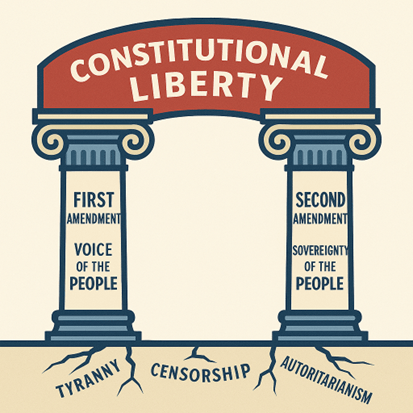
The Bill of Rights was not a mere document, but a product of the founders’ deep suspicion of concentrated power. They had witnessed the crushing of liberties under a monarchy and feared that even a republican government might someday drift toward authoritarianism. The First Amendment enshrines freedoms of mind and voice; the Second Amendment ensures the citizenry will never be entirely powerless should those freedoms come under assault. This foresight of the founders enlightens us about the historical context of the Bill of Rights, giving us a deeper understanding of our constitutional rights.
History was their teacher. British suppression of colonial assemblies, censorship of dissenting press, and the Intolerable Acts were enforced not with argument but with troops. The Revolution began not at a printing press, but when local militias clashed with regular soldiers at Lexington and Concord (1775) to resist the seizure of their weapons. It was this combination—ideas in pamphlets like Common Sense (1776) and the willingness to defend them—that secured independence.
James Madison (Federalist 46) envisioned an armed citizenry as the ultimate check on federal overreach, noting that “the advantage of being armed” would deter encroachments on liberty. Alexander Hamilton (Federalist 29), though skeptical of full-time militias, conceded that a people capable of bearing arms would make any tyranny costly. Later commentators, such as St. George Tucker (1803), referred to the Second Amendment as the “true palladium of liberty,” a final barrier against usurpation (Tucker, Blackstone’s Commentaries).
The framers did not celebrate rebellion, and neither should we. They built a republic designed to settle disputes through institutions—legislatures, courts, and elections—not through insurrection. The Second Amendment was less an invitation to revolt than a final constitutional guardrail, a reminder to government that the people remain sovereign. It was meant to make authoritarian control—whether through censorship, suppression of dissent, or militarized governance—impractical.
“The Second defends the First,” captures part of this truth but misses the deeper genius of the American design. Our first line of defense for free expression is institutional: the separation of powers, judicial independence, and a free press that is able to hold the government accountable. An armed citizenry is the last resort, the failsafe that ensures no regime can permanently silence the governed, providing a sense of security about our rights.
Even in polarized times, the resilience of this framework is remarkable. Courts still strike down attempts at censorship, legislators still debate fiercely, and citizens continue to speak, publish, assemble, and worship according to their conscience. With some legislators seeming to yield to the mob or bend a knee for their own political survival, our Constitution has withstood civil war, economic depression, McCarthyism, and demagoguery precisely because its protections are layered—legal, institutional, and cultural. The greatest defense of liberty is not fear of armed resistance but the enduring resolve of citizens who insist on their right to speak and be heard. When we do not defend the first, we risk the second, the fourteenth, the fifteenth, and the nineteenth. When we defend free speech, preserve checks and balances, and reject authoritarian shortcuts and fragile egos—whether from the left or the right—we prove that the American experiment remains not only viable but vital. This reiteration of the importance of defending free speech should empower you and make you feel responsible for upholding your rights, instilling a sense of duty and empowerment in you. # NeverFearTheDream # Stand for Truth # Stand with Pride # Stand with Spine
Always feel free to re-post—anywhere, anytime, to anyone—share freely.
NeverFearTheDream simplebender.comStand For Truth
If you’re looking for daily thoughts and insights you will want to start the morning with:
Lap Around the Sun: Daily Steps Forward
If you know someone who is facing any facet of Alzheimer’s they might gain some insight from:
Joy in Alzheimer’s: My Mom’s Brave Walk into Dementia’s Abyss
Please consider following simplebender, you’re reading makes my writing more fun..…
Comments and thoughts are always welcome and feel free to re-post …..
Strip the politics and twisted morality from the equation and look at the ledger. Detain-and-deport is a bad deal, a bad business model. It is a capital-intensive, low-yield operation that consumes cash upfront and erases future revenue streams. ICE’s reports estimate 2024 detention at ~$152 per person per day, and Alternatives to Detention (ATD/ISAP) run less than $4.20/day. With an average detention time of ~47 days, costs are roughly $7,100 before airfare or litigation. The ATD analogue costs approximately $200. The ATD option is significantly more cost-effective. No operator would choose a bloated workflow over one that accomplishes the compliance goals, unless driven by ideology. [1][2][3]
What are the “savings” from deportation? They are mostly phantom fiction. Undocumented immigrants are largely ineligible for means-tested benefits (Medicare & SNAP) but do pay taxes—$96.7 billion in 2022. Every removal wave eliminates the systematic recurring cash flow to Social Security, Medicare, and state/local treasuries. That’s not ideology; it’s real revenue loss, which U.S. taxpayers must now cover. [4]
Scale it to policy. FY2024 removals: 271,484. Apply the per-diem and dwell time above, and you’re in multi-billion direct outlays—before transport—plus foregone taxes compounding each year that workers would have remained employed. The CBO is explicit and clear: higher immigration raises revenues faster than outlays and lowers deficits over the 2024–2034 period—those are good things. Shrinking the workforce via deportation pushes the other way—those are bad things. [5][6][7]
Now consider and add the 2025 capex binge. Florida’s “Alligator Alcatraz” chomped up $245M+ in contracts, faces $15–$20M in immediate shutdown costs, and could leave taxpayers with approximately $218M if closure holds. In Texas, the Fort Bliss complex is a $1.2–$1.26B build for a 5,000-bed camp. None of this produces tradable output; it locks in fixed costs for an already established inferior business model. [8][9][10][11]
Deportation supporters claim enforcement frees jobs for U.S. citizens. Reality check: key sectors (agriculture, construction, and manufacturing) depend on immigrant labor. In agriculture, roughly 42% of hired crop workers lack work authorization. Remove that labor at harvest and you don’t get higher yields; you get unpicked fields and lost revenue—exactly what state-level crackdowns have shown. Construction and parts of manufacturing tell similar stories: persistent vacancies and delayed projects don’t resolve themselves without labor—but look, ICE just booked another flight. [12]
Crucially, there’s a proven substitute. Case-management ATD programs deliver 97–99% court-appearance compliance at a fraction of detention costs. If the goal is rule-of-law compliance, ATD wins on both price and performance. Detention should be the exception for demonstrably high-risk cases. [13][14][15]
If you’re genuinely fiscally conservative, the decision tree is simple. Each detained-then-deported worker carries:
a high acquisition cost (detention, transport, litigation, facilities),
negative NPV from lost tax receipts, and
sector-level output losses when crops aren’t picked or projects slip.
In contrast, ATD + lawful work authorization during proceedings flips the script:
minimal custody costs,
(2) continued tax payments, and
(3) fewer supply-side shocks.
Even hard-line models concede that mass deportation shrinks GDP by the trillions. The Penn Wharton Budget Model, a conservative economic model, concedes that mass deportation shrinks GDP by trillions—that’s a bad thing—and projects primary deficits of approximately $862–$987B over 10 years under mass deportation scenarios. That’s the destruction of U.S. shareholder value.[16][17]
If this were optimizing a business, you’d terminate detention first, scale case management ATD, and reserve deportation for the narrow slice where public safety benefits justify the expenditure. Anything else is a bad deal and taxpayer-subsidized ideology—that’s not a good thing. #NeverFearTheDream
Footnotes
[1] U.S. Immigration and Customs Enforcement, “Alternatives to Detention (ATD)” — < $4.20/day ATD vs ~$152/day detention. ICE [2] ICE, Fiscal Year 2024 Annual Report — average length of stay 46.9 days. (PDF) ICE [3] American Immigration Council, “Alternatives to Immigration Detention: An Overview.” American Immigration Council+1 [4] Institute on Taxation and Economic Policy (ITEP), “Tax Payments by Undocumented Immigrants” — $96.7B in 2022. ITEP [5] ICE news release (Dec. 20, 2024): 271,484 removals in FY2024. ICE [6] Congressional Budget Office, “Effects of the Immigration Surge on the Federal Budget and the Economy” — higher immigration lowers deficits via revenues > outlays. Congressional Budget Office+1 [7] ICE, “FY2024 Annual Report” companion release. ICE [8] AP News, “Florida may lose $218M on empty ‘Alligator Alcatraz’ as judge orders shutdown.” AP News+1 [9] CBS Miami, “Florida taxpayers could be on the hook for $218 million … ‘Alligator Alcatraz.’” CBS News+1 [10] Yahoo News round-ups on court-ordered shutdown and wind-down. Yahoo+1 [11] The Texas Tribune, “Feds plan to build nation’s biggest migrant detention center at Fort Bliss” — $1.26B, 5,000 beds. The Texas Tribune [12] U.S. Dept. of Labor, NAWS 2021–2022 (Report No. 17) — ~42% of hired crop workers lack work authorization; summary page. DOL+1 [13] Human Rights First, “Proven Alternatives to Mass Incarceration of Families” — programs with ~97% appearance; cost far below detention. (PDF/brief) Human Rights First+1 [14] Women’s Refugee Commission, Family Case Management Program — ~99% compliance with ICE and court. (Report/summary) Women’s Refugee Commission+1 [15] National Immigrant Justice Center, “The Real Alternatives to Detention.” (Policy brief) National Immigrant Justice Center [16] American Action Forum, “The Budgetary and Economic Costs of Addressing Unauthorized Immigration” & “A Costly Immigration Policy” — $400–$600B federal cost; −$1.6T GDP. AAF+1 [17] Penn Wharton Budget Model, “Mass Deportation of Unauthorized Immigrants: Fiscal and Economic Effects” — revenues −$300.4B (2025–2034); primary deficits +$862B pre-feedback, +$987B with feedback. (Brief & PDF) Penn Wharton Budget Model+1
Always feel free to re-post—anywhere, anytime, to anyone—share freely.
NeverFearTheDream simplebender.comStand For Truth
If you’re looking for daily thoughts and insights you will want to start the morning with:
Lap Around the Sun: Daily Steps Forward
If you know someone who is facing any facet of Alzheimer’s they might gain some insight from:
Joy in Alzheimer’s: My Mom’s Brave Walk into Dementia’s Abyss
Please consider following simplebender, you’re reading makes my writing more fun..…
Comments and thoughts are always welcome and feel free to re-post …..







 simplebender