Posted in Current Events

Citizen: Adjectives Not Required

Protection Imperative

America’s founding documents largely avoided attaching adjectives to the concept of “Citizen.” They established broad philosophical principles centered on liberty, personal rights, and self-determination without attempting to divide citizenship into preferred categories. For their time, the idea was radical: a nation built more on shared principles than on shared bloodlines.

Our founders were imperfect people, constrained by the limits and prejudices of their era. Yet many of their aspirations remain deeply human and recognizable today. They sought the freedom to shape their own lives, raise their families safely, worship as they chose, speak openly, and pursue opportunity without a domineering central authority. They envisioned a country driven not by inherited class, tribe, bloodline, or title, but by the ambitions and determination of its citizens.

The Constitution and the Bill of Rights speak largely in universal terms: citizens, persons, and the people. The documents themselves are far more neutral than many who later interpreted and enforced them.

The problem has rarely been the principles. It has been people; it is us, the “Citizens.”

Human beings instinctively protect power once they possess it. They create social and political adjectives around the word “Citizen” to determine who fully belongs, who deserves influence, whose rights matter more, and whose freedoms may be limited. Throughout history, those in power have repeatedly narrowed broad constitutional principles through discrimination, exclusion, fear, and tribal identity.

That reality is precisely why federal and state protections became necessary. The Constitution may aspire toward color-blind liberty; the administration of those principles has often fallen short. Courts and lawmakers must continually wrestle with that contradiction while remaining anchored in the original promise of equal citizenship under the law.

The easy path is to turn a blind eye to humankind’s tendencies. The hard path, but the right one, is to address, restrain, and retrain them and to uphold the standards of our original foundations.

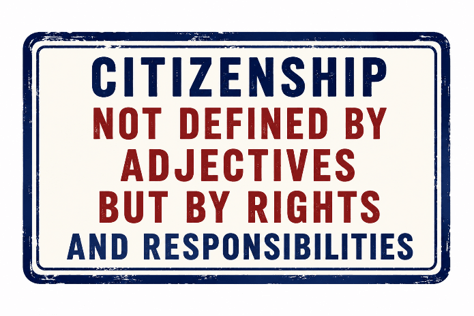
Citizenship carries enormous responsibility and accountability. It also carries extraordinary freedom. Both weaken the moment adjectives become more important than the word “Citizen” itself.                     NeverFearTheDream   simplebender.com

… .. — .–. .-.. . / -.-. .. – .. –.. . -.


Lap Around the Sun: Daily Steps Forward
by WCBarron

Buy at Amazon Buy at Barnes & Noble Buy at Books2Read

Joy in Alzheimer’s: My Mom’s Brave Walk into Dementia’s Abyss
by WCBarron

Buy at Amazon Buy at Barnes & Noble Buy at Books2Read
Posted in Current Events, Philosophy

Kodachrome America on US2


Road Tripping along US2- Our Northern Most Highway Mirror

Traveling US2 reminded me of some things easily forgotten from a couch, a cable-news chair, or the algorithmic cave we now mistake for public discourse and life.

America is Kodachrome, not monochrome.

It is not one color, story, tribe, flag, grievance, joy, anger, or one carefully rehearsed slogan. It is a long, uneven road running through farm fields, forests, high plains, small towns, county seats, and metropolises. Yet, US2 barely touches political power at all, which feels about right for a road more interested in citizens than rulers. It touches the Great Lakes and crosses the Rocky Mountains. It passes poverty, pride, fresh paint, boarded windows, new diners, old dreams, and people trying to get through the day without losing their minds, humor, decency, or pride.

US2 is not polished America. It is not brochure America. It is not the America politicians sell when they need applause. It is better than that. It is real.

There were simple homes and extravagant ones. Fancy shopping centers and flea markets. New businesses with flashing banners announcing someone’s fresh shot at the American dream. And there were uncountable hollowed-out buildings, closed storefronts, ruined signs, tattered flags, and boarded windows reminding us that not every dream survives. Hope and wreckage share the same street.

The road itself seemed honest to. US2 shifted from single-lane “take your turn” stretches to four-lane, divided-lane confidence, from rough, rutted pavement to smooth sailing. That felt about right. America has always been part pothole, part promise.

Along the way, diversity was not a slogan. It was simply present. Greeted, helped, waved at, and politely served by people of multiple races, genders, orientations, accents, and backgrounds—Black, Native American, Hispanic, Asian, white, and everyone in between. Fellow campers and travelers chatted without demanding a political affidavit or proof of citizenship. People waved because waving still works. They smiled because not every human exchange has to be a tribal transaction.

Near one town, modern tricked-out equipment rolled through the same landscape where Amish oxen plows tilled the soil, and family carriages filled with four to five family members trotted toward Sunday evening service. Every face seemed eager to wave. Modern machinery and horse-drawn faith shared the road, not as enemies, not as symbols in someone else’s culture war, but as neighbors moving through the same evening light. That is America when we let it breathe.

And yes, the American ego rode along too. Somewhere in North Dakota, a place without a hospital, advertised world-class spinal services. Every mascot of every team in every town was the ‘world’s best; go figure. And, every other town seemed to claim world-class pancakes. I cannot say whether any other country makes pancakes, but we have apparently perfected them nine hundred times between the Great Lakes and the Rockies. This country may be divided, but no one has surrendered our breakfast supremacy.

Then came the names: Pleasant, Superior, and others that sounded less like towns and more like national therapeutic goals. Maybe we need more Pleasant in our politics and lives, and a little less self-declared Superior in and from our leaders. A country does not heal by shouting louder. It heals when enough ordinary people decide the neighbor is not the enemy, the stranger is not a threat, and disagreement is not treason.

One of the most refreshing parts of the route was how pleasantly devoid it was of cult political banners and flags. Not devoid of belief. Not devoid of opinion. Just free from the need to turn every porch, truck, fence, and field into a loyalty test. After years of national shouting, quiet felt amazingly patriotic.

The warm evening, outside an Irish pub, blues and alternative rock shared the stage at a block party. People smiled and danced. No one checking party registration or citizenship before tapping a foot and having a beer. For a few hours, the country remembered that rhythm is older and better than ideology.

US2 showed me real America in all its diversity—not singularity, not uniformity, not forced sameness. Maybe that is what makes us great, and shows us how and when we are great.

Not our boastfulness. Not our need to be the world’s overlord or policeman. Maybe America’s better role is partner, not ruler. Maybe being “number two” would not be humiliation. Maybe it would teach us to try harder, listen better, brag less, and build more, back to our roots and strength.

US2 gave me hope. Not naive hope. Hope with rust on it. Hope with a cracked windshield, a Dollar General at every crossroads, and every state somehow claiming Sasquatch as a local resident. But hope nonetheless.

Because beneath the noise, most people were doing what people have always done: working, serving, driving, cooking, repairing, praying, camping, building, failing, starting again, and trying to keep their families safe and well.

That is the America worth defending.

Not monochrome America. Not purified America. Not a fantasy where everyone thinks, looks, votes, worships, or eats pancakes alike. But, a Kodachrome America. Bright, faded, scratched, beautiful, uneven, funny, heartbreaking, generous, stubborn, and still—despite everything—moving forward together even when we agree to disagree. NeverFearTheDream simplebender.com

-.- — -.. .- -.-. …. .-. — — . / .- — . .-. .. -.-. .-


Lap Around the Sun: Daily Steps Forward
by WCBarron

Buy at Amazon Buy at Barnes & Noble Buy at Books2Read

Joy in Alzheimer’s: My Mom’s Brave Walk into Dementia’s Abyss
by WCBarron

Buy at Amazon Buy at Barnes & Noble Buy at Books2Read
Posted in Current Events

Our National Midlife Crisis

Everyone ages, though few like to admit it. We prefer the glow of our youth—when everything felt strong, certain, and inevitable—yet we recoil from the mirror’s reflection that reveals a harsher truth. The United States, now, as an aging adult, is staring down its own midlife crisis: restless, nostalgic, anxious about declining vitality, and unsure of its purpose. And like any midlife crisis, it is largely self-inflicted.

As a fledgling republic, we leaned heavily on foreign counsel and support, learning to stand on principles whose ink was still wet. We quarreled with the empire that birthed us, a restless adolescent convinced that independence alone equated to maturity. In our late teens, our Manifest Destiny carried us across a continent—eager, energized, and careless. We violated Indigenous sovereignty, claimed vast stretches of land, and seldom paused to reflect on the cost—youth rarely does.

Then came the moment we stepped beyond our borders to confront tyranny abroad. Isolation gave way to global responsibility, and in defeating fascism, we crowned ourselves the “leader of the free world.” That era—the Greatest Generation era—became our cultural mythology of peak performance. In economic terms, we hit our stride: strong, wealthy, and ambitious, so confident we assumed the world wanted our model replicated everywhere.

Adulthood matured us further. We recognized injustices at home and, imperfectly, pushed to correct them. We abolished poll taxes, dismantled legal segregation, expanded civil rights, and pursued gender equality—though we famously stumbled in ratifying the ERA. Still, we dreamed big. We mapped the ocean floor and walked on the lunar surface. We believed no frontier was beyond reach.

But adulthood also revealed strain. Our swagger crippled amid a string of grinding foreign conflicts in which overwhelming force could not overcome nationalist resolve. Regime-change efforts faltered. Confidence thinned. The armor dulled. The steps slowed. The world noticed.

We now resemble a nation in midlife denial. We want the prowess of our youth without the discipline, unity, or sacrifice that once produced it. We have become too large, internally conflicted, and politically stiff, unable to move with the nimble decisiveness we admire in our past. Instead of planning for the next horizon, we rummage through the attic of lost greatness and flirt with the symbolic trappings of monarchy—strongman fantasies, grievance crowds, and performative nationalism. These are not signs of renewed vigor; they are early symptoms of institutional cognitive decline.

The irony is painful: past generations always knew our shared mission. We debated the path but rarely the direction. Today, the direction itself is disputed, diluted, or abandoned. A country without a horizon behaves like a retiree with no hobbies—restless, resentful, and prone to delusion.

Yet midlife crises can be turning points if approached with humility and long-view statesmanship. Older nations endure by learning from their past without worshipping it, by building for the grandchildren rather than reconstructing their own adolescence. The future is not reclaimed by nostalgia but by vision. Let’s not just look back; let’s learn from our past, reflect on it, and use it to shape our future.

So let us do what adults do at their best: acknowledge our age, accept our limitations, but not be defined by them, and chart a path worthy of those who will inherit this place. Square our shoulders, and focus forward—not back. Our midlife crisis can be a descent or a rebirth. We choose which. Collectively, with a common focus, let’s reject the polarizing radical positions of the extreme amongst us. Let’s encourage the great masses of the middle to lead us forward toward new goals and our next horizon. Let’s remember, we are all in this together, and it’s our shared responsibility to shape the future of our nation.    NeverFearTheDream   simplebender.com

… – — .–. / .-.. — — -.- .. -. –. / -… .- -.-. -.-


Lap Around the Sun: Daily Steps Forward
by WCBarron

Buy at Amazon Buy at Barnes & Noble Buy at Books2Read

Joy in Alzheimer’s: My Mom’s Brave Walk into Dementia’s Abyss
by WCBarron

Buy at Amazon Buy at Barnes & Noble Buy at Books2Read

Posted in Current Events

Real Court Reform: One Pick, Five Seats, Twenty Years

Court reform should not be driven by frustration, anger, or revenge. It should begin with reason, a belief in ‘what’s good for them will be good for me,’ and be simple to administer. The current system rewards timing, tribal fury, and biological chance. A serious republic should do better.

A Supreme Court, whether state or federal, should not be a political lottery. The system should not depend on actuarial luck, strategic retirement, or the medical endurance required to retain lifetime power. These factors create a system more akin to institutional gambling than to constitutional wisdom and public confidence. A system in which an executive inherits three vacancies and another none is inherently unfair and destined for manipulation.

A cleaner model should be considered: five justices, a twenty-year term*, and one appointment per executive term. Simply put, each executive receives one appointment per term. Justices serve twenty years, not for life, and no justice serves twice. Systematically, the bench stabilizes at five because the math is straightforward: one appointment every four years, paired with a twenty-year term, yields a predictable five-seat court.

Operationally, if any justice leaves early for any reason, the seat is filled to keep the Court at five. The replacement can serve only the remainder of that seat’s twenty-year term. This preserves the rhythm and prevents opportunism. The point is not to help Democrats or Republicans, conservatives or liberals. The point is to remove the jackpot and keep the Court dynamic by increasing turnover.

The transition would begin with the current justices and take sixteen years. In the first year of a new executive, the most senior justice with more than twenty years of service would step down and be replaced by the executive’s single-term selection. Each subsequent year, the most senior justice with more than twenty years of service would step down and not be replaced. This annual review would continue until all current justices with more than twenty years of service had retired from their seats. Going forward, all justices would be subject to the twenty-year limit.

This model would reduce nomination warfare and gamesmanship because every executive would have predictable influence. It would reduce gerontocracy because no seat would become a lifetime throne. It would reduce court-packing hysteria because the size would be fixed. It would strengthen legitimacy because citizens could understand the structure without a constitutional séance.

Five justices are enough for deliberation, dissent, and clarity. Twenty years is long enough for independence and not long enough for political immortality. The court’s direction naturally swings with the general elections. The court becomes more the people’s choice than the power brokers and political parties.

Reform should not ask, “Who benefits today?” or “Who will be the most loyal?” It should ask, “What structure would we trust if our side loses?” NeverFearTheDream…simplebender.com

.—- —… ….. —… ..— —– / … .. — .–. .-.. .


Lap Around the Sun: Daily Steps Forward
by WCBarron

Buy at Amazon Buy at Barnes & Noble Buy at Books2Read

Joy in Alzheimer’s: My Mom’s Brave Walk into Dementia’s Abyss
by WCBarron

Buy at Amazon Buy at Barnes & Noble Buy at Books2Read

*During the first 100 years of the Supreme Court, the average term of service for a Justice was less than 17 years. Since 1960, the average term of service has been 23 years.

Posted in Current Events

SAVE Act: Administrative Filter–Voter Suppression

Voting should be easier for everyone, not harder.

Voting in a healthy republic should become easier as citizenship becomes clearer, broader, and more secure. Instead, America appears to be drifting toward a system in which voting increasingly depends not on citizenship itself but on the continuity and perfection of one’s paper trail.

We’ve all seen the ads. You need an ID for travel and even for dinner; so obviously you should need one to vote, right?. But what now counts as an ID is changing in subtle yet substantial ways. Supporters of the SAVE Act present it as a measure to ensure election integrity. Yet its structure and likely impact suggest something larger and more complicated.

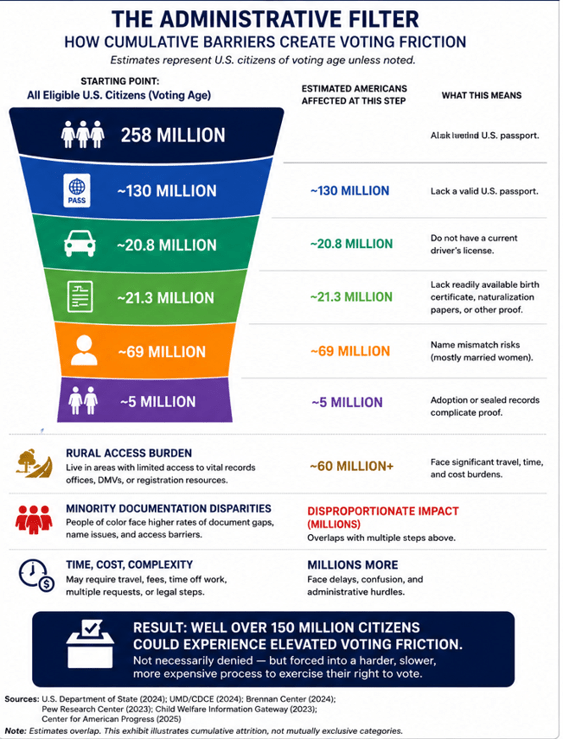
Nearly 170 million valid U.S. passports are in circulation, meaning roughly half the country does not hold one.[1] More than 21 million voting-age citizens reportedly lack ready access to citizenship documents.[2] Millions of married women have legal names that may not match their birth certificates.[3] Millions of adoptees navigate sealed or amended records.[4] Rural Americans may live far from the offices that maintain vital records, while many urban residents have built entire lives without ever needing a driver’s license.[5]

None of these people are “illegal voters.” They are citizens living ordinary American lives, and lives can be complicated.

That observation shifts the frame. Traditional election-security efforts should isolate fraud as narrowly as possible while minimizing burdens on lawful voters. The SAVE Act appears to move in the opposite direction, creating a broader administrative filter that disproportionately affects citizens whose lives are complex: marriage, divorce, adoption, relocation, poverty, aging, rural isolation, inconsistent records, or bureaucratic gaps.

The burden does not fall evenly because American life is not evenly documented. The burdens differ, but the results are the same: voter disenfranchisement and suppression.

Every political tribe eventually succumbs to the temptation of selective friction. Not necessarily banning votes outright, but making participation slower, harder, more uncertain, and more exhausting for populations deemed politically unreliable. One missing document. One mismatch. One courthouse trip. One workday lost. One bureaucratic loop too many.

History suggests that rights are rarely removed in a single dramatic moment. More often, they are narrowed through layers of procedure that seem reasonable individually but restrictive collectively. And don’t put it past any current or future administration to find ways to justify removing your right to have the ‘approved’ form of ID. There are currently many ways to revoke a passport which would impede your ability to travel and now vote.

Once citizenship rights become contingent on continuous bureaucratic verification, the government gradually shifts from presuming citizenship to administering verification. It becomes: “Citizen, show me your papers.”

The irony is hard to ignore. A political movement deeply skeptical of federal power now seems comfortable building one of the largest federal identity-verification frameworks in modern voting history.

A republic confident in its citizens removes unnecessary barriers. A republic uncertain of its citizens builds walls.  NeverFearTheDream   simplebender.com

…- — – . // …- — – . // …- — – .


Lap Around the Sun: Daily Steps Forward
by WCBarron

Buy at Amazon Buy at Barnes & Noble Buy at Books2Read

Joy in Alzheimer’s: My Mom’s Brave Walk into Dementia’s Abyss
by WCBarron

Buy at Amazon Buy at Barnes & Noble Buy at Books2Read
Posted in Current Events, Philosophy

Capacity for Pain

Middle Eastern tolerance for pain is greater than expected. Once again, a Western power is repeating the same mistake with Iran as they have with much of the modern Middle East: they assume pain leads to surrender. That is a very Western way of understanding conflict: material, linear, and transactional. But in the Middle East, suffering is often not seen just as loss. It can also signify and reinforce the resolve for endurance, legitimacy, memory, and honor. Iran demonstrates this logic in one way; the Palestinians in another. Yet they both share and reveal a broader regional pattern of viewing pain not just as punishment but as proof that the struggle is real and, therefore, must be endured.

Iran exemplifies this concept most clearly. The Islamic Republic relies on the Karbala paradigm, martyrdom symbolism, and a political culture of resistance that has intensified since 1979. However, it is not powered solely by martyrdom. It also depends on maslahat—expediency, prudence, and the preservation of the state. This is the crucial point many outsiders miss. Tehran is not built to die heroically. It is constructed to endure, adapt, and survive. It promotes resistance when it benefits the system and compromises when necessary to maintain stability.

That instinct was shaped in ancestral times and hardened in recent history. The 1953 coup taught Iranians that foreign powers would overthrow a government when independence threatened outside interests. The 1979 revolution then fused anti-imperial memory with sacred politics. The Iran-Iraq War completed the lesson. It was prolonged, hugely destructive, and formative. It exemplified much of Iranian strategic thinking: that time itself can be weaponized. One does not always need a clear victory. One only needs to deny the enemy closure, increase his costs, outlast his patience, and drag him through the quagmire for as long as possible.

The Palestinian example demonstrates a similar pattern of resilience. The word sumud—meaning steadfastness—has long represented a way of enduring, surviving, and refusing to be erased regardless of hardship and genocide. A sumud approach fosters a determination to stay in place despite persistent attacks. Iran’s state-centered doctrine and propaganda also use this. Suffering can gain political importance and become a source of strength. Pain does not automatically erase identity; instead, it can bolster it. Bombing, siege, isolation, and coercion do not always lead to surrender. Sometimes, they deepen collective memory, increase grievances, renew the desire to resist, and feed intergenerational hostility and hate.

That is why Western strategy often misfires. It keeps viewing pain as if it were always disqualifying and debilitating. In this region, it is frequently absorbed, narrated, and repurposed. Iran has turned that into statecraft and proxy warfare across Hezbollah, Iraqi militias, the Houthis, and allied networks. Palestinians live it as the national standard bearer of steadfastness, resistance, and survival. If we continue to interpret these societies through a purely Western lens of cost, comfort, and quick resolution, why are we still shocked when assault results in resolve, not in surrender? NeverFearTheDream   simplebender.com

.. -. … …. .- .-.. .-.. .- ….


Lap Around the Sun: Daily Steps Forward
by WCBarron

Buy at Amazon Buy at Barnes & Noble Buy at Books2Read

Joy in Alzheimer’s: My Mom’s Brave Walk into Dementia’s Abyss
by WCBarron

Buy at Amazon Buy at Barnes & Noble Buy at Books2Read
Posted in Current Events

Spin of War — Opportunistic Diversion

Operation Epstein Fury

There’s a common tactic governments use when they want the advantages of war without the drawbacks of the word. They don’t declare war; they call it an “operation.” It’s not conquest; it’s prevention. Not aggression; it’s protection. Not a choice; it’s a necessity.

Russia attacks Ukraine and calls it a “special military operation,” framing it as forced self-defense — claiming to protect threatened people, prevent danger, purge “Naziism,” and “demilitarize” a neighbor that supposedly left Moscow with “no other option.” Those phrases aren’t analysis; they’re anesthetic. They’re designed to make violence seem like a matter of hygiene.

Then came the blessing. The Russian Orthodox hierarchy portrayed the conflict as a spiritual struggle against a decadent West — a defensive moral crusade, not merely a geopolitical choice. When a state recruits sacred language, it isn’t seeking God’s guidance. It’s seeking immunity.

The U.S. is now running the same playbook in Iran. Officials sell “objectives,” not wars — missiles, proxies, a nuclear pathway — carefully described as controlled, and nothing like all previous “open-ended” American disasters. The invasion was essential to protect against an impending, not imminent, threat, to hold the radical Islamic regime at bay, and annihilate their military. The branding changes to suit the audience; the psychology doesn’t. You’re still being asked to feel reassured by a label and comforted by the phrase “proactive act.”

But the script becomes darker. The Military Religious Freedom Foundation (MRFF) reports having received hundreds of complaints from service members claiming commanders justified the Iran campaign as “God’s plan,” invoking Revelation, end times, and Armageddon itself.[1][2][3][4] That isn’t faith. It’s propaganda wearing faith’s clothing.

Armageddon is not a marketing theme or a recruitment slogan. It is the ultimate condemnation of human rulers who confuse power with righteousness. Inserting the Second Coming into strike briefings doesn’t sanctify the policy — it desecrates the text. And framing any sitting leader in messianic terms isn’t patriotism. It’s an admission: that the case for war cannot stand on honest ground, so it must be propped up by manufactured revelation.

The spin is consistent even when the players change. What varies is the packaging — “momentum,” “dominance,” “inevitability” — language engineered to make aggression feel like physics rather than choice. If the timing of the Iran campaign was shaped as much by domestic political pressure as by genuine security necessity, then what is being sold as strategy may be closer to spectacle. It is a diversion substituting urgency for accountability. This is the next most hazardous and heinous stage of “Operation Epstein Fury.”

When religious fervor is added to that mix, the cynicism becomes complete. It is no longer merely policy dressed as necessity. There is nothing sacred or honorable in that — and the willingness to go there tells you everything about the strength of the underlying case. It bolsters an ego while others die. It is policy and self-preservation masquerading as prophecy.  NeverFearTheDream     simplebender.com


Lap Around the Sun: Daily Steps Forward
by WCBarron

Buy at Amazon Buy at Barnes & Noble Buy at Books2Read

Joy in Alzheimer’s: My Mom’s Brave Walk into Dementia’s Abyss
by WCBarron

Buy at Amazon Buy at Barnes & Noble Buy at Books2Read

Footnotes references :

  1. Military Religious Freedom Foundation, “MRFF Inundated with Complaints of Gleeful Commanders Telling Troops Iran War is ‘Part of God’s Divine Plan’ to Usher in the Return of Jesus Christ,” March 3, 2026.
  2. Military Religious Freedom Foundation, “Unit combat readiness briefing and Armageddon,” MRFF’s Inbox, March 3, 2026 (complaint dated March 2, 2026; includes the “all part of God’s divine plan” wording and Revelation/Armageddon references).
  3. Sara Braun, “US troops were told war on Iran was ‘all part of God’s divine plan’, watchdog alleges,” The Guardian, March 3, 2026 (last modified March 5, 2026).
  4. Cornell University Media Relations Office (Cornell Chronicle Tip Sheet), “End-times rhetoric in US military ‘didn’t infiltrate, was invited in’,” March 4, 2026 (summarizes MRFF’s reported complaints and the “God’s plan for Armageddon” framing).
Posted in Current Events

Who Lit the Fuse

Rejection of Western Supremacy: Defending Strategic Sovereignty

Perspective is everything… There is always another viewpoint to consider…not to agree or disagree with but to appreciate and understand…

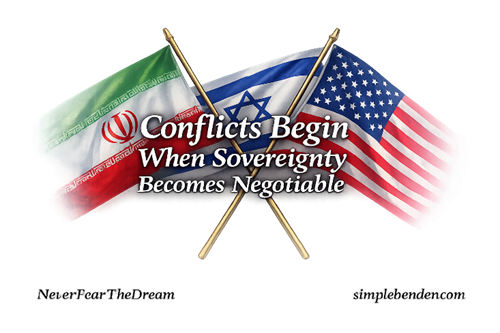
The current U.S.–Israel conflict with Iran began decades ago, through memory, humiliation, and contested sovereignty. Conflicts rarely begin with weapons. They begin when one nation decides another’s sovereignty is negotiable.

In the Iranian narrative, the creation of Israel in 1948 was not just the forced seizure of land and the establishment of a state. It was the implantation of a Western-supported political project into the heart of the Muslim world, leading to displacement, repeated wars, and ongoing territorial disputes.[1] For many throughout the region—including Iran, especially after the 1979 Islamic Revolution—the Palestinian cause became more than a geopolitical issue. It turned into a moral test of the Islamic world’s resolve and dignity. Legal disputes over occupation, settlements, and borders only strengthened that perception.[2]

Iran’s distrust of Western intentions hardened long before any nuclear ambition. In 1953, the U.S. and Britain supported the coup to overthrow Prime Minister Mohammad Mossadegh after he nationalized Iranian oil[3], just as Venezuela did. That intervention left a lasting mark, a generational memory. To the revolutionaries who later overthrew the Shah in 1979, it showed that Iranian sovereignty could be compromised whenever it conflicted with Western strategic interests.

The Shah’s brutal rule, especially during the student protests starting in 1978, was seen by many Iranians not as partnership but as alignment with foreign powers—security cooperation, oil coordination, and intelligence sharing that seemed to serve Washington’s Cold War agenda more than the interests of Iranian citizens.[3] When the Islamic Republic emerged, its ideology combined Shia political theology with anti-imperialist resistance and rejection of the Shah’s authoritarian rule. Independence was raised from a political choice to something more like a sacred duty.

The 1979 humiliating seizure of the U.S. Embassy in Tehran was viewed, by the West, as an act of lawlessness; in Tehran, it was justified as a preemptive move to prevent recurring foreign intervention.[4] The resulting hostage crisis and humiliating failed rescue attempt solidified a rift that has defined U.S.–Iran hostility ever since.[4][5]

Against this background, Iran’s nuclear program is often presented as a form of deterrence rather than aggression—especially in a region where Israel is widely believed to possess nuclear weapons under a policy of deliberate ambiguity.[6] Surrounded by U.S. military presence and regional instability, Iranian leaders argue, as do North Korea’s, that vulnerability invites intervention. Deterrence, in this context, acts as insurance, just as nuclear stockpiles do for the U.S. and Russia under the logic of mutually assured destruction.

From this perspective, what outsiders call escalation can seem like a form of strategic self-preservation. Iran’s stated goal is peaceful coexistence with neighbors—preferring trade over siege and recognition over tutelage—while staying prepared for perceived threats. Whether one accepts that framing or not, it is based on a simple idea: sovereignty needs the ability to defend itself, even as other regional sovereigns have been indiscriminately assaulted, Iran has acted with strategic patience.

This conflict is often mistakenly seen as religious because it lacks any clear reason, and adding a religious angle is the last tactic to ignite passions and gain support. In reality, the main issues are more geopolitical. Israel maintains strong ties with Muslim countries, and Iran works with non-Muslim allies when their interests align. Labeling this as a religious crusade greatly raises the chance of the conflict spreading worldwide. While religion fuels rhetoric, sovereignty shapes actions.

Remove the slogans and caricatures. They serve as rallying cries for the faithful. “Death to America” shares the same insecure roots and purpose as “fight like hell” and “axis of evil,” making the conflict easier to understand: a regional power seeking independence from a global power that wants to influence or control. Tensions have escalated over decades through intervention, oversight, resistance, mutual suspicion, secret negotiations, and arms deals.

To be very clear, the killing and abuse of protesters should never be normalized, anywhere and at any time; not during the Shah’s monarchy or under the Ayatollah. The depravity of the theological regime should not be downplayed. However, these are not external issues to solve. Western agents have been doing that for too long without any lasting change. The Iranian people chose an Islamic Republic; they can choose to change it; they have done so before and will do so again.

Empires remember insults; nations remember humiliation; and people endure suffering. Both memories tend to outlast treaties. This is another unfortunate, avoidable skirmish in a world on fire; a fire fueled by ego. NeverFearTheDream simplebender.com


Lap Around the Sun: Daily Steps Forward
by WCBarron

Buy at Amazon Buy at Barnes & Noble Buy at Books2Read

Joy in Alzheimer’s: My Mom’s Brave Walk into Dementia’s Abyss
by WCBarron

Buy at Amazon Buy at Barnes & Noble Buy at Books2Read

Footnotes

[1] Encyclopedia Britannica, “Arab–Israeli Wars” and “Palestine” entries (overview of the 1948 war and its aftermath).
[2] International Court of Justice, Legal Consequences of the Construction of a Wall in the Occupied Palestinian Territory (Advisory Opinion, 9 July 2004).
[3] Encyclopedia Britannica, “1953 Coup in Iran” (Operation Ajax; U.S./UK involvement and consequences).
[4] Encyclopedia Britannica, “Iran Hostage Crisis” (1979–1981; diplomatic rupture).
[5] U.S. Department of State, Office of the Historian, “The Iranian Hostage Crisis.”
[6] Federation of American Scientists, global nuclear stockpile assessments referencing Israel’s undeclared nuclear capability.

Posted in Current Events

Paradox of Power and Terror

You can’t eliminate terrorist threats by becoming one. You only demonstrate that terror works.

A superpower doesn’t need to win an argument; it only needs to win the moment. And lately, the United States looks less like a restraining force and more like a superpower increasingly willing to use terror’s tools—fear, coercion, and unilateral force—then call the wreckage “security.”

Consider the new precedent we’re showing the world. On the last day of February, U.S. and Israeli strikes on Iran assassinate Iran’s Supreme Leader, Ayatollah Ali Khamenei. This act would have been unthinkable inside the “rules-based order” we demand others respect. When the strongest country on earth normalizes decapitation-by-airstrike, every aspiring strongman learns the lesson: power can replace legitimacy.

Then there’s Venezuela. In early January, U.S. forces invaded and forcefully apprehended President Nicolás Maduro—Washington’s most direct intervention in Latin America in decades. The invasion wasn’t about drugs or oil, but ego. The operation immediately spun the story of necessary law enforcement. But it’s also a template: if we can seize a head of state, others can too.

We used to be the protector of the seas, but now U.S. authorities seize tankers carrying Venezuelan crude and seek forfeiture of millions of barrels, arguing sanctions evasion and links to hostile actors. The message isn’t subtle: “international waters” don’t protect you if you are smaller and weaker, and we decide you’re sanctioned. From protector to pirate.

And coercion isn’t only military. It’s economic. Tariffs, threatened and applied as leverage, even against allies, turn trade into a cudgel. Our regime calls it bargaining, but the targets call it bullying, extortion, and coercion. Either way, it trains the world to treat commerce as warfare by other means.

The contradiction doesn’t stop at the shoreline. When immigration enforcement becomes a national spectacle, dissent gets pulled into the machinery. Amid protests of warrantless immigration detentions, Americans have been imprisoned and killed. Those deaths don’t prove a grand conspiracy; it proves something quieter: when government and protest meet in a fog of fear, people die—and everyone hardens. Terrorism isn’t only foreign. It is domestic, too—not just in bombs, but in the slow conditioning of a public: say less, vote less, protest less, comply more.

If we want the world to reject terror’s logic, we have to stop promoting and exemplifying it. By our actions, we have given Russia moral grounds to press their invasion of Ukraine, and China the justification to embargo and invade Taiwan. What we once did covertly we now do overtly; and shouldn’t be shocked when other countries do the same. We were once admired and known as the protectors of the aggrieved, the helpers of the weak. Now we are the aggressor nation. From savior to storm-trooper. Maybe we should replicate the ‘change’ at home before our national memory forgets the difference between domination and freedom.    NeverFearTheDream   simplebender.com

A nation that uses threats, fear, and terror can never be great; never.

… – .- -. -.. / ..-. — .-. / – .-. ..- – ….


Lap Around the Sun: Daily Steps Forward
by WCBarron

Buy at Amazon Buy at Barnes & Noble Buy at Books2Read

Joy in Alzheimer’s: My Mom’s Brave Walk into Dementia’s Abyss
by WCBarron

Buy at Amazon Buy at Barnes & Noble Buy at Books2Read
Posted in Current Events

Operation Wetback 2.0: America’s Immigration Purgatory

(Except for First Nations….Lest we forgot, we are all immigrants, lest we forget.)

America’s immigration history has two defining bookends—both failures that masquerade as solutions: brute force and endless procedure. In the 1950s, the United States chose force—regionally and aggressively. Today, it chooses process—nationally, diffusely, and with targeted intensity. Both claim legitimacy. Both avoid responsibility. Both are unapologetic for failure and death. Neither deserves moral cover; both merit condemnation.

In the late 1950s, Operation Wetback was panic impersonating as policy. It treated human beings as a problem, refuse, to be flushed from the system—quickly, cruelly, and visibly. Across the Southwestern United States, Texas, California, Arizona, and New Mexico became enforcement zones. Farms, towns, and cities were swept with little regard for documentation or citizenship. The only thing that mattered was ethnicity. Its defenders praised its “effectiveness,” even calling it “a model,” collapsing ethnics into numbers. Humans were caged. Deportations were swift. Fear spread quickly—along with the erosion of constitutional restraint and human dignity. Citizens were caught up. Families were broken. People died.

For all its cruelty, Operation Wetback held one principle firm: deportation meant returning people to their country of origin, typically Mexico. Removal was brutal, but the destination was at least coherent. The state expelled people to a homeland, not into geopolitical limbo.

Condemning that era is easy. The more demanding task is confronting the present.

Today’s ICE-DHS enforcement regime operates as a nationwide system, shaped by discretion, delay, and unequal impact. Enforcement now extends coast to coast, embedded in courts, databases, detention centers, and subcontracted detention abroad. Deportation no longer guarantees return ‘home.’ Individuals may be transferred to third countries not because of their origin but because corrupt, weak governments are willing to accept detainees in exchange for compensation or a diplomatic concession—transactional detention, prisons for hire.

There are hearings now, maybe. Appeals, maybe. Paperwork, surely. Shockingly, today’s violence is less and more isolated, but still vile, unnecessary, and with bystanders being provoked and killed. Actions outsourced to undertrained enforcement at the direction of uninformed and opportunistic bureaucracy. Masked agents, hide their faces, names, and affiliation, are brandishing weapons and using unwarranted force without accountability. Families are not always torn apart in a single raid; instead, more perversely, they unravel over months or years of detention, uncertainty, and displacement.

Operation Wetback was cruelty without due process. Today’s enforcement is often one-size-fits-all, due process without courage. One system expelled people brutally but directly. The other disperses suffering nationally and indefinitely. America’s most infamous mass deportation campaign reveals a shift not from cruelty to compassion, but from visible brutality to managed, indefinite human limbo and indifference.

Immigration laws should be followed by everyone and every organization. We need immigration control and enforcement, but not draconian brutalization. The tragedy is not that America once chose force. It is that, decades later, it still refuses to choose honesty. This is the immigration purgatory we now live in and may die in.   NeverFearTheDream · simplebender.com

Joy in Alzheimer’s
W.C. Barron
Lap Around the Sun
Daily Steps Forward — W.C. Barron