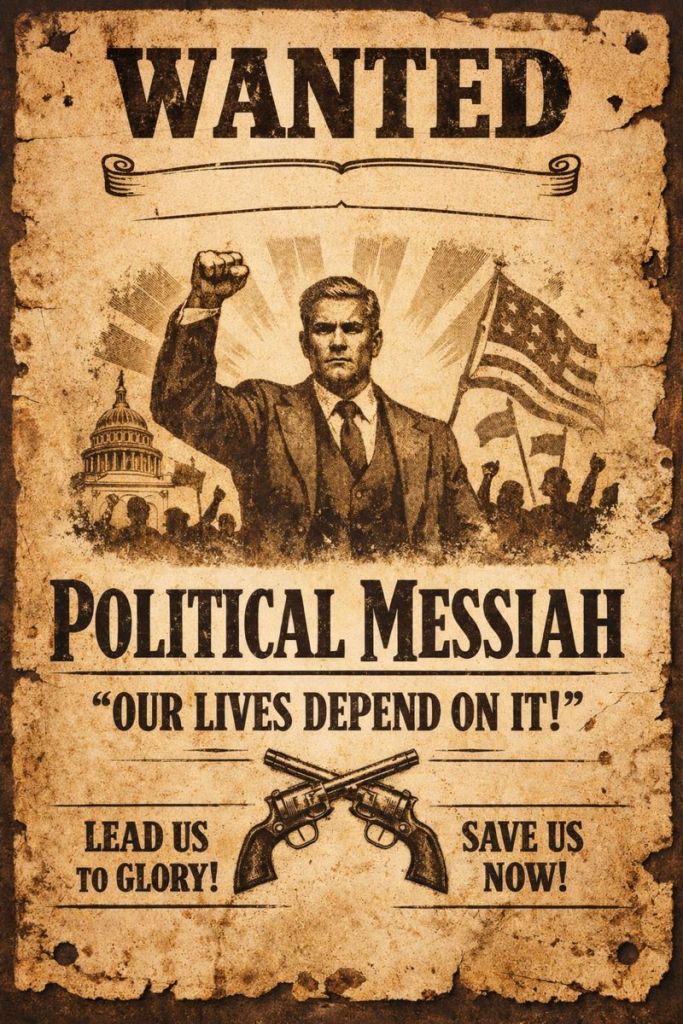
Soteriology is the study of salvation, traditionally rooted in religious contexts. Political soteriology shifts this concept from spiritual change to public action by relocating salvation from the inner life to the public square; to a leader, a movement, or a state treated as the saving agent, a political messiah. An agent not for peace, care, and order, but a means of deliverance: win power, cleanse the enemy, restore our world.
Political soteriology comes with a familiar liturgy. True believers begin with diagnosis: we are oppressed, humiliated, betrayed. Then blame is assigned, and vilification begins: they did this to us, the elites, outsiders, immigrants, or those who are just different; pick your villain. Next comes self-identity: we are the chosen people, the rightful heirs, those whose voices have been stolen. And then the yearning for, seeking, and anointing the savior. The political messiah: the only one who can restore what was taken, punish what was done, and reverse the shame. After the savior is anointed, purification follows. The system must be “cleansed.” Norms and laws become nuisances to be ignored. Anything can be justified if it’s done in the name of the lost cause. Victory is described in pseudo-religious terms: once we win, order, justice, and our greatness return.
This type of soteriology provides what ordinary politics cannot. It gives meaning: your pain has a cause. It offers immediate hope: you can finally do something—vote, march, expose, punish, purge—making you feel empowered and motivated to act. Through this association, it creates the delusion that something can be done about the perceived injustice and plight, even if that entails retribution and purification. The ‘believers’ are normal people convinced they are suffering a chronic threat to culture, morality, demographics, and becoming irrelevant. But they are your neighbors and family members, desperately grasping for someone to defend them because they feel helplessly inept in the current ‘corrupt’ system; they are us, and we are them.
Spiritual salvation is slow, demanding, esoteric, nebulous, and often ambiguous. Political salvation feels immediate and muscular. It doesn’t ask for patience; it demands loyalty. It doesn’t promise transformation; it espouses reversal. In that climate, religion itself can be conscripted—its language, symbols, and institutions repurposed as fuel for political deliverance.
The result is moral nearsightedness: salvation now, consequences later. This isn’t a new choice. A similar one occurred when the mob chose Barabbas, changing the course of history. A choice for the man of action, the insurrectionist and murderer, over the one offering a different kind of eternal kingdom. When a society chooses the “rescuer” who breaks rules to save “us,” it quietly trains everyone that law is optional and freedom is whatever our side declares it to be.
So, who will we choose? Who will you stand behind and support? A liberator who will reclaim what we believe we’ve lost, by any means necessary; or one who refuses the easy thrill of vengeance for the more complex work of long-term good? If political soteriology is chosen, what exactly is being saved? Is it our country, or an appetite for conquest and control dressed up as freedom? NeverFearTheDream simplebender.com
NeverFearTheDream simplebender.com Stand For Truth
Please consider following simplebender, you’re reading makes my writing more fun..…
Comments and thoughts are always welcome and feel free to re-post …..



 SimpleBender.....wcb