
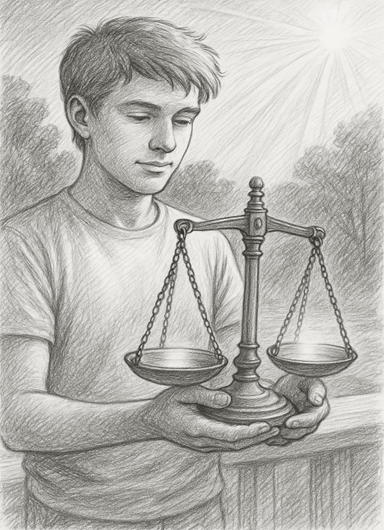
The old man sat on the porch, the autumn wind stirring the fallen leaves. His grandson, an impatient teen, leaned against the rail and sighed heavily.
“Opportunity for everyone—what a joke,” the boy muttered. “Not for us anymore. Maybe for someone else—they’ve taken everything.”
The grandfather didn’t answer. He reached for a small, rusted balance scale on the railing—an heirloom from his own father.
“You know this scale?” he asked. “Your great-grandad was a miner. He used it to weigh ore, but he said it measured something greater than metal—justice. Not everything weighs the same, but a good scale makes sure the measure is fair.”
He dropped a pebble on one pan. “This is what you think you’ve lost.” Then another. “And this, what someone else gained.”
The boy watched, his arms crossed, curiosity overtaking his frustration.
The old man added a third pebble, heavier than the rest. “This one’s the story you were told—that if their side rises, yours must fall. That story was sold by the same people who bent the beam and called it balance.”
The boy frowned. “What do you mean?”
“When I was your age,” said the grandfather, “we believed hard work guaranteed the climb. For a while, it did. Then markets changed and factories closed, machines got smarter, and those who owned the levers of money built taller ladders while the rest of us argued over who deserved the bottom rung. Now they feed you anger because angry men don’t notice the hands at the top pressing on the scale. They treat us like puppets—because too many dance when they pull the strings.”
He flipped the scale over; the pebbles scattered. The arms hung limp, like broken marionettes. “They’ve convinced you the problem is the person climbing beside you. But look closer—the scale isn’t even anchored to the ground anymore. The fight isn’t for equal weight; it’s for honest measure. Equity means measuring every stone’s, every person’s, its true worth.”
The boy’s jaw tightened. “So what do I do with that?”
The grandfather smiled. “Simple. Stop counting other people’s pebbles and start measuring their worth. Fix the scale. Learn, build, vote, speak, stand—not for the side you were born on, but for the fairness your great-grandad believed in. Opportunity isn’t gone, son. It’s just been disguised by those who need you too angry to see the game.”
The boy turned the scale in his hands. It felt lighter than he’d imagined—and suddenly, so did he. He set it on the railing, and as the arms found their balance, the old man said softly, “Remember, life’s not meant to be equal—it’s meant to be just.”#NeverFearTheDream
____________________________________________________________________________________________________________
Author’s Reflection — Equality vs. Equity
Equality assumes sameness, but nature has never been equal. No two stones weigh alike, no two lives start level. Equity is the art of fair measure — adjusting the balance so that justice, not uniformity, prevails. It asks that we see worth in context, not in comparison. The world doesn’t need everyone to carry the same load; it requires each of us to bear our share with integrity and pride. The lesson of the scale is simple: fairness isn’t about equal weight, but about honest measure — the foundation of any just and enduring society.
_____________________________________________________________________________________________________________
Factoids for reference:
- 54% of Black men born in the bottom income quintile remain there as adults, compared to 22% of White men.1
- Hispanic children are more likely than Black children but less likely than White children to move up from the bottom 20% into the middle or top 40%.2
- Black boys earn less than White boys in 99% of U.S. neighborhoods.1
- Among children from low-income households, only 17% of White children remain in the bottom decile as adults versus 42% of Black children.3
- Between cohorts born in 1978 and 1992, the racial mobility gap shrank by about 27%, yet Black men and Native Americans remain twice as likely as White men to experience downward mobility.4
1:(Brookings, 2018; Chetty et al., Opportunity Insights, 2018)
2:(Chicago Fed, 2023; Opportunity Insights, 2018)
3:(Equitable Growth, 2022; Pew Research Center, 2022)
4: (Equitable Growth, 2023; U.S. Census Bureau, 2024)
Always feel free to re-post—anywhere, anytime, to anyone—share freely.
NeverFearTheDream simplebender.com Stand For Truth
If you’re looking for daily thoughts and insights you will want to start the morning with:

If you know someone who is facing any facet of Alzheimer’s they might gain some insight from:

Please consider following simplebender, you’re reading makes my writing more fun..…
Comments and thoughts are always welcome and feel free to re-post …..

 simplebender