Posted in Current Events

When Power Destroys Strength

Strength is different than power. Power has the ability to compel. Strength is broader: it encompasses trust, credibility, influence, and reputation. It is shown in others’ willingness to stand beside you, even when they are free to walk away.

America possesses enormous power, but our international strength is weakening as we increasingly confuse coercion with leadership. The world is adapting through trade agreements, defense relationships, financial decisions, and more independent, divergent foreign policies. By demonstrating our dominance too aggressively, we are making ourselves less indispensable.

After World War II, the United States helped build an international order grounded in collective security, trade, sovereignty, and mutual interest. Broader postwar institutional systems gave countries reasons to align with us beyond fear or dependency. Our strength grew not merely because our power increased, but because America was widely seen as useful, dependable, and trustworthy.

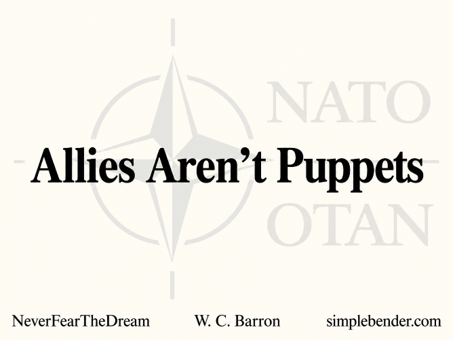
Our allies were never mere satellites. They were sovereign nations that sometimes disagreed with us, yet they justified their partnership with the United States as strengthening their security and prosperity. That voluntary, symbiotic, and beneficial alignment was a foundation of American power and influence.

Today, we are eroding our trustworthiness and losing their confidence. Tariffs, economic threats, unilateral military actions, demands for conformity, and public criticism of governments that resist American preferences turn partnership into subordination. Even when some demands are justified, such as greater defense burden-sharing, the method matters. A critical difference exists between asking an ally to carry a larger share and condemning resistance as disloyalty that warrants retribution.

Our allies notice and recognize the difference. European governments are expanding their defense industries and pursuing greater strategic autonomy. Canada has joined European defense procurement arrangements. Traditional U.S. partners are expanding trade relationships beyond American-centric structures, including with our economic rivals. Central banks are reassessing where they hold strategic reserves and their share of federal bonds. These actions do not mean our allies are abandoning us. They mean they have lost faith in us and are choosing to diversify risk and security rather than tolerate increasing uncertainty.

A sovereign nation does not need to become our enemy to diminish American influence. It only needs more choices and a reason to choose. Alternative markets lower the cost of resisting American tariffs. Independent defense production reduces reliance on American weapons. New security relationships reduce dependence on American guarantees. Diversified reserves reduce exposure to American jurisdiction.

Each step creates optionality, and optionality reduces leverage. Each option taken erodes America’s influence and economy.

The emerging world may not divide neatly into allies and adversaries. Instead, countries may remain allied with the United States while building the capacity to oppose us when their interests diverge. That is not hostility. It is strategic independence. It is being an independent sovereign, not a territory.

The contrarian argument matters. Some of this adjustment is healthy. Europe should spend more on defense. Nations should diversify their trade and financial exposure. Russia and China provide independent reasons for allies to strengthen themselves. A more capable alliance system could ultimately strengthen the West.

But there is a critical difference between allies becoming stronger because we encouraged partnership and allies becoming more independent because they fear dependence and are tired of threats and insults. Power can force compliance for a time. Strength makes cooperation worth choosing.

America may not lose all its allies. Something more consequential is unfolding. They may remain allies even as they learn to function without us. We could still possess extraordinary military and economic power while losing the structural advantage that defined the postwar era—the belief that America was THE indispensable partner. Our own actions, demands, and ego are making them stronger at our expense.

We need to reconcile: Are we stronger when sovereign nations obey because resistance is costly, or when they choose us because the partnership is valuable? Overlords have historically been overthrown by peasants, but these aren’t peasants or serfs; they are independent sovereigns.

NeverFearTheDream………. W. C. Barron………. simplebender.com……….keystonecompact.org

… – .-. . -. –. – …. / — …- . .-. / .–. — .– . .-.


Lap Around the Sun: Daily Steps Forward
by WCBarron

Buy at Amazon Buy at Barnes & Noble Buy at Books2Read

Joy in Alzheimer’s: My Mom’s Brave Walk into Dementia’s Abyss
by WCBarron

Buy at Amazon Buy at Barnes & Noble Buy at Books2Read
Posted in NeverFeartheDream

NeverFearTheDream…

Is the carrot meant to be reached—or merely to make the horse pull harder? 26.09.03.1

NeverFearTheDream………. W. C. Barron………. simplebender.com……….keystonecompact.org

Posted in Philosophy

A Republic of Appearances

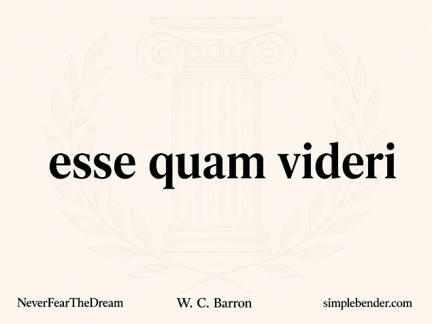
W. C. Barron esse quam videri

Betrayal should hurt. It should burn a little, especially when it is a betrayal of what we once believed ourselves to be.

Somewhere along the way, we began mistaking the appearance of greatness for greatness itself. We wrapped ourselves in gilded tapestry, built elaborate spectacles, polished the veneer—and hoped no one would notice the tarnish and rust beneath. Our national buildings, institutions, and monuments have been altered, renamed, and draped in political imagery, as their historic meaning increasingly competes with the personality of the moment.

Public money, public space, and presidential attention continue flowing toward spectacle—troops in the capital, cage fights on the White House lawn, the capital’s streets converted for racing, monuments, banners, and ceremonies. The White House increasingly resembles a gilded monument to personal taste rather than the temporary residence of the republic’s leader. Meanwhile, the betrayal: citizens struggle with persistent costs and rising interest rates, the return of preventable diseases, strained global alliances, and global ego-driven conflicts, while families still struggle to build their own small version of the American dream.

Pomp is not power. Pageantry is not leadership. Personal glorification is neither national greatness nor patriotism.

The warning is hardly new. Nearly 2,500 years ago, Aeschylus drew a distinction between being and merely seeming. The Romans later distilled the idea into three enduring words:

Esse quam videri            Be rather than appear.

Something feels almost too fitting about confronting a 2,500-year-old warning as America celebrates its 250th anniversary. At ten times the age of our republic, humanity has long understood the temptation—and danger—of confusing appearance with character. 

A great nation does not need to continually proclaim its greatness. It demonstrates greatness by what it builds, whom it protects, how it governs, and whether its institutions remain larger than the people who temporarily occupy them.

Ceremony has its place. Nations need symbols, celebrations, monuments, and moments of shared pride. But spectacle becomes dangerous when it stops honoring the country and starts honoring the individual. When institutions become props, public spaces become stages, and governance becomes performance, appearance slowly supplants substance.

Perhaps ‘esse quam videri’ should become more than an old motto—a national reminder and the corrective we need.

We should strive to be the leaders, thinkers, innovators, creators, and builders we claim to be—not merely appear to be them. Bluster is a thin veil, and the world is perfectly capable of seeing through it.

We are better than a gilded façade. It is better to show the scars and the resolve behind them than to cover them with gold leaf and ceremony.

America can still put on an impressive show. The hard question is whether, at 250, we still remember or care about the difference between looking great and being great.

Understand: when you build shrines to your own glory, they share your mortality. When you build them for ideals, they endure as long as someone believes.

NeverFearTheDream   W. C. Barron   simplebender.com

. … … . / –.- ..- .- — / …- .. -.. . .-. ..


Lap Around the Sun: Daily Steps Forward
by WCBarron

Buy at Amazon Buy at Barnes & Noble Buy at Books2Read

Joy in Alzheimer’s: My Mom’s Brave Walk into Dementia’s Abyss
by WCBarron

Buy at Amazon Buy at Barnes & Noble Buy at Books2Read
Posted in Philosophy

Horizon’s Calm

Regardless of the calamity crashing onto the shore, the horizon always seems calm.

The headlines confronting us every day are inescapable. World events spill into ordinary life with reckless abandon. Add our own worries, obligations, and frustrations, and it becomes easy to feel that everything is happening at once—and that we control almost none of it.

So we put our heads down to focus on every step we take, and that is all we think we control.

We watch for the exposed rocks, the tidal pools, and the creeping surge of the surf. We concentrate so intently on keeping our feet dry that we miss the gulls skimming the waves, the eagles soaring overhead, the pelican’s wonderfully gangly dive, and, if we look further out, maybe, just maybe, a breaching whale.

Most of all, we miss the horizon. We don’t even look up, out of fear.

Trauma, conflict, and drama lie at our feet. Some of it is real and deserves our attention. The waves may indeed be growing larger. We should not pretend otherwise. But the closer we stand to the crashing surf, the more each wave can consume us.

Our breathing shortens. Frustration rises. Helplessness creeps in. Eventually, the thing directly in front of us begins to feel like the whole world. But it rarely is, and it rarely is as big as it appears.

Lift your head and look beyond the wave breaking at your feet. The horizon offers perspective—not because it promises everything will be fine, but because it reminds us that this moment, however difficult, is only part of a much larger landscape.

Today matters. What is crashing around us matters. But neither is everything.

That doesn’t mean ignoring the surf. Brace for what may come. Watch for the sneaker wave. Step back when wisdom and experience tell you to. Deal with the rocks beneath your feet. But we do not have to fight every wave or avoid every stone.

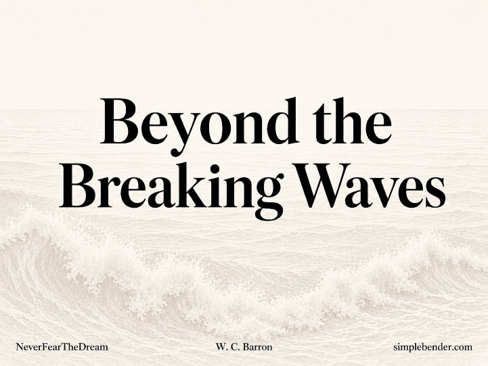
Perhaps calm begins with remembering the difference between what demands our focused attention and what deserves our entire field of vision. The shore may be chaotic, noisy, even frightening. So look up. Look beyond the breaking waves and see that the horizon remains calm; so should we.

Look up Horizon

Calamitous shore waves break

Horizon placid

NeverFearTheDream…W. C. Barron…simplebender.com

.-.. — — -.- / ..- .–. / …. — .-. .. –.. — -.


Lap Around the Sun: Daily Steps Forward
by WCBarron

Buy at Amazon Buy at Barnes & Noble Buy at Books2Read

Joy in Alzheimer’s: My Mom’s Brave Walk into Dementia’s Abyss
by WCBarron

Buy at Amazon Buy at Barnes & Noble Buy at Books2Read