Posted in Philosophy

The World’s Lost Beacon

Before dawn, I watched a fishing boat riding the black seam of the horizon off the rugged, unmerciful Oregon coast. The winter swells were building as the storm approached, and one bright mast light—tiny at that distance—kept announcing itself. It bobbed and drifted, sliding right, dipping down, climbing back—never still. The rougher the water became, the more that light danced, hypnotic and uneasy, like a pulse you couldn’t stop watching.

I pictured the crew out there—cold, wet, working for every inch of their livelihood—rocking at the mercy of a winter ocean that doesn’t negotiate. Then the light softened. It blinked once. And then it was gone. Just gone.

I leaned forward and stared until my eyes hurt. Four possibilities flashed through my mind, half of them concerning: the boat had turned, the power had failed, the sea had taken it, or it had sailed over the horizon. When dawn finally thinned the night, I still couldn’t find the vessel. The view was magnificent—and bleakly vacant.

I kept turning it over. That bright beacon was the American Dream: a light you can earn into existence. Risk. Work. Pride in the day’s catch. A stubborn belief that effort matters. It also felt like something else—something more fragile than we like to admit. A vessel doesn’t survive the storm, and its light doesn’t stay bright just because it once was; it stays bright because someone maintains it. Someone powers it. Someone refuses to let it fail.

Now the larger beacon the world has watched—our democracy—looks less steady than it used to. Is the vessel simply turning, its beam shifting out of our line of sight? Or is it losing power? Is it taking on water from neglect, corruption, ego, and self-inflicted damage?

The ocean doesn’t care what flag flies on a boat. It has swallowed the famous and the foolish. What makes this loss feel different is that the light represented not a ship at all—it was a method: an educated citizenry, self-restraint, lawful transfer of power, and the courage to resist tyranny without becoming it. That doesn’t replicate easily. It’s not a gadget you install. It’s seamanship, practiced daily.

Democracy doesn’t need constant tinkering by people trying to remake it in their own image. It needs upkeep. It needs citizens who treat it like a shared vessel, not a private yacht. It needs leaders who care more about the ship and the crew than about the applause on the deck.

I kept scanning the horizon, straining for a pinprick of light—any sign the boat hadn’t gone under. If it’s only turned, the beam will come back. If it’s crippled, we’ll learn what we never wanted to learn: a beacon can fail. If it sailed away, it would be alone in the ocean, and risks increase, especially for mutiny. History doesn’t promise rescue or replacements.

And if we want the beacon back, it won’t be because we wished for it. It will be because we, the crew, set this ship right. Democracies fail the way machines do: ignored tolerances, deferred maintenance, and a crew that doesn’t heed the telltale sounds of failure. So here’s the corrective action: stop rewarding sabotage, stop normalizing lies, stop treating institutions like disposable parts. Do the boring work—vote, show up locally, protect the rulebook, and enforce consequences. If we don’t, the beacon won’t “fade,” but our vessel will lose power and be swallowed by the sea. It will be lost forever.  NeverFearTheDream   simplebender.com

Joy in Alzheimer’s
W.C. Barron
Lap Around the Sun
Daily Steps Forward — W.C. Barron
Posted in Current Events, Political

Guardrails Against the Authoritarianism Storm

Columns supporting our Constitutional Liberties

Article first published in the Bend Bulletin 9/27/25

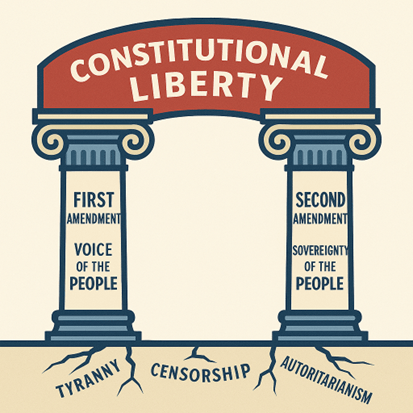
The Bill of Rights was not a mere document, but a product of the founders’ deep suspicion of concentrated power. They had witnessed the crushing of liberties under a monarchy and feared that even a republican government might someday drift toward authoritarianism. The First Amendment enshrines freedoms of mind and voice; the Second Amendment ensures the citizenry will never be entirely powerless should those freedoms come under assault. This foresight of the founders enlightens us about the historical context of the Bill of Rights, giving us a deeper understanding of our constitutional rights.

History was their teacher. British suppression of colonial assemblies, censorship of dissenting press, and the Intolerable Acts were enforced not with argument but with troops. The Revolution began not at a printing press, but when local militias clashed with regular soldiers at Lexington and Concord (1775) to resist the seizure of their weapons. It was this combination—ideas in pamphlets like Common Sense (1776) and the willingness to defend them—that secured independence.

James Madison (Federalist 46) envisioned an armed citizenry as the ultimate check on federal overreach, noting that “the advantage of being armed” would deter encroachments on liberty. Alexander Hamilton (Federalist 29), though skeptical of full-time militias, conceded that a people capable of bearing arms would make any tyranny costly. Later commentators, such as St. George Tucker (1803), referred to the Second Amendment as the “true palladium of liberty,” a final barrier against usurpation (Tucker, Blackstone’s Commentaries).

The framers did not celebrate rebellion, and neither should we. They built a republic designed to settle disputes through institutions—legislatures, courts, and elections—not through insurrection. The Second Amendment was less an invitation to revolt than a final constitutional guardrail, a reminder to government that the people remain sovereign. It was meant to make authoritarian control—whether through censorship, suppression of dissent, or militarized governance—impractical.

“The Second defends the First,” captures part of this truth but misses the deeper genius of the American design. Our first line of defense for free expression is institutional: the separation of powers, judicial independence, and a free press that is able to hold the government accountable. An armed citizenry is the last resort, the failsafe that ensures no regime can permanently silence the governed, providing a sense of security about our rights.

Even in polarized times, the resilience of this framework is remarkable. Courts still strike down attempts at censorship, legislators still debate fiercely, and citizens continue to speak, publish, assemble, and worship according to their conscience. With some legislators seeming to yield to the mob or bend a knee for their own political survival, our Constitution has withstood civil war, economic depression, McCarthyism, and demagoguery precisely because its protections are layered—legal, institutional, and cultural. The greatest defense of liberty is not fear of armed resistance but the enduring resolve of citizens who insist on their right to speak and be heard. When we do not defend the first, we risk the second, the fourteenth, the fifteenth, and the nineteenth. When we defend free speech, preserve checks and balances, and reject authoritarian shortcuts and fragile egos—whether from the left or the right—we prove that the American experiment remains not only viable but vital. This reiteration of the importance of defending free speech should empower you and make you feel responsible for upholding your rights, instilling a sense of duty and empowerment in you. # NeverFearTheDream # Stand for Truth # Stand with Pride # Stand with Spine

For Every Problem...A Solution...
Lap Around the Sun: Daily Steps Forward
Joy in Alzheimer’s: My Mom’s Brave Walk into Dementia’s Abyss