Posted in Philosophy

Sometimes HOPE Needs a Little HELP

Hope is stubborn. It is resilient. It is also fragile, and often, it isn’t self-sufficient. Sometimes it needs a little help. It survives in a world that holds both the best and the worst of us—breakthroughs and backslides, mercy and malice—often on the same day.

When hope thins, we don’t need slogans; we need help. Sometimes that help is borrowed from others. Sometimes we loan it to ourselves. It can be as simple as noticing the ground we’ve gained, not just the mud we’re stuck in. Much remains broken—violence, injustice, genocidal aggressors, and loneliness—but much has moved forward: more cures, more voices heard, more tools to repair what we once accepted as incurable, unrepairable, and unbelievable. Progress for many is not yet progress for all. Both truths can stand. As does the truth that hope can be easily lost, but there is help.

Help for hope usually arrives in small packages: a neighbor’s knock, a hand on a shoulder, a laugh that breaks a hard silence. Tidal art scribbled in seaweed and sand dollars. The warm, unjudging eyes of a favorite pet. A child’s cheering as the lopsided sandcastle dares the next wave. The constant roll of the ocean or the low thrum of a river reminds you that motion exists even when you feel still.

If you’re carrying more night than daylight, don’t ignore or romanticize it—and don’t accept or surrender to it. Ask for help. Offer some. Build tiny structures of meaning you can reach without a ladder.

Many say these are dark days; others say they’re a dawn. Either way, morning keeps its appointment. There will be a sunrise tomorrow, even if it is behind the storm clouds. Let it be the HELP your HOPE needs—and let your hands make the most of the light. Speak up and Stand up for yourself and those who can not. Be your own help if you can, and be the help others may seek. You may not be able to initiate hope’s growth, but you can certainly start removing what inhibits it. #NeverFearTheDream

For Every Problem...A Solution...
Lap Around the Sun: Daily Steps Forward
Joy in Alzheimer’s: My Mom’s Brave Walk into Dementia’s Abyss

Posted in Current Events

America: The Debtor Consumer Nation

Perfect storms don’t appear overnight. They brew over years, with shifting conditions that slowly build into turbulent waves and headwinds. Our financial storm is no different. Patience and persistence—not quick fixes for political gain or to placate an impatient electorate—are the only means to weather it.

After World War II, America emerged as the world’s manufacturing powerhouse. In 1950, four in ten workers were employed in manufacturing or farming. Today, it is fewer than one in ten. Urban centers now dominate public policy, with four urban residents for every one rural—compared to 1.4 to 1 in 1950. Over the same period, private debt ballooned from $142 billion to nearly $49 trillion, while our national debt-to-GDP ratio climbed from 0.9 to 4.0—among the highest in the developed world, worse even than Greece before its IMF bailout. By IMF criteria, the U.S. now checks multiple distress boxes: soaring debt, accelerating accumulation, vast unfunded liabilities, and a widening deficit. We are a nation of consumers, not producers, and we have run a trade deficit every year since 1960.

The irony is stark. In 2001, the federal budget posted a $128 billion surplus, with forecasts indicating that the national debt would be entirely retired by 2009. Two decades later, we face a $1.7 trillion deficit and a $33 trillion debt. Tax cuts have increased the debt-to-GDP ratio by 37%, boosted spending by 33%, and added another 28% to COVID-era responses. Seventy-seven percent of the debt increase is attributed to bipartisan legislation, as federal spending rose from 17% of GDP to 23%, while revenue fell from 19% to 16%.

These are the numbers. They reveal a storm that has been decades in the making. The U.S. is unlikely to reverse course quickly, as we lack the necessary manufacturing infrastructure, globally competitive wages, or political appetite to balance spending with revenue. If 2001 tax and spending levels had been maintained, the debt picture would look radically different. But we didn’t, and we can’t go back. We’ve now doubled down, and Congress has passed legislation that is projected to add another $3 trillion to the debt while concurrently cutting social and international support programs. The cost of these programs is now the burden of each state. Some will shoulder their share, others will opt not to, at the detriment of their citizens.

The way forward will not be painless. Gutting agencies or waging trade wars won’t solve structural imbalances. We will face difficult choices, including the scope of social welfare programs, military commitments, and global engagement. To remain respected, we cannot retreat behind walls of protectionism—we will need cooperation from allies while we put our house in order.

Ultimately, the national problem mirrors the personal one. Our culture of instant gratification and debt-driven consumption cannot be sustained. Just as households must learn to live within their means, so too must the nation. It will take time, sacrifice, and discipline to undo decades of drift toward becoming a debtor nation of consumers that we are now. #NeverFearTheDream

For Every Problem...A Solution...
Lap Around the Sun: Daily Steps Forward
Joy in Alzheimer’s: My Mom’s Brave Walk into Dementia’s Abyss

Posted in NeverFeartheDream

Never Fear The Dream…

Truth seen is a perspective. Truth heard is understanding. Truth spoken is courageous wisdom. Words are dangerous—they can be misheard, misread, twisted, and manipulated. But actions? Actions speak for themselves. Let yours be clear. Doubt isn’t weakness—it’s permission to question and grow. Even self-doubt can be a catalyst for resolve and honest reflection. 25.08.3

For Every Problem...A Solution...
Lap Around the Sun: Daily Steps Forward
Joy in Alzheimer’s: My Mom’s Brave Walk into Dementia’s Abyss

Posted in Miscellaneous Thoughts, NeverFeartheDream

Never Fear The Dream…

Boldness, even if a delusional facade, eliminates internal and external doubt and subdues awkwardness. If all you have is the facade, your life is like a pine tree with a hollow trunk, only bark and withering needles. 25.08.1

For Every Problem...A Solution...
Lap Around the Sun: Daily Steps Forward
Joy in Alzheimer’s: My Mom’s Brave Walk into Dementia’s Abyss

Posted in Philosophy

Bound in Fragile Balance: Freedom and Liberty

Can you be free without liberty or have liberty without freedom?

When freedoms are being challenged, coerced, and twisted to fit ideologies—as they are now- this isn’t a rhetorical question. It is an essential one. Because freedom and liberty are not the same thing. You can be free without liberty; however, you cannot have liberty without freedom.

Freedoms are what everyone is born with. They are innate. The freedom to speak, roam, think, and express yourself. Liberty is the social contract, a framework that defines those rights and protects them from government overreach, ideology, mob rule, and individual abuse.

Freedoms can exist in isolation; liberty requires a society. You can escape to the wilderness and be as free as you like. Liberty exists to balance the tensions between individual freedoms and the responsibilities of societal citizens coexisting in a communal environment. There will always be tension between them as social norms and technologies continue to evolve. But it is our liberty that will guide us, allow us to protect it, and our freedoms. Liberty protects our rights to do what we ought to do, not the power to do what we want to do.

Liberty is guarded and protected; freedom is what you assert and claim. And yet, liberty’s role is to protect your freedoms if others impinge on yours and vice versa. Liberty is for everyone and must be protected by everyone. Because freedom can be absolute, liberty must be conditional. Without setting civil boundaries within the construct of liberty, freedom will run amok. Everyone believing and acting as if they have no responsibilities or accountability is the recipe for chaos and anarchy, making humans no better than any other social animal. Freedom untethered isn’t freedom at all.

Liberty is created when people agree to limit certain freedoms. Ironic as that may seem. Liberty is a civilized form of freedom. It is the civil contract we live by. It allows the freedoms we agree upon. Freedom of speech, but not speech that incites violence. Freedom of the press, but not a deceptive, manipulated media. Freedom to worship and assemble without fear of retribution by worshiping a minority religion or assembling to support, or protest, what may be viewed as unjust or a violation of liberty. Within the context of our liberty, we should pause before yielding to the temptation to trade freedoms for perceived security. Once lost, those freedoms are hard to regain, just as yielding civil authority to the government.

While Patrick Henry decried, “Give me Liberty or give me Death“; Thomas Paine opined, “Government, even in its best state, is but a necessary evil; in its worst state an intolerable one.” Their’s wasn’t a cry for freedom, but for a governing system that protected the agreed-upon freedoms of all. We may not like the clamorous protests demanding action, or the ideas and opinions espoused by others—just as much as they may not appreciate ours—but in our Liberty we have agreed to allow them, and that Liberty is worth defending. Without it, the saber of perceived justice can and will cut both ways, depending upon who yields it. The Liberty we should protect, our Liberty, must sheath the sword and allow the voices of freedom to be boldly, openly, and freely expressed.

For Every Problem...A Solution...
Lap Around the Sun: Daily Steps Forward
Joy in Alzheimer’s: My Mom’s Brave Walk into Dementia’s Abyss

Posted in Communication

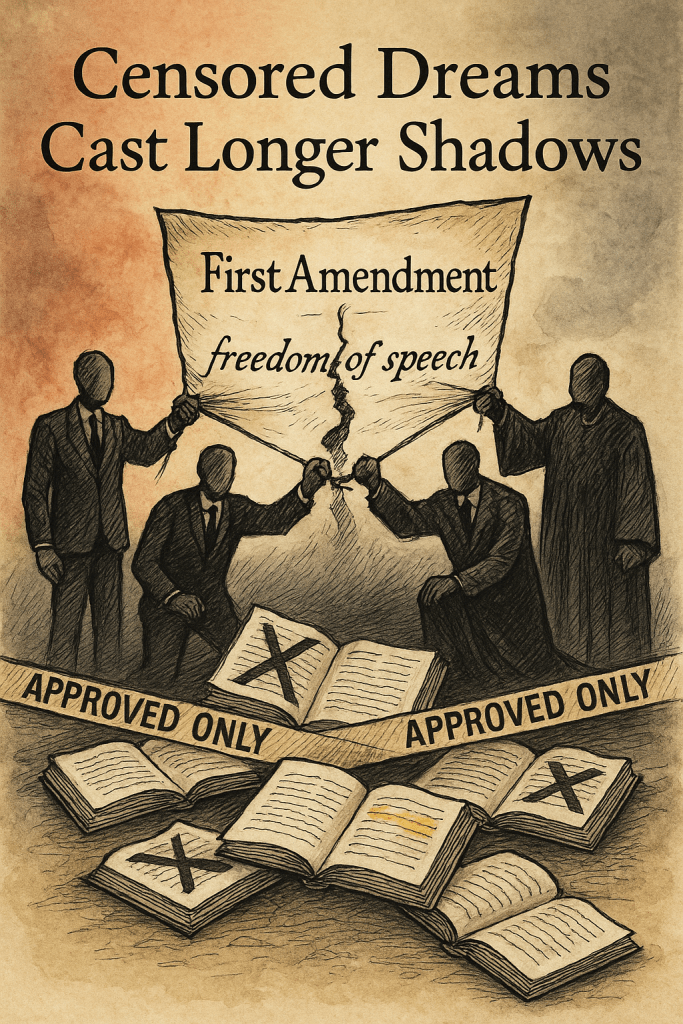
Viewpoint Discrimination: Forgetting What Makes Us Free?

Isn’t the difference of opinion the very thing that built this country?

We weren’t founded on sameness—but on dissent. The thirteen colonies didn’t rise up because they agreed with the power, but because they dared to question it. That impulse—audacious, messy, courageous—is what the First Amendment was written to protect. And yet, here we are again, toying with the dangerous idea that some speech is more tolerable than others. That some viewpoints belong, and others must be silenced and erased.

Shouldn’t that make us uncomfortable?

When tax-funded public institutions—schools, libraries, boards—begin removing books because someone doesn’t like what they say, that’s not preservation of order. That’s viewpoint discrimination. It’s not protecting children. It’s insulating and cuddling weak ideologies. And it’s a blade that ultimately cuts both ways.

You may cheer today when a book you dislike is banned. But what happens tomorrow, when the next board turns its gaze toward the ones you cherish? What makes you think your shelves won’t be next?

We have been here before. In the 1950s, it was Communists. In the 1930s, it was Jews, dissidents, and “degenerates.” Ideas were labeled threats. Libraries were sanitized. People fell silent. Is that the direction we want to revisit?

And what of free speech? Have we forgotten that the First Amendment isn’t just the right to speak, but the right to receive, to read, to explore—especially the uncomfortable truths?

A candidate who once shouted from podiums about the sanctity of the First Amendment, to get elected, now wields it like a partisan tool—defending it when it serves him, abandoning it when it doesn’t, and threatening retaliation, retribution, revoking citizenship, and deportation. Isn’t that the ultimate hypocrisy? To claim allegiance to liberty, but only on your terms, isn’t democracy; it is authoritarianism.

Let’s ask plainly: If a public school or library removes a book about a Muslim child exploring faith, or an LGBTQ teen navigating identity, or a historical critique of systemic injustice—while allowing others that affirm dominant religious or political norms—can that possibly be considered neutral? Can it promote learning diversity and inclusion, or only foster selfish isolation and the illusion of greatness?

And if the government—through policy, threat, or performance—signals what speech is safe and what is not, can we still call ourselves a free people?

Pluralism is not about liking every voice. It’s about letting them speak. It’s about understanding that in a nation where taxes are paid by atheists and Baptists, Muslims, Mormons, and immigrants, the public square must be open to all—or none.

If one religion is given space in a publicly funded institution, then all must be. If one ideology is allowed to teach, then all must have a place at the table. If one set of values is protected, then all must be. Or else what we are protecting is not freedom—but control.

So, we must ask ourselves: Do we still believe in a country where debate is encouraged, not silenced? Where a library or a school is a place of discovery, not conformity? Where the power of ideas—not the fear of them—leads us? Because if not, then we are no longer the land of the free—we are simply the land of the approved, bowing to fragile egos. We, and the world, have been there before and rejected viewpoint discrimination; we can, have, and must do better.

For Every Problem...A Solution...
Lap Around the Sun: Daily Steps Forward
Joy in Alzheimer’s: My Mom’s Brave Walk into Dementia’s Abyss

Posted in NeverFeartheDream

Never Fear the Dream…

Independent thought is bold to some, seductive or even dangerous to others. Be bold anyway. Make your thoughts your own—don’t regurgitate the ideas of others. Life’s path is a conundrum: follow the rugged trail of Truth is Knowledge, rather than retreat to the comfortable path of Ignorance is Bliss. 25.07.3

For Every Problem...A Solution...
Lap Around the Sun: Daily Steps Forward
Joy in Alzheimer’s: My Mom’s Brave Walk into Dementia’s Abyss

Posted in NeverFeartheDream

Never Fear the Dream…

The right thing is often obvious and usually the hardest, but it yields the best outcomes. Yet, what is “right” depends on perspective—and perspective shapes everything. Even the ranting of the insane makes sense to them. Strive to see the world through their eyes, not to agree, but to understand. 25.07.2

For Every Problem...A Solution...
Lap Around the Sun: Daily Steps Forward
Joy in Alzheimer’s: My Mom’s Brave Walk into Dementia’s Abyss

Posted in NeverFeartheDream

Never Fear The Dream…

Life is a game of cards—you play the hand you’re dealt. Know who’s dealing. If it’s not you, you may be a bit player in someone else’s life game. Fold when needed, bluff if you must, but next time, make sure you’re the one dealing. 25.06.04

For Every Problem...A Solution...
Lap Around the Sun: Daily Steps Forward
Joy in Alzheimer’s: My Mom’s Brave Walk into Dementia’s Abyss

Posted in NeverFeartheDream

Never Fear The Dream…

We cherish time with loved ones only when death is near, yet squander the ample time we have with them while they’re still alive. 25.06.02

For Every Problem...A Solution...
Lap Around the Sun: Daily Steps Forward
Joy in Alzheimer’s: My Mom’s Brave Walk into Dementia’s Abyss