Posted in Political

The Optics of Weakness

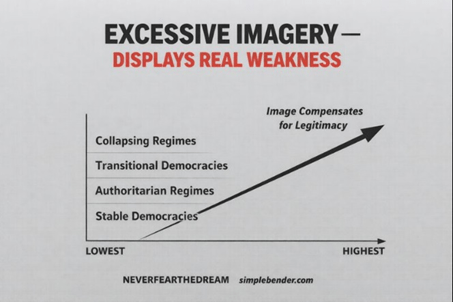
When I worked in Syria, Assad’s pictures and banners were everywhere. There was a saying you heard quietly uttered and trusted immediately: You can tell the weakness of a leader by the number of his portraits hanging in public. It wasn’t cynical. It was observational. People who had lived under strongmen understood; power that must constantly announce itself is power that doubts its own legitimacy.

We once believed America was exempt from this rule. Our institutions were supposed to be independent, strong, equally balanced, and impersonal enough to keep authority both distributed and temporary. That confidence now seems naïve.

Modern American politics is increasingly visual, performative, and personality-driven. Faces dominate screens—names eclipse policies. Rallies resemble revival meetings. Loyalty is measured by personal allegiance rather than by commitment to constitutional principles. Flags, slogans, branded backdrops, portraits draped across government buildings, names adorning every possible grift, and omnipresent imagery—assertions of dominance in a restless, anxious public square.

When institutions lose trust, leaders step forward as symbols, as demigods. When governance grows complex and outcomes disappoint, image fills the void left by results. Legitimacy shifts from systems to the worship of individuals, from rules to personalities. The leader does not serve the institution; the institution is recast to serve the leader.

The more fragile trust becomes—in elections, courts, media, and science—the more faux leaders insist on being ever-present. Every success must bear their name and likeness. Every failure must be blamed on an enemy. Every criticism becomes sabotage and treason. In this environment, real leaders cannot afford to fade into the background of dysfunctional systems, which are themselves under strain.

This transformation is dangerous, not dramatic. Once power is personalized, disagreement becomes disloyalty. Oversight becomes persecution. Independent judges, journalists, and civil servants are no longer neutral actors but obstacles to image maintenance. Reality itself becomes negotiable because the image cannot tolerate correction. Facts that undermine the portrait must be attacked, dismissed, twisted, or replaced.

This is how republics erode without collapsing—slowly, legally, and often enthusiastically. Genuine leadership does not require constant reaffirmation. It does not need its face everywhere or its name in every chant. It governs through institutions robust enough to outlast any individual. It allows space for criticism because it is anchored in systems, not in the self. Weak leadership crowds out that space. It fills every silence. It demands recognition not because it has earned it, but because it fears what happens without it.

The sage wisdom still holds. You just have to know where to look. The walls are no longer plaster or stone. They are timelines, feeds, stages, and screens. Yet they tell the same story they always have—about insecurity masquerading as strength and the stark divide between leaders who trust and support institutions and those who need to be seen leading. The irony is that every image becomes an incendiary insult, inflaming resistance more than rallying support.

Once you recognize the pattern, the noise becomes legible. And once it is legible, it becomes impossible to ignore. Indeed, You can tell the weakness of a leader by the number of his portraits hanging in public; and history has a way of knowing which effigies to hang-up.    NeverFearTheDream   simplebender.com

Joy in Alzheimer’s
W.C. Barron
Lap Around the Sun
Daily Steps Forward — W.C. Barron
Posted in NeverFeartheDream

Never Fear The Dream…

vvv

Genuine compassion is when you treat those who oppose you the same way you do those who support you, and how you treat yourself. 26.02.04

Joy in Alzheimer’s
W.C. Barron
Lap Around the Sun
Daily Steps Forward — W.C. Barron
Posted in Miscellaneous Thoughts

CTRL+ALT+DEL…..NOW….

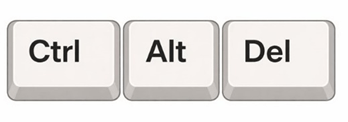
Maybe, just maybe, it’s time for America and her citizens to collectively hit Ctrl+Alt+Del and take a breath—activate the security sequence and pause the program, check the Task Manager, and see what’s actually running in the background. We don’t need a reflexive Ctrl+Y. And we definitely don’t need another round of Ctrl+C and Ctrl+V—same talking points, new panic, new distraction, new deceit.

Too many of us have pounded Ctrl+L and Ctrl+R so long that we’ve forgotten there are margins—limits—to acknowledge and real value in being more centered… more Ctrl+J. A little Ctrl+E, some actual centering, would go a long way toward calming everything and everyone. A little more respect, whether you understand or agree.

But some folks only know Ctrl+B—louder, harder, bolder—thinking volume equals truth. The result is predictable: everyone else starts hammering Ctrl+H, replacing nuance with slogans and facts with whatever “fits” the moment.

We now have a regime trying to Ctrl+Shift+H what’s happening in plain sight, while freedom-minded protesters hit the same keys to unmask it. A little Shift+F1 to reveal the intent, purpose, and scope in the spirit of transparency would also help. Violence isn’t needed. But warrants are. It’s really pretty simple: Ctrl+J the actions. Justify them—lawfully, transparently—or ESC.

There’s an entire world ready to Ctrl+Z the last year of chaos, confusion, and uncertainty. It’s fine to be Ctrl+B—confident, decisive—but not arrogant and demeaning. They don’t want a Ctrl+Y of the next several years. They want stability, reason, and science back as cornerstones of world relations.

What we need is a pause—not a Ctrl+W. More like a Ctrl+Z on a few policies before we reach for Ctrl+Alt+Del three times and reboot: a hard reset. But if we keep pretending the system isn’t crashing, we may end up rebooting the hard way before a Trojan virus and malware consume our entire system. At times… maybe a reboot and a deep clean scan wouldn’t be the worst idea.

Feel free to Ctrl+S, Ctrl+A, Ctrl+C, and Ctrl+V on any forum you want.

NeverFearTheDream  simplebender.com

Ctrl+Alt+Del—interrupt, security sequence;  Ctrl+A—Select all;  Ctrl+B—Bold toggle;  Ctrl+C—Copy;  Ctrl+E—Center;  Ctrl+H—Find/Replace;  Ctrl+J—Justify;  Ctrl+L—Align left;  Ctrl+S –Save;  Ctrl+R—Align right;  Ctrl+Shift+H—Hidden text toggle;  Ctrl+V—Paste;  Ctrl+W—Close window/document;  Ctrl+Y—Redo;  Ctrl+Z—Undo;  ESC—backout, cancel;  Shift+F1—Reveal Format;  Task Manager—View/kill processes

Joy in Alzheimer’s
W.C. Barron
Lap Around the Sun
Daily Steps Forward — W.C. Barron
Posted in NeverFeartheDream

Never Fear The Dream…

///

Self-awareness and honest self-assessment are the keys to improvement. Conversely, self-complacency is devastating. 26.02.03

Joy in Alzheimer’s
W.C. Barron
Lap Around the Sun
Daily Steps Forward — W.C. Barron
Posted in Philosophy

The World’s Lost Beacon

Before dawn, I watched a fishing boat riding the black seam of the horizon off the rugged, unmerciful Oregon coast. The winter swells were building as the storm approached, and one bright mast light—tiny at that distance—kept announcing itself. It bobbed and drifted, sliding right, dipping down, climbing back—never still. The rougher the water became, the more that light danced, hypnotic and uneasy, like a pulse you couldn’t stop watching.

I pictured the crew out there—cold, wet, working for every inch of their livelihood—rocking at the mercy of a winter ocean that doesn’t negotiate. Then the light softened. It blinked once. And then it was gone. Just gone.

I leaned forward and stared until my eyes hurt. Four possibilities flashed through my mind, half of them concerning: the boat had turned, the power had failed, the sea had taken it, or it had sailed over the horizon. When dawn finally thinned the night, I still couldn’t find the vessel. The view was magnificent—and bleakly vacant.

I kept turning it over. That bright beacon was the American Dream: a light you can earn into existence. Risk. Work. Pride in the day’s catch. A stubborn belief that effort matters. It also felt like something else—something more fragile than we like to admit. A vessel doesn’t survive the storm, and its light doesn’t stay bright just because it once was; it stays bright because someone maintains it. Someone powers it. Someone refuses to let it fail.

Now the larger beacon the world has watched—our democracy—looks less steady than it used to. Is the vessel simply turning, its beam shifting out of our line of sight? Or is it losing power? Is it taking on water from neglect, corruption, ego, and self-inflicted damage?

The ocean doesn’t care what flag flies on a boat. It has swallowed the famous and the foolish. What makes this loss feel different is that the light represented not a ship at all—it was a method: an educated citizenry, self-restraint, lawful transfer of power, and the courage to resist tyranny without becoming it. That doesn’t replicate easily. It’s not a gadget you install. It’s seamanship, practiced daily.

Democracy doesn’t need constant tinkering by people trying to remake it in their own image. It needs upkeep. It needs citizens who treat it like a shared vessel, not a private yacht. It needs leaders who care more about the ship and the crew than about the applause on the deck.

I kept scanning the horizon, straining for a pinprick of light—any sign the boat hadn’t gone under. If it’s only turned, the beam will come back. If it’s crippled, we’ll learn what we never wanted to learn: a beacon can fail. If it sailed away, it would be alone in the ocean, and risks increase, especially for mutiny. History doesn’t promise rescue or replacements.

And if we want the beacon back, it won’t be because we wished for it. It will be because we, the crew, set this ship right. Democracies fail the way machines do: ignored tolerances, deferred maintenance, and a crew that doesn’t heed the telltale sounds of failure. So here’s the corrective action: stop rewarding sabotage, stop normalizing lies, stop treating institutions like disposable parts. Do the boring work—vote, show up locally, protect the rulebook, and enforce consequences. If we don’t, the beacon won’t “fade,” but our vessel will lose power and be swallowed by the sea. It will be lost forever.  NeverFearTheDream   simplebender.com

Joy in Alzheimer’s
W.C. Barron
Lap Around the Sun
Daily Steps Forward — W.C. Barron
Posted in NeverFeartheDream

Never Fear The Dream…

,,,

Your lifespan is the relative duration of a lightning bolt; strive to burn just as hot. 26.02.02

Joy in Alzheimer’s
W.C. Barron
Lap Around the Sun
Daily Steps Forward — W.C. Barron
Posted in Philosophy

Moral Fiber Held Hostage by Power

Morals are the guardrails of daily life. When laws are slow, ambiguous, or absent, morals keep neighbors from becoming predators. Yes—morals change, even within a single culture. Some call that “decline.” Others call it “advancement.” When morality ceases to be a shared thread and becomes a private permit, I’m only limited by my moral limits, which are the only ones that matter; social order is at risk.

We don’t have to guess whether moral change can be good. Slavery was defended based on profit and convenient readings of scripture. Interracial marriage was illegal in many states until 1967. Divorce was branded a moral failure, even as an escape from violence. Women who chose careers over homemaking were dismissed as selfish, as if ambition were a vice.

Even our smaller moral judgments have shifted. Tattoos and piercings, once shorthand for “irresponsible,” “a drunken folly,” or signs of criminal association, are now common, meaningful personal statements and art. Online dating used to carry a whiff of desperation, but now it’s ordinary, and even practical.

So the issue isn’t the changing landscape of morality. The issue is the persistent temptation of power to usurp it. It’s when a determined few, or an individual, insist that their morals should govern everyone else, while exempting themselves from the burden of society’s norms of consistency.

That’s when moral limits replace moral fiber. Moral fiber restrains the self. Moral limits wielded by the powerful are used to restrain others. When leaders claim to be the sole keepers of the moral framework, history doesn’t reward them with harmony. Instead, it rewards them with conflict, mistrust, and the slow degradation of the very moral foundation they claim to defend. And those who mainly want comfort, access, and advantage will often go along—because chameleon morality is profitable when you’re standing near the throne.

In a healthy society, the moral posture of elected officials should broadly reflect the people they serve—all of them, not just the loyal, the loud, and/or those who bend a knee. Moral diversity isn’t wrong; it’s necessary. But a line is crossed when one imposes their morality on others without dialogue. Majority rule matters, but so do minority rights—because “shared morality” without protection becomes tyranny with faux-moral backing.

Morals will keep evolving as life does. Moral fiber isn’t loud. It shows up in restraint, fairness, and the humility to admit, “I could be wrong.” A society isn’t shaken because people argue about morals; it is when the powerful stop being bound by anything—when “values” become a weapon, not a compass.

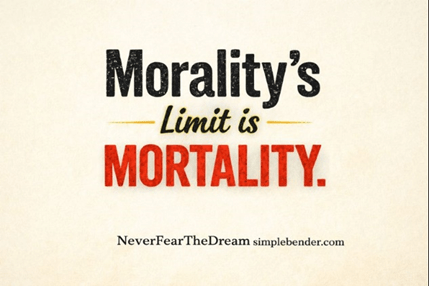
Find your moral fiber, but don’t stop there. Demand it—publicly and relentlessly—from anyone who seeks authority over your life. If they won’t live by civil standards, treat their immoral talk as propaganda to be challenged and rejected. One certainty: moral limits cease with mortality.  NeverFearTheDream   simplebender.com

Joy in Alzheimer’s
W.C. Barron
Lap Around the Sun
Daily Steps Forward — W.C. Barron
Posted in NeverFeartheDream

Never Fear The Dream…

The only way for the majority to be safe is for the minority to be free, acknowledged, and protected. 26.02.01

Joy in Alzheimer’s
W.C. Barron
Lap Around the Sun
Daily Steps Forward — W.C. Barron
Posted in Favoites

Accountability Gunned Down

and Credibility Mortally Wounded…..

The first videos weren’t clear. They were chaotic—grainy clips, partial frames, shouting without context. But the official messaging arrived before evidence was gathered, witnesses interviewed, or a timeline stitched together, the verdict was delivered. Heroic officers. Clear self-defense. Thwarted mass terror. The dead were “deranged domestic terrorists,” and the valiant officers had barely survived and saved many.

That’s narrative warfare—not investigation.

This is the modern media playbook: speak first, speak loudly, and force everyone else to prove you wrong. Flood the zone with ‘certainty,’ half-facts, and righteous adjectives. Let supporters do the rest. If later evidence complicates the story, it won’t matter; the first impression has already been welded into identity. And if you can manufacture images, clips, or “context” with AI, you can make doubt look like proof while you stall, bury, and obscure the real record.

What makes the lie persuasive is that it rides on a few fragments of truth. A legal concealed-carry permit becomes a justification for killing. A photo of a holstered firearm becomes “brandishing.” A moment of chaos becomes “attempted assassination.” A tender snapshot of agents “helping” a frightened child becomes moral cover for whatever came before or happens after. The lifestyle of one is used to instill moral judgment and question motive. Just enough ‘truth’ to make the rest feel plausible to the true believers.

We’re told to relax. Trust the regime and its process. Wait for the facts they want to show us. The rest of the facts arrive late and edited—while the narrative sprints ahead, unchallenged and amplified by officials who treat accountability as optional.

There’s a deeper fatal wound: credibility. Bullets may have killed Renee Good and Alex Pretti, but the words that followed targeted something larger—the public’s ability to discern what is real. When institutions train citizens to doubt their eyes and distrust every correction as “spin,” they aren’t governing; they’re conditioning. They are self-serving protectionists maximizing propaganda’s bullhorn.

So we should ask, without hysteria or naiveté: Was a five-year-old used as bait or as a shield? Was Good’s death justified or convenient? Was Pretti killed because he believed in the 2nd Amendment or because zealous masked bullies lost control of themselves? If we can be pushed to accept a finished story before an investigation even begins, what else have we been trained to swallow—about elections, wars, enemies, or the files that power keeps sealed? Move along, citizen. Nothing to see here.   NeverFeartheDream   simplebender.com

Joy in Alzheimer’s
W.C. Barron
Lap Around the Sun
Daily Steps Forward — W.C. Barron
Posted in NeverFeartheDream

Never Fear The Dream…

Mindfulness is about awareness and acceptance—of yourself and everything around you. 26.01.8

Joy in Alzheimer’s
W.C. Barron
Lap Around the Sun
Daily Steps Forward — W.C. Barron