Posted in Philosophy

Escape the Prison of Reflection: A Parable of Ego and Humility

An older man, with an air of superiority, left his opulent, gilded house and strolled into a bustling marketplace surrounded by his fawning, obedient minions. He proudly carried a polished, reflective, framed glass. His head held high, he admired his own reflection as he weaved through the crowd. The crowd could see him, but he could only see himself, and he was thoroughly pleased. He barely noticed those on either side of him as his minions pushed them aside out of his view. When he did catch a fleeting glimpse, he compared himself to them—the merchants, the homeless, the travelers, the artists, and the minorities—with his arrogance, ignorance, and bombast on full display, he declared, “I am far superior to them all, and they should be forbidden from saying otherwise.”

But as the day wore on, dust gathered on the glass. His reflection grew dim and distorted. He frowned, exclaimed how unfair and unacceptable the conditions were. He lifted his feeble arm and wiped it with his soiled sleeve. Raising it again, he loudly demanded that the crowd see him as he saw himself, even through the grime. Some ignored him, some laughed, and the braver, at great peril, mocked him. His anger rose, and his threats of retaliation grew robust and offensive.

At last, an old immigrant woman left the row of unpicked crops and approached him, offering nothing but silence in her weary eyes. With her weathered hands, she took the glass gently from his manicured fingers, turned it around, and asked, “What do you see now?” The mirrored glass, once a tool for self-admiration, now became a symbol of understanding and empathy as he viewed the world rather than himself.

The old man was initially taken aback but remained self-absorbed. In the mirror was no longer his own face, but the faces of the people around him—each one bearing burdens, scars, joys, and pride of their own which he had never truly seen or bothered to comprehend.

The old woman’s voice was a gentle, refreshing breeze: “The glass is not for self-worship but for understanding. Turn it outward and you’ll see the truth: you are not the center, only a small part. Your ego makes the glass a prison; humility makes it a window.” Her words carried a profound truth that seemed to resonate in the old man’s heart.

The old man, humbled by her wisdom, lowered his head. For the first time, the marketplace seemed vast and vibrant, filled not just with his own reflection but with the dreams of real people. He left the market, dusty and disheveled, and a question lingered for all who watched: Will he remember what the mirror revealed, or will he brush away the dust of human humility and return to the prison of his own reflection? As the old woman returned to the field, she turned and said: “We should all look into our own reflective glass and ask ourselves, how much of him are we?” #NeverFearTheDream

For Every Problem...A Solution...
Lap Around the Sun: Daily Steps Forward
Joy in Alzheimer’s: My Mom’s Brave Walk into Dementia’s Abyss

Posted in Current Events

From Comfort to Crisis: The Coming Reliability Deficit

The era of power limitations and rationing may be knocking on our door. Without a portfolio of power generation, the reality of July heat waves and January cold snaps causing rolling blackouts can be expected. Driven by data centers, the focus on household electrification, and a population that expects 24/7 plug-and-play power, the demand for electricity in the U.S. is increasing. Yet, the national discourse is veering towards reducing or even eliminating key alternatives—wind, solar, nuclear—and increasing reliance primarily on a finite resource; hydrocarbons. This is likely a shortsighted policy choice.

It is a potentially dangerous gamble. Our current fleet of natural-gas plants already runs near record levels, and petroleum generation is a rounding error in national totals. The Department of Energy (DOE) warns that by 2030, more than 100 GW of firm capacity will retire, while only 20GW of the planned new capacity is firm, dispatchable power. This type of power, which can be relied upon to meet demand at any time, is crucial for maintaining a stable and reliable grid. Even if we invested in new gas turbines today, it would take years to finance, permit, build, and connect them. Transmission projects face decade-long lead times even with streamlined regulations. In the meantime, demand does not politely wait—it climbs relentlessly, pressing the grid ever closer to its limits and breaking point.

And when, not if, the grid fails, the pain will not be evenly distributed. Households near and below the poverty line will suffer the most. For them, a prolonged outage in the middle of a heat dome or a polar vortex is not just uncomfortable—it is life-threatening. Wealthier households can afford generators, home batteries, or even leave town, but the poor cannot. Businesses will be forced to close, adversely affecting commerce. The cascading effects will stress public safety, and security risks will magnify as communications, traffic systems, and emergency response falter. This isn’t a dystopian forecast but a reasonable scenario to expect, or at least plan for.

The capital cost of replacing all lost alternatives with new gas is daunting, and would expose consumers to fuel price volatility and emissions penalties. More importantly, it overlooks the reliability and diversity that a balanced portfolio brings. A grid built on a single fuel is fragile—one pipeline outage, one price spike, one extended heavy load event away from disaster. Just like your personal finances, a balanced portfolio is more stable and outperforms all others. By diversifying our energy sources, we can build a more resilient and reliable grid, providing all of us with reassurance.

A more prudent path forward is to accelerate what works: finish stalled renewable projects, extend nuclear plant lifetimes, and streamline permitting for clean firm capacity. Oil and gas should remain the dependable floor—the baseload anchor, providing a consistent level of power—but not the sole pillar holding up the house. Meeting demand is possible, but only if we stop dismantling the roof while the storm clouds are gathering. My life has been in the oil and gas industry—but we must recognize that wind farms aren’t inherently evil; solar energy has its place in many regions, nuclear power should always be an option, and battery technology is essential. The choice is between planning now and positioning for the future. Spiking energy costs and rolling blackouts should not be acceptable options; they should be considered national failures. #NeverFearTheDream

For Every Problem...A Solution...
Lap Around the Sun: Daily Steps Forward
Joy in Alzheimer’s: My Mom’s Brave Walk into Dementia’s Abyss

Posted in Philosophy

Four Cascading Truths of Change

  • No situation is beyond change.
    • A shared vision and a sound strategy can shape that change.
      • Everyone must help make a difference.
        • No one is free of responsibilities.

Re-read those slowly. These truths have outlived generations because they work—alone or together. Like people, they stand stronger when connected.

Change is never still. It may be welcome or feared, but it will come. When we craft a common vision and act with purpose, change can be shaped instead of endured. That means leaning in—not leaving the work to “them,” whoever they are, nor just to yourself. Those who only watch from the sidelines end up resenting the outcome. Those excluded will also be resentful and work to sabotage the effort. Find a way to have a shared vision or the vision will eventually fail.

Being part of change means being accountable: creating, planning, and carrying some of the weight yourself. If everyone contributes, no one is left out—and no one is left behind.

The work never truly ends. When one change is complete, we pause, assess, and begin again. Done well, change builds its own momentum and draws people forward. Done poorly, it collapses under its own weight—because one or more of these truths was ignored or broken.

Bring everyone along. Let everyone contribute to their capacity. Share both the burden and the credit, but never the blame, that’s on you—and then—and only then will you change more than you ever imagined. #NeverFearTheDream

For Every Problem...A Solution...
Lap Around the Sun: Daily Steps Forward
Joy in Alzheimer’s: My Mom’s Brave Walk into Dementia’s Abyss

Posted in NeverFeartheDream

Never Fear The Dream…

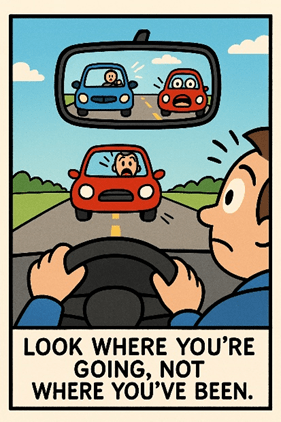
If you see today the same as yesterday, you’re not living in the present—you’re trapped in the past, with no future but its repetition. 25.09.3

For Every Problem...A Solution...
Lap Around the Sun: Daily Steps Forward
Joy in Alzheimer’s: My Mom’s Brave Walk into Dementia’s Abyss

Posted in Current Events, Political

Vilifier to Victim Cycle

Vilification is not an innocent weapon — it’s a destructive one. It takes little effort to sling insults, caricature opponents, or cast entire groups as villains. But like a boomerang, what you hurl often returns. The sharper the words, the more likely they cut you on the rebound. This cycle of destruction is something we must recognize — and break.

When you vilify, you don’t invite reasoned debate but reactionary hate. Anger rarely absorbs anger; it mirrors it. History shows escalation is almost inevitable: one stone cast is met with another, one torch answered with fire. In that spiral of hostility, the target shifts. Today’s accuser becomes tomorrow’s accused. The vilifier becomes the victim.

History offers painful lessons. Denunciation fueled the French Revolution, each faction outshouting and out-purging the last. Robespierre, once the loudest voice condemning “enemies of the revolution,” soon faced the guillotine he praised. Hate and retribution have no loyalty — they devour their own.

Modern politics echoes the same pattern. Leaders, activists, and media figures who stoke division often find themselves caught in the very fires they lit. Hate has no brake; once unleashed, it runs its own course.

Vilification is seductive. It feels like strength — drawing bold lines, protecting your tribe, mobilizing energy. But human nature is wired for reciprocity: what we project comes back. To weaponize hate is to release a force you cannot control. Your gender, race, faith, politics, or power won’t shield you — the backlash spares no one — you reap what you sow.

This is not a call for naïve pacifism but for clarity. To vilify is to plant the seed of retribution. To demonize is to risk becoming the demon in another’s story. History is merciless to those who think they can ride the tiger of hate and not be eaten.

When there is no room for counter-opinion, there is no compromise. Without compromise, polarity hardens into conflict. And conflict, left unchecked, leads to violence — and death. But there is hope. We should call for understanding, not for “beating the hell out of” those we oppose. Listening can reveal common ground. Words can wound, but they can also heal. If we speak to persuade rather than to poison, we stand a chance of escaping the boomerang’s return flight. Vilification may win the moment, but it never secures a peaceful future.  #NeverFearTheDream

For Every Problem...A Solution...
Lap Around the Sun: Daily Steps Forward
Joy in Alzheimer’s: My Mom’s Brave Walk into Dementia’s Abyss

Posted in Current Events

Roundabout Books-Bend, Oregon–Sat. 9/20

Excited to be part of this two hour event at Roundabout Books in NWCrossing, Bend this Saturday 12-2p.m.

Hoping all my Bend friends will come by and say hello. I will also have copies of Joy in Alzheimer’s: My Mom’s Brave Walk into Dementia’s Abyss……

Please support local authors and local book sellers…….

Posted in Current Events

Cause and Effect

History wears many masks. To some, it is nothing more than a tidy chronology of people and events. To others, it is the triumphal record of victors praising themselves over the vanquished. But its critical purpose is deeper: a study of cause and effect, an unblinking analysis illuminating the consequences when we choose to forget.

Amnesia is accidental, an uncontrolled loss of memory. What we face today is not amnesia but willed forgetting — intentional oblivion, the deliberate distortion of our collective memory. History is not supposed to soothe or flatter. In its fullness, it unsettles even as it enlightens. It is conscience and compass, guide and warning. Once edited for convenience or neutered by policy, it ceases to be either. It becomes propaganda for the weak, a tool of control disguised as comfort and a noble past.

The danger of this willed forgetting is simple: when the past is edited, the future tends to repeat its horrors and evils. Obliterated memory opens the door to evil and foolish repetition. It allows reality to be twisted into fictions that serve those who want to manipulate and/or lack the courage to confront and learn from the past. We cannot forget that human beings were once legal property, subject, without recourse, to mental, physical, and sexual abuse at the will of their ‘owners’. It is too easy to forget that this country was built upon and continues to rely on the labor of immigrants. We cannot forget the mortality and misery of children before vaccines — iron lungs for polio, blindness and brain damage from measles, deafness from mumps, miscarriages from rubella. To erase these memories is to invite and hasten the return of these atrocities.

We must have the courage to stand in the breach against this intentional oblivion. To study history, its cause and effect, is to bear witness, to heed its cries so that the next generation is spared their toll. It is too easy to listen to policymakers who pander for power. Too easy to strip protections from the weakest among us. It’s too easy to erase artifacts, ban books, and redact textbooks, all in the name of comfort. We must not turn a blind eye or deaf ear to the cries of those lessons lest we allow the next generation to suffer the plagues that will insidiously creep in and take their toll.

But comfort is not progress. Memory, even painful memory, is the price of wisdom and freedom. If we genuinely want to move forward, we must resist the temptation to rewrite the past and accept instead the discomfort of truth. Only in remembering — fully, painfully, and honestly — can we avoid repeating what history has already judged too costly to endure. You must understand the past to plan your future. Don’t erase, modify, or twist history—learn from it. #NeverFearTheDream

For Every Problem...A Solution...
Lap Around the Sun: Daily Steps Forward
Joy in Alzheimer’s: My Mom’s Brave Walk into Dementia’s Abyss

Posted in NeverFeartheDream

Never Fear The Dream…

Acceptance is harder than judgment—and far better. An open mind can be filled; a closed one isn’t worth the effort. Healing hurts. So does growth. So does learning. Pain often means you’re expanding your limits. 25.09.2

For Every Problem...A Solution...
Lap Around the Sun: Daily Steps Forward
Joy in Alzheimer’s: My Mom’s Brave Walk into Dementia’s Abyss

Posted in Current Events

Isolationism’s Price Tag: Self-Marginalization

Isolationism is not simply folding one’s arms and turning inward. It is worse. It is an accelerant poured on the fire of realignments already underway. Today, American isolationist tendencies, packaged as “America First” or wrapped in tariff protection, are not just national policies; they are geopolitical catalysts. And those sparks are igniting a wildfire that pushes Europe and the BRICS nations closer together, while the United States drifts toward self-marginalization.

The European Union, long a stable and interdependent ally, is recalibrating. Reeling from broken treaties and facing generational tariffs on steel, autos, and manufactured goods (Financial Times, July 2025), Brussels is negotiating as if Washington is no longer a reliable partner. Free trade agreements with India and Mercosur are being revived, with trade deficits accepted as a form of diversification insurance (European Commission, 2024). Strategic forums like Weimar+ are asserting European security identity outside NATO’s shadow. EU leaders now warn against “lecturing” the Global South (European Council, 2025), recasting Europe as a multipolar broker rather than a U.S. dependent.

BRICS has seized the moment. Expanded to include Saudi Arabia, the UAE, and Egypt, the bloc now represents nearly 47% of global GDP (PPP) and more than half of the world’s population (CFR, 2025). Intra-BRICS trade has surpassed flows with the G7 (BCG, 2024), and new payment systems are being constructed to reduce dollar dependence. By mid-2025, dollar use in inter-BRICS trade had fallen to one-third of prior levels (AgWeb, 2025). China and India—the world’s largest food consumers—are securing long-term agricultural pacts with Brazil and Russia (USDA, 2024).

Once again, America’s rural farm belt is bearing the brunt. U.S. agricultural exports to China fell 17% in early 2025 (American Action Forum), while South American soy and Russian wheat dominate EU and Asian contracts (Financial Times, June 2025). Brazil alone shipped $106 billion in agricultural commodities in 2024, much of it bound for Asia under preferential trade agreements (USDA, 2024). The USDA forecasts a 25% decline in net farm income in 2025 (USDA ERS). Rural America, once the proud breadbasket of the world, is being replaced—collateral damage of shortsighted policies and shifting winds of trade.

It does not take much to project forward. The U.S., reliant on debt-driven consumption, faces narrowing options. If Europe deepens trade with BRICS, and BRICS solidifies internal financing systems, the U.S. risks exclusion from supply chains and capital flows. Dollar dominance will not collapse, but it will erode as alternatives gain trust. The industrial base is unprepared—hampered by high labor costs and neglected infrastructure. America risks becoming a secondary commodities market for EU and BRICS products while its traditional export advantages are sourced elsewhere.

Yet decline is not destiny. The U.S. still holds immense resources: the deepest capital markets, unmatched military power, and hubs of innovation in energy, biotech, and technology. But those strengths are not shields against mistrust. They cannot offset a strategy that drives allies and rivals alike toward new arrangements that deliberately exclude us.

America’s greatest risk is not sudden collapse but creeping irrelevance: farm towns hollowed, factories bypassed, financial hubs sidelined, and household debt climbing. Isolationism, sold as insolating protection, will instead isolate. In a world reorganizing outward, self-marginalization is the steepest price of all. #NeverFearTheDream

For Every Problem...A Solution...
Lap Around the Sun: Daily Steps Forward
Joy in Alzheimer’s: My Mom’s Brave Walk into Dementia’s Abyss

Posted in Philosophy

Sometimes HOPE Needs a Little HELP

Hope is stubborn. It is resilient. It is also fragile, and often, it isn’t self-sufficient. Sometimes it needs a little help. It survives in a world that holds both the best and the worst of us—breakthroughs and backslides, mercy and malice—often on the same day.

When hope thins, we don’t need slogans; we need help. Sometimes that help is borrowed from others. Sometimes we loan it to ourselves. It can be as simple as noticing the ground we’ve gained, not just the mud we’re stuck in. Much remains broken—violence, injustice, genocidal aggressors, and loneliness—but much has moved forward: more cures, more voices heard, more tools to repair what we once accepted as incurable, unrepairable, and unbelievable. Progress for many is not yet progress for all. Both truths can stand. As does the truth that hope can be easily lost, but there is help.

Help for hope usually arrives in small packages: a neighbor’s knock, a hand on a shoulder, a laugh that breaks a hard silence. Tidal art scribbled in seaweed and sand dollars. The warm, unjudging eyes of a favorite pet. A child’s cheering as the lopsided sandcastle dares the next wave. The constant roll of the ocean or the low thrum of a river reminds you that motion exists even when you feel still.

If you’re carrying more night than daylight, don’t ignore or romanticize it—and don’t accept or surrender to it. Ask for help. Offer some. Build tiny structures of meaning you can reach without a ladder.

Many say these are dark days; others say they’re a dawn. Either way, morning keeps its appointment. There will be a sunrise tomorrow, even if it is behind the storm clouds. Let it be the HELP your HOPE needs—and let your hands make the most of the light. Speak up and Stand up for yourself and those who can not. Be your own help if you can, and be the help others may seek. You may not be able to initiate hope’s growth, but you can certainly start removing what inhibits it. #NeverFearTheDream

For Every Problem...A Solution...
Lap Around the Sun: Daily Steps Forward
Joy in Alzheimer’s: My Mom’s Brave Walk into Dementia’s Abyss