Posted in Political

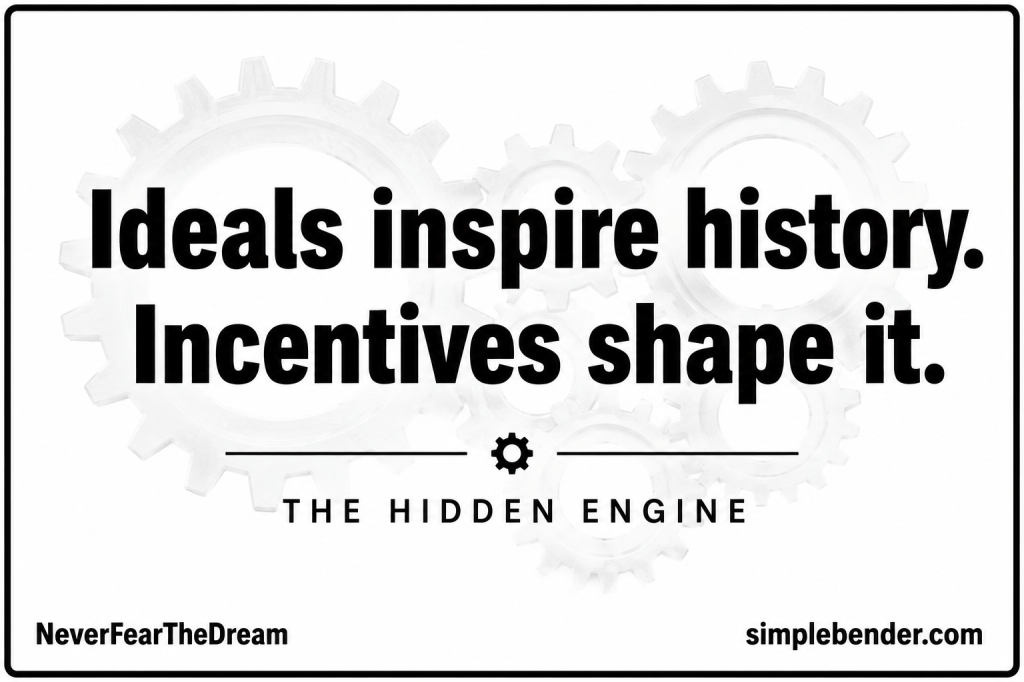
The Hidden Engine: Incentives Drive American History

History can be viewed through many lenses—culture, religion, technology, personalities, and ideals. One of the least celebrated, yet most consistently revealing, is incentives.

Our nation’s history, like that of most nations, is wrapped in slogans, banners, symbolism, and stirring ideals. Those are the stories we are taught, love to recite, and eagerly pass down from one generation to the next. Beneath them, however, lies a quieter force: incentives. History is also a story of wealth, resources, and the struggle to control them. Looking beyond the slogans does not diminish our past—it helps explain it, understand our present, and better anticipate our future.

History loves heroes because they are easy to remember. Incentives are harder to celebrate, yet they often explain why events unfolded as they did. The American Revolution is remembered as a triumph of liberty over tyranny. It was also a dispute over taxation, restrictions on western land, merchant profits, and who would control the colonies’ economic future. Liberty became the language of the revolution; incentives supplied its momentum.

The Constitution is rightly celebrated as the foundation of our republic. It also sought to stabilize commerce, resolve debt, protect contracts and property, and balance the competing interests of sovereign states and the new federal government. The Louisiana Purchase was as much about controlling the Mississippi River and expanding agriculture as it was about national destiny. The Mexican-American War brought territory, ports, mineral wealth, and farmland, accelerating American growth.

The Civil War is too often reduced to a choice between slavery and freedom. It was also a massive collision between competing economic systems. The North relied on industry, wage labor, railroads, finance, and expanding domestic markets. The South depended on plantation agriculture built on the horrific institution of slavery—a labor system that required enormous capital and drove global cotton production. Tariffs, transportation, banking, and western expansion were all gears in that engine.

The United States entered both world wars only after concluding that its secure commerce and long-term strategic interests were directly threatened, not for the grandiose, much-heralded altruistic reason of ‘saving the world.’ The New Deal helped struggling Americans and stabilized capitalism during an unprecedented economic crisis, thereby averting an outright civil revolt. The Cold War, Vietnam, and the Gulf conflicts were framed in ideological and moral language and falsely cast as pitched battles against Communism and Islam. Yet strategic resources, trade routes, and regional influence consistently drove policy.

The pattern persists today. Taxes, tariffs, national debt, healthcare, housing, climate policy, artificial intelligence, and immigration are debates over incentives and resource allocation. Politics is the mechanism by which societies decide how wealth, opportunity, and resources are created, distributed, protected, and transferred. Major conflicts arise when people no longer agree on those rules.

Every political philosophy ultimately answers one unavoidable question: Who controls the incentives that determine wealth, opportunity, and power? Everything else is the language used to justify those decisions. People rarely fight over money itself; they fight over the rules that determine who earns, keeps, taxes, inherits, spends, or controls it. Look beyond the banners and speeches. Whether the issues are local, regional, domestic, or international, follow the incentives. They have explained our past—and they will be the hidden engine driving our future.   NeverFearTheDream      simplebender.com

.. -. -.-. . -. – .. …- . … / -. — – / .. -.. . .- .-.. …


Lap Around the Sun: Daily Steps Forward
by WCBarron

Buy at Amazon Buy at Barnes & Noble Buy at Books2Read

Joy in Alzheimer’s: My Mom’s Brave Walk into Dementia’s Abyss
by WCBarron

Buy at Amazon Buy at Barnes & Noble Buy at Books2Read

Posted in Current Events

Cause and Effect

History wears many masks. To some, it is nothing more than a tidy chronology of people and events. To others, it is the triumphal record of victors praising themselves over the vanquished. But its critical purpose is deeper: a study of cause and effect, an unblinking analysis illuminating the consequences when we choose to forget.

Amnesia is accidental, an uncontrolled loss of memory. What we face today is not amnesia but willed forgetting — intentional oblivion, the deliberate distortion of our collective memory. History is not supposed to soothe or flatter. In its fullness, it unsettles even as it enlightens. It is conscience and compass, guide and warning. Once edited for convenience or neutered by policy, it ceases to be either. It becomes propaganda for the weak, a tool of control disguised as comfort and a noble past.

The danger of this willed forgetting is simple: when the past is edited, the future tends to repeat its horrors and evils. Obliterated memory opens the door to evil and foolish repetition. It allows reality to be twisted into fictions that serve those who want to manipulate and/or lack the courage to confront and learn from the past. We cannot forget that human beings were once legal property, subject, without recourse, to mental, physical, and sexual abuse at the will of their ‘owners’. It is too easy to forget that this country was built upon and continues to rely on the labor of immigrants. We cannot forget the mortality and misery of children before vaccines — iron lungs for polio, blindness and brain damage from measles, deafness from mumps, miscarriages from rubella. To erase these memories is to invite and hasten the return of these atrocities.

We must have the courage to stand in the breach against this intentional oblivion. To study history, its cause and effect, is to bear witness, to heed its cries so that the next generation is spared their toll. It is too easy to listen to policymakers who pander for power. Too easy to strip protections from the weakest among us. It’s too easy to erase artifacts, ban books, and redact textbooks, all in the name of comfort. We must not turn a blind eye or deaf ear to the cries of those lessons lest we allow the next generation to suffer the plagues that will insidiously creep in and take their toll.

But comfort is not progress. Memory, even painful memory, is the price of wisdom and freedom. If we genuinely want to move forward, we must resist the temptation to rewrite the past and accept instead the discomfort of truth. Only in remembering — fully, painfully, and honestly — can we avoid repeating what history has already judged too costly to endure. You must understand the past to plan your future. Don’t erase, modify, or twist history—learn from it. #NeverFearTheDream

For Every Problem...A Solution...
Lap Around the Sun: Daily Steps Forward
Joy in Alzheimer’s: My Mom’s Brave Walk into Dementia’s Abyss

Posted in Current Events

The Next Workforce: Undocumented

We stand on the edge, about to return to a dark period in our history—not the chains of the plantation, but a new form of labor, forged in law and sanitized by policy. Its roots are not in the Lost Cause but in Jim Crow, born of a single parenthetical phrase. It sits there in plain sight, unhidden, and dangerous—a legal justification waiting to be revived.

13th Amendment to the United States Constitution:
“Section 1. Neither slavery nor involuntary servitude, except as a punishment for crime whereof the party shall have been duly convicted, shall exist within the United States, or any place subject to their jurisdiction.”

That loophole was not an afterthought. It was demanded and defended to secure the Amendment’s ratification in 1865. Southern states then weaponized it through convict leasing and chain gangs. A practice some want to pretend didn’t happen and want to erase or bury in vague history—as if it never really happened.

The logic is chillingly simple. Every undocumented entrant violates Federal law. First entry: misdemeanor. Re-entry: felony. The 13th doesn’t distinguish — a crime is a crime. Increasingly, arrests occur without warrants, and detentions blur the line of due process, regardless of the circumstances. Traditionally, the punishment has been deportation. However, deportation leaves a labor vacuum in construction, agriculture, manufacturing, and other services. A clear economic disaster and ample justification for yet another ‘National Emergency.’ The temptation is obvious: why expel “criminals” when you can harness their labor?

Congress has never summoned the courage to erase this parenthetical. For 160 years, the loophole has endured. A handful of States have purged it from their constitutions, but the Federal version reigns supreme. If it is exploited again, it could be a mix of State and Federal sponsored incarcerated labor. We’ve lacked the fortitude to change it, and now may pay the price for our lack of conviction and foresight.

The path forward isn’t clear—it could be problematic, but it doesn’t have to be. Rather than arresting, deporting, or conscripting, let’s build America’s future upon the hopes, dreams, and passion all of us have to offer. But that isn’t history’s pattern. And history’s show never ends—it simply changes costumes.

For Every Problem...A Solution...
Lap Around the Sun: Daily Steps Forward
Joy in Alzheimer’s: My Mom’s Brave Walk into Dementia’s Abyss

Posted in Political

‘The Ultimate Cancel Act’ (Florida SB 1248): Beware of Unintended Consequences

Florida SB 1248 was filed and now referred to five committees. The current bill calls for the termination of any political party which ‘previously advocated for, or been in support of, slavery or involuntary servitude.’

What happens, presuming it passes and in the next session the Christian National Party (CNP) combines with the Southern Baptist Convention (SBC). The SBC was founded in 1845 to support the cause of slavery and gave it ‘biblical’ credibility. It took 173 years before the SBC softened its position. In keeping with SB 1248 the CNP and the SBC could be on a termination list.

What happens if the statue is amended to include non-political organizations. Would the Sons and Daughters of the Confederacy be at risk of termination? What about the monuments, statutes, and memorials which they sponsored, or which glorify the Confederacy? Wouldn’t they too be at risk?

What if in the preparation of statue regulations, or amendments, companies which benefited from Jim Crow Laws were included? The list of those whose founders supported or benefited from slavery or involuntary servitude could be extensive.

And as to involuntary servitude; what if the recent interpretation, by several Federal Judges, that forced continued pregnancy is in fact ‘involuntary servitude’ is upheld? Wouldn’t every anti-abortion organization and even churches be on the ever expanding list of organizations required to be terminated?

Good legislation is hard to craft and administer. Even the best risk their original intent being misinterpreted, modified, altered, or amended. But partisan legislation, passed in the heat of the moment or whimsically is ripe for abuse. Good legislation has a dual role. First, to support a positive change in society while simultaneously protecting the rights of all affected. All legislation has some degree of unintended consequences. This piece of partisan legislation is ripe for abuse, now and in the future. Let’s be careful what we ask for in all legislation and be ready for the inevitable unintended consequences.

#NeverFearTheDream

(If you like this post or are challenged by it, please considerer following)