Rejection of Western Supremacy: Defending Strategic Sovereignty
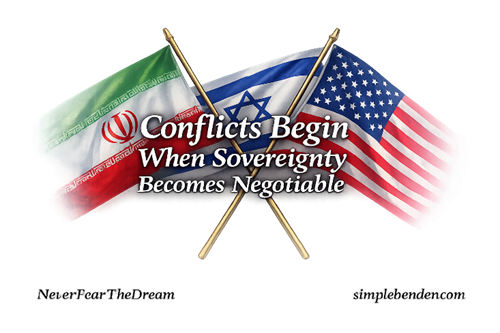
Perspective is everything… There is always another viewpoint to consider…not to agree or disagree with but to appreciate and understand…
Consider: We are increasingly viewed as an uncontrollable, ego-driven, nuclear-armed rogue nation…how would we respond to ourselves?
The current U.S.–Israel conflict with Iran began decades ago, through memory, humiliation, and contested sovereignty. Conflicts rarely begin with weapons. They begin when one nation decides another’s sovereignty is negotiable.
In the Iranian narrative, the creation of Israel in 1948 was not just the forced seizure of land and the establishment of a state. It was the implantation of a Western-supported political project into the heart of the Muslim world, leading to displacement, repeated wars, and ongoing territorial disputes.[1] For many throughout the region—including Iran, especially after the 1979 Islamic Revolution—the Palestinian cause became more than a geopolitical issue. It turned into a moral test of the Islamic world’s resolve and dignity. Legal disputes over occupation, settlements, and borders only strengthened that perception.[2]
Iran’s distrust of Western intentions hardened long before any nuclear ambition. In 1953, the U.S. and Britain supported the coup to overthrow Prime Minister Mohammad Mossadegh after he nationalized Iranian oil[3], just as Venezuela did. That intervention left a lasting mark, a generational memory. To the revolutionaries who later overthrew the Shah in 1979, it showed that Iranian sovereignty could be compromised whenever it conflicted with Western strategic interests.
The Shah’s brutal rule, especially during the student protests starting in 1978, was seen by many Iranians not as partnership but as alignment with foreign powers—security cooperation, oil coordination, and intelligence sharing that seemed to serve Washington’s Cold War agenda more than the interests of Iranian citizens.[3] When the Islamic Republic emerged, its ideology combined Shia political theology with anti-imperialist resistance and rejection of the Shah’s authoritarian rule. Independence was raised from a political choice to something more like a sacred duty.
The 1979 humiliating seizure of the U.S. Embassy in Tehran was viewed, by the West, as an act of lawlessness; in Tehran, it was justified as a preemptive move to prevent recurring foreign intervention.[4] The resulting hostage crisis and humiliating failed rescue attempt solidified a rift that has defined U.S.–Iran hostility ever since.[4][5]
Against this background, Iran’s nuclear program is often presented as a form of deterrence rather than aggression—especially in a region where Israel is widely believed to possess nuclear weapons under a policy of deliberate ambiguity.[6] Surrounded by U.S. military presence and regional instability, Iranian leaders argue, as do North Korea’s, that vulnerability invites intervention. Deterrence, in this context, acts as insurance, just as nuclear stockpiles do for the U.S. and Russia under the logic of mutually assured destruction.
From this perspective, what outsiders call escalation can seem like a form of strategic self-preservation. Iran’s stated goal is peaceful coexistence with neighbors—preferring trade over siege and recognition over tutelage—while staying prepared for perceived threats. Whether one accepts that framing or not, it is based on a simple idea: sovereignty needs the ability to defend itself, even as other regional sovereigns have been indiscriminately assaulted, Iran has acted with strategic patience.
This conflict is often mistakenly seen as religious because it lacks any clear reason, and adding a religious angle is the last tactic to ignite passions and gain support. In reality, the main issues are more geopolitical. Israel maintains strong ties with Muslim countries, and Iran works with non-Muslim allies when their interests align. Labeling this as a religious crusade greatly raises the chance of the conflict spreading worldwide. While religion fuels rhetoric, sovereignty shapes actions.
Remove the slogans and caricatures. They serve as rallying cries for the faithful. “Death to America” shares the same insecure roots and purpose as “fight like hell” and “axis of evil,” making the conflict easier to understand: a regional power seeking independence from a global power that wants to influence or control. Tensions have escalated over decades through intervention, oversight, resistance, mutual suspicion, secret negotiations, and arms deals.
To be very clear, the killing and abuse of protesters should never be normalized, anywhere and at any time; not during the Shah’s monarchy or under the Ayatollah. The depravity of the theological regime should not be downplayed. However, these are not external issues to solve. Western agents have been doing that for too long without any lasting change. The Iranian people chose an Islamic Republic; they can choose to change it; they have done so before and will do so again.
Empires remember insults; nations remember humiliation; and people endure suffering. Both memories tend to outlast treaties. This is another unfortunate, avoidable skirmish in a world on fire; a fire fueled by ego. NeverFearTheDream simplebender.com
-. — / ..-. . .- .-. / -. — / … .. .-.. . -. -.-. .
NeverFearTheDream simplebender.com Stand For Truth
Please consider following simplebender, you’re reading makes my writing more fun..…
Comments and thoughts are always welcome and feel free to re-post …..
Books You Might Enjoy…
Lap Around the Sun: Daily Steps Forward
by WCBarron
Buy at Amazon
Buy at Barnes & Noble
Buy at Books2Read
Joy in Alzheimer’s: My Mom’s Brave Walk into Dementia’s Abyss
by WCBarron
Buy at Amazon
Buy at Barnes & Noble
Buy at Books2Read
Footnotes
[1] Encyclopedia Britannica, “Arab–Israeli Wars” and “Palestine” entries (overview of the 1948 war and its aftermath).
[2] International Court of Justice, Legal Consequences of the Construction of a Wall in the Occupied Palestinian Territory (Advisory Opinion, 9 July 2004).
[3] Encyclopedia Britannica, “1953 Coup in Iran” (Operation Ajax; U.S./UK involvement and consequences).
[4] Encyclopedia Britannica, “Iran Hostage Crisis” (1979–1981; diplomatic rupture).
[5] U.S. Department of State, Office of the Historian, “The Iranian Hostage Crisis.”
[6] Federation of American Scientists, global nuclear stockpile assessments referencing Israel’s undeclared nuclear capability.
 SimpleBender.....wcb