Posted in Philosophy

Your Step is Your Choice

Where you step matters more than how you step.

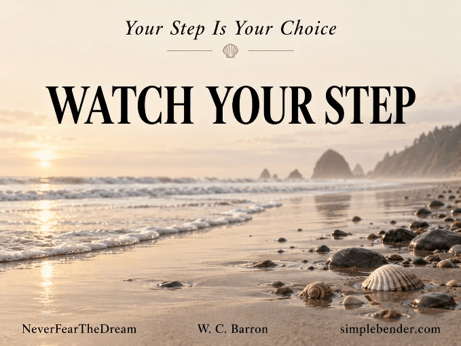
Walking along the rugged Oregon coast at low tide, I found the exposed sand smooth, firm, yet forgiving. I strode briskly, watching the surf and gulls and listening to waves breaking against the distant capes. I slipped off my sandals to feel the cool sand. My pace grew easy and carefree—until I stepped hard on the first stone.

Without noticing, I had wandered from smooth sand into a stretch peppered with stones, broken shells, and the discarded armor of crabs. My stride changed immediately. The beach hadn’t stopped me, nor had my destination changed, but suddenly where I placed my foot mattered more than how gracefully or quickly I walked. The journey remained the same distance. The experience and conditions had changed significantly.

I could have put my sandals back on and barged through. Protection was available to me. But something was interesting about staying barefoot. I had to pay attention. Every step required a small decision: sand, stone, shell, water. Being exposed without protection demanded awareness.

Life often offers us sandals. Money, position, privilege, education, experience, even simple good fortune can insulate us from terrain others must feel directly. There is nothing inherently wrong with wearing sandals. Sometimes wisdom demands them. But protection carries its own danger: eventually we may stop noticing what we are walking across—or what others are walking across without them.

That led me to another question. How much of our path do we actually choose? Some of it, certainly. Decisions accumulate beneath us like footprints in wet sand. But none of us selects the entire terrain. We inherit circumstances, encounter unexpected stones, climb hills we never intended to, and sometimes find ourselves on roads we would never have chosen. We may not be responsible for every path beneath our feet, but we remain solely responsible for the next step and its consequence.

Perhaps that is one of life’s quieter distinctions. The path is shaped by circumstance. The step is a choice. And the things we place between ourselves and the ground are protection. Wisdom lies in knowing which is which.

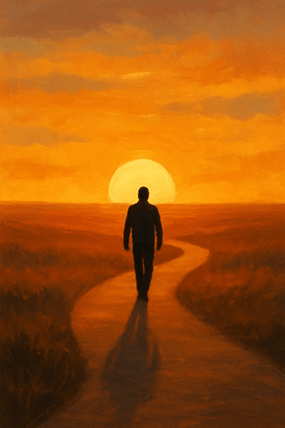
Life’s road is rarely narrow, straight, or smooth. It twists through roots and rocks, rises unexpectedly, and occasionally opens onto stretches of wonderfully firm sand. Sometimes we walk beside others; sometimes the path narrows, and we walk alone. Either way, attention matters. We should notice the hazards and opportunities along our path, but also recognize that the person beside us may be walking barefoot on entirely different ground.

Walk quickly if you wish. Walk slowly if you need to. Wear sandals when the terrain demands them, and take them off occasionally so you remember how the ground feels.

Watch where you step; your next one might land on someone else.

NeverFearTheDream………. W. C. Barron………. simplebender.com……….keystonecompact.org

-.– — ..- .-. / … – . .–. / -.– — ..- .-. / -.-. …. — .. -.-. .


Lap Around the Sun: Daily Steps Forward
by WCBarron

Buy at Amazon Buy at Barnes & Noble Buy at Books2Read

Joy in Alzheimer’s: My Mom’s Brave Walk into Dementia’s Abyss
by WCBarron

Buy at Amazon Buy at Barnes & Noble Buy at Books2Read
Posted in Current Events

Our National Midlife Crisis

Everyone ages, though few like to admit it. We prefer the glow of our youth—when everything felt strong, certain, and inevitable—yet we recoil from the mirror’s reflection that reveals a harsher truth. The United States, now, as an aging adult, is staring down its own midlife crisis: restless, nostalgic, anxious about declining vitality, and unsure of its purpose. And like any midlife crisis, it is largely self-inflicted.

As a fledgling republic, we leaned heavily on foreign counsel and support, learning to stand on principles whose ink was still wet. We quarreled with the empire that birthed us, a restless adolescent convinced that independence alone equated to maturity. In our late teens, our Manifest Destiny carried us across a continent—eager, energized, and careless. We violated Indigenous sovereignty, claimed vast stretches of land, and seldom paused to reflect on the cost—youth rarely does.

Then came the moment we stepped beyond our borders to confront tyranny abroad. Isolation gave way to global responsibility, and in defeating fascism, we crowned ourselves the “leader of the free world.” That era—the Greatest Generation era—became our cultural mythology of peak performance. In economic terms, we hit our stride: strong, wealthy, and ambitious, so confident we assumed the world wanted our model replicated everywhere.

Adulthood matured us further. We recognized injustices at home and, imperfectly, pushed to correct them. We abolished poll taxes, dismantled legal segregation, expanded civil rights, and pursued gender equality—though we famously stumbled in ratifying the ERA. Still, we dreamed big. We mapped the ocean floor and walked on the lunar surface. We believed no frontier was beyond reach.

But adulthood also revealed strain. Our swagger crippled amid a string of grinding foreign conflicts in which overwhelming force could not overcome nationalist resolve. Regime-change efforts faltered. Confidence thinned. The armor dulled. The steps slowed. The world noticed.

We now resemble a nation in midlife denial. We want the prowess of our youth without the discipline, unity, or sacrifice that once produced it. We have become too large, internally conflicted, and politically stiff, unable to move with the nimble decisiveness we admire in our past. Instead of planning for the next horizon, we rummage through the attic of lost greatness and flirt with the symbolic trappings of monarchy—strongman fantasies, grievance crowds, and performative nationalism. These are not signs of renewed vigor; they are early symptoms of institutional cognitive decline.

The irony is painful: past generations always knew our shared mission. We debated the path but rarely the direction. Today, the direction itself is disputed, diluted, or abandoned. A country without a horizon behaves like a retiree with no hobbies—restless, resentful, and prone to delusion.

Yet midlife crises can be turning points if approached with humility and long-view statesmanship. Older nations endure by learning from their past without worshipping it, by building for the grandchildren rather than reconstructing their own adolescence. The future is not reclaimed by nostalgia but by vision. Let’s not just look back; let’s learn from our past, reflect on it, and use it to shape our future.

So let us do what adults do at their best: acknowledge our age, accept our limitations, but not be defined by them, and chart a path worthy of those who will inherit this place. Square our shoulders, and focus forward—not back. Our midlife crisis can be a descent or a rebirth. We choose which. Collectively, with a common focus, let’s reject the polarizing radical positions of the extreme amongst us. Let’s encourage the great masses of the middle to lead us forward toward new goals and our next horizon. Let’s remember, we are all in this together, and it’s our shared responsibility to shape the future of our nation.    NeverFearTheDream   simplebender.com

… – — .–. / .-.. — — -.- .. -. –. / -… .- -.-. -.-


Lap Around the Sun: Daily Steps Forward
by WCBarron

Buy at Amazon Buy at Barnes & Noble Buy at Books2Read

Joy in Alzheimer’s: My Mom’s Brave Walk into Dementia’s Abyss
by WCBarron

Buy at Amazon Buy at Barnes & Noble Buy at Books2Read