Posted in Philosophy

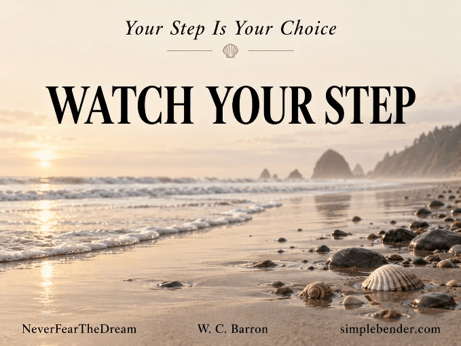
Your Step is Your Choice

Where you step matters more than how you step.

Walking along the rugged Oregon coast at low tide, I found the exposed sand smooth, firm, yet forgiving. I strode briskly, watching the surf and gulls and listening to waves breaking against the distant capes. I slipped off my sandals to feel the cool sand. My pace grew easy and carefree—until I stepped hard on the first stone.

Without noticing, I had wandered from smooth sand into a stretch peppered with stones, broken shells, and the discarded armor of crabs. My stride changed immediately. The beach hadn’t stopped me, nor had my destination changed, but suddenly where I placed my foot mattered more than how gracefully or quickly I walked. The journey remained the same distance. The experience and conditions had changed significantly.

I could have put my sandals back on and barged through. Protection was available to me. But something was interesting about staying barefoot. I had to pay attention. Every step required a small decision: sand, stone, shell, water. Being exposed without protection demanded awareness.

Life often offers us sandals. Money, position, privilege, education, experience, even simple good fortune can insulate us from terrain others must feel directly. There is nothing inherently wrong with wearing sandals. Sometimes wisdom demands them. But protection carries its own danger: eventually we may stop noticing what we are walking across—or what others are walking across without them.

That led me to another question. How much of our path do we actually choose? Some of it, certainly. Decisions accumulate beneath us like footprints in wet sand. But none of us selects the entire terrain. We inherit circumstances, encounter unexpected stones, climb hills we never intended to, and sometimes find ourselves on roads we would never have chosen. We may not be responsible for every path beneath our feet, but we remain solely responsible for the next step and its consequence.

Perhaps that is one of life’s quieter distinctions. The path is shaped by circumstance. The step is a choice. And the things we place between ourselves and the ground are protection. Wisdom lies in knowing which is which.

Life’s road is rarely narrow, straight, or smooth. It twists through roots and rocks, rises unexpectedly, and occasionally opens onto stretches of wonderfully firm sand. Sometimes we walk beside others; sometimes the path narrows, and we walk alone. Either way, attention matters. We should notice the hazards and opportunities along our path, but also recognize that the person beside us may be walking barefoot on entirely different ground.

Walk quickly if you wish. Walk slowly if you need to. Wear sandals when the terrain demands them, and take them off occasionally so you remember how the ground feels.

Watch where you step; your next one might land on someone else.

NeverFearTheDream………. W. C. Barron………. simplebender.com……….keystonecompact.org

-.– — ..- .-. / … – . .–. / -.– — ..- .-. / -.-. …. — .. -.-. .


Lap Around the Sun: Daily Steps Forward
by WCBarron

Buy at Amazon Buy at Barnes & Noble Buy at Books2Read

Joy in Alzheimer’s: My Mom’s Brave Walk into Dementia’s Abyss
by WCBarron

Buy at Amazon Buy at Barnes & Noble Buy at Books2Read
Posted in Current Events

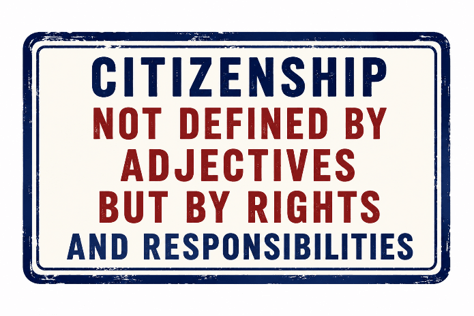
Citizen: Adjectives Not Required

Protection Imperative

America’s founding documents largely avoided attaching adjectives to the concept of “Citizen.” They established broad philosophical principles centered on liberty, personal rights, and self-determination without attempting to divide citizenship into preferred categories. For their time, the idea was radical: a nation built more on shared principles than on shared bloodlines.

Our founders were imperfect people, constrained by the limits and prejudices of their era. Yet many of their aspirations remain deeply human and recognizable today. They sought the freedom to shape their own lives, raise their families safely, worship as they chose, speak openly, and pursue opportunity without a domineering central authority. They envisioned a country driven not by inherited class, tribe, bloodline, or title, but by the ambitions and determination of its citizens.

The Constitution and the Bill of Rights speak largely in universal terms: citizens, persons, and the people. The documents themselves are far more neutral than many who later interpreted and enforced them.

The problem has rarely been the principles. It has been people; it is us, the “Citizens.”

Human beings instinctively protect power once they possess it. They create social and political adjectives around the word “Citizen” to determine who fully belongs, who deserves influence, whose rights matter more, and whose freedoms may be limited. Throughout history, those in power have repeatedly narrowed broad constitutional principles through discrimination, exclusion, fear, and tribal identity.

That reality is precisely why federal and state protections became necessary. The Constitution may aspire toward color-blind liberty; the administration of those principles has often fallen short. Courts and lawmakers must continually wrestle with that contradiction while remaining anchored in the original promise of equal citizenship under the law.

The easy path is to turn a blind eye to humankind’s tendencies. The hard path, but the right one, is to address, restrain, and retrain them and to uphold the standards of our original foundations.

Citizenship carries enormous responsibility and accountability. It also carries extraordinary freedom. Both weaken the moment adjectives become more important than the word “Citizen” itself.                     NeverFearTheDream   simplebender.com

… .. — .–. .-.. . / -.-. .. – .. –.. . -.


Lap Around the Sun: Daily Steps Forward
by WCBarron

Buy at Amazon Buy at Barnes & Noble Buy at Books2Read

Joy in Alzheimer’s: My Mom’s Brave Walk into Dementia’s Abyss
by WCBarron

Buy at Amazon Buy at Barnes & Noble Buy at Books2Read
Posted in Current Events

Isolationism’s Price Tag: Self-Marginalization

Isolationism is not simply folding one’s arms and turning inward. It is worse. It is an accelerant poured on the fire of realignments already underway. Today, American isolationist tendencies, packaged as “America First” or wrapped in tariff protection, are not just national policies; they are geopolitical catalysts. And those sparks are igniting a wildfire that pushes Europe and the BRICS nations closer together, while the United States drifts toward self-marginalization.

The European Union, long a stable and interdependent ally, is recalibrating. Reeling from broken treaties and facing generational tariffs on steel, autos, and manufactured goods (Financial Times, July 2025), Brussels is negotiating as if Washington is no longer a reliable partner. Free trade agreements with India and Mercosur are being revived, with trade deficits accepted as a form of diversification insurance (European Commission, 2024). Strategic forums like Weimar+ are asserting European security identity outside NATO’s shadow. EU leaders now warn against “lecturing” the Global South (European Council, 2025), recasting Europe as a multipolar broker rather than a U.S. dependent.

BRICS has seized the moment. Expanded to include Saudi Arabia, the UAE, and Egypt, the bloc now represents nearly 47% of global GDP (PPP) and more than half of the world’s population (CFR, 2025). Intra-BRICS trade has surpassed flows with the G7 (BCG, 2024), and new payment systems are being constructed to reduce dollar dependence. By mid-2025, dollar use in inter-BRICS trade had fallen to one-third of prior levels (AgWeb, 2025). China and India—the world’s largest food consumers—are securing long-term agricultural pacts with Brazil and Russia (USDA, 2024).

Once again, America’s rural farm belt is bearing the brunt. U.S. agricultural exports to China fell 17% in early 2025 (American Action Forum), while South American soy and Russian wheat dominate EU and Asian contracts (Financial Times, June 2025). Brazil alone shipped $106 billion in agricultural commodities in 2024, much of it bound for Asia under preferential trade agreements (USDA, 2024). The USDA forecasts a 25% decline in net farm income in 2025 (USDA ERS). Rural America, once the proud breadbasket of the world, is being replaced—collateral damage of shortsighted policies and shifting winds of trade.

It does not take much to project forward. The U.S., reliant on debt-driven consumption, faces narrowing options. If Europe deepens trade with BRICS, and BRICS solidifies internal financing systems, the U.S. risks exclusion from supply chains and capital flows. Dollar dominance will not collapse, but it will erode as alternatives gain trust. The industrial base is unprepared—hampered by high labor costs and neglected infrastructure. America risks becoming a secondary commodities market for EU and BRICS products while its traditional export advantages are sourced elsewhere.

Yet decline is not destiny. The U.S. still holds immense resources: the deepest capital markets, unmatched military power, and hubs of innovation in energy, biotech, and technology. But those strengths are not shields against mistrust. They cannot offset a strategy that drives allies and rivals alike toward new arrangements that deliberately exclude us.

America’s greatest risk is not sudden collapse but creeping irrelevance: farm towns hollowed, factories bypassed, financial hubs sidelined, and household debt climbing. Isolationism, sold as insolating protection, will instead isolate. In a world reorganizing outward, self-marginalization is the steepest price of all. #NeverFearTheDream

For Every Problem...A Solution...
Lap Around the Sun: Daily Steps Forward
Joy in Alzheimer’s: My Mom’s Brave Walk into Dementia’s Abyss