Posted in Current Events

Pawns of Power

poster declaring law should not be a weapon

Laws are supposed to be the bones of a society: neutral, structural, holding us upright. Law enforcement and the courts are meant to be the muscles that move those bones, not the fists of those who hold the throne or the majority. When that line blurs, when enforcement and justice become tools of power rather than its restraint, a nation quietly shifts away from a representative republic into a dystopian state.

We don’t have to look too far back in history for insight…

On the eve of the French Revolution, courts and law enforcement were not known for their impartiality. Judgeships were bought. Noble privilege was protected. Commoners knew they lived under one set of rules while the gilded lived under another. The Bastille didn’t fall because of seven prisoners; it fell because the building had become a cold stone symbol proclaiming that the law served the crown, not the people.

More recently, Nazi Germany carried this to an industrial scale. The regime did not usually act “outside” the law; it rewrote the law. Judges swore loyalty not to justice, but to Hitler. Police, courts, and camps formed a single pipeline: define enemies, demean them, label them criminal, process them through a legal machine designed to produce the same answer every time—guilty and repulsive. Decent people and law enforcement could tell themselves they were “following and upholding the law,” all the while the law itself had been converted into a weapon.

The pattern is always the same: two-track justice, selective enforcement, and a growing sense that legal outcomes can be predicted by status, ideology, race, ethnicity, or wealth before any evidence is heard. Power claims the language of order and safety, then quietly rigs the referees.

We should stop deceiving ourselves that “it can’t happen here.” Instead, we must ask: Are the laws and enforcement practices fair and impartial? Citizens need to question whether the justice system’s harshness is aimed downward and if mercy is truly reserved for the well-connected or like-minded. The uniforms, the architecture, and the slogans may differ. The logic does not. It may not be their intent, but their enforcement practices become a reality they must recognize. As many lose confidence in their independence, they lose support, which in turn leads to greater distrust and disdain.

A free society does not depend on the moral character of its rulers; it depends on the independence of its restraints. When those restraints are captured and controlled, the slide is already underway, even if the fragile skeletal forms of democracy remain.

So the uncomfortable question is this: Is law enforcement and justice beginning to tilt toward power? How long can ordinary citizens obey without quietly helping to destroy the very rule of law they claim to defend? When will they rise up, and will it be too late? Turn up the volume and blow your whistle loud and often. NeverFearTheDream   simplebender.com

Joy in Alzheimer’s
W.C. Barron
Lap Around the Sun
Daily Steps Forward — W.C. Barron

Posted in Current Events

From Comfort to Crisis: The Coming Reliability Deficit

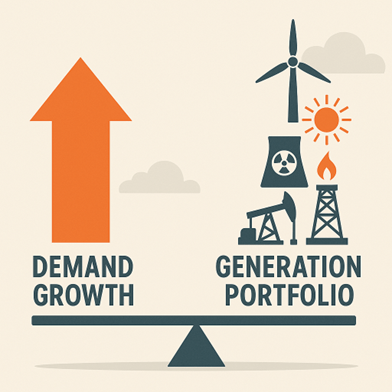
The era of power limitations and rationing may be knocking on our door. Without a portfolio of power generation, the reality of July heat waves and January cold snaps causing rolling blackouts can be expected. Driven by data centers, the focus on household electrification, and a population that expects 24/7 plug-and-play power, the demand for electricity in the U.S. is increasing. Yet, the national discourse is veering towards reducing or even eliminating key alternatives—wind, solar, nuclear—and increasing reliance primarily on a finite resource; hydrocarbons. This is likely a shortsighted policy choice.

It is a potentially dangerous gamble. Our current fleet of natural-gas plants already runs near record levels, and petroleum generation is a rounding error in national totals. The Department of Energy (DOE) warns that by 2030, more than 100 GW of firm capacity will retire, while only 20GW of the planned new capacity is firm, dispatchable power. This type of power, which can be relied upon to meet demand at any time, is crucial for maintaining a stable and reliable grid. Even if we invested in new gas turbines today, it would take years to finance, permit, build, and connect them. Transmission projects face decade-long lead times even with streamlined regulations. In the meantime, demand does not politely wait—it climbs relentlessly, pressing the grid ever closer to its limits and breaking point.

And when, not if, the grid fails, the pain will not be evenly distributed. Households near and below the poverty line will suffer the most. For them, a prolonged outage in the middle of a heat dome or a polar vortex is not just uncomfortable—it is life-threatening. Wealthier households can afford generators, home batteries, or even leave town, but the poor cannot. Businesses will be forced to close, adversely affecting commerce. The cascading effects will stress public safety, and security risks will magnify as communications, traffic systems, and emergency response falter. This isn’t a dystopian forecast but a reasonable scenario to expect, or at least plan for.

The capital cost of replacing all lost alternatives with new gas is daunting, and would expose consumers to fuel price volatility and emissions penalties. More importantly, it overlooks the reliability and diversity that a balanced portfolio brings. A grid built on a single fuel is fragile—one pipeline outage, one price spike, one extended heavy load event away from disaster. Just like your personal finances, a balanced portfolio is more stable and outperforms all others. By diversifying our energy sources, we can build a more resilient and reliable grid, providing all of us with reassurance.

A more prudent path forward is to accelerate what works: finish stalled renewable projects, extend nuclear plant lifetimes, and streamline permitting for clean firm capacity. Oil and gas should remain the dependable floor—the baseload anchor, providing a consistent level of power—but not the sole pillar holding up the house. Meeting demand is possible, but only if we stop dismantling the roof while the storm clouds are gathering. My life has been in the oil and gas industry—but we must recognize that wind farms aren’t inherently evil; solar energy has its place in many regions, nuclear power should always be an option, and battery technology is essential. The choice is between planning now and positioning for the future. Spiking energy costs and rolling blackouts should not be acceptable options; they should be considered national failures.

For Every Problem...A Solution...
Lap Around the Sun: Daily Steps Forward
Joy in Alzheimer’s: My Mom’s Brave Walk into Dementia’s Abyss

Posted in NeverFeartheDream

Never Fear The Dream…

If all you’ve ever known is privilege, you believe in your superiority and resist efforts for equality and balance. If all you’ve ever known is oppression, then you believe in your right to resist. If the privileged sense a loss of inherited rights, they are incensed. If the oppressed gain any new rights, they feel empowered to grasp for more. And so, the power pendulum swings synchronized with misunderstanding and mistrust. At some point, the pendulum must reach a point of stasis, lest we are forever trapped in senseless struggles. 25:07

simplebender.com @simplebender.bsky.social