Posted in Keystone

Capitalism Needs Rules, Not Cronyism

Being pro-business is easy; being pro-market means defending competition, even when insiders oppose it.

The last essay argued that a tax code should raise necessary revenue without becoming a warehouse for political favors. That principle extends beyond taxation. Economic freedom cannot survive when government embeds private advantages in public rules.

Capitalism and corporate favoritism are often treated as the same system, but they are not. Free enterprise depends on people being able to create, invest, work, trade, compete, fail, and try again under rules that are understandable and reasonably equal. Crony capitalism begins when success depends less on the value created than on purchased access.

Healthy markets require rules. Contracts must be enforceable, property rights must be secure, and accounting must be honest. Fraud, theft, coercion, and monopoly abuse must carry consequences. Workers must be able to move, customers must be able to choose, and new competitors must be able to enter without first seeking permission from firms already in the market.

Markets without rules do not remain free. They become hunting grounds for those with the most information, leverage, or political protection.

Government can distort competition in many familiar ways: subsidies for favored firms, bailouts that shield decision-makers from the consequences of failure, regulatory carveouts, licensing barriers unrelated to public safety, procurement written around a preferred bidder, monopoly protections, donor favors, and agencies effectively governed by the industries they regulate. Each advantage is defended as temporary, strategic, necessary, or too technical for ordinary citizens to question.

The cost is widely distributed, making it easy to hide. Entrepreneurs face higher barriers. Small firms absorb compliance costs that large competitors spread across entire departments. Ratepayers and customers pay more. As markets consolidate, workers lose options. Taxpayers finance the rescue while executives and investors retain the upside. Political influence becomes an economic asset.

Pro-business is not the same as pro-market.

The Keystone Compact supports capitalism because decentralized enterprise, voluntary exchange, investment, and competition create opportunities that government cannot command into existence. It opposes crony capitalism because political favoritism corrupts those strengths and turns public authority into private insulation.

That means the government should establish fair rules, punish fraud, enforce contracts, protect property, scrutinize monopolistic abuse, and resist the temptation to pick winners. It should not guarantee every business a profit or every worker a particular outcome. Failure is part of a functioning market. But failure must not be reserved for small firms while politically connected institutions receive rescue packages and revised rules.

Both parties compromise this principle in different ways. Populists often defend favored corporations as though every corporate demand were a defense of capitalism. Progressives often build regulatory and subsidy systems that reward approved industries, institutions, or social objectives, then call the resulting favoritism justice. One side protects incumbents through deference, while the other protects them through bureaucracy. Either way, competition, and the consumer, loses.

Economic stewardship requires more than cheering on growth statistics. It asks where opportunity begins, who bears risk, who receives protection, and whether rules reward productive value or political proximity. A booming sector built on permanent subsidies, captured regulation, or suppressed competition may enrich insiders while leaving the broader economy less resilient.

The local evidence is usually clearer than the national rhetoric. A contractor watches a public bid go to a larger competitor. A farmer sees a program designed for the scale of corporate agriculture. A neighborhood business spends scarce hours complying with rules that a national chain handles automatically. A worker remains in a poor job because licensing barriers make moving costly. The public is falsely told that tariffs burden a nondescript foreign importer, when in fact domestic businesses and the consumer are ultimately responsible. Another hidden tax. These are not abstract market failures. They are the daily price of connections becoming more valuable than competence.

The Government should not be anti-business. It should be anti-favoritism. It should welcome enterprise, reduce needless barriers, protect competition, and apply consequences consistently. The standard must be grounded in equal rules: no private immunity based on corporate size, no public punishment for political disfavor, and no hidden thumb on the scale.

The market test is simple: does policy reward value created or connections bought?

That question closes the fiscal category and opens the next. A free economy will still produce hardship, disruption, illness, disability, and bad luck. The challenge is not whether a decent society should help. It is whether assistance restores agency or quietly becomes another system organized around dependency and political management.

Next in Category III: Compassion Should Help People Stand

NeverFearTheDream………. W. C. Barron………. simplebender.com……….keystonecompact.org


Lap Around the Sun: Daily Steps Forward
by WCBarron

Buy at Amazon Buy at Barnes & Noble Buy at Books2Read

Joy in Alzheimer’s: My Mom’s Brave Walk into Dementia’s Abyss
by WCBarron

Buy at Amazon Buy at Barnes & Noble Buy at Books2Read
Posted in Keystone

Rights Are Not Tribal Trophies

CATEGORY I: FOUNDATIONAL PHILOSOPHY  |  Article 2 OF 4  |  WHY WE NEED THIS DISCUSSION

A right that survives only when your side approves is not a right. It is a permission slip.

The first essay in this series (America Does Not Need Another Tribe) rejected the party bargain that asks citizens to trade judgment for belonging. That refusal has consequences. Once no party owns our conscience, no party can ever claim ownership of our rights.

A right that survives only if your side approves is not a right. It is a permission slip.

American politics routinely praises liberty in the abstract and negotiates it away in practice. Free speech is deemed sacred until the speaker becomes contrarian or countercultural. Due process is indispensable until the accused is despised or destitute. Privacy matters until surveillance targets the other side. Religious liberty is celebrated when it protects familiar beliefs and dismissed when it protects unfamiliar ones. Equal protection is invoked as a principle, then narrowed to a benefit for the politically favored.

Every tribe is eloquent when it feels threatened. The real test comes when it holds power.

Rights are not rewards for good behavior, respectable opinions, or approved identities. Their purpose is most evident when they protect the critic, the dissenter, the unpopular speaker, the accused, the religious minority, the disliked neighbor, and the political opponent. A system that protects only agreeable people does not need a Bill of Rights.

The Keystone Compact therefore treats free speech, religious liberty, due process, privacy, equal protection, property rights, bodily autonomy, and peaceful disagreement as part of a single moral framework. These protections do not belong to the right, the left, the center, the religious, the secular, the majority, the marginalized, or the compromised. They belong to all people because political power is too dangerous to be used to distribute them selectively.

That universality will make nearly everyone uncomfortable at some point. It means defending the right of a small-town church to worship without harassment and the right of a gay couple to live openly under the same law. It means protecting a gun owner’s lawful property and a pro-choice woman’s bodily autonomy. It means ensuring due process for an immigrant facing removal and for a police officer accused of misconduct. It means allowing a controversial speaker to speak and peaceful protesters to protest. It means respecting the conscience of a religious doctor while ensuring that public policy does not erase a patient’s lawful access to care.

These cases are not identical, and policy details matter. The principle that unites them is that the government may not change the rules merely because the person seeking protection has become unpopular.

Selective rights create a predictable civic disaster. When citizens believe the law will be applied differently depending on who controls the institutions, they lose trust in the law itself. Politics then becomes a race to seize the weapon before the opposing tribe can wield it. Elections feel existential. Courts become prizes. Agencies become instruments of revenge. Every transfer of power breeds fear because restraint has been replaced by an expectation of retaliation.

That is how constitutional government decays: not usually through a single dramatic decree, but through a thousand exceptions, each defended as necessary at the time.

The defense of universal rights is sometimes mistaken for moral indifference. It is the opposite. It requires moral discipline. We can condemn a person’s words without asking the government to silence them. We can oppose a person’s choices without denying equal protection. We can demand accountability while preserving due process. We can hold strong beliefs without using public power to force peaceful neighbors to live by them.

Pluralism is not agreement. It is the constitutional maturity to accept that disagreement does not erase citizenship.

The Keystone Compact offers no tribal exemption. The same standard must apply when power changes hands, when headlines turn ugly, and when the person invoking a right makes us angry. Otherwise, rights are merely temporary permissions granted by whoever won the last election.

Here is the practical test: would you defend the same right for someone whose bumper sticker makes your blood pressure rise?

If the answer is no: the problem is probably not the ‘right’ but our desire to control who deserves it.

Once rights belong to everyone, another question becomes unavoidable. What should government presume when peaceful adults make private choices? The Keystone answer is not supervision. Personal liberty is the default.

Next in Category I: Personal Liberty Is the Default

NeverFearTheDream………. W. C. Barron………. simplebender.com……….keystonecompact.org

– .-. .. -… . … / -.. — -. .—-. – / -.-. — -. – .-. — .-.. / -.– — ..- .-. / .-. .. –. …. – …


Lap Around the Sun: Daily Steps Forward
by WCBarron

Buy at Amazon Buy at Barnes & Noble Buy at Books2Read

Joy in Alzheimer’s: My Mom’s Brave Walk into Dementia’s Abyss
by WCBarron

Buy at Amazon Buy at Barnes & Noble Buy at Books2Read
Posted in Current Events

The Logic Trap of “Choice”: But Whose Choice?

Some communities insist no one has the right to tell you what goes into your body. Vaccine mandates for children? Eliminated. Parents, they say, should decide. Yet the same lawmakers ban abortion, declaring the state must dictate what goes into—or comes out of—a woman’s body. One breath they champion autonomy—“your body, your choice.” The next, they revoke it. That is the hypocrisy of their own making: a logic trap.

This is hubris—elevating choice above consequence until the reckoning arrives. By enthroning autonomy in one case and crushing it in another, political positions collapse under their own contradictions.

The deeper problem is not hypocrisy alone, but the refusal to face consequences. If a sick, unvaccinated child infects another and death follows, is that so different from a parent choosing to end a pregnancy? Both are questions of prevention—or its absence. Both end in the loss of life. Stripped of rhetoric, the moral arithmetic is the same.

Plato’s Ship of State reminds us that freedom without shared responsibility is not freedom but chaos. To let each untrained helmsman steer as he pleases is to wreck the vessel and drown all aboard. Vaccine “freedom” follows the same course: individual choice unmoored from collective duty imperils the innocent.

Abortion bans claim to “protect life.” Yet removing vaccine safeguards erodes the very protections that preserve the living. Both paths, meant to uphold life, may instead hasten its loss. Vaccination is not solely a personal decision; it is an act of care for the vulnerable child who cannot choose. To shrug it off is to clearly echo and exclaim the denial: “I am not my brother’s keeper.” That is tragedy—outcome born of blindness to consequence.

If morality is to mean anything, it cannot be applied with one hand and denied with the other. If a child who is unable to be vaccinated dies from exposure, who bears responsibility? The parents of the unvaccinated infecting child? The government that stripped safeguards? The community that endorsed it? Those who hold women accountable for abortion, especially those who are rape victims, cannot escape this parallel dilemma. Freedom framed as virtue but practiced as refusal to protect another is no virtue at all. Either the body is inviolable, or it is not. Either life is sacred in all forms, or it is not. Pretending otherwise is meant to satisfy a political base, but it cannot withstand the test of reason—or history. #NeverFearTheDream

For Every Problem...A Solution...
Lap Around the Sun: Daily Steps Forward
Joy in Alzheimer’s: My Mom’s Brave Walk into Dementia’s Abyss

Posted in Communication

Viewpoint Discrimination: Forgetting What Makes Us Free?

Isn’t the difference of opinion the very thing that built this country?

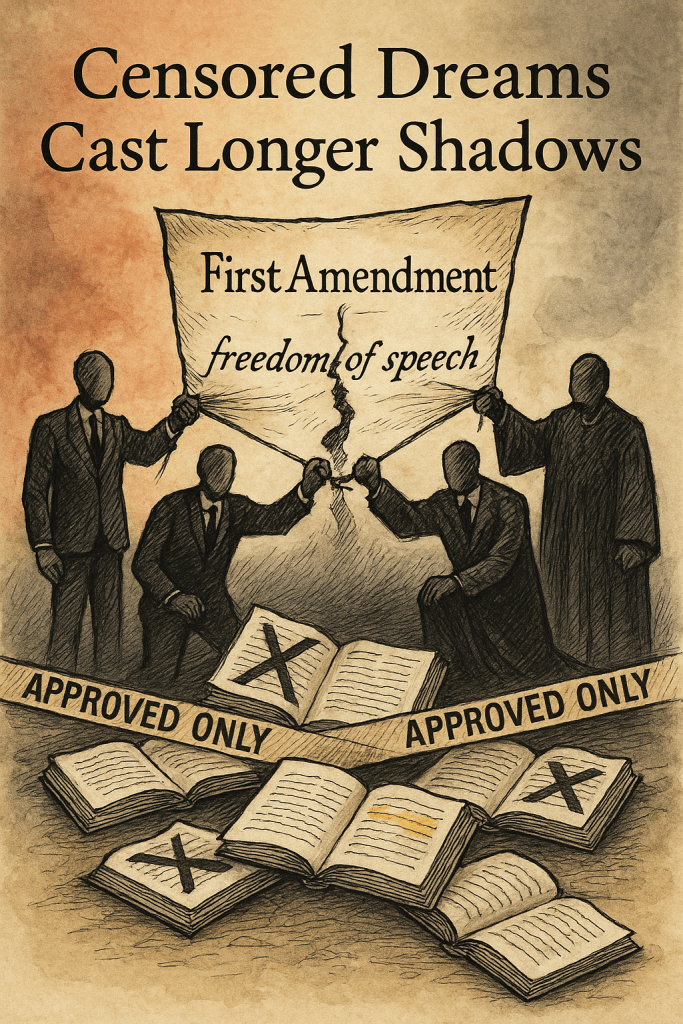
We weren’t founded on sameness—but on dissent. The thirteen colonies didn’t rise up because they agreed with the power, but because they dared to question it. That impulse—audacious, messy, courageous—is what the First Amendment was written to protect. And yet, here we are again, toying with the dangerous idea that some speech is more tolerable than others. That some viewpoints belong, and others must be silenced and erased.

Shouldn’t that make us uncomfortable?

When tax-funded public institutions—schools, libraries, boards—begin removing books because someone doesn’t like what they say, that’s not preservation of order. That’s viewpoint discrimination. It’s not protecting children. It’s insulating and cuddling weak ideologies. And it’s a blade that ultimately cuts both ways.

You may cheer today when a book you dislike is banned. But what happens tomorrow, when the next board turns its gaze toward the ones you cherish? What makes you think your shelves won’t be next?

We have been here before. In the 1950s, it was Communists. In the 1930s, it was Jews, dissidents, and “degenerates.” Ideas were labeled threats. Libraries were sanitized. People fell silent. Is that the direction we want to revisit?

And what of free speech? Have we forgotten that the First Amendment isn’t just the right to speak, but the right to receive, to read, to explore—especially the uncomfortable truths?

A candidate who once shouted from podiums about the sanctity of the First Amendment, to get elected, now wields it like a partisan tool—defending it when it serves him, abandoning it when it doesn’t, and threatening retaliation, retribution, revoking citizenship, and deportation. Isn’t that the ultimate hypocrisy? To claim allegiance to liberty, but only on your terms, isn’t democracy; it is authoritarianism.

Let’s ask plainly: If a public school or library removes a book about a Muslim child exploring faith, or an LGBTQ teen navigating identity, or a historical critique of systemic injustice—while allowing others that affirm dominant religious or political norms—can that possibly be considered neutral? Can it promote learning diversity and inclusion, or only foster selfish isolation and the illusion of greatness?

And if the government—through policy, threat, or performance—signals what speech is safe and what is not, can we still call ourselves a free people?

Pluralism is not about liking every voice. It’s about letting them speak. It’s about understanding that in a nation where taxes are paid by atheists and Baptists, Muslims, Mormons, and immigrants, the public square must be open to all—or none.

If one religion is given space in a publicly funded institution, then all must be. If one ideology is allowed to teach, then all must have a place at the table. If one set of values is protected, then all must be. Or else what we are protecting is not freedom—but control.

So, we must ask ourselves: Do we still believe in a country where debate is encouraged, not silenced? Where a library or a school is a place of discovery, not conformity? Where the power of ideas—not the fear of them—leads us? Because if not, then we are no longer the land of the free—we are simply the land of the approved, bowing to fragile egos. We, and the world, have been there before and rejected viewpoint discrimination; we can, have, and must do better.

For Every Problem...A Solution...
Lap Around the Sun: Daily Steps Forward
Joy in Alzheimer’s: My Mom’s Brave Walk into Dementia’s Abyss

Posted in Joy In Alzheimer's, NeverFeartheDream

Just Released….

I’m pleased to announce the release of two books that will hopefully inspire and support your daily lives, regardless of your obstacles.

Experience the transformative power of this heart-wrenching true story, Joy in Alzheimer’s. Witness how one woman’s journey through dementia forever changed her and those around her. This book not only sheds light on the effects of Alzheimer’s, but also offers valuable resources and information for those facing similar challenges.

Discover a unifying journey through humanity’s greatest wisdom traditions with Lap Around the Sun: Daily Steps Forward. This daily companion transcends cultural and philosophical boundaries, weaving together the profound insights of Eastern contemplation, Western rational thought, and African communal wisdom into a harmonious collage of human understanding.

I hope you pick them up and enjoy the journey they will take you on.

Books are available on multiple distribution sites, including Kindle, Apple, Barnes & Noble, and Smashwords as EPUBS and also available in paperback…