King Wannabe stood before the crowd of people, his back hunched, too feeble to be erect, his greying, bushy eyebrows raised, his face twisted in contempt. The people would not chant his name nor bow to his image. “Rabbits,” he scoffed. “Nothing but rabbits. They eat, they breed, they exist for my pleasure. Especially the young ones—for my pleasure. Everyone must love Wannabe, everyone, especially these rabbits.” His entourage knelt in obedience, fearful of his rage.
One brave advisor dared to whisper, “But sir, no one is loved by everyone, and they are more than rabbits. They are people, with minds, with hopes and dreams.” In a buffoonish manner, Wannabe waved the thought aside, clutching a handful of pamphlets. “Look at these. Lies! All lies! Their words are filth. Take their paper and their pens. Silence them, cancel their culture.” He signed an Order, and the dutiful minions obeyed, seizing what they could.
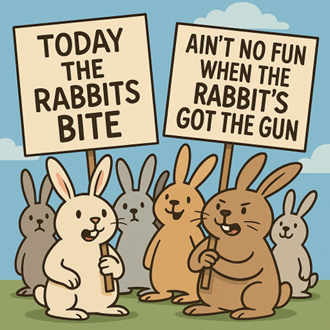
Yet the words did not stop. Thought traveled without ink. Discontent spread without parchment. And so Wannabe tightened his grip. In a tyrannical rage, he yelled, “We will control the news. We will make them pay to speak. We will force them to listen. We will tell them what books to read. We will be their favorite, the one they love; they will love Wannabe.” Again, with trepidation, the advisor leaned close: “But sir, even without paper, they have found their voices. They still have minds. And even rabbits, when cornered, will bite. Not today, perhaps—but one day the rabbits will bite. Remember this if you remember nothing at all. And heed the hunter’s satire.” The Wannabe dismissed him with a bitter laugh and a sneer. “Nonsense. They are only rabbits. They are for my pleasure; their only care is to eat and breed.” He arrogantly sneered. “And as to the satirical, I hate comics: ‘ain’t no fun when the rabbit’s got the gun’ is just silly. It’s for the weak and timid; not for Wannabe because Wannabe controls all and fears nothing.” He laughed, but his laugh was uneasy, and the silence from his minions was unmistakable and deafening.
Seasons passed. The whisper and wisdom of the sage advisor lingered. The people—mocked as useless, underestimated lagomorphs—grew weary of abuse and felt more cornered yet bolder. The self-serving advisors, sensing doom, scurried away with whatever spoils they could steal. At last, Wannabe stood alone, his armies and decrees powerless against a multitude no longer afraid, but resolute and united.
And from the crowd, like sparks catching fire, came the clamorous chants:
“Today the rabbits bite.”
“Ain’t no fun when the rabbit’s got the gun.”

The chants rolled through the streets, half warning, half laughter, but all serious. It was no threat of violence, but a proverb of irony. These people, these ‘rabbits’, had never needed literal guns because they had found something much more lethal—strength in their numbers, in their unified ideas, in their memory, dreams, and words, and now in their collective refusal to bow. The chant was their laughter, their truth, their declaration that the world had turned and change was in the offing. And the wise sage smiled a subtle, small, sly smile, always knowing and anticipating the power of their unity.
Civil society thrives only when none are treated as beasts, but as human beings with voices, hopes, and dreams. Wise leaders understand that thought is stronger than chains and the pen is stronger than the sword. The silencing of truth and thought control is always temporary; revolt begins the moment words are stifled, and action follows when endurance breaks.
If you have a gun—put it down, and put it away, we rabbits don’t need them.
Instead, pick up your pen and write your thoughts and dreams. Raise your voice and speak your mind. Open your ears and listen to others. Kings, Emperors, and wannabes are mortal. But thoughts endure. Words endure. And yours are essential. #NeverFearTheDream #Ain’tNoFun #RabbitsBite
Always feel free to re-post—anywhere, anytime, to anyone—share freely.
NeverFearTheDream simplebender.com Stand For Truth
If you’re looking for daily thoughts and insights you will want to start the morning with:

If you know someone who is facing any facet of Alzheimer’s they might gain some insight from:

Please consider following simplebender, you’re reading makes my writing more fun..…
Comments and thoughts are always welcome and feel free to re-post …..

 SimpleBender.....wcb