Posted in Political

Hidden Union in American Politics

Beneath the noise, political factions still share constitutional commons.

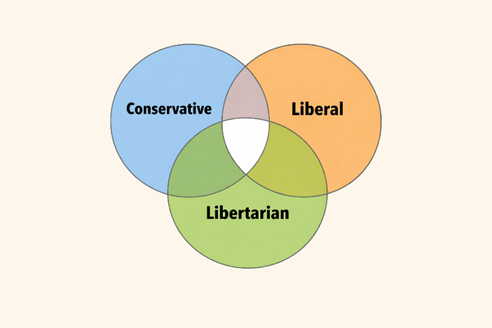
Parsing Conservative, Liberal, and Libertarian positions is like studying a cut diamond: the same stone, different facets, different reflections. At first glance, it seems simple enough to ask what conservatives want to conserve and liberals want to liberate. But then the light shifts. What do liberals want to conserve? What do conservatives want to liberate? Tilt the stone again through the libertarian lens, and the picture changes once more. Is there any union among the three, or are they too disjointed to share meaningful ground? We come from the same national roots. Differences will remain, but if the republic is to move forward, we should seek common ground, not sharpen divisions.

We keep lying to ourselves about politics. We say one side wants to conserve, and the other wants to liberate, yet every serious political tribe aims to do both. It appears Conservatives want to preserve borders, continuity, duty, and order while freeing producers, parents, and speech from progressive control. Liberals seemingly seek to maintain rights, inclusion, benefits, regulation, and public guarantees while liberating bodies, identity, labor, and participation from inherited constraints. Libertarians, that awkward but increasingly relevant third lane, seemingly aim to conserve privacy, due process, open rules, and pluralism while freeing adults, innovators, builders, and enterprises from bureaucratic burden. The real divide is not freedom versus order. It’s over what deserves protection and what should be released.

If one only listens to the rhetoric of the fringe, one might conclude there is no common ground. However, the overlap, while narrow, does exist. Conservatives and liberals still find common ground on benefits and national resilience. Conservatives and libertarians connect over concerns about speech and suspicion of bureaucracy. Liberals and libertarians share concerns about bodily autonomy, privacy, and resistance to over-policing private life. More importantly, the center of all three groups is smaller, more resilient, and more enduring than policy pundits tend to admit. It is not economic; it is constitutional.

The data support that conclusion.

  • PRRI found that 93% say belief in individual freedoms, such as freedom of speech, is important to being “truly American,” 91% say belief in the Constitution, 89% say accepting people of diverse racial and religious backgrounds, and 88% say respecting American institutions and laws.[1]
  • Pew found that 73% say freedom of the press is extremely or very important to society, 62% say it is very important that Americans be able to speak without government censorship, and 78% say it would be too risky to give presidents more power.[2]
  • Gallup found that 83% reject political violence, 80% say leaders should compromise, and 84% say the United States benefits from a mix of cultures.[3]
  • AP-NORC found that 49% say freedom of speech faces a major threat and another 29% a minor one.[4]

The American union is real, but it isn’t a sentimental union based on shared outcomes. Instead, it’s a tougher union built on shared principles: expression, restraint, pluralism, and rejection of violence. The work ahead is less glamorous and more mature. Stop pretending total victory is possible. Stop treating every disagreement as treason. Protect what keeps a free people from falling apart. Free what no longer should bind us. Let’s build from the constitutional commons that still reverberates through all of us. Do we want the quick thrill of conflict, or the harder dignity of agreement, even if it requires compromise?  NeverFearTheDream   simplebender.com

-… ..- .. .-.. -.. / ..-. .-. — — / … …. .- .-. . -.. / .. -.. . .- .-.. …


Lap Around the Sun: Daily Steps Forward
by WCBarron

Buy at Amazon Buy at Barnes & Noble Buy at Books2Read

Joy in Alzheimer’s: My Mom’s Brave Walk into Dementia’s Abyss
by WCBarron

Buy at Amazon Buy at Barnes & Noble Buy at Books2Read

[1] PRRI, Trump’s Unprecedented Actions Deepen Asymmetric Divides (Oct. 22, 2025).

[2] Pew Research Center, Topic: Freedom of the Press (Dec. 20, 2024), and Most Americans say giving presidents, including Trump, more power is “too risky” (Feb. 14, 2025).

[3] Gallup, Americans Show Consensus on Many Democracy-Related Matters (Nov. 20, 2025).

[4] AP-NORC, Many concerned about political violence and threats to free speech across the ideological spectrum (Oct. 29, 2025). AP-


Posted in NeverFeartheDream

Never Fear The Dream…

Pain and discomfort, whether physical, emotional, or mental, is a part of life. Treated as an enemy, they will act as one and consume you. Treated as an irritating friend, they will show us ways to grow in strength and understanding. 26.04.05

-. . …- . .-. ..-. . .- .-. – …. . -.. .-. . .- —

Posted in NeverFeartheDream

Never Fear The Dream…

Our free will empowers us to choose—right or wrong—and it is our conscience that rewards or punishes us. 26.04.04

-. . …- . .-. ..-. . .- .-. – …. . -.. .-. . .- —

Posted in Philosophy, Political

Our Zimbardo Moment

We like to stare in the mirror and tell ourselves a flattering story: that we are the guardian, the steady hand after chaos, the adult in a disorderly world. But history is less sentimental. Power does not stay still. It expands, rationalizes, and—if left unchecked—redefines itself.

This is our Zimbardo[1] [2] moment. The guards didn’t start as tyrants. They became them over time. Not because of being inherently cruel, but because the role allowed it, rewarded it, and eventually made it the norm. We are unknowingly replicating that experiment both domestically and internationally. Once authority is absolute, it begins to reshape identity. Enforcement shifts into domination, control, and coercion.

The United States was never purely a guardian—though it once proudly assumed the mantle and maintained that stance. There was at least an effort at restraint, rules, institutional international bodies, and shared legitimacy. Now the tone has changed. When a nation declares, implicitly or explicitly, ‘we are a superpower and will act because we can,’ the world no longer sees stewardship. It sees a gorilla—massive, unchallenged, and increasingly indifferent to the damage it causes as it thrashes its arms around, asserts its will, and enforces its law and morality beyond its own borders.

This is not benevolent dominance; it is selective force. Weak nations aren’t protected because they are weak; they are often pressured because they are. Sovereignty becomes conditional, resources become targets, and nations are no longer seen as distinct societies with histories and rights. They are seen and treated as pieces on a board—deindividualized, reduced to utility.

The rhetoric stays polished: freedom, order, stability. But listen carefully. The rules are in effect—until they aren’t. Especially when the rule-maker finds them inconvenient. We hear; extraordinary threats justify extraordinary actions. But who decides what the threat is? Of course, the same hand that holds the power.

That is the pivot. When a hegemon starts to extend its internal narrative over external reality, and assumes its perception overrides others’ sovereignty. At that moment, it crossed from guardian to gorilla. Not because it abandoned ideals, but because it makes itself the exception to them.

And perhaps most dangerously, the world starts to comply. Domestic and international institutional capitulation—silent, gradual—strengthens the stance. Power, if not challenged, becomes assumed and then exploited on a massive scale.

The experiment never ends; it only scales. So the question is not whether the gorilla can justify the overt actions, but how the ape will be brought to heel. And history shows they always are, and the end is never pretty.  NeverFearTheDream   simplebender.com

… – .- -. -.. / ..-. — .-. / – .-. ..- – ….


Lap Around the Sun: Daily Steps Forward
by WCBarron

Buy at Amazon Buy at Barnes & Noble Buy at Books2Read

Joy in Alzheimer’s: My Mom’s Brave Walk into Dementia’s Abyss
by WCBarron

Buy at Amazon Buy at Barnes & Noble Buy at Books2Read

[1] Haney, Craig, Curtis Banks, and Philip G. Zimbardo. “Interpersonal Dynamics in a Simulated Prison.” International Journal of Criminology and Penology 1, no. 1 (1973): 69–97.

[2] Le Texier, Thibault. “Debunking the Stanford Prison Experiment.” American Psychologist 74, no. 7 (2019): 823–839.

Posted in NeverFeartheDream

Never Fear The Dream…

Every day you get a fresh start at not saying, doing, or going to places you shouldn’t; take the opportunity while you can. 26.04.03

-. . …- . .-. ..-. . .- .-. – …. . -.. .-. . .- —

Posted in Philosophy

Social Dichromacy…Missing the Threat

Is the danger unseen or deliberately ignored? The tiger has an unusual tactical advantage over most of its prey because those animals suffer from dichromacy, a color-vision limitation that makes the tiger’s bright orange-and-black stripes appear as muted greens and shadows. The prey may detect movement, but they cannot recognize the warning in time. By the time the predator is fully noticed, it is often already too late.

It appears we suffer from a form of social dichromacy. Our perception of danger, especially when disguised by deceit, charm, or false strength, is limited. People are not knowingly ignorant; they have become perceptually impaired. Like a tiger’s prey, they see movement but miss the deeper meaning. They notice someone’s presence but don’t recognize the danger; or worse, they see it but timidly choose comfort over confrontation.

Some see confidence but not menace; charisma but not manipulation. They notice the person, but miss the mortal threat. The fully developed danger exists, but isn’t recognized until surrender is already happening, and resisting becomes more difficult than giving in.

This is not a physical defect but a civic and moral failure. It stems from shallow thinking, lazy observation, herd mentality, groupthink, and a deliberate indifference to history’s cause and effect. The situation is often quite clear. We prefer not to look too closely. Familiarity calms us. Nostalgia tempts us. Easy promises weaken us. Those who prey upon us know our weakness and don’t hesitate to exploit it. Twisting the message just enough to make it sound special for each of us.

That is how societies drift backward while hoping, and being told, they are being saved. The missing perception channel doesn’t just distort individuals; it corrupts entire communities. We stop noticing danger where it most often resides: inside what flatters us, comforts us, and promises to make things simple and great again. Recognizing this collective blindness should motivate us to stay vigilant and not simply close our eyes.

The harder question is not whether danger is present, but this: what discipline, honesty, and courage are required to pierce the veil of our own dichromacy before the predator is no longer merely stalking us, but consuming us?  NeverFearTheDream   simplebender.com

-… . .– .- .-. . / – …. . / -.-. — -. — .- -.


Lap Around the Sun: Daily Steps Forward
by WCBarron

Buy at Amazon Buy at Barnes & Noble Buy at Books2Read

Joy in Alzheimer’s: My Mom’s Brave Walk into Dementia’s Abyss
by WCBarron

Buy at Amazon Buy at Barnes & Noble Buy at Books2Read
Posted in NeverFeartheDream

Never Fear The Dream…

Separation, isolation, and loneliness are destructive—collectiveness, togetherness, and closeness are resilient. We are in this together—like it or not—like reeds; standing alone, we bend and yield in the storm, but together we withstand it and grow. 26.04.02

-. . …- . .-. ..-. . .- .-. – …. . -.. .-. . .- —

Posted in Communication

Assumptions Are Exhausting

Assumptions are exhausting because they require us to use energy on things we don’t really understand. They are those quiet, baseless conclusions we form from observation, experience, memory, and perception — often with less evidence than we’d like to admit. They may seem helpful or even protective, but more often they distort reality and hinder our ability to think and live clearly.

It helps to pause now and then to examine them. Many of our assumptions persist not because they are true, but because they are comfortable. They fit our preferred storyline. That’s why their challenge is uncomfortable. Our experiences shape us, from which, we build expectations about people, outcomes, and motives. But assumptions usually are about others’ intentions and actions. When we presume we understand someone else without understanding what shaped them, we set ourselves up for frustration, disappointment, needless conflict, and likely failure.

Assumptions are false knowledge which drain us as they give a false sense of preparedness. We rehearse a likely reaction, expect a certain outcome, and convince ourselves we know what will happen. Then life surprises us, and we must put in even more mental and emotional effort to adjust to what we never truly saw coming. The expense of recovering from false certainty is typically greater than the effort required to honestly assess uncertainty from the outset.

We live this out every day in small ways. That moment of surprise—’I didn’t see that coming’—is often when our assumption fell apart. Surprise is unavoidable, but unnecessary disappointment is not. The more we question our assumptions, the more flexible, calm, and clear-headed we become.

Recognize and avoid arrogant certainty. Question your perceptions. Reevaluate your beliefs and risks. Expect others to be more complicated. Plan for life to turn out differently than you expect. You might not avoid every surprise, but you can avoid falling for the exhausting illusion of assumptions false knowledge.  NeverFearTheDream   simplebender.com

.-. . … .–. . -.-. –


Lap Around the Sun: Daily Steps Forward
by WCBarron

Buy at Amazon Buy at Barnes & Noble Buy at Books2Read

Joy in Alzheimer’s: My Mom’s Brave Walk into Dementia’s Abyss
by WCBarron

Buy at Amazon Buy at Barnes & Noble Buy at Books2Read
Posted in Current Events, Philosophy

Capacity for Pain

Middle Eastern tolerance for pain is greater than expected. Once again, a Western power is repeating the same mistake with Iran as they have with much of the modern Middle East: they assume pain leads to surrender. That is a very Western way of understanding conflict: material, linear, and transactional. But in the Middle East, suffering is often not seen just as loss. It can also signify and reinforce the resolve for endurance, legitimacy, memory, and honor. Iran demonstrates this logic in one way; the Palestinians in another. Yet they both share and reveal a broader regional pattern of viewing pain not just as punishment but as proof that the struggle is real and, therefore, must be endured.

Iran exemplifies this concept most clearly. The Islamic Republic relies on the Karbala paradigm, martyrdom symbolism, and a political culture of resistance that has intensified since 1979. However, it is not powered solely by martyrdom. It also depends on maslahat—expediency, prudence, and the preservation of the state. This is the crucial point many outsiders miss. Tehran is not built to die heroically. It is constructed to endure, adapt, and survive. It promotes resistance when it benefits the system and compromises when necessary to maintain stability.

That instinct was shaped in ancestral times and hardened in recent history. The 1953 coup taught Iranians that foreign powers would overthrow a government when independence threatened outside interests. The 1979 revolution then fused anti-imperial memory with sacred politics. The Iran-Iraq War completed the lesson. It was prolonged, hugely destructive, and formative. It exemplified much of Iranian strategic thinking: that time itself can be weaponized. One does not always need a clear victory. One only needs to deny the enemy closure, increase his costs, outlast his patience, and drag him through the quagmire for as long as possible.

The Palestinian example demonstrates a similar pattern of resilience. The word sumud—meaning steadfastness—has long represented a way of enduring, surviving, and refusing to be erased regardless of hardship and genocide. A sumud approach fosters a determination to stay in place despite persistent attacks. Iran’s state-centered doctrine and propaganda also use this. Suffering can gain political importance and become a source of strength. Pain does not automatically erase identity; instead, it can bolster it. Bombing, siege, isolation, and coercion do not always lead to surrender. Sometimes, they deepen collective memory, increase grievances, renew the desire to resist, and feed intergenerational hostility and hate.

That is why Western strategy often misfires. It keeps viewing pain as if it were always disqualifying and debilitating. In this region, it is frequently absorbed, narrated, and repurposed. Iran has turned that into statecraft and proxy warfare across Hezbollah, Iraqi militias, the Houthis, and allied networks. Palestinians live it as the national standard bearer of steadfastness, resistance, and survival. If we continue to interpret these societies through a purely Western lens of cost, comfort, and quick resolution, why are we still shocked when assault results in resolve, not in surrender? NeverFearTheDream   simplebender.com

.. -. … …. .- .-.. .-.. .- ….


Lap Around the Sun: Daily Steps Forward
by WCBarron

Buy at Amazon Buy at Barnes & Noble Buy at Books2Read

Joy in Alzheimer’s: My Mom’s Brave Walk into Dementia’s Abyss
by WCBarron

Buy at Amazon Buy at Barnes & Noble Buy at Books2Read
Posted in NeverFeartheDream

Never Fear The Dream

We often demand transparency from others yet rarely demand it of ourselves. Personal growth will always be hindered without honest self-reflection and transparency—don’t lie to yourself. 26.04.01

-. . …- . .-. ..-. . .- .-. – …. . -.. .-. . .- —