Posted in Philosophy

Sanctity for Survival: Weaponizing Religion

Religion has always walked a knife-edge between faith and power. Religion is best when it brings comfort and worst when it becomes a tool of politics. Within our lifetime, there are two salient examples of the twisting of religion and state power: Iran and Russia. Two very different nations illustrate how this symbiotic relationship unfolds and precisely why our founders wisely established a separation between the church and the state. Spoiler alert—the walls are crumbling.

Iran: Mosque as State—Under the Shah, Iran’s clerics were suppressed, their influence diminished as the monarchy rushed to modernize. In 1979, the pendulum swung violently back. Ayatollah Khomeini and the mosque became the state itself. For decades, sermons dictated law, dissent was heresy, and the Revolutionary Guard enforced both politics and piety. Religion achieved supremacy at the cost of freedom.

Today, Iran’s youth — connected, progressive, impatient — are no longer persuaded by clerical authority. Protests after the death of Mahsa Amini revealed the fracture: religion wielded as control is no longer seen as sacred. The bargain that once restored the mosque’s power has hardened into a straitjacket, hollowing faith even as its institutions endure.

Russia: Saints for Soldiers—For most of the 20th century, the Russian Orthodox Church was brutalized under communism. Priests executed, cathedrals destroyed, believers silenced. When the Soviet Union collapsed, the Church sought revival — but revival required allies. Putin offered protection, prestige, and funding. In return, Patriarch Kirill and his bishops sanctified not only his rule, but his wars. Each branch of the Russian military is assigned a patron saint, and these are displayed as soldiers march—icons and rifles in hand. And mosaics of saints standing beside tanks and missiles—faith stitched into firepower.

It is a mutual, parasite-host alliance for survival. The Church props up the empire; the empire props up the Church. Orthodoxy regains prestige after decades of persecution, while the Kremlin secures sacred legitimacy for its conquests.

United States: Are Pulpits the Next Podiums?—Judeo-Christianity has influenced our national culture from its founding. Currently, church attendance is shrinking, younger generations walk away, scandals erode credibility, and the religiously unaffiliated approaches 30% of the population (PRRI). We are evolving into a secular nation of diverse beliefs. In this decline and transition, political power has become a lifeline for some of the more radical to guard against the nightmare of irrelevance becomes a reality.

Some fringe religious leaders now align with vocal politicians who promise to “fight for them,” to restore an age and influence gone by. In exchange, some of their pulpits have become podiums. Political leaders boast, “I hate my enemies,” and vow to “beat the hell out of them,” these words juxtaposed to:” do good to those who hate you, bless those who curse you, pray for those who mistreat you.” The contrast is crisp —aggressive pulpits now espouse vengeance rather than pleading for understanding. Rhetoric that contradicts the very teachings once held sacrosanct. The threat of pulpits becoming podiums is a genuine concern.

Lessons: Learn the Lessons—The parallels are clear. In Iran, religion became the state. In Russia, the Church promotes the empire for its own security. In America, the mainstream is often overshadowed by extremists who cling to authoritarian strongmen for cultural relevance and power—trading faith’s essence for influence.

When religion becomes a weapon of politics, the backlash is not revival but rebellion. These bargains may preserve institutions for a generation, but they ultimately lead to decay.

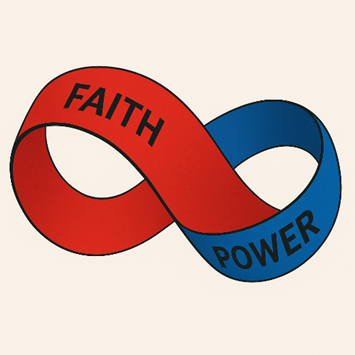
Like a Möbius strip, the inside and outside of faith and power continuously trade places, with no true end and no certainty. The loop is endless, the inversion unending — a path where faith loses its soul and nations lose their way, twisting around and around until revolt. The American founders understood this and wisely built institutional walls between state and church to prevent their blighted bonding, but now the walls are crumbling.

First published in Bend Bulletin 10/29/25

For Every Problem...A Solution...
Lap Around the Sun: Daily Steps Forward
Joy in Alzheimer’s: My Mom’s Brave Walk into Dementia’s Abyss

Posted in Philosophy

Rediscover Your First Nature: Beneath the Vener of Your Second

Every day, we hear people declare, ‘This is just second nature.’ For something to become second nature, there had to be practice and/or social influence to change what their first nature was. Does anyone remember what their first nature was, and can we peel back the veneer of our second to return to the first, if we wanted to?

We rarely talk about our First Nature. The nature we were blessed with in the beginning, before we were conditioned and formed life-altering habits. They are the innate, biological, pre-social capacities of curiosity, fear, empathy, attachment, and so on. First nature doesn’t hate; it differentiates. It notices patterns of familiarity, comfort, threat, and protection. It produces the capacity for bias, but it doesn’t develop an ideology of it.

Second Nature is learned, habituated, and socially enforced structures of behaviors and beliefs. When a reaction or attitude becomes second nature, it means it has been so deeply culturally engineered that it feels automatic—a reflex done without thinking. Second nature is encoding through stories, rituals, hierarchies, and reward systems. Hate and bigotry are not natural; they are second nature; they are a cultural metastasis of a cycle.

Run the loop long enough and hate feels ‘natural’—it is second nature and doesn’t feel like a negative response or reaction, it just merely is—because you’ve been socially corrupted and molded.

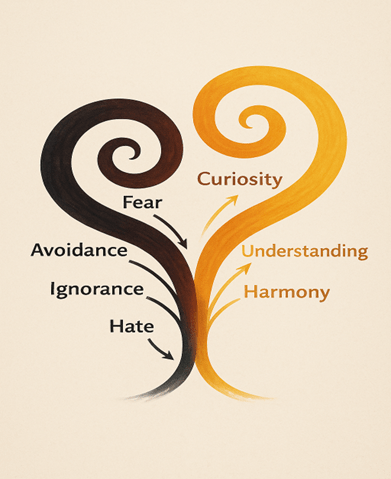
A thoughtful person in reflection must ask: Can it be reversed? The answer is a resounding yes. It can if we recognize the cycle. Instead of fear-triggering avoidance, what if it triggered natural curiosity? This shift in perspective opens up a world of possibilities for growth and change.

This isn’t sentimental. It’s disciplined work: notice the trigger, interrupt the habit, and retrain the response by consciously choosing a different reaction. The task isn’t to erase second nature but to realign it—so what feels automatic again serves what is authentic.

We are defined by what we love and what we detest, what we accept, what we tolerate, and what we reject. Each of us can rediscover our first nature characteristics. Because first nature doesn’t have a set of instructions, rediscovery isn’t about reprogramming yourself but about acknowledging that you are a product of your socio-economic environment. Take time to reflect and, honestly, aggressively self-assess. Self-deception is self-deprivation—denying yourself the truth denies you growth. But when you embrace self-reflection, you take control of your growth journey. Ask yourself if the second nature virtue you exhibit is really a tortured, misconfigured, misaligned first nature—like fear yielding to hate. Give yourself the latitude and patience to look deep, rediscover alternatives, and be open to the power of curiosity and understanding.

For Every Problem...A Solution...
Lap Around the Sun: Daily Steps Forward
Joy in Alzheimer’s: My Mom’s Brave Walk into Dementia’s Abyss

Posted in Current Events, Political

Our Future or Present: Authoritarianism and Transactional Leadership: Reprinted…..for a Reason

No Kings, slash through blood dripping crown

This was first published 8/29/22; yes 2022. It seems unfortunately appropriate that I republish it recognizing the events in which we currently find ourselves and the world

_________________________________________________________________________________________

Our grand experiment of Democracy is dramatically different than every social norm, every other system of leadership, governance, and social fabric with which we live. It’s little wonder our system is always under attack and slowly yielding to authoritarianism. We must stay committed to our representative republic and the triad balance of power. If not, we too will slip into a transactional authoritarian government.

Social norms in our family, religion, business, and most world governments, have a strong bias toward authoritarianism. This is what we grew up with. A family structure which requires the adult(s) to be responsible and accountable. Youth are rewarded for following instructions and guidelines. In world religions, there is the priest, pastor, imam, grandmaster, or lama. Each controlling the message. All imposing authority over their flock. Grooming them for the future of the leader, ‘church’, or cult. At its worst this level of uncontrolled authority leads to mass suicides and child abuse. In business, unless you are self-employed, we all have supervisors. Authorities giving us assignments, judging our performance, and controlling our wages. This is when we truly begin to feel the influence and practice of transactional leadership. When decisions are made, not necessarily on the merits of the problem but on how the results can affect individuals and organizations. Globally, very few countries have histories other than dictator, monarchy, warlord, or czar. Their culture and history are rooted in non-democratic leadership. The plague of transactional leadership is the most dangerous in governments. Casting long term policy aside for near term benefit of themselves, their cronies, and minions. To be clear, there is a difference between transactions for self interest and those for policy advancement.

Fledgling democracies of the former Soviet Union and the countries which blossomed during the Arab Spring have fallen back to authoritarian governments where transactions are key to survival. Russia and China have changed their constitutions allowing Putin and Xi to be leaders for life, returning to the time of Stalin and Mao. Are we on the same precipice? We’ve seen the original basis of triad balance of power eroded as the executive branch has usurped congressional powers. Methodically, creating a ‘strong’ executive branch and thereby a weak, neutered, dysfunctional legislature. Boisterous, self-absorbed, ‘leaders’ don’t really care about your cause, only your money and your vote. In exchange, they will act as your advocate and protector. Disparage, insult, and harass those whom you believe are a threat, especially minorities, in exchange for your support. They will play the victim, if they think they can tug at your heart so you will tug at your wallet. Candidates pandering for their endorsement want it only to gain your support. They fear the zealous wrath at the polls so, as chameleons, will enthusiastically espouse whatever the loudest want to hear. Everything is a transaction. More ‘perfect’ phone calls. No long-term policy and direction considered. It boils down to: Put me in power today, keep me in power tomorrow and I’ll do your bidding, to hell with what’s right.

How do we arrest the accelerating demise of our democracy? We should re-establish the balance of power. The triad must be equal and accountable to each other. Executive orders should have sunsets and if not codified by Congress should expire. Restore and strengthen Congressional subpoena power. Reign in Executive Privilege; it’s a shield for deceit. Institute term limits on Supreme Court Justices and require the Senate to act immediately on nominations. Institute Congressional term limits and dismantle the seniority power structure. The Electoral College process should be updated, ensuring the count based on the people’s vote not the State’s politicized legislature.

Our democracy has matured over time, and we must be wary of the pendulum swing toward authoritarian transactional leadership. Once there, the fight to climb back up the moral pedestal will be very hard. We don’t need protectors. We need calm, stable, policy driven leadership. We need to declare allegiance to the Constitution not any party or person.

Posted in Philosophy

The Pinhole Prison

child's pinhole glasses with sideshields

As a child, I wore pinhole glasses with side shields. I had Coats’ Disease and was one of the youngest patients to undergo pre-laser photo-coagulation, where swollen blood vessels on my retina were burned into place. As their youngest and most active patient, the specialists feared that even slight eye movement might breach the scars and leave me blind. Their solution was to narrow and control my vision to protect it. To see more, I had to move my head, mentally stitching fragments into a larger, coherent picture.

Today, too many choose to live this way—peering at the world not only through pinhole glasses but through pinhole windows in houses of self-imposed isolation.

We are fortunate to have the ability to see both panorama and detail. Yet many deliberately confine themselves to the narrowest slits of vision. They call it principle, but it is often blindness. When you see only fragments, you are not informed—you are managed. Critical thinking can change this. It helps us see beyond fragments, connect the dots, and make informed decisions.

Life is messy, confusing, thrilling and interconnected. To reduce it to one grievance, one tribe, or one slogan is not clarity; it is surrender. Families and communities depend on us to see beyond personal outrage. Narrow vision produces narrow outcomes—divisive politics, social inequality, and environmental degradation. Such outcomes almost always serve those in power, not those staring through the pinhole.

Isolation breeds fragility. Fragile citizens are the easiest to rule. People who see only what they want soon treat alternative views as offensive rather than essential. That is a weakness, not a strength. And it plays into the hands of those who designed the house, who placed the windows exactly where they want you to look. They don’t want you to see the horizon. Their concern is not you—it never was.

As a child, I had no choice; my parents and doctors demanded the glasses. As an adult, I do. And so do you. To widen your view does not mean agreeing with every perspective, but it does mean choosing to understand rather than accept without question.

My treatments gave me two things: the gift of sight in one eye, and an appreciation for looking beyond monocular perspectives. Life is not a snippet or a shard. It is a mosaic. Each tile taken in isolation is meaningless, maybe even deceptive. But the whole is magical. The choice is stark: stitch together the fragments, or let others decide what you see. Choose depth and insight. Never surrender your vision. Step out of the pinhole window house, discard the pinhole glasses, and turn your head on a swivel to absorb the beauty of a limitless world.

For Every Problem...A Solution...
Lap Around the Sun: Daily Steps Forward
Joy in Alzheimer’s: My Mom’s Brave Walk into Dementia’s Abyss

Posted in Philosophy

When Ten Is Just Too Many…

Encourage ethical living through four simple principles

The bridge of life over turbulent river supported by four critical spans....

Religions and philosophies have long sought to distill the principles of life into something memorable and enduring. The story goes that Moses ascended the mountain to retrieve the Ten Commandments for his people. Ten was supposed to be simple. Yet if today’s headlines are any measure, ten is too many for too many. So let’s cut to the core—four principles that are not bound by any specific belief system, but are universal and can be practiced by anyone:

Act with reverence to all.
Cultivate generosity.
Be considerate in relationships.
Tell the truth with care.

Act with reverence to all.
The key phrase is to all. Reverence means respect, grace, and honor—offered not just to friends or allies but to those who oppose, insult, or dismiss you. You don’t have to like or agree with someone to treat them with dignity. Doing so shows moral maturity, honors both of you, and sets an example—even if it isn’t returned.

Cultivate generosity.
Generosity isn’t about giving away everything. It is a practice of timely kindness—offering what is needed, when it is needed, to whomever needs it. Like any skill, generosity grows through practice until it becomes second nature.

Be considerate in relationships.
Every intimate relationship carries hope and vulnerability. To honor that is to see beyond the carnal into the emotional and intellectual—embracing another’s fears and dreams without violating them. That takes openness and courage. And once you learn it in intimacy, extend it outward—adjusting the degree, but carrying consideration into every human interaction.

Tell the truth with care.
Truth matters—but it can wound. Some truths people bury, rewrite, or try to cancel because they hurt. Still, the truth must surface. The key is how we share it: directly, yet not cruelly, honestly, yet not demeaning. Speak truth the way you would want to hear it yourself. And remember, truth is rarely black and white; perspective adds the shades of gray that make it whole.

Headlines are filled with destruction, hatred, and division. We can’t stop it all. But each of us can live by these four guardrails. They are not lofty commandments carved in stone, just four simple principles to practice every day. Because ten may be too many, but we can manage four:

Reverence. Generosity. Consideration. Truth.

For Every Problem...A Solution...
Lap Around the Sun: Daily Steps Forward
Joy in Alzheimer’s: My Mom’s Brave Walk into Dementia’s Abyss

Posted in Political

Rabbits’ Revenge: A Fable of Hidden Strength

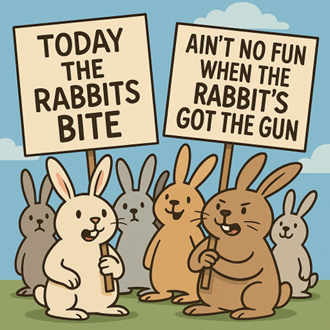
Protesting 'Rabbits' Ain't No Fun When the Rabbit's Got the Gun

King Wannabe stood before the crowd of people, his back hunched, too feeble to be erect, his greying, bushy eyebrows raised, his face twisted in contempt. The people would not chant his name nor bow to his image. “Rabbits,” he scoffed. “Nothing but rabbits. They eat, they breed, they exist for my pleasure. Especially the young ones—for my pleasure. Everyone must love Wannabe, everyone, especially these rabbits.” His entourage knelt in obedience, fearful of his rage.

One brave advisor dared to whisper, “But sir, no one is loved by everyone, and they are more than rabbits. They are people, with minds, with hopes and dreams.” In a buffoonish manner, Wannabe waved the thought aside, clutching a handful of pamphlets. “Look at these. Lies! All lies! Their words are filth. Take their paper and their pens. Silence them, cancel their culture.” He signed an Order, and the dutiful minions obeyed, seizing what they could.

Yet the words did not stop. Thought traveled without ink. Discontent spread without parchment. And so Wannabe tightened his grip. In a tyrannical rage, he yelled, “We will control the news. We will make them pay to speak. We will force them to listen. We will tell them what books to read. We will be their favorite, the one they love; they will love Wannabe.” Again, with trepidation, the advisor leaned close: “But sir, even without paper, they have found their voices. They still have minds. And even rabbits, when cornered, will bite. Not today, perhaps—but one day the rabbits will bite. Remember this if you remember nothing at all. And heed the hunter’s satire.” The Wannabe dismissed him with a bitter laugh and a sneer. “Nonsense. They are only rabbits. They are for my pleasure; their only care is to eat and breed.” He arrogantly sneered. “And as to the satirical, I hate comics: ‘ain’t no fun when the rabbit’s got the gun’ is just silly. It’s for the weak and timid; not for Wannabe because Wannabe controls all and fears nothing.” He laughed, but his laugh was uneasy, and the silence from his minions was unmistakable and deafening.

Seasons passed. The whisper and wisdom of the sage advisor lingered. The people—mocked as useless, underestimated lagomorphs—grew weary of abuse and felt more cornered yet bolder. The self-serving advisors, sensing doom, scurried away with whatever spoils they could steal. At last, Wannabe stood alone, his armies and decrees powerless against a multitude no longer afraid, but resolute and united.

And from the crowd, like sparks catching fire, came the clamorous chants:

“Today the rabbits bite.”
“Ain’t no fun when the rabbit’s got the gun.”

Protesting against authoritarianism

The chants rolled through the streets, half warning, half laughter, but all serious. It was no threat of violence, but a proverb of irony. These people, these ‘rabbits’, had never needed literal guns because they had found something much more lethal—strength in their numbers, in their unified ideas, in their memory, dreams, and words, and now in their collective refusal to bow. The chant was their laughter, their truth, their declaration that the world had turned and change was in the offing. And the wise sage smiled a subtle, small, sly smile, always knowing and anticipating the power of their unity.

Civil society thrives only when none are treated as beasts, but as human beings with voices, hopes, and dreams. Wise leaders understand that thought is stronger than chains and the pen is stronger than the sword. The silencing of truth and thought control is always temporary; revolt begins the moment words are stifled, and action follows when endurance breaks.

If you have a gun—put it down, and put it away, we rabbits don’t need them.

Instead, pick up your pen and write your thoughts and dreams. Raise your voice and speak your mind. Open your ears and listen to others. Kings, Emperors, and wannabes are mortal. But thoughts endure. Words endure. And yours are essential. #Ain’tNoFun

For Every Problem...A Solution...
Lap Around the Sun: Daily Steps Forward
Joy in Alzheimer’s: My Mom’s Brave Walk into Dementia’s Abyss

Posted in Current Events, Political

Guardrails Against the Authoritarianism Storm

Columns supporting our Constitutional Liberties

Article first published in the Bend Bulletin 9/27/25

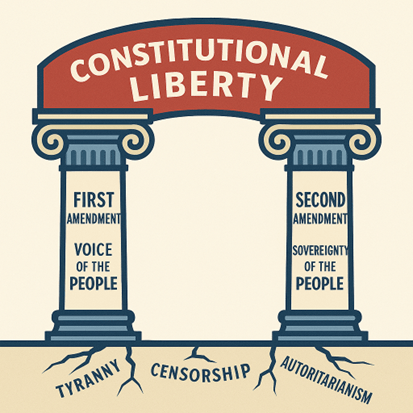
The Bill of Rights was not a mere document, but a product of the founders’ deep suspicion of concentrated power. They had witnessed the crushing of liberties under a monarchy and feared that even a republican government might someday drift toward authoritarianism. The First Amendment enshrines freedoms of mind and voice; the Second Amendment ensures the citizenry will never be entirely powerless should those freedoms come under assault. This foresight of the founders enlightens us about the historical context of the Bill of Rights, giving us a deeper understanding of our constitutional rights.

History was their teacher. British suppression of colonial assemblies, censorship of dissenting press, and the Intolerable Acts were enforced not with argument but with troops. The Revolution began not at a printing press, but when local militias clashed with regular soldiers at Lexington and Concord (1775) to resist the seizure of their weapons. It was this combination—ideas in pamphlets like Common Sense (1776) and the willingness to defend them—that secured independence.

James Madison (Federalist 46) envisioned an armed citizenry as the ultimate check on federal overreach, noting that “the advantage of being armed” would deter encroachments on liberty. Alexander Hamilton (Federalist 29), though skeptical of full-time militias, conceded that a people capable of bearing arms would make any tyranny costly. Later commentators, such as St. George Tucker (1803), referred to the Second Amendment as the “true palladium of liberty,” a final barrier against usurpation (Tucker, Blackstone’s Commentaries).

The framers did not celebrate rebellion, and neither should we. They built a republic designed to settle disputes through institutions—legislatures, courts, and elections—not through insurrection. The Second Amendment was less an invitation to revolt than a final constitutional guardrail, a reminder to government that the people remain sovereign. It was meant to make authoritarian control—whether through censorship, suppression of dissent, or militarized governance—impractical.

“The Second defends the First,” captures part of this truth but misses the deeper genius of the American design. Our first line of defense for free expression is institutional: the separation of powers, judicial independence, and a free press that is able to hold the government accountable. An armed citizenry is the last resort, the failsafe that ensures no regime can permanently silence the governed, providing a sense of security about our rights.

Even in polarized times, the resilience of this framework is remarkable. Courts still strike down attempts at censorship, legislators still debate fiercely, and citizens continue to speak, publish, assemble, and worship according to their conscience. With some legislators seeming to yield to the mob or bend a knee for their own political survival, our Constitution has withstood civil war, economic depression, McCarthyism, and demagoguery precisely because its protections are layered—legal, institutional, and cultural. The greatest defense of liberty is not fear of armed resistance but the enduring resolve of citizens who insist on their right to speak and be heard. When we do not defend the first, we risk the second, the fourteenth, the fifteenth, and the nineteenth. When we defend free speech, preserve checks and balances, and reject authoritarian shortcuts and fragile egos—whether from the left or the right—we prove that the American experiment remains not only viable but vital. This reiteration of the importance of defending free speech should empower you and make you feel responsible for upholding your rights, instilling a sense of duty and empowerment in you. # NeverFearTheDream # Stand for Truth # Stand with Pride # Stand with Spine

For Every Problem...A Solution...
Lap Around the Sun: Daily Steps Forward
Joy in Alzheimer’s: My Mom’s Brave Walk into Dementia’s Abyss