Posted in Political

Parable: When King’s Divide—People Unite

Chairs of absent kings trying to divide while the people join hands and unite
NeverFearTheDream   simplebender.com

In weary corners of the world, three elder kings sat in their gilded castles, polishing medals they’d never earned. Their peasants staggered through hunger, cheap drugs, and endless funerals, but the kings were busy with more important matters—like drawing new lines on old maps and wallowing in opulence.

One dark, cold winter, the kings gathered at a marble table and decided that ruling their own crumbling kingdoms wasn’t enough. They would divide the whole world into “areas of influence,” like carving a roast they hadn’t paid for. Each slice came with rights: to plunder, to threaten, to “stabilize” by force. Responsibilities, however, were deemed inefficient. One would gain the Orient, one would be allowed, unfettered, to restore their former Empire, and the last would gain a vast Western Hemisphere. They embraced, shook hands, winked, made the deal, and secretly crossed their fingers behind their backs.

Their longtime allies—small kingdoms that had stood by them through storms and wars—were called into the throne rooms and, in ungracious tones, scolded; they were now “on their own.” It was dressed up as tough love, of course. “You must learn to defend yourselves. You must be strong, not weak,” the kings said, while quietly moving their troops, their money, and their promises elsewhere.

The peasants, meanwhile, noticed something awkward: the kings always seemed richest after a war, and safest after a crisis. So the villages began whispering across borders. Farmers traded grain instead of insults. Healers crossed checkpoints to treat strangers. Workers in different lands realized they were all being squeezed by the same velvet-gloved hands.

Soon, small alliances of towns and regions formed—not to conquer, but to refuse. They refused to buy the king’s fear, refused to send their sons and daughters to die for “influence,” and declined to hate people who were just as tired and broke as they were.

When the three kings tried to enforce their New World Order, they found something inconvenient: the world had quietly ordered itself, not into empires, but into bonds of mutual survival. They found that the sovereigns they had harassed and attacked, out of vanity and spite, had aligned against them. The small sovereignties had forged strength by joining together. The weakened kings found that by trying to be dominant, they had become feeble and irrelevant. And then, to their horror, each discovered the other king had made secret trade deals and alliances outside their spheres. Each cheated on the other because they thought they could get away with it.

It turns out, when rulers isolate and divide, the people eventually learn the oldest truth of all: if we don’t lift each other, no one is coming to save us. It turns out that failing, deceptive, greedy kings cannot divvy up the world and forge a lasting new world order. They lie, cheat, and steal for their own prosperity, not the betterment of the people, and the people finally know the truth. NeverFearTheDream simplebender.com

For Every Problem...A Solution...
Lap Around the Sun: Daily Steps Forward
Joy in Alzheimer’s: My Mom’s Brave Walk into Dementia’s Abyss

Posted in NeverFeartheDream

Never Fear The Dream….

Always return to your beginner’s mind—your shoshin. No matter your skill or experience, seek the wonder and energy of the first time. Good things don’t happen to just a few—it’s that a few choose to see the good in everything. 25.12.2

For Every Problem...A Solution...
Lap Around the Sun: Daily Steps Forward
Joy in Alzheimer’s: My Mom’s Brave Walk into Dementia’s Abyss

Posted in Current Events

Manufactured Scarcity as a Strategy

scarcity for some abundance for others...manufacturing distractions.....simplebender.com

We are told the world is running out of everything: security, dignity, opportunity, patience. The message is constant—there is not enough to go around. And when people believe there is not enough, they do what humans have always done under threat: they turn on whoever is closest, whoever they think has what they should have.

This is manufactured scarcity—not a natural shortage, but a strategic one. The point is not merely to frighten us. The point is to redirect our fear sideways.

Horizontal hostility is far more useful to those in power than unity ever could be. If we are busy resenting each other, we are not examining the hands holding the power strings and who declared the scarcity to begin with.

Consider who benefits when workers distrust workers, when rural communities distrust urban ones, when generations resent each other, when racial and ethnic groups fight over scraps. At the same time, the banquet table is dragged into a gilded private room. The beneficiaries are not hard to identify. They are the ones who remain untouched by the conflict they provoke. They are the ones who used the distraction to fleece for their benefit.

Manufactured scarcity is a form of quiet governance. It makes control self-enforcing. No police state is needed when citizens police each other, when communities fracture themselves, when people become suspicious by default. But this civil fracture is used as an excuse to declare manufactured emergencies to seize more power.

But scarcity is not just political—it is psychological. Once trust is gone, every interaction becomes expensive. Friendship takes caution. Cooperation takes courage. Even hope feels dangerous. The fringe takes stronger hold as the masses in the middle scan the horizon for hope, while looking back in fear of cowardly aggression.

And yet, trust is not rebuilt by argument or persuasion. Ideology is a divider. No ideology has ever restored a broken community. Trust is rebuilt the oldest way humans have ever known: by doing things together, understanding that the most potent joining agents are dreams and suffering, not ideology.

When we work side-by-side—repairing a fence line, running a volunteer shift, restoring a riverbank, organizing a childcare co-op—we rebuild something deeper than agreement. We rebuild interdependence. We remember, through action, that we rely on one another to live.

This is the part those who profit from division fear most. They do not fear protest slogans. They do not fear outrage. They fear cooperation and communication.

Because cooperation makes scarcity visible for what it is: a story someone told us. A story that has authors and agents who have their own agenda.

The significant problems are only solved when the small ones are solved first. We do not need to solve the world’s problems before the nation’s, or the nation’s before we solve the ones on our street. We do not need to fix society before we rebuild the block we stand on. We don’t need to tear down the building to fix the windows.

When we choose to stand together and challenge the narrative, the manufactured scarcity loses its power. The illusion breaks. The wedge loses its edge. And the architects of division suddenly find themselves standing alone. Let’s start by turning away from face-to-face conflict toward shoulder-to-shoulder and side-by-side cooperation and community growth. #NeverFearTheDream simplebender.com

First Published in Bend Bulletin 12/2/25

For Every Problem...A Solution...
Lap Around the Sun: Daily Steps Forward
Joy in Alzheimer’s: My Mom’s Brave Walk into Dementia’s Abyss

Posted in NeverFeartheDream

Never Fear The Dream…

Your faults are yours. Theirs are theirs. Strengthen yourself and accept others as they are. Don’t waste energy trying to change them—change yourself. See with sober eyes, both inward and outward. Step back from the stones of the mosaic to grasp the whole picture. Be self-sufficient, not isolated. 25.12.1

For Every Problem...A Solution...
Lap Around the Sun: Daily Steps Forward
Joy in Alzheimer’s: My Mom’s Brave Walk into Dementia’s Abyss

Posted in Favoites

When Bonds Become Bondage

the soft wood bridge building bonds turn to chains of bondage quickly....simplebender.com

Bonds are built on trust and shared purpose. What begins as social alignment can harden into dependency and quiet surrender. We’re encouraged to join teams, tribes, and causes—to belong. But what happens when those bonds start to dictate not just our identity, but also what we’re permitted to think?

Healthy bonds help us carry burdens, share experiences, and grow. They give us identity, protection, and the comfort of not standing alone. Long, strong bonds take effort: listening, repair, and the freedom to disagree without being cast out.

Yet the same bond that holds us up can also hold us down. It becomes bondage when internal disagreement feels like betrayal and outside questions feel like an attack. When you sense that leaving—or even doubting—will cost you your status, your income, your family, or your place at the table, you’re no longer just bonded. You’re being managed.

This innocuous type of bondage isn’t so bold as handcuffs. It seeps in through reward and punishment. Praise for loyalty. Shame for dissent. Fear of exile. Our “independence muscle” atrophies, not only because we stop using it, but because the systems around us—media, parties, teams, neighborhoods, companies, even congregations—profit from our reflexive defense of the group. We start repeating talking points. We don’t think or challenge; we begin to become puppets. Their script becomes our voice.

And yet, people don’t choose this only out of weakness or neglect. Tight bonds promise safety in a chaotic world. They offer clear enemies, simple answers, and the warmth of “us.” Sometimes bondage feels much better than isolation.

That’s why we need quiet tests of our own chains. When was the last time you openly challenged your group’s beliefs, and how did they respond? If you walked away tomorrow, what would you truly lose—and what might you gain?

Society survives through bonds—and through resisting the slide into silent obedience. So yes, build bonds. But also actively seek out and connect with those who think differently, and to those your group teaches you to fear or mock. Cross-group ties don’t erase convictions; they loosen the hidden shackles of certainty.

Stand with others, not under a thumb or behind a shield. Bonds are necessary—bondage is optional and may not be escapable. NeverFearTheDream   simplebender.com

For Every Problem...A Solution...
Lap Around the Sun: Daily Steps Forward
Joy in Alzheimer’s: My Mom’s Brave Walk into Dementia’s Abyss

Posted in NeverFeartheDream

Never Fear The Dream…

Complaining doesn’t lighten the load. Explaining failure doesn’t fix it. 25.11.4.1

For Every Problem...A Solution...
Lap Around the Sun: Daily Steps Forward
Joy in Alzheimer’s: My Mom’s Brave Walk into Dementia’s Abyss

Posted in NeverFeartheDream

Never Fear The Dream…

Long-term solutions evolve through compromise, and short-term ones evolve through conflict. Yours isn’t the only viable opinion, and maybe you are more wrong than right. 25.11.4

For Every Problem...A Solution...
Lap Around the Sun: Daily Steps Forward
Joy in Alzheimer’s: My Mom’s Brave Walk into Dementia’s Abyss

Posted in NeverFeartheDream

Never Fear The Dream…

Gender roles are socially constructed limits. Maybe once they served for communal survival—but now they’re used to demean, divide, and uphold a gender caste system. Acceptance is a radical act of self-liberation. 25.11.3

For Every Problem...A Solution...
Lap Around the Sun: Daily Steps Forward
Joy in Alzheimer’s: My Mom’s Brave Walk into Dementia’s Abyss

Posted in Favoites

Credibility: The Fragile Currency of Character

Credibility is a delicate characteristic — slow to earn, swift to lose, and nearly impossible to fully restore. It’s like a crystal goblet: clear, strong in purpose, yet so easily fractured by careless acts. Once shattered, even after the best repair, the cracks remain visible and weak, and the goblet, once pristine, is forever damaged. Those who’ve tried to rebuild their chalice of credibility know the haunting truth — it becomes easier to break again, and probably will. Credibility doesn’t erode overnight; it erodes through capitulation, excuses, and the convenience of shifting with the wind.

There was a time when credibility was among our highest personal currencies and a source of pride. A person’s word was their bond. Their handshake was a contract. Their consistency was a mirror of their moral compass. Their willingness to admit mistakes and change positions in light of new information was seen as extreme emotional maturity and self-confidence. Perfection doesn’t—and didn’t—earn credibility, but integrity does. A visible, demonstrated alignment between belief, speech, and action. Today, that alignment is bent under the weight of expediency and twisted for target audiences.

The credibility of leaders — political, pulpit, legal, law enforcement, academic, athletic — has become collateral in the age of populism and applause metrics. When polls become the goal, truth becomes negotiable. When power is the aim, credibility is an afterthought, and diversion and deceit are the tools of choice. The words ‘I promise’ and ‘trust me’ become code for watch your back. We see it in leaders who flip their stances to appease whichever crowd can give them more leverage. They conveniently forget that credibility is built through conviction and compromise—not appeasement. It’s not the stance itself that matters most; it’s the steadiness of principle that gives credibility its meaning.

In this swirling chaos of contradiction and convenience, we, and the world, have grown cynical. Our long-standing allies no longer trust our national commitments. Those who stand ‘against us’ leverage our lack of credibility to their advantage.

We no longer trust what’s said, only what’s repeated—and if a lie is told often enough and loud enough, some believe it to be a truth—but it’s not, it’s still a lie—with or without a sprinkle of truth to placate the gullible. And, unfortunately, when the truth is actually told, we are all skeptical, uncertain, with no clear way to confirm or deny—so, everything feels like a lie, or a hybrid truth.

We no longer follow those who lead — we watch to see if they’re trending. We analyze ten-second snippets or AI-generated memes designed to slander and divide, not unify. In doing so, we participate in the erosion we claim to despise—we, the people, become willing players in the deceit and the shattering of credibility.

We need to stop outsourcing integrity and credibility. Stop waiting for heroes to save us, saints to guide us, or perfect voices to speak for us. The world doesn’t need any more idols, demigods, or people placed upon false pedestals. It needs individuals who live as examples — quietly, calmly, patiently, consistently, courageously.

Let’s stop looking for heroes and start being credible ones — with every choice and every word you make every day. #NeverFearTheDream

For Every Problem...A Solution...
Lap Around the Sun: Daily Steps Forward
Joy in Alzheimer’s: My Mom’s Brave Walk into Dementia’s Abyss

Posted in Philosophy

Sanctity for Survival: Weaponizing Religion

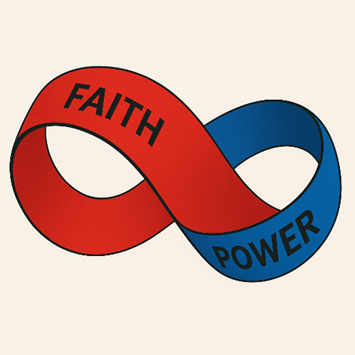
Religion has always walked a knife-edge between faith and power. Religion is best when it brings comfort and worst when it becomes a tool of politics. Within our lifetime, there are two salient examples of the twisting of religion and state power: Iran and Russia. Two very different nations illustrate how this symbiotic relationship unfolds and precisely why our founders wisely established a separation between the church and the state. Spoiler alert—the walls are crumbling.

Iran: Mosque as State—Under the Shah, Iran’s clerics were suppressed, their influence diminished as the monarchy rushed to modernize. In 1979, the pendulum swung violently back. Ayatollah Khomeini and the mosque became the state itself. For decades, sermons dictated law, dissent was heresy, and the Revolutionary Guard enforced both politics and piety. Religion achieved supremacy at the cost of freedom.

Today, Iran’s youth — connected, progressive, impatient — are no longer persuaded by clerical authority. Protests after the death of Mahsa Amini revealed the fracture: religion wielded as control is no longer seen as sacred. The bargain that once restored the mosque’s power has hardened into a straitjacket, hollowing faith even as its institutions endure.

Russia: Saints for Soldiers—For most of the 20th century, the Russian Orthodox Church was brutalized under communism. Priests executed, cathedrals destroyed, believers silenced. When the Soviet Union collapsed, the Church sought revival — but revival required allies. Putin offered protection, prestige, and funding. In return, Patriarch Kirill and his bishops sanctified not only his rule, but his wars. Each branch of the Russian military is assigned a patron saint, and these are displayed as soldiers march—icons and rifles in hand. And mosaics of saints standing beside tanks and missiles—faith stitched into firepower.

It is a mutual, parasite-host alliance for survival. The Church props up the empire; the empire props up the Church. Orthodoxy regains prestige after decades of persecution, while the Kremlin secures sacred legitimacy for its conquests.

United States: Are Pulpits the Next Podiums?—Judeo-Christianity has influenced our national culture from its founding. Currently, church attendance is shrinking, younger generations walk away, scandals erode credibility, and the religiously unaffiliated approaches 30% of the population (PRRI). We are evolving into a secular nation of diverse beliefs. In this decline and transition, political power has become a lifeline for some of the more radical to guard against the nightmare of irrelevance becomes a reality.

Some fringe religious leaders now align with vocal politicians who promise to “fight for them,” to restore an age and influence gone by. In exchange, some of their pulpits have become podiums. Political leaders boast, “I hate my enemies,” and vow to “beat the hell out of them,” these words juxtaposed to:” do good to those who hate you, bless those who curse you, pray for those who mistreat you.” The contrast is crisp —aggressive pulpits now espouse vengeance rather than pleading for understanding. Rhetoric that contradicts the very teachings once held sacrosanct. The threat of pulpits becoming podiums is a genuine concern.

Lessons: Learn the Lessons—The parallels are clear. In Iran, religion became the state. In Russia, the Church promotes the empire for its own security. In America, the mainstream is often overshadowed by extremists who cling to authoritarian strongmen for cultural relevance and power—trading faith’s essence for influence.

When religion becomes a weapon of politics, the backlash is not revival but rebellion. These bargains may preserve institutions for a generation, but they ultimately lead to decay.

Like a Möbius strip, the inside and outside of faith and power continuously trade places, with no true end and no certainty. The loop is endless, the inversion unending — a path where faith loses its soul and nations lose their way, twisting around and around until revolt. The American founders understood this and wisely built institutional walls between state and church to prevent their blighted bonding, but now the walls are crumbling. #NeverFearTheDream

First published in Bend Bulletin 10/29/25

For Every Problem...A Solution...
Lap Around the Sun: Daily Steps Forward
Joy in Alzheimer’s: My Mom’s Brave Walk into Dementia’s Abyss