Posted in Keystone

America Does Not Need Another Tribe

CATEGORY I: FOUNDATIONAL PHILOSOPHY  |  TOPIC 1 OF 4  |  WHY THIS MOVEMENT EXISTS

Keystone holds competing forces in position by compression....

The country does not need another political identity. It needs more citizens willing to keep ownership of their judgment

America has no shortage of political tribes. We have colors, slogans, hats, hashtags, enemies, approved grievances, and a daily supply of reasons to be furious. Belonging is not the problem; people naturally seek community. The problem arises when belonging becomes a substitute for judgment—when the team has spoken, and contradiction must be defended. No governing philosophy can survive if citizens apply principles only to their opponents.

Many Americans no longer fit the package deals offered to them. They may believe the government should live within its means without becoming indifferent to suffering. They may support personal liberty while recognizing the need for public order, favor a secure border and workable, lawful immigration, or want reliable energy alongside environmental stewardship. They may value alliances while still asking what commitments cost and where they lead. That is not confusion. It is a refusal to outsource every judgment to a platform.

The tribal bargain is tempting because it simplifies politics. Loyalty brings moral certainty, convenient enemies, and permission to overlook one’s own side. Debt can suddenly look responsible. Executive power can become necessary. Restrictions on speech can be recast as safety, or punishment as patriotism, depending on who holds authority. The facts may be unchanged while the standard quietly shifts.

The Keystone Compact is not an effort to split the difference between the parties. Nor is it an invitation to shop selectively for whichever positions feel comfortable. The keystone in an arch works because competing forces are held in check by structure. Politically, the equivalent is a set of principles sturdy enough to withstand a change in who governs.

That standard creates discomfort on both sides. The populist right can speak of freedom while tolerating government power directed at cultural adversaries and excusing fiscal recklessness. The bureaucratic left can speak of justice while accepting the expansion of administrative control, dependency, public disorder, or decisions increasingly distant from ordinary citizens. The temptations differ, but the civic danger is similar: principles become conditional on who holds power.

Keystone begins with the citizen rather than the coalition. Free citizens are not raw material for political movements. A serious political philosophy should demand less loyalty and more responsibility: think independently, weigh trade-offs, acknowledge costs, apply standards consistently, and remain willing, and eager, to change your mind when the evidence changes.

That need is evident far from Washington. It appears in the small-business owner navigating rules written with larger institutions in mind; the retiree hearing promises while leaders avoid the arithmetic behind them; parents who want schools to teach well rather than become permanent culture-war arenas; and workers who want safe communities, honest wages, reliable power, and a functioning immigration system. These concerns do not line up neatly on a partisan checklist, nor should they.

Calling such citizens ‘moderate’ misses the point. Fiscal honesty is not a midpoint. Equal rights are not a midpoint. Constitutional restraint and competent government are not compromises between extremes. They are standards, and standards matter most when applying them is inconvenient for one’s own side.

The more useful divide, then, is not simply left versus right. It is between citizens who retain their judgment and movements that ask them to surrender it. Political parties can be useful tools, but they become poor masters when membership begins excusing contradiction.

The first Keystone question is therefore not, ‘Which side are you on?’ It is more demanding: when does loyalty stop helping you participate and start giving someone else permission to think for you?

If tribes cannot dictate our judgment, the next principle follows naturally: they cannot dictate our rights either.

Next in Category I: Rights Are Not Tribal Trophies

NeverFearTheDream………. W. C. Barron………. simplebender.com……….keystonecompact.org

-. — / -. . .– / – .-. .. -… . … / .— ..- … – / -. . .– / .. -.. . .- …


Lap Around the Sun: Daily Steps Forward
by WCBarron

Buy at Amazon Buy at Barnes & Noble Buy at Books2Read

Joy in Alzheimer’s: My Mom’s Brave Walk into Dementia’s Abyss
by WCBarron

Buy at Amazon Buy at Barnes & Noble Buy at Books2Read
Posted in Philosophy

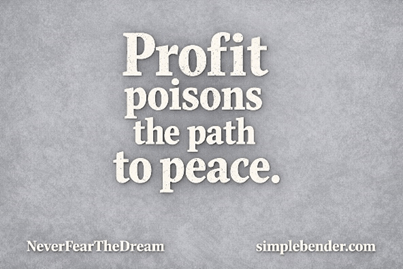
Peace Isn’t a Transaction

True peace involves transparency and lasting stability, not just temporary agreements that leave underlying issues unresolved.

Peace usually arrives in one of two ways: the combatants decide they’ve had enough, or one side is crushed. When the cost of continuing exceeds the cost of stopping, both parties yield—grudgingly—and accept a compromise. It’s rarely elegant. More often, it’s a deal both sides dislike, but it’s better than attending the next round of funerals.

Mediators can help when they are genuinely independent: attentive to each side’s fears, aims, and non-negotiables, and skilled at translating rage into terms that can be signed. A good mediator doesn’t erase the chasm; they build a narrow, temporary bridge and keep traffic moving long enough for a fragile truce to harden into something closer to peace.

But when the mediator wants something out of the game, the process shifts. Influence becomes leverage. The negotiation stops being about stabilizing a region and starts being about capturing value. Quiet “side letters” and backchannel commitments on resources, arms, protection, exclusive access to markets, manufacturing, or intellectual property tilt the table before the first public handshake. The parties are no longer bargaining over borders or security alone; they’re trading away remaining national assets and future autonomy to a broker whose primary loyalty is to their own gain.

That doesn’t produce peace. It produces a transactional truce: temporary, brittle, and designed to be violated and renegotiated. One side will test it, and the other will retaliate. Both will rearm. Both will reposition, and each will be desperately trying to win the mediator’s favor for the inevitable next round.

And the cold-eyed, self-impressed mediator will call it “progress,” label it “strategy,” and shop for new pressure points. This is not mediation; it is profiteering, prolonging pain for profit. An oversized, bombastic arms dealer in a tailored suit, prolonging the pain until the spoils are secured. Always boasting of skills that don’t exist, promising ridiculous timeframes, and fleecing the dying for the privilege of false hope.

The irony is hard to miss: if the combatants ever compared notes, exposed the hidden terms, and refused to be monetized, they might discover a common enemy—not across the front line but behind the curtain: the amoral mediator profiting from perpetual instability. NeverFearTheDream    simplebender.com

..— ….. – …. / ….- –… – ….


Lap Around the Sun: Daily Steps Forward
by WCBarron

Buy at Amazon Buy at Barnes & Noble Buy at Books2Read

Joy in Alzheimer’s: My Mom’s Brave Walk into Dementia’s Abyss
by WCBarron

Buy at Amazon Buy at Barnes & Noble Buy at Books2Read

Posted in Favoites

Recognition Heals—and Then Hustles

a leader extolls people by acknowledging their plight...only to gain their loyalty
NeverFearTheDream   simplebender.com

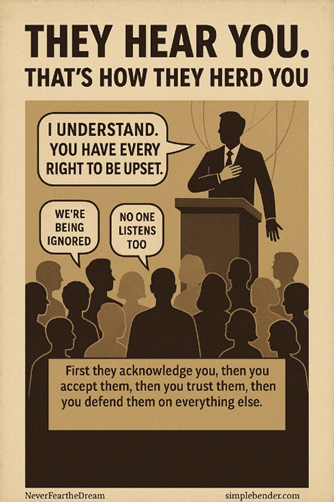
We like to think facts, arguments, and data persuade us. But we are fooling ourselves. We are moved by something much simpler and more primitive: being seen —being acknowledged.

When someone with power looks out at a frustrated crowd and says, “You’ve been ignored, dismissed, and lied to—and you’re right to be angry,” they’ve already won half the battle and most of the crowd. No policy yet, no cost, no trade-offs. Just an acknowledgement. And for people who feel they have been treated as invisible for years, those words are not just drunk, but we bathe in them.

This is the benevolent side of acknowledgment. It’s the foundation of honest dialogue. When people feel genuinely heard, they experience a sense of dignity and respect. They can tolerate imperfect outcomes if they trust the process and believe their concerns are genuinely recognized. Acknowledgment restores a sense of worth: I exist in this system. I matter.

The subsequent step is where things get murky and sticky. First comes acceptance: “At least this one is listening.” Then, subconsciously, we yield our trust: “If they hear me on this, they must be on my side in general.” Give it a little more time and constant repetition, and that trust quietly turns into loyalty. Not because the leader has delivered, but because the follower feels psychologically indebted: “Everyone else ignored us; this one didn’t. This one understands us, believes in us. We owe them a chance.” That shift is dangerous—moving from judging leaders based upon results to unquestioningly defending them because they once made us feel heard and important. This is precisely where healthy acknowledgement can harden into uncritical allegiance. Your ego has been played.

Once someone in authority is branded as “the only one who really understands us,” they can cash that emotional credit almost anywhere. They can stay vague on solutions. They can peddle simple stories for complex problems. Anything can be solved on ‘day one.’ Leaders may use hollow acknowledgment to manipulate, shifting blame and redirecting anger while still being applauded—because they’ve anchored themselves to identity, not performance. Questioning becomes essential to avoid falling for theater rather than reality.

At this point, the line between leadership and chicanery gets very thin and easily crossed. The leader doesn’t need to heal the wound; they need to keep poking it, refusing to let it heal, wanting it to fester. Keep naming the grievance, keep feeding the resentment, keep pointing at new enemies. Distracting you from seeing what is really happening. The followers’ loyalty is no longer about what’s actually being done; it’s about who stands with “people like us.”

Suppose the feeling of being acknowledged matters more to us than the reality of what is actually being done on our behalf. How long will it be before we become willing accomplices in our own manipulation, or have we already crossed that bridge?

Whenever a leader spends far more time jabberwocking and mirroring your pain than functionally measuring their results, don’t be flattered that they “see you”—check your wallet, your rights, and your future. NeverFearTheDream    simplebender.com

Joy in Alzheimer’s
W.C. Barron
Lap Around the Sun
Daily Steps Forward — W.C. Barron