Posted in Philosophy

When Ten Is Just Too Many…

Encourage ethical living through four simple principles

The bridge of life over turbulent river supported by four critical spans....

Religions and philosophies have long sought to distill the principles of life into something memorable and enduring. The story goes that Moses ascended the mountain to retrieve the Ten Commandments for his people. Ten was supposed to be simple. Yet if today’s headlines are any measure, ten is too many for too many. So let’s cut to the core—four principles that are not bound by any specific belief system, but are universal and can be practiced by anyone:

Act with reverence to all.
Cultivate generosity.
Be considerate in relationships.
Tell the truth with care.

Act with reverence to all.
The key phrase is to all. Reverence means respect, grace, and honor—offered not just to friends or allies but to those who oppose, insult, or dismiss you. You don’t have to like or agree with someone to treat them with dignity. Doing so shows moral maturity, honors both of you, and sets an example—even if it isn’t returned.

Cultivate generosity.
Generosity isn’t about giving away everything. It is a practice of timely kindness—offering what is needed, when it is needed, to whomever needs it. Like any skill, generosity grows through practice until it becomes second nature.

Be considerate in relationships.
Every intimate relationship carries hope and vulnerability. To honor that is to see beyond the carnal into the emotional and intellectual—embracing another’s fears and dreams without violating them. That takes openness and courage. And once you learn it in intimacy, extend it outward—adjusting the degree, but carrying consideration into every human interaction.

Tell the truth with care.
Truth matters—but it can wound. Some truths people bury, rewrite, or try to cancel because they hurt. Still, the truth must surface. The key is how we share it: directly, yet not cruelly, honestly, yet not demeaning. Speak truth the way you would want to hear it yourself. And remember, truth is rarely black and white; perspective adds the shades of gray that make it whole.

Headlines are filled with destruction, hatred, and division. We can’t stop it all. But each of us can live by these four guardrails. They are not lofty commandments carved in stone, just four simple principles to practice every day. Because ten may be too many, but we can manage four:

Reverence. Generosity. Consideration. Truth.

For Every Problem...A Solution...
Lap Around the Sun: Daily Steps Forward
Joy in Alzheimer’s: My Mom’s Brave Walk into Dementia’s Abyss

Posted in Philosophy

Four Cascading Truths of Change

  • No situation is beyond change.
    • A shared vision and a sound strategy can shape that change.
      • Everyone must help make a difference.
        • No one is free of responsibilities.

Re-read those slowly. These truths have outlived generations because they work—alone or together. Like people, they stand stronger when connected.

Change is never still. It may be welcome or feared, but it will come. When we craft a common vision and act with purpose, change can be shaped instead of endured. That means leaning in—not leaving the work to “them,” whoever they are, nor just to yourself. Those who only watch from the sidelines end up resenting the outcome. Those excluded will also be resentful and work to sabotage the effort. Find a way to have a shared vision or the vision will eventually fail.

Being part of change means being accountable: creating, planning, and carrying some of the weight yourself. If everyone contributes, no one is left out—and no one is left behind.

The work never truly ends. When one change is complete, we pause, assess, and begin again. Done well, change builds its own momentum and draws people forward. Done poorly, it collapses under its own weight—because one or more of these truths was ignored or broken.

Bring everyone along. Let everyone contribute to their capacity. Share both the burden and the credit, but never the blame, that’s on you—and then—and only then will you change more than you ever imagined.

For Every Problem...A Solution...
Lap Around the Sun: Daily Steps Forward
Joy in Alzheimer’s: My Mom’s Brave Walk into Dementia’s Abyss

Posted in Current Events

Faceless Justice:

When did masks shift from villains to “authorities”?

If you're doing good you shouldn't have to hide behind a mask....

When I was a kid, masks were for the bad guys. Bandits in Westerns, bank robbers with bandanas, the Klan hiding under white hoods, and the muggers in dark alleys. A mask meant you didn’t want to be recognized because you were doing something you shouldn’t be doing. Evil hid its face. Goodness walked in daylight.

But now? Somewhere along the way, the script flipped. Those we were told to trust—law enforcement, federal agents—have adopted the mask. Acting with impunity, ICE officers are staging “operations,” Homeland Security agents are sweeping into neighborhoods, even U.S. Marshals and Border Patrol units, all with faces hidden. They now resemble the masked members of Patriot Front or Blood Tribe. Once respected symbols of authority, they are now appearing faceless, anonymous, and interchangeable. Supporters argue that the masks protect officers from retaliation or online targeting, but to the rest of us, it appears to be a means to avoid scrutiny and shirk accountability.

The claim is they’re targeting “the worst of the worst.” That phrase is supposed to conjure violent criminals, cartel bosses, or human traffickers. Yet the data tells a different story: government data shows that the majority — often well over half, approaching 70%—of ICE detainees have no criminal record at all. They’re being seized at immigration hearings where they’ve come voluntarily, pursued through farm fields, even pulled from schools and churches. They are NOT gunmen. Not the “worst of the worst.” They are just the easy ones. The soft targets. The ones who won’t shoot back.

Which raises the uncomfortable questions: do the masks hide fear, or shame? Fear of retaliation if they went after actual hardened criminals? Shame at arresting the powerless in the most public and humiliating of ways? Or maybe the mask makes it easier to see human beings as quotas instead of neighbors. Is this about public safety—or about hitting administrative numbers?

It’s a bitter irony. The only true ‘good guys’ who still wear masks today are doctors and firefighters. Their anonymity is a sacrifice, not secrecy. They shield their faces not to hide, but to protect and survive, thereby shielding others. That’s the difference. One mask hides identity to avoid accountability; the other shields life in the service of it.

The lesson is as old as childhood morality tales: if you hide your face to do your work, maybe, just maybe, it’s the kind of work that shouldn’t be done in the first place.

For Every Problem...A Solution...
Lap Around the Sun: Daily Steps Forward
Joy in Alzheimer’s: My Mom’s Brave Walk into Dementia’s Abyss

Posted in NeverFeartheDream

Never Fear The Dream…

Life is fleeting, but legacy can echo for generations. Mourn death no more than the husk of a butterfly’s cocoon—its purpose served, its spirit free. Stop blaming—or blessing—your circumstances. You are where you are because of your actions and reactions. 25.08.2

For Every Problem...A Solution...
Lap Around the Sun: Daily Steps Forward
Joy in Alzheimer’s: My Mom’s Brave Walk into Dementia’s Abyss

Posted in Philosophy

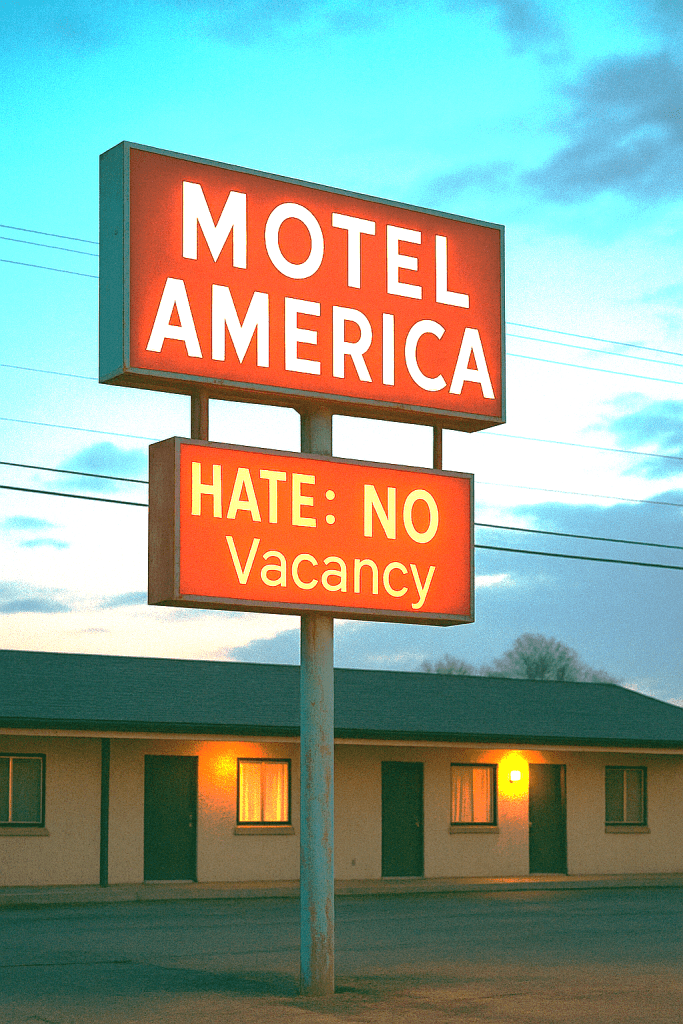
No Place for Hate—Not Here

There is no room for Hate…NONE

There is no place for hate in our homes, our faiths, or our government—none. The grievances of Palestinians, Ukrainians, and displaced peoples around the world may be deep and justifiable—and may very well usher in generational hate. But we Americans have no excuse to let hate in. Not in our hearts, our homes, our places of worship—and definitely not in our policies.

Yet hate has become almost reflexive—normalized, even celebrated. It’s hoisted like a banner, waved by those clinging to lost causes and imagined enemies. It grows in minds and festers in rhetoric, often without genuine cause—and with no end goal beyond destruction and domination.

Those who lead or campaign on hate do so to divide, not to solve. Hate is a wedge—driven between communities to create illusionary superiority and incite rage. It doesn’t clarify; it confuses. It doesn’t elevate; it manipulates. When leaders resort to hate, they expose their inability to persuade, to unify, or to understand. Their bluster masks weakness. Their venom reveals fear. They seek the power of the mob, not the strength of dialogue or the courage of compromise.

Listen carefully: hate speech is no longer fringe. The denigration of individuals—by race, gender, belief, political group, or origin—has become a strategy. Its purpose is not discourse, but dominance. Not freedom, but control.

This country cannot be governed by contempt. We must reject those who exploit division. Hate has no place in a nation built on liberty—and none in a future worth striving for. America is stronger because of our diversity, not despite it. We are more mature—intellectually and emotionally—because of our historic willingness to understand and compromise.

Look neither backwards with anger nor forward with hate. Don’t give hate any space. Not here. Not now. Not tomorrow.

For Every Problem...A Solution...
Lap Around the Sun: Daily Steps Forward
Joy in Alzheimer’s: My Mom’s Brave Walk into Dementia’s Abyss

Posted in Communication

This Christmas, Safe refuge at the kid’s table

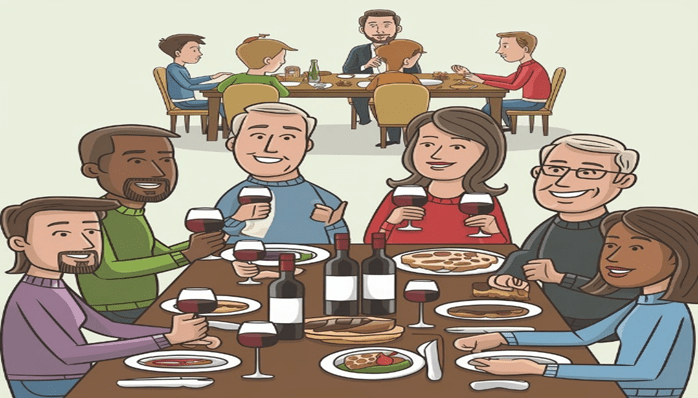
This Christmas, I took a break from the drama and posturing at the adult table and found refuge at the kid’s table.

Yearning for the casual banter of innocence, the insight of young wisdom, and the opportunity to hear the thoughts and words of our future, I decided to sit at the kid’s table. Sitting in smaller chairs, closer to the ground, we may be better grounded than in taller, oversized adult chairs, which these days seem a little too tipsy.

The easy game of Connect the Dots yields winks and laughs as we dabble and play with our food. We chatted and giggled about the presents we had opened and those gifts we still hoped to get. I chuckle at the confused looks as we taste the cranberry sauce and smile as the dressing and mashed potatoes are swirled into a tasty mush.

Overhearing the adults discuss their ‘big people’s topics as I watch the kids. The toast for ‘world peace’ quickly regressed to biting analogies of the Middle East and Ukraine. The younger ones seem more confused as the voices rise. The ‘older ones’ frown and turn away from the tension, showing some disgust at the hypocrisy and arguments. Turning up my hearing aids just a little, I hear one mumble…’ giving aid to one for genocide and taking it away from another fighting for self-defense.’ As their heads shook a little, the simple game of hangman took on new meaning. The table returned to the whispers and giggles of youth as a game or two of tic-tac-toe started. I pondered their insight and perspective and lost the hangman game.

The lighthearted snickers and under-the-table poking were interrupted as another bottle of wine was opened for the adults. A hearty toast at their table as we lifted our glasses of water and mimicked them with our silly smiles and googly eyes. The topics at the big people’s table ebbed and flowed about current events, sports, business, and then back to politics. I shook my head and wished they could listen to us at the kid’s table. We were having fun, laughing, and smiling. Their table got louder as abortion and women’s rights became the main topic. Then the epiphany. One of the girls whispers to another…’ great, the convicted sex predator wants to protect us whether we like it or not…cringe…’ I turned my hearing aids back down, hoping to give them the space they needed and not become the adult at the table.

I thought about what I’d heard at both tables. I wanted to avoid the stress and conflict at the adult table, but I only saw and heard the stress that wafted across the room to the kid’s table. Their young minds are open to so much. Soaking in everything and forming opinions that will drive our world’s future. Too much stress. Too much tension. The heat spilling out of the kitchen to the tables filled with the cornucopia of abundance. We sat there wondering about those with so much less and how fortunate we were. This privileged family has the luxury of having discussions and not worrying about where their next meal is coming from. And yet, these adults don’t realize they may be forming irreversible opinions and generational hate through their terse and tense words.

We, the adults, can impart hope or hate. We can show how to listen and try to understand. It is our choice, and they, the kids, are watching and listening to everything.

My distracted thoughts were interrupted when the youngest leaned over, tapped me, and said, ‘Knock, knock.’ I smiled and thought, ‘Maybe, just maybe, things will be alright’…’ Who’s there?’

NeverFearTheDream     simplebender.com

This article was first published in the Bend Bulletin 12/26/24

Posted in Philosophy

The Cosmic Treadmill: Time, Energy, and the Great Solar Lap

Imagine the Earth as a cosmic runner on a celestial treadmill, circling the Sun in its annual marathon. This cosmic racetrack spans about 940 million kilometers, and whether you are a newborn or a centenarian, the finish line arrives in precisely 365.25 days. Time, in its relentless march, does not care about the state of the runner – it is an impartial timekeeper in our universal stadium. Unless we drop out of the race, we all finish at precisely the same time every year.

Here’s where things get interesting: while the track remains constant, we, the runners, the individuals in the human race, change dramatically over time. The real mind-bender is that while we struggle to keep up with basic life, time keeps marching at the same relentless pace. The Earth does not slow down its cosmic dance just because your back hurts or your busted knees do not work either. Deadlines still loom, birthdays still sneak up on you, and somehow, it is always tax season again.

It is almost like the universe is playing some sick resource management game. “Here’s your annual allotment of time,” it says, “but we’re going to keep decreasing your energy levels. Good luck with that.” And we are left scrambling, trying to cram more into less, wondering how we ever had time for hobbies or, you know, a social life.

Imagine you are a shiny new car, fresh off the assembly line. Your engine purrs, your gears shift smoothly, and your fuel efficiency is at its peak. You zoom around the solar racetrack, accomplishing multiple tasks with minimal effort. This is you in your prime, a well-oiled machine capable of incredible feats within that 365-day lap.

Now, a few decades later. You are still making the same lap, but something is changed. Your once-pristine engine is now coughing and sputtering. Your gears grind a bit, and your fuel efficiency has taken a nosedive. This is the essence of aging – increasing entropy in our biological systems.

In terms of physics, we are dealing with the concept of mechanical efficiency. Our body’s ability to convert chemical energy (food) into mechanical work (actions) decreases as we age. It is like trying to power a Tesla with a steam engine – you will still move, but it won’t be pretty, and it certainly won’t be efficient.

Let’s quantify this with some napkin physics. Suppose you were young and could do 100 tasks per solar lap, requiring 1,000 units of energy. Your efficiency rating would be a respectable 0.1 tasks per energy unit. You can get several workouts in a day, along with your work, and raise your rambunctious young family.

Fast-forward 60 years. You’re lucky to manage 50 tasks with the same energy input. Your efficiency has halved to 0.05 tasks per energy unit. Now you are happy with one workout, a little reading time, and a little time of playing with the grandkids before your early bedtime.

This deterioration is akin to mechanical wear and tear. Just as a car’s engine loses compression over time, our cellular machinery accumulates damage. Mitochondria, our body’s power plants, become less efficient at producing ATP, the energy currency of cells. It is like trying to run a modern smartphone on a battery from the 1990s – technically possible, but woefully inadequate.

The cruel irony is that as our energy efficiency plummets, our energy demands often increase. Maintaining basic biological functions – the equivalent of a car’s idle speed – requires more fuel as we age. It is as if our personal gravitational field intensifies, making every movement an uphill battle against an invisible force.

Yet, the Earth keeps spinning, completing its solar lap with unwavering precision. The cosmic treadmill does not slow down or offer a gentler incline for its aging runners. This disconnect between our internal time – measured in declining energy and capability – and the unyielding external time creates the illusion of time speeding up as we age.

In essence, we are dealing with a fundamental mismatch between biological and astronomical timescales. Our personal energy graphs slope downward while the Earth’s orbital period stays stubbornly constant. It is a cosmic joke played on a universal scale – a reminder that while we may be star stuff, we are also subject to the unforgiving laws of thermodynamics.

As we continue our laps around the sun, remember: the race does not get longer, but the runner certainly gets slower. It is up to us to make each lap count, efficiency be damned. The Earth’s going to keep on spinning, and time is going to keep on flying, which we cannot change. We can change how we use the energy we have left. Maybe it is time to say “screw it” to the things that don’t matter and double down on what does. After all, even if you double down you are only going to achieve a tenth of what you want to….#NeverFearTheDream

Posted in Philosophy

Life’s Continuance

We all look at life, and death, differently. Some differences are subtle, others dramatic. Some lean heavily upon religious practices and beliefs to understand and cope with the unknown. Others seek solitude and find solace in nature’s quiet while they calm their minds to calm their souls. Neither approach is right nor wrong, inferior, or superior. They are simply different means to reconcile life, life’s end, and the unknown nature of life after death.

What if there was no death but only a continuance? What if there is an ‘after-life’ of soul and body? Indeed, there is an end to our physical manifestation, but is that the entirety of existence? Or do we continue through our families and the generations to follow? A never-ending continuing sequence in humankind.

Look at your hand, what do you see? Do you only see your hand, your skin, your blood vessels, your skin cells? Is that all you, see? Look closer, I see all those but also, I see my parents, and their parents, and theirs before them and farther still. I see a continuum of life. A never ending always building continuance. Every cell in my body has the genetic sequence of my family past. While unique, I am not new. I am a product of the infinite interactions of all my forebears and theirs.

Look at your child’s hand and the hands of their children. Look closely. There it is. There you are. And there is your family’s past. You are a part of them. You always have been and always will be. You will always be a part of the future generations to come as well.

While you are part of them forever, they are also part of you. You cannot separate yourself from a part of something of which you are integral. They will continue after your physical form is gone. They will carry your memories and your teachings, good and bad, and pass them on to others. More importantly, you will always be with them, a part of every cell within them.

Look at your children holding their children’s hands and know you are holding their hands as well. Even if you are not there physically, you are there and always will be. There is no passing, only a continuance. No death; as life goes on.

NeverFearTheDream