Posted in Current Events

Spin of War — Opportunistic Diversion

Operation Epstein Fury

There’s a common tactic governments use when they want the advantages of war without the drawbacks of the word. They don’t declare war; they call it an “operation.” It’s not conquest; it’s prevention. Not aggression; it’s protection. Not a choice; it’s a necessity.

Russia attacks Ukraine and calls it a “special military operation,” framing it as forced self-defense — claiming to protect threatened people, prevent danger, purge “Naziism,” and “demilitarize” a neighbor that supposedly left Moscow with “no other option.” Those phrases aren’t analysis; they’re anesthetic. They’re designed to make violence seem like a matter of hygiene.

Then came the blessing. The Russian Orthodox hierarchy portrayed the conflict as a spiritual struggle against a decadent West — a defensive moral crusade, not merely a geopolitical choice. When a state recruits sacred language, it isn’t seeking God’s guidance. It’s seeking immunity.

The U.S. is now running the same playbook in Iran. Officials sell “objectives,” not wars — missiles, proxies, a nuclear pathway — carefully described as controlled, and nothing like all previous “open-ended” American disasters. The invasion was essential to protect against an impending, not imminent, threat, to hold the radical Islamic regime at bay, and annihilate their military. The branding changes to suit the audience; the psychology doesn’t. You’re still being asked to feel reassured by a label and comforted by the phrase “proactive act.”

But the script becomes darker. The Military Religious Freedom Foundation (MRFF) reports having received hundreds of complaints from service members claiming commanders justified the Iran campaign as “God’s plan,” invoking Revelation, end times, and Armageddon itself.[1][2][3][4] That isn’t faith. It’s propaganda wearing faith’s clothing.

Armageddon is not a marketing theme or a recruitment slogan. It is the ultimate condemnation of human rulers who confuse power with righteousness. Inserting the Second Coming into strike briefings doesn’t sanctify the policy — it desecrates the text. And framing any sitting leader in messianic terms isn’t patriotism. It’s an admission: that the case for war cannot stand on honest ground, so it must be propped up by manufactured revelation.

The spin is consistent even when the players change. What varies is the packaging — “momentum,” “dominance,” “inevitability” — language engineered to make aggression feel like physics rather than choice. If the timing of the Iran campaign was shaped as much by domestic political pressure as by genuine security necessity, then what is being sold as strategy may be closer to spectacle. It is a diversion substituting urgency for accountability. This is the next most hazardous and heinous stage of “Operation Epstein Fury.”

When religious fervor is added to that mix, the cynicism becomes complete. It is no longer merely policy dressed as necessity. There is nothing sacred or honorable in that — and the willingness to go there tells you everything about the strength of the underlying case. It bolsters an ego while others die. It is policy and self-preservation masquerading as prophecy.  NeverFearTheDream     simplebender.com


Lap Around the Sun: Daily Steps Forward
by WCBarron

Buy at Amazon Buy at Barnes & Noble Buy at Books2Read

Joy in Alzheimer’s: My Mom’s Brave Walk into Dementia’s Abyss
by WCBarron

Buy at Amazon Buy at Barnes & Noble Buy at Books2Read

Footnotes references :

  1. Military Religious Freedom Foundation, “MRFF Inundated with Complaints of Gleeful Commanders Telling Troops Iran War is ‘Part of God’s Divine Plan’ to Usher in the Return of Jesus Christ,” March 3, 2026.
  2. Military Religious Freedom Foundation, “Unit combat readiness briefing and Armageddon,” MRFF’s Inbox, March 3, 2026 (complaint dated March 2, 2026; includes the “all part of God’s divine plan” wording and Revelation/Armageddon references).
  3. Sara Braun, “US troops were told war on Iran was ‘all part of God’s divine plan’, watchdog alleges,” The Guardian, March 3, 2026 (last modified March 5, 2026).
  4. Cornell University Media Relations Office (Cornell Chronicle Tip Sheet), “End-times rhetoric in US military ‘didn’t infiltrate, was invited in’,” March 4, 2026 (summarizes MRFF’s reported complaints and the “God’s plan for Armageddon” framing).
Posted in Current Events

Who Lit the Fuse

Rejection of Western Supremacy: Defending Strategic Sovereignty

Perspective is everything… There is always another viewpoint to consider…not to agree or disagree with but to appreciate and understand…

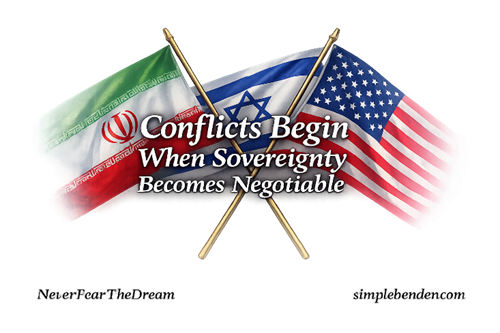
The current U.S.–Israel conflict with Iran began decades ago, through memory, humiliation, and contested sovereignty. Conflicts rarely begin with weapons. They begin when one nation decides another’s sovereignty is negotiable.

In the Iranian narrative, the creation of Israel in 1948 was not just the forced seizure of land and the establishment of a state. It was the implantation of a Western-supported political project into the heart of the Muslim world, leading to displacement, repeated wars, and ongoing territorial disputes.[1] For many throughout the region—including Iran, especially after the 1979 Islamic Revolution—the Palestinian cause became more than a geopolitical issue. It turned into a moral test of the Islamic world’s resolve and dignity. Legal disputes over occupation, settlements, and borders only strengthened that perception.[2]

Iran’s distrust of Western intentions hardened long before any nuclear ambition. In 1953, the U.S. and Britain supported the coup to overthrow Prime Minister Mohammad Mossadegh after he nationalized Iranian oil[3], just as Venezuela did. That intervention left a lasting mark, a generational memory. To the revolutionaries who later overthrew the Shah in 1979, it showed that Iranian sovereignty could be compromised whenever it conflicted with Western strategic interests.

The Shah’s brutal rule, especially during the student protests starting in 1978, was seen by many Iranians not as partnership but as alignment with foreign powers—security cooperation, oil coordination, and intelligence sharing that seemed to serve Washington’s Cold War agenda more than the interests of Iranian citizens.[3] When the Islamic Republic emerged, its ideology combined Shia political theology with anti-imperialist resistance and rejection of the Shah’s authoritarian rule. Independence was raised from a political choice to something more like a sacred duty.

The 1979 humiliating seizure of the U.S. Embassy in Tehran was viewed, by the West, as an act of lawlessness; in Tehran, it was justified as a preemptive move to prevent recurring foreign intervention.[4] The resulting hostage crisis and humiliating failed rescue attempt solidified a rift that has defined U.S.–Iran hostility ever since.[4][5]

Against this background, Iran’s nuclear program is often presented as a form of deterrence rather than aggression—especially in a region where Israel is widely believed to possess nuclear weapons under a policy of deliberate ambiguity.[6] Surrounded by U.S. military presence and regional instability, Iranian leaders argue, as do North Korea’s, that vulnerability invites intervention. Deterrence, in this context, acts as insurance, just as nuclear stockpiles do for the U.S. and Russia under the logic of mutually assured destruction.

From this perspective, what outsiders call escalation can seem like a form of strategic self-preservation. Iran’s stated goal is peaceful coexistence with neighbors—preferring trade over siege and recognition over tutelage—while staying prepared for perceived threats. Whether one accepts that framing or not, it is based on a simple idea: sovereignty needs the ability to defend itself, even as other regional sovereigns have been indiscriminately assaulted, Iran has acted with strategic patience.

This conflict is often mistakenly seen as religious because it lacks any clear reason, and adding a religious angle is the last tactic to ignite passions and gain support. In reality, the main issues are more geopolitical. Israel maintains strong ties with Muslim countries, and Iran works with non-Muslim allies when their interests align. Labeling this as a religious crusade greatly raises the chance of the conflict spreading worldwide. While religion fuels rhetoric, sovereignty shapes actions.

Remove the slogans and caricatures. They serve as rallying cries for the faithful. “Death to America” shares the same insecure roots and purpose as “fight like hell” and “axis of evil,” making the conflict easier to understand: a regional power seeking independence from a global power that wants to influence or control. Tensions have escalated over decades through intervention, oversight, resistance, mutual suspicion, secret negotiations, and arms deals.

To be very clear, the killing and abuse of protesters should never be normalized, anywhere and at any time; not during the Shah’s monarchy or under the Ayatollah. The depravity of the theological regime should not be downplayed. However, these are not external issues to solve. Western agents have been doing that for too long without any lasting change. The Iranian people chose an Islamic Republic; they can choose to change it; they have done so before and will do so again.

Empires remember insults; nations remember humiliation; and people endure suffering. Both memories tend to outlast treaties. This is another unfortunate, avoidable skirmish in a world on fire; a fire fueled by ego. NeverFearTheDream simplebender.com


Lap Around the Sun: Daily Steps Forward
by WCBarron

Buy at Amazon Buy at Barnes & Noble Buy at Books2Read

Joy in Alzheimer’s: My Mom’s Brave Walk into Dementia’s Abyss
by WCBarron

Buy at Amazon Buy at Barnes & Noble Buy at Books2Read

Footnotes

[1] Encyclopedia Britannica, “Arab–Israeli Wars” and “Palestine” entries (overview of the 1948 war and its aftermath).
[2] International Court of Justice, Legal Consequences of the Construction of a Wall in the Occupied Palestinian Territory (Advisory Opinion, 9 July 2004).
[3] Encyclopedia Britannica, “1953 Coup in Iran” (Operation Ajax; U.S./UK involvement and consequences).
[4] Encyclopedia Britannica, “Iran Hostage Crisis” (1979–1981; diplomatic rupture).
[5] U.S. Department of State, Office of the Historian, “The Iranian Hostage Crisis.”
[6] Federation of American Scientists, global nuclear stockpile assessments referencing Israel’s undeclared nuclear capability.

Posted in Current Events

Paradox of Power and Terror

You can’t eliminate terrorist threats by becoming one. You only demonstrate that terror works.

A superpower doesn’t need to win an argument; it only needs to win the moment. And lately, the United States looks less like a restraining force and more like a superpower increasingly willing to use terror’s tools—fear, coercion, and unilateral force—then call the wreckage “security.”

Consider the new precedent we’re showing the world. On the last day of February, U.S. and Israeli strikes on Iran assassinate Iran’s Supreme Leader, Ayatollah Ali Khamenei. This act would have been unthinkable inside the “rules-based order” we demand others respect. When the strongest country on earth normalizes decapitation-by-airstrike, every aspiring strongman learns the lesson: power can replace legitimacy.

Then there’s Venezuela. In early January, U.S. forces invaded and forcefully apprehended President Nicolás Maduro—Washington’s most direct intervention in Latin America in decades. The invasion wasn’t about drugs or oil, but ego. The operation immediately spun the story of necessary law enforcement. But it’s also a template: if we can seize a head of state, others can too.

We used to be the protector of the seas, but now U.S. authorities seize tankers carrying Venezuelan crude and seek forfeiture of millions of barrels, arguing sanctions evasion and links to hostile actors. The message isn’t subtle: “international waters” don’t protect you if you are smaller and weaker, and we decide you’re sanctioned. From protector to pirate.

And coercion isn’t only military. It’s economic. Tariffs, threatened and applied as leverage, even against allies, turn trade into a cudgel. Our regime calls it bargaining, but the targets call it bullying, extortion, and coercion. Either way, it trains the world to treat commerce as warfare by other means.

The contradiction doesn’t stop at the shoreline. When immigration enforcement becomes a national spectacle, dissent gets pulled into the machinery. Amid protests of warrantless immigration detentions, Americans have been imprisoned and killed. Those deaths don’t prove a grand conspiracy; it proves something quieter: when government and protest meet in a fog of fear, people die—and everyone hardens. Terrorism isn’t only foreign. It is domestic, too—not just in bombs, but in the slow conditioning of a public: say less, vote less, protest less, comply more.

If we want the world to reject terror’s logic, we have to stop promoting and exemplifying it. By our actions, we have given Russia moral grounds to press their invasion of Ukraine, and China the justification to embargo and invade Taiwan. What we once did covertly we now do overtly; and shouldn’t be shocked when other countries do the same. We were once admired and known as the protectors of the aggrieved, the helpers of the weak. Now we are the aggressor nation. From savior to storm-trooper. Maybe we should replicate the ‘change’ at home before our national memory forgets the difference between domination and freedom.    NeverFearTheDream   simplebender.com

A nation that uses threats, fear, and terror can never be great; never.

… – .- -. -.. / ..-. — .-. / – .-. ..- – ….


Lap Around the Sun: Daily Steps Forward
by WCBarron

Buy at Amazon Buy at Barnes & Noble Buy at Books2Read

Joy in Alzheimer’s: My Mom’s Brave Walk into Dementia’s Abyss
by WCBarron

Buy at Amazon Buy at Barnes & Noble Buy at Books2Read
Posted in Philosophy

Sanctity for Survival: Weaponizing Religion

Religion has always walked a knife-edge between faith and power. Religion is best when it brings comfort and worst when it becomes a tool of politics. Within our lifetime, there are two salient examples of the twisting of religion and state power: Iran and Russia. Two very different nations illustrate how this symbiotic relationship unfolds and precisely why our founders wisely established a separation between the church and the state. Spoiler alert—the walls are crumbling.

Iran: Mosque as State—Under the Shah, Iran’s clerics were suppressed, their influence diminished as the monarchy rushed to modernize. In 1979, the pendulum swung violently back. Ayatollah Khomeini and the mosque became the state itself. For decades, sermons dictated law, dissent was heresy, and the Revolutionary Guard enforced both politics and piety. Religion achieved supremacy at the cost of freedom.

Today, Iran’s youth — connected, progressive, impatient — are no longer persuaded by clerical authority. Protests after the death of Mahsa Amini revealed the fracture: religion wielded as control is no longer seen as sacred. The bargain that once restored the mosque’s power has hardened into a straitjacket, hollowing faith even as its institutions endure.

Russia: Saints for Soldiers—For most of the 20th century, the Russian Orthodox Church was brutalized under communism. Priests executed, cathedrals destroyed, believers silenced. When the Soviet Union collapsed, the Church sought revival — but revival required allies. Putin offered protection, prestige, and funding. In return, Patriarch Kirill and his bishops sanctified not only his rule, but his wars. Each branch of the Russian military is assigned a patron saint, and these are displayed as soldiers march—icons and rifles in hand. And mosaics of saints standing beside tanks and missiles—faith stitched into firepower.

It is a mutual, parasite-host alliance for survival. The Church props up the empire; the empire props up the Church. Orthodoxy regains prestige after decades of persecution, while the Kremlin secures sacred legitimacy for its conquests.

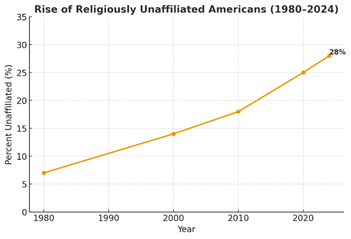
United States: Are Pulpits the Next Podiums?—Judeo-Christianity has influenced our national culture from its founding. Currently, church attendance is shrinking, younger generations walk away, scandals erode credibility, and the religiously unaffiliated approaches 30% of the population (PRRI). We are evolving into a secular nation of diverse beliefs. In this decline and transition, political power has become a lifeline for some of the more radical to guard against the nightmare of irrelevance becomes a reality.

Some fringe religious leaders now align with vocal politicians who promise to “fight for them,” to restore an age and influence gone by. In exchange, some of their pulpits have become podiums. Political leaders boast, “I hate my enemies,” and vow to “beat the hell out of them,” these words juxtaposed to:” do good to those who hate you, bless those who curse you, pray for those who mistreat you.” The contrast is crisp —aggressive pulpits now espouse vengeance rather than pleading for understanding. Rhetoric that contradicts the very teachings once held sacrosanct. The threat of pulpits becoming podiums is a genuine concern.

Lessons: Learn the Lessons—The parallels are clear. In Iran, religion became the state. In Russia, the Church promotes the empire for its own security. In America, the mainstream is often overshadowed by extremists who cling to authoritarian strongmen for cultural relevance and power—trading faith’s essence for influence.

When religion becomes a weapon of politics, the backlash is not revival but rebellion. These bargains may preserve institutions for a generation, but they ultimately lead to decay.

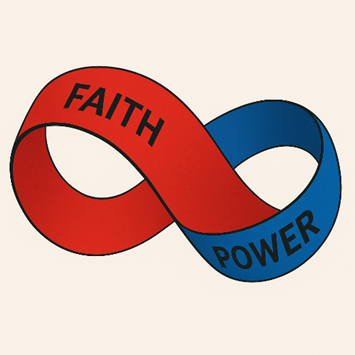
Like a Möbius strip, the inside and outside of faith and power continuously trade places, with no true end and no certainty. The loop is endless, the inversion unending — a path where faith loses its soul and nations lose their way, twisting around and around until revolt. The American founders understood this and wisely built institutional walls between state and church to prevent their blighted bonding, but now the walls are crumbling. #NeverFearTheDream

First published in Bend Bulletin 10/29/25

For Every Problem...A Solution...
Lap Around the Sun: Daily Steps Forward
Joy in Alzheimer’s: My Mom’s Brave Walk into Dementia’s Abyss