Posted in Current Events

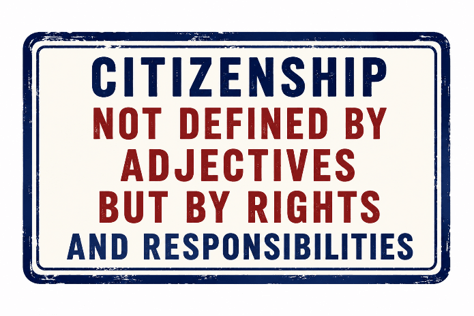
Citizen: Adjectives Not Required

Protection Imperative

America’s founding documents largely avoided attaching adjectives to the concept of “Citizen.” They established broad philosophical principles centered on liberty, personal rights, and self-determination without attempting to divide citizenship into preferred categories. For their time, the idea was radical: a nation built more on shared principles than on shared bloodlines.

Our founders were imperfect people, constrained by the limits and prejudices of their era. Yet many of their aspirations remain deeply human and recognizable today. They sought the freedom to shape their own lives, raise their families safely, worship as they chose, speak openly, and pursue opportunity without a domineering central authority. They envisioned a country driven not by inherited class, tribe, bloodline, or title, but by the ambitions and determination of its citizens.

The Constitution and the Bill of Rights speak largely in universal terms: citizens, persons, and the people. The documents themselves are far more neutral than many who later interpreted and enforced them.

The problem has rarely been the principles. It has been people; it is us, the “Citizens.”

Human beings instinctively protect power once they possess it. They create social and political adjectives around the word “Citizen” to determine who fully belongs, who deserves influence, whose rights matter more, and whose freedoms may be limited. Throughout history, those in power have repeatedly narrowed broad constitutional principles through discrimination, exclusion, fear, and tribal identity.

That reality is precisely why federal and state protections became necessary. The Constitution may aspire toward color-blind liberty; the administration of those principles has often fallen short. Courts and lawmakers must continually wrestle with that contradiction while remaining anchored in the original promise of equal citizenship under the law.

The easy path is to turn a blind eye to humankind’s tendencies. The hard path, but the right one, is to address, restrain, and retrain them and to uphold the standards of our original foundations.

Citizenship carries enormous responsibility and accountability. It also carries extraordinary freedom. Both weaken the moment adjectives become more important than the word “Citizen” itself.                     NeverFearTheDream   simplebender.com

… .. — .–. .-.. . / -.-. .. – .. –.. . -.


Lap Around the Sun: Daily Steps Forward
by WCBarron

Buy at Amazon Buy at Barnes & Noble Buy at Books2Read

Joy in Alzheimer’s: My Mom’s Brave Walk into Dementia’s Abyss
by WCBarron

Buy at Amazon Buy at Barnes & Noble Buy at Books2Read
Posted in Political

Beyond Tokenism, Tribalism, and Wokeism

The issues and consternation we face with Diversity, Equity, Inclusion, and Accessibility aren’t new. Humanity is predisposed to tribalism and discrimination. We like to be around those who are like us….whether race, gender, creed, hobby, or sports team. This country has had an issue with DEIA from its start. The idea that someone gets something to fill a quota rather than being the most qualified just isn’t American.

We stand on a merit-based system. As a country, we have struggled with DEIA laws thrust upon us since post-Civil War reconstruction and especially since the Civil Rights Act of 1964. We reject the concept of merit and privilege being replaced with legislation trying to eliminate discrimination because the result is systematic alienization and reverse discrimination.

Diversity is not just a preference; it’s a necessity in business, sports, education, social interaction, and life. The ideas, experiences, prowess, and insights of other nationalities, races, genders, and creeds enrich our lives and country. It’s a vibrant aspect of our nation—a nation of immigrants.

Equity is not equality. It’s about ensuring everyone is on an equal footing. The privileged should not be treated any better or worse than the impoverished, and the rich should not have any more access to political officials than the hoi polloi. The challenge is: How can you ensure equity when the playing field has never been level? None of us start with the same privileges or handicaps. Treating everyone equally only perpetuates and extends inequities. And if you believe the education system and/or medical care in this country is equal for all, you’ll struggle to understand any of this.

We stand on a merit-based system. We reject the idea of nepotism and ‘pay to play’ influence. Right? Yet, we all know the person who got the job because their parent knew someone, had money, or owned the company. We stand on merit, right? I understand the frustration with DEI. I was once told I would hire a specific person for an open, publicly posted position. The job description was unambiguous. Looking at the resume, the new hire didn’t appear to be a good match, but that didn’t matter. Quickly checking my DEI card, I recognized there was, in fact, justification for the hire, regardless of qualification. The new employee was part of an exclusive minority. With a little extra time, patience, and training, the company finally had a good employee. The child of a sitting U.S. Senator allowed us to check a box and have an amazingly unique perspective at break time. Merit didn’t matter then; to some, it doesn’t matter now. Of course, the good-ole-boy, nepotistic system was always so much better in so many ways, right?

Remember that DEI never intended to mean ‘Don’t Ever Integrate.’ It was meant to be a way to give opportunities to all people, not just those with connections. Is the current direction and directives about merit or returning to our country’s quasi-legal racial segregation state? As cop killers and killing cops are pardoned, the answer may already be self-evident. Courage and Be Bold   

#NeverFearTheDream   simplebender.com @simplebender.bsky.social

This was first printed in the Bend Bulletin 1/30/25 titled: Measuring merit and diversity