Posted in Current Events

Accountability Gunned Down

and Credibility Mortally Wounded…..
The first videos weren’t clear. They were chaotic—grainy clips, partial frames, shouting without context. But the official messaging arrived before evidence was gathered, witnesses interviewed, or a timeline stitched together, the verdict was delivered. Heroic officers. Clear self-defense. Thwarted mass terror. The dead were “deranged domestic terrorists,” and the valiant officers had barely survived and saved many.

That’s narrative warfare—not investigation.

This is the modern media playbook: speak first, speak loudly, and force everyone else to prove you wrong. Flood the zone with ‘certainty,’ half-facts, and righteous adjectives. Let supporters do the rest. If later evidence complicates the story, it won’t matter; the first impression has already been welded into identity. And if you can manufacture images, clips, or “context” with AI, you can make doubt look like proof while you stall, bury, and obscure the real record.

What makes the lie persuasive is that it rides on a few fragments of truth. A legal concealed-carry permit becomes a justification for killing. A photo of a holstered firearm becomes “brandishing.” A moment of chaos becomes “attempted assassination.” A tender snapshot of agents “helping” a frightened child becomes moral cover for whatever came before or happens after. The lifestyle of one is used to instill moral judgment and question motive. Just enough ‘truth’ to make the rest feel plausible to the true believers.

We’re told to relax. Trust the regime and its process. Wait for the facts they want to show us. The rest of the facts arrive late and edited—while the narrative sprints ahead, unchallenged and amplified by officials who treat accountability as optional.

There’s a deeper fatal wound: credibility. Bullets may have killed Renee Good and Alex Pretti, but the words that followed targeted something larger—the public’s ability to discern what is real. When institutions train citizens to doubt their eyes and distrust every correction as “spin,” they aren’t governing; they’re conditioning. They are self-serving protectionists maximizing propaganda’s bullhorn.

So we should ask, without hysteria or naiveté: Was a five-year-old used as bait or as a shield? Was Good’s death justified or convenient? Was Pretti killed because he believed in the 2nd Amendment or because zealous masked bullies lost control of themselves? If we can be pushed to accept a finished story before an investigation even begins, what else have we been trained to swallow—about elections, wars, enemies, or the files that power keeps sealed? Move along, citizen. Nothing to see here.   NeverFeartheDream   simplebender.com

Joy in Alzheimer’s
W.C. Barron
Lap Around the Sun
Daily Steps Forward — W.C. Barron
Posted in Current Events

Operation Wetback 2.0: America’s Immigration Purgatory

(Except for First Nations….Lest we forgot, we are all immigrants, lest we forget.)

America’s immigration history has two defining bookends—both failures that masquerade as solutions: brute force and endless procedure. In the 1950s, the United States chose force—regionally and aggressively. Today, it chooses process—nationally, diffusely, and with targeted intensity. Both claim legitimacy. Both avoid responsibility. Both are unapologetic for failure and death. Neither deserves moral cover; both merit condemnation.

In the late 1950s, Operation Wetback was panic impersonating as policy. It treated human beings as a problem, refuse, to be flushed from the system—quickly, cruelly, and visibly. Across the Southwestern United States, Texas, California, Arizona, and New Mexico became enforcement zones. Farms, towns, and cities were swept with little regard for documentation or citizenship. The only thing that mattered was ethnicity. Its defenders praised its “effectiveness,” even calling it “a model,” collapsing ethnics into numbers. Humans were caged. Deportations were swift. Fear spread quickly—along with the erosion of constitutional restraint and human dignity. Citizens were caught up. Families were broken. People died.

For all its cruelty, Operation Wetback held one principle firm: deportation meant returning people to their country of origin, typically Mexico. Removal was brutal, but the destination was at least coherent. The state expelled people to a homeland, not into geopolitical limbo.

Condemning that era is easy. The more demanding task is confronting the present.

Today’s ICE-DHS enforcement regime operates as a nationwide system, shaped by discretion, delay, and unequal impact. Enforcement now extends coast to coast, embedded in courts, databases, detention centers, and subcontracted detention abroad. Deportation no longer guarantees return ‘home.’ Individuals may be transferred to third countries not because of their origin but because corrupt, weak governments are willing to accept detainees in exchange for compensation or a diplomatic concession—transactional detention, prisons for hire.

There are hearings now, maybe. Appeals, maybe. Paperwork, surely. Shockingly, today’s violence is less and more isolated, but still vile, unnecessary, and with bystanders being provoked and killed. Actions outsourced to undertrained enforcement at the direction of uninformed and opportunistic bureaucracy. Masked agents, hide their faces, names, and affiliation, are brandishing weapons and using unwarranted force without accountability. Families are not always torn apart in a single raid; instead, more perversely, they unravel over months or years of detention, uncertainty, and displacement.

Operation Wetback was cruelty without due process. Today’s enforcement is often one-size-fits-all, due process without courage. One system expelled people brutally but directly. The other disperses suffering nationally and indefinitely. America’s most infamous mass deportation campaign reveals a shift not from cruelty to compassion, but from visible brutality to managed, indefinite human limbo and indifference.

Immigration laws should be followed by everyone and every organization. We need immigration control and enforcement, but not draconian brutalization. The tragedy is not that America once chose force. It is that, decades later, it still refuses to choose honesty. This is the immigration purgatory we now live in and may die in.   NeverFearTheDream · simplebender.com

Joy in Alzheimer’s
W.C. Barron
Lap Around the Sun
Daily Steps Forward — W.C. Barron
Posted in Current Events, Political

Protection of Dissent

Decent people support dissent   NeverFearTheDream  simplebender.com

Democracies don’t die when people stop agreeing; they die when people stop dissenting. The loud, awkward, sometimes offensive voices are not a nuisance in a free society—they’re proof the system is still breathing.

We like to think “decency” means keeping things calm and polite. But genuine decency involves the courage to say, “This is wrong,” when power would rather you stay silent. The “decent” citizen who never questions authority isn’t truly decent; they’re just obedient.

That’s why dissent is always the first target of any controlling system. Not murderers. Not fraudsters. Not the genuinely dangerous. No, the temptation is to start with the inconvenient. Today, that often means immigrants, students, and visa holders. ICE and DHS don’t just police borders; they’re increasingly policing opinions—trawling social media, flagging protest, and turning lawful speech into a quiet risk factor for deportation.

On paper, the First Amendment belongs to “the people,” not just citizens. In practice, the easiest place to test new forms of control is with those who have the weakest political footing. If you can punish an international student for a tweet, you’ve just built a working model of speech control that can be scaled later. The laboratory is immigration; the product can be rolled out to everyone else.

That’s where the “protection of dissent” comes in. If decent people, like us, sit this out because they dislike the protesters’ slogans or hashtags, they’re missing the plot. The issue isn’t whether we agree with the content of dissent. The issue is whether the government can quietly attach a price and a punishment to dissent, leaving only the reckless or the desperate willing to speak.

History is blunt: once it becomes dangerous to disagree, it eventually becomes dangerous to be different.

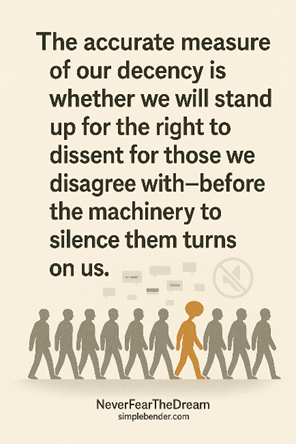
The accurate measure of our decency is whether we will stand up for the right to dissent for those we disagree with, before the machinery to silence them turns on us. NeverFearTheDream   simplebender.com

Joy in Alzheimer’s
W.C. Barron
Lap Around the Sun
Daily Steps Forward — W.C. Barron

Posted in Current Events

Faceless Justice:

When did masks shift from villains to “authorities”?

If you're doing good you shouldn't have to hide behind a mask....

When I was a kid, masks were for the bad guys. Bandits in Westerns, bank robbers with bandanas, the Klan hiding under white hoods, and the muggers in dark alleys. A mask meant you didn’t want to be recognized because you were doing something you shouldn’t be doing. Evil hid its face. Goodness walked in daylight.

But now? Somewhere along the way, the script flipped. Those we were told to trust—law enforcement, federal agents—have adopted the mask. Acting with impunity, ICE officers are staging “operations,” Homeland Security agents are sweeping into neighborhoods, even U.S. Marshals and Border Patrol units, all with faces hidden. They now resemble the masked members of Patriot Front or Blood Tribe. Once respected symbols of authority, they are now appearing faceless, anonymous, and interchangeable. Supporters argue that the masks protect officers from retaliation or online targeting, but to the rest of us, it appears to be a means to avoid scrutiny and shirk accountability.

The claim is they’re targeting “the worst of the worst.” That phrase is supposed to conjure violent criminals, cartel bosses, or human traffickers. Yet the data tells a different story: government data shows that the majority — often well over half, approaching 70%—of ICE detainees have no criminal record at all. They’re being seized at immigration hearings where they’ve come voluntarily, pursued through farm fields, even pulled from schools and churches. They are NOT gunmen. Not the “worst of the worst.” They are just the easy ones. The soft targets. The ones who won’t shoot back.

Which raises the uncomfortable questions: do the masks hide fear, or shame? Fear of retaliation if they went after actual hardened criminals? Shame at arresting the powerless in the most public and humiliating of ways? Or maybe the mask makes it easier to see human beings as quotas instead of neighbors. Is this about public safety—or about hitting administrative numbers?

It’s a bitter irony. The only true ‘good guys’ who still wear masks today are doctors and firefighters. Their anonymity is a sacrifice, not secrecy. They shield their faces not to hide, but to protect and survive, thereby shielding others. That’s the difference. One mask hides identity to avoid accountability; the other shields life in the service of it.

The lesson is as old as childhood morality tales: if you hide your face to do your work, maybe, just maybe, it’s the kind of work that shouldn’t be done in the first place.

For Every Problem...A Solution...
Lap Around the Sun: Daily Steps Forward
Joy in Alzheimer’s: My Mom’s Brave Walk into Dementia’s Abyss

Posted in Current Events

Uniquely American: Civil Discord and Disobedience

Ideas can wound more deeply than fists—their scars often outlast bruises. But dissent isn’t treason; it’s the American expectation. The audacity to voice a contrarian view without fear of punishment was once a defining feature of our national character. That freedom, that courage, is slipping.

A fundamental right is to stand, speak, write, or peacefully protest what you believe is wrong. It’s a moral responsibility at the core of our civic being. It is how we started. As Americans, it is who we are.

Yes, this right has been repeatedly abused and suppressed: during the Civil Rights Movement, LGBTQ advocacy, and Black Lives Matter protests. These weren’t our proudest moments—they were our failures. And yet, we are better than those moments. And we are better because of them. Just as we should be better than today’s attempts to silence pro-Palestinian and pro-Ukrainian voices, or to weaponize immigration enforcement.

Yes, public safety matters. And yes, misinformation can be dangerous, especially when weaponized at scale. But the line between protection and suppression is perilously thin. When fear becomes a rationale for silencing protest, we drift toward authoritarianism under the guise of security.

But let me be honest. I write this as someone of privilege—a white male in the dominant race and gender. I’ve never feared for my safety when expressing my views. I’ve never had to calculate the cost of speaking out to simply be heard. That insulation is not universal. And acknowledging that it is the least I can do.

The truly brave are those who speak anyway, knowing the risks. Minorities are demanding the rights that this country claims to guarantee. Immigrants who were escaping violence and chasing a future are thrust back into violence. And yet, their domestic complicit employers are not subject to the heavy hand of the law. The Pro-Palestinian voices speaking into the silence of global indifference as their homeland, their homeland of generations, is taken and broken, and their families are indiscriminately killed and starved. And even those supporting Ukraine as it fiercely defends its children and its homeland from slaughter by an invading army.

They are the ones carrying this nation’s conscience forward. They take the blows, not for fame or ideology, but for survival and dignity. The road to a better America is paved by those who get off the couch and speak out through civil dialogue, discord, and yes, disobedience.

This country grows not by force, but by engagement. We will be stronger when those in power trade masks and riot gear for open conversation—and when fabricated, non-existent, dystopian, national “emergencies” are no longer used to justify suppression. When we are afraid to speak out, the words of others fill the void, becoming all that is heard. When those of us who can speak don’t, we become complicit in the decay. The slide is ours to stop; or ours to be held accountable.

For Every Problem...A Solution...
Lap Around the Sun: Daily Steps Forward
Joy in Alzheimer’s: My Mom’s Brave Walk into Dementia’s Abyss