Posted in Philosophy

Sanctity for Survival: Weaponizing Religion

Religion has always walked a knife-edge between faith and power. Religion is best when it brings comfort and worst when it becomes a tool of politics. Within our lifetime, there are two salient examples of the twisting of religion and state power: Iran and Russia. Two very different nations illustrate how this symbiotic relationship unfolds and precisely why our founders wisely established a separation between the church and the state. Spoiler alert—the walls are crumbling.

Iran: Mosque as State—Under the Shah, Iran’s clerics were suppressed, their influence diminished as the monarchy rushed to modernize. In 1979, the pendulum swung violently back. Ayatollah Khomeini and the mosque became the state itself. For decades, sermons dictated law, dissent was heresy, and the Revolutionary Guard enforced both politics and piety. Religion achieved supremacy at the cost of freedom.

Today, Iran’s youth — connected, progressive, impatient — are no longer persuaded by clerical authority. Protests after the death of Mahsa Amini revealed the fracture: religion wielded as control is no longer seen as sacred. The bargain that once restored the mosque’s power has hardened into a straitjacket, hollowing faith even as its institutions endure.

Russia: Saints for Soldiers—For most of the 20th century, the Russian Orthodox Church was brutalized under communism. Priests executed, cathedrals destroyed, believers silenced. When the Soviet Union collapsed, the Church sought revival — but revival required allies. Putin offered protection, prestige, and funding. In return, Patriarch Kirill and his bishops sanctified not only his rule, but his wars. Each branch of the Russian military is assigned a patron saint, and these are displayed as soldiers march—icons and rifles in hand. And mosaics of saints standing beside tanks and missiles—faith stitched into firepower.

It is a mutual, parasite-host alliance for survival. The Church props up the empire; the empire props up the Church. Orthodoxy regains prestige after decades of persecution, while the Kremlin secures sacred legitimacy for its conquests.

United States: Are Pulpits the Next Podiums?—Judeo-Christianity has influenced our national culture from its founding. Currently, church attendance is shrinking, younger generations walk away, scandals erode credibility, and the religiously unaffiliated approaches 30% of the population (PRRI). We are evolving into a secular nation of diverse beliefs. In this decline and transition, political power has become a lifeline for some of the more radical to guard against the nightmare of irrelevance becomes a reality.

Some fringe religious leaders now align with vocal politicians who promise to “fight for them,” to restore an age and influence gone by. In exchange, some of their pulpits have become podiums. Political leaders boast, “I hate my enemies,” and vow to “beat the hell out of them,” these words juxtaposed to:” do good to those who hate you, bless those who curse you, pray for those who mistreat you.” The contrast is crisp —aggressive pulpits now espouse vengeance rather than pleading for understanding. Rhetoric that contradicts the very teachings once held sacrosanct. The threat of pulpits becoming podiums is a genuine concern.

Lessons: Learn the Lessons—The parallels are clear. In Iran, religion became the state. In Russia, the Church promotes the empire for its own security. In America, the mainstream is often overshadowed by extremists who cling to authoritarian strongmen for cultural relevance and power—trading faith’s essence for influence.

When religion becomes a weapon of politics, the backlash is not revival but rebellion. These bargains may preserve institutions for a generation, but they ultimately lead to decay.

Like a Möbius strip, the inside and outside of faith and power continuously trade places, with no true end and no certainty. The loop is endless, the inversion unending — a path where faith loses its soul and nations lose their way, twisting around and around until revolt. The American founders understood this and wisely built institutional walls between state and church to prevent their blighted bonding, but now the walls are crumbling.

First published in Bend Bulletin 10/29/25

For Every Problem...A Solution...
Lap Around the Sun: Daily Steps Forward
Joy in Alzheimer’s: My Mom’s Brave Walk into Dementia’s Abyss

Posted in Philosophy

When Hyperbole becomes Hypocrisy*

“Love thy neighbor as thyself.” That wasn’t a suggestion. It wasn’t conditional—based on citizenship, health, or ideology. It was a commandment. And it’s not a value exclusive to Christianity. In Islam, the Prophet Muhammad declared, “None of you truly believes until he loves for his brother what he loves for himself.” (Sahih Muslim 45).

Yet here we are—deporting the desperate, dismantling Medicaid, trimming food assistance—while proclaiming Judeo-Christian values and shouting “God bless America.” If “faith without works is dead” (James 2:17), then what is belief without basic compassion? Are we still our brother’s keeper—were we ever?

All major world religions share a call to love, share, and care. To walk with the downtrodden. To clothe the naked, feed the hungry, and welcome the stranger. These aren’t metaphors. “I was a stranger, and you welcomed me.” (Matthew 25:35). But today we build legal walls and bureaucratic barbed wire, often in the name of sovereignty or security. It’s hard to square that with the Quran’s instruction: “Do good to parents, relatives, orphans, the needy, the near neighbor, the distant neighbor, the companion at your side…” (Quran 4:36). Neither scripture suggests checking someone’s documentation before offering mercy. In Hinduism: “The best way to find yourself is to lose yourself in the service of others.” (Bhagavad Gita 3:19, interpreted)

And what of the sick? Medicaid—flawed, but vital—was designed to catch those who would otherwise fall. Yet many leaders now seek to shrink it, as if health were a luxury item. Would Jesus have denied healing because of a lack of insurance? Would the Prophet have charged the sick? “Whatever you did not do for the least of these, you did not do for me.” (Matthew 25:45). Moral clarity doesn’t get much plainer.

The same goes for hunger. SNAP isn’t charity—it’s survival. Reducing it isn’t fiscal responsibility—it’s spiritual failure. “He who oppresses the poor shows contempt for their Maker.” (Proverbs 14:31). And Islam reminds us: “He is not a believer whose stomach is filled while his neighbor to his side goes hungry.” (Sunan al-Kubra). If we take these words seriously, cutting food aid isn’t just bad policy—it’s hypocrisy.

Meanwhile, the rhetoric hardens. Hate has grown bold—voiced not only on fringe platforms but from seats of power. Immigrants are labeled as invaders. The LGBTQ+ community is cast as a threat. People experiencing poverty and the foreign scapegoated for systemic failure. The Bible warns: “The tongue has the power of life and death.” (Proverbs 18:21). Islam teaches: “A kind word is charity.” (Sahih Bukhari). Words are not just sounds—they are signals of the soul, or sledgehammers to the weak.

Some maintain that compassion is a private duty, not a governmental one. But when our policies punish the very people our faiths command us to protect, what exactly are we defending? Government doesn’t stand apart from morality—it reflects it. And right now, the reflection is disturbing. You cannot wave a Quran, Bible, or any other religious doctrine in one hand and slam the door on the vulnerable with the other. You cannot preach abundance and legislate scarcity and discrimination. If we are to be judged by how we treat the least among us—and all major faiths, say we are—then we are not just falling short. We are failing. We can be better.

*This was first published in the Bend Bulletin 7/25/25

For Every Problem...A Solution...
Lap Around the Sun: Daily Steps Forward
Joy in Alzheimer’s: My Mom’s Brave Walk into Dementia’s Abyss

Posted in Communication

This Christmas, Safe refuge at the kid’s table

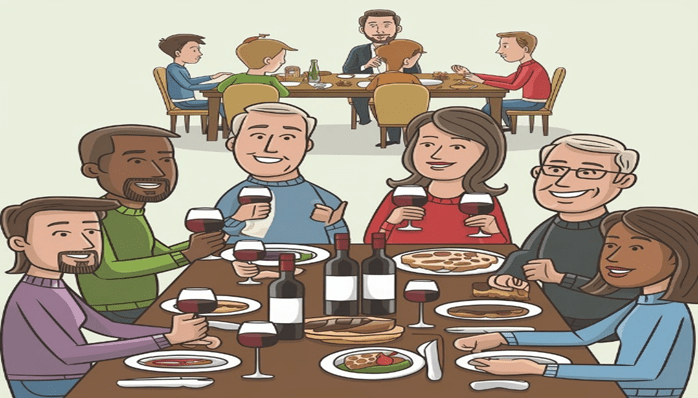
This Christmas, I took a break from the drama and posturing at the adult table and found refuge at the kid’s table.

Yearning for the casual banter of innocence, the insight of young wisdom, and the opportunity to hear the thoughts and words of our future, I decided to sit at the kid’s table. Sitting in smaller chairs, closer to the ground, we may be better grounded than in taller, oversized adult chairs, which these days seem a little too tipsy.

The easy game of Connect the Dots yields winks and laughs as we dabble and play with our food. We chatted and giggled about the presents we had opened and those gifts we still hoped to get. I chuckle at the confused looks as we taste the cranberry sauce and smile as the dressing and mashed potatoes are swirled into a tasty mush.

Overhearing the adults discuss their ‘big people’s topics as I watch the kids. The toast for ‘world peace’ quickly regressed to biting analogies of the Middle East and Ukraine. The younger ones seem more confused as the voices rise. The ‘older ones’ frown and turn away from the tension, showing some disgust at the hypocrisy and arguments. Turning up my hearing aids just a little, I hear one mumble…’ giving aid to one for genocide and taking it away from another fighting for self-defense.’ As their heads shook a little, the simple game of hangman took on new meaning. The table returned to the whispers and giggles of youth as a game or two of tic-tac-toe started. I pondered their insight and perspective and lost the hangman game.

The lighthearted snickers and under-the-table poking were interrupted as another bottle of wine was opened for the adults. A hearty toast at their table as we lifted our glasses of water and mimicked them with our silly smiles and googly eyes. The topics at the big people’s table ebbed and flowed about current events, sports, business, and then back to politics. I shook my head and wished they could listen to us at the kid’s table. We were having fun, laughing, and smiling. Their table got louder as abortion and women’s rights became the main topic. Then the epiphany. One of the girls whispers to another…’ great, the convicted sex predator wants to protect us whether we like it or not…cringe…’ I turned my hearing aids back down, hoping to give them the space they needed and not become the adult at the table.

I thought about what I’d heard at both tables. I wanted to avoid the stress and conflict at the adult table, but I only saw and heard the stress that wafted across the room to the kid’s table. Their young minds are open to so much. Soaking in everything and forming opinions that will drive our world’s future. Too much stress. Too much tension. The heat spilling out of the kitchen to the tables filled with the cornucopia of abundance. We sat there wondering about those with so much less and how fortunate we were. This privileged family has the luxury of having discussions and not worrying about where their next meal is coming from. And yet, these adults don’t realize they may be forming irreversible opinions and generational hate through their terse and tense words.

We, the adults, can impart hope or hate. We can show how to listen and try to understand. It is our choice, and they, the kids, are watching and listening to everything.

My distracted thoughts were interrupted when the youngest leaned over, tapped me, and said, ‘Knock, knock.’ I smiled and thought, ‘Maybe, just maybe, things will be alright’…’ Who’s there?’

NeverFearTheDream     simplebender.com

This article was first published in the Bend Bulletin 12/26/24