Every day, we hear people declare, ‘This is just second nature.’ For something to become second nature, there had to be practice and/or social influence to change what their first nature was. Does anyone remember what their first nature was, and can we peel back the veneer of our second to return to the first, if we wanted to?
We rarely talk about our First Nature. The nature we were blessed with in the beginning, before we were conditioned and formed life-altering habits. They are the innate, biological, pre-social capacities of curiosity, fear, empathy, attachment, and so on. First nature doesn’t hate; it differentiates. It notices patterns of familiarity, comfort, threat, and protection. It produces the capacity for bias, but it doesn’t develop an ideology of it.
Second Nature is learned, habituated, and socially enforced structures of behaviors and beliefs. When a reaction or attitude becomes second nature, it means it has been so deeply culturally engineered that it feels automatic—a reflex done without thinking. Second nature is encoding through stories, rituals, hierarchies, and reward systems. Hate and bigotry are not natural; they are second nature; they are a cultural metastasis of a cycle.
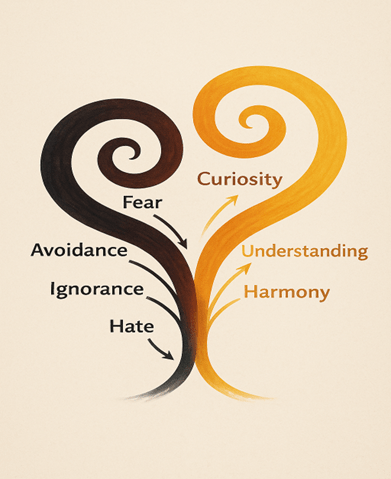
Fear triggers avoidance.
Avoidance promotes ignorance.
Ignorance fortifies fear.
Fear then justifies hate.
Run the loop long enough and hate feels ‘natural’—it is second nature and doesn’t feel like a negative response or reaction, it just merely is—because you’ve been socially corrupted and molded.
A thoughtful person in reflection must ask: Can it be reversed? The answer is a resounding yes. It can if we recognize the cycle. Instead of fear-triggering avoidance, what if it triggered natural curiosity? This shift in perspective opens up a world of possibilities for growth and change.
Fear triggers curiosity.
Curiosity promotes understanding.
Understanding fortifies commonality.
Commonality then justifies harmony.
This isn’t sentimental. It’s disciplined work: notice the trigger, interrupt the habit, and retrain the response by consciously choosing a different reaction. The task isn’t to erase second nature but to realign it—so what feels automatic again serves what is authentic.
We are defined by what we love and what we detest, what we accept, what we tolerate, and what we reject. Each of us can rediscover our first nature characteristics. Because first nature doesn’t have a set of instructions, rediscovery isn’t about reprogramming yourself but about acknowledging that you are a product of your socio-economic environment. Take time to reflect and, honestly, aggressively self-assess. Self-deception is self-deprivation—denying yourself the truth denies you growth. But when you embrace self-reflection, you take control of your growth journey. Ask yourself if the second nature virtue you exhibit is really a tortured, misconfigured, misaligned first nature—like fear yielding to hate. Give yourself the latitude and patience to look deep, rediscover alternatives, and be open to the power of curiosity and understanding. #NeverFearTheDream
Always feel free to re-post—anywhere, anytime, to anyone—share freely.
NeverFearTheDream simplebender.comStand For Truth
If you’re looking for daily thoughts and insights you will want to start the morning with:
Lap Around the Sun: Daily Steps Forward
If you know someone who is facing any facet of Alzheimer’s they might gain some insight from:
Joy in Alzheimer’s: My Mom’s Brave Walk into Dementia’s Abyss
Please consider following simplebender, you’re reading makes my writing more fun..…
Comments and thoughts are always welcome and feel free to re-post …..
Vilification is not an innocent weapon — it’s a destructive one. It takes little effort to sling insults, caricature opponents, or cast entire groups as villains. But like a boomerang, what you hurl often returns. The sharper the words, the more likely they cut you on the rebound. This cycle of destruction is something we must recognize — and break.
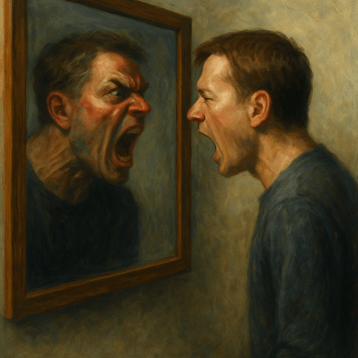
When you vilify, you don’t invite reasoned debate but reactionary hate. Anger rarely absorbs anger; it mirrors it. History shows escalation is almost inevitable: one stone cast is met with another, one torch answered with fire. In that spiral of hostility, the target shifts. Today’s accuser becomes tomorrow’s accused. The vilifier becomes the victim.
History offers painful lessons. Denunciation fueled the French Revolution, each faction outshouting and out-purging the last. Robespierre, once the loudest voice condemning “enemies of the revolution,” soon faced the guillotine he praised. Hate and retribution have no loyalty — they devour their own.
Modern politics echoes the same pattern. Leaders, activists, and media figures who stoke division often find themselves caught in the very fires they lit. Hate has no brake; once unleashed, it runs its own course.
Vilification is seductive. It feels like strength — drawing bold lines, protecting your tribe, mobilizing energy. But human nature is wired for reciprocity: what we project comes back. To weaponize hate is to release a force you cannot control. Your gender, race, faith, politics, or power won’t shield you — the backlash spares no one — you reap what you sow.
This is not a call for naïve pacifism but for clarity. To vilify is to plant the seed of retribution. To demonize is to risk becoming the demon in another’s story. History is merciless to those who think they can ride the tiger of hate and not be eaten.
When there is no room for counter-opinion, there is no compromise. Without compromise, polarity hardens into conflict. And conflict, left unchecked, leads to violence — and death. But there is hope. We should call for understanding, not for “beating the hell out of” those we oppose. Listening can reveal common ground. Words can wound, but they can also heal. If we speak to persuade rather than to poison, we stand a chance of escaping the boomerang’s return flight. Vilification may win the moment, but it never secures a peaceful future. #NeverFearTheDream
NeverFearTheDream simplebender.comStand For Truth
If you’re looking for daily thoughts and insights you will want to start the morning with:
Lap Around the Sun: Daily Steps Forward
If you know someone who is facing any facet of Alzheimer’s they might gain some insight from:
Joy in Alzheimer’s: My Mom’s Brave Walk into Dementia’s Abyss
Please consider following simplebender, you’re reading makes my writing more fun..…
Comments and thoughts are always welcome and feel free to re-post …..
When did masks shift from villains to “authorities”?
When I was a kid, masks were for the bad guys. Bandits in Westerns, bank robbers with bandanas, the Klan hiding under white hoods, and the muggers in dark alleys. A mask meant you didn’t want to be recognized because you were doing something you shouldn’t be doing. Evil hid its face. Goodness walked in daylight.
But now? Somewhere along the way, the script flipped. Those we were told to trust—law enforcement, federal agents—have adopted the mask. Acting with impunity, ICE officers are staging “operations,” Homeland Security agents are sweeping into neighborhoods, even U.S. Marshals and Border Patrol units, all with faces hidden. They now resemble the masked members of Patriot Front or Blood Tribe. Once respected symbols of authority, they are now appearing faceless, anonymous, and interchangeable. Supporters argue that the masks protect officers from retaliation or online targeting, but to the rest of us, it appears to be a means to avoid scrutiny and shirk accountability.
The claim is they’re targeting “the worst of the worst.” That phrase is supposed to conjure violent criminals, cartel bosses, or human traffickers. Yet the data tells a different story: government data shows that the majority — often well over half, approaching 70%—of ICE detainees have no criminal record at all. They’re being seized at immigration hearings where they’ve come voluntarily, pursued through farm fields, even pulled from schools and churches. They are NOT gunmen. Not the “worst of the worst.” They are just the easy ones. The soft targets. The ones who won’t shoot back.
Which raises the uncomfortable questions: do the masks hide fear, or shame? Fear of retaliation if they went after actual hardened criminals? Shame at arresting the powerless in the most public and humiliating of ways? Or maybe the mask makes it easier to see human beings as quotas instead of neighbors. Is this about public safety—or about hitting administrative numbers?
It’s a bitter irony. The only true ‘good guys’ who still wear masks today are doctors and firefighters. Their anonymity is a sacrifice, not secrecy. They shield their faces not to hide, but to protect and survive, thereby shielding others. That’s the difference. One mask hides identity to avoid accountability; the other shields life in the service of it.
The lesson is as old as childhood morality tales: if you hide your face to do your work, maybe, just maybe, it’s the kind of work that shouldn’t be done in the first place.
NeverFearTheDream simplebender.com@simplebender.bsky.socialStand For Truth
If you’re looking for daily thoughts and insights you will want to start the morning with:
Lap Around the Sun: Daily Steps Forward
If you know someone who is facing any facet of Alzheimer’s they might gain some insight from:
Joy in Alzheimer’s: My Mom’s Brave Walk into Dementia’s Abyss
Please consider following simplebender, you’re reading makes my writing more fun..…
Comments and thoughts are always welcome and feel free to re-post …..
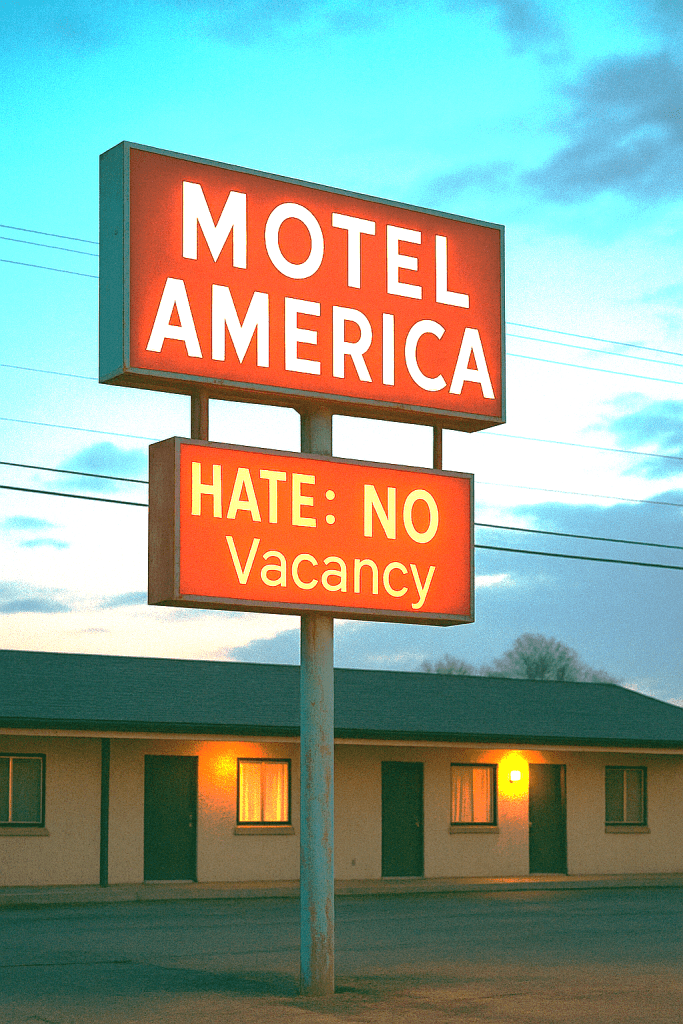
There is no place for hate in our homes, our faiths, or our government—none. The grievances of Palestinians, Ukrainians, and displaced peoples around the world may be deep and justifiable—and may very well usher in generational hate. But we Americans have no excuse to let hate in. Not in our hearts, our homes, our places of worship—and definitely not in our policies.
Yet hate has become almost reflexive—normalized, even celebrated. It’s hoisted like a banner, waved by those clinging to lost causes and imagined enemies. It grows in minds and festers in rhetoric, often without genuine cause—and with no end goal beyond destruction and domination.
Those who lead or campaign on hate do so to divide, not to solve. Hate is a wedge—driven between communities to create illusionary superiority and incite rage. It doesn’t clarify; it confuses. It doesn’t elevate; it manipulates. When leaders resort to hate, they expose their inability to persuade, to unify, or to understand. Their bluster masks weakness. Their venom reveals fear. They seek the power of the mob, not the strength of dialogue or the courage of compromise.
Listen carefully: hate speech is no longer fringe. The denigration of individuals—by race, gender, belief, political group, or origin—has become a strategy. Its purpose is not discourse, but dominance. Not freedom, but control.
This country cannot be governed by contempt. We must reject those who exploit division. Hate has no place in a nation built on liberty—and none in a future worth striving for. America is stronger because of our diversity, not despite it. We are more mature—intellectually and emotionally—because of our historic willingness to understand and compromise.
Look neither backwards with anger nor forward with hate.Don’t give hate any space. Not here. Not now. Not tomorrow.
NeverFearTheDream simplebender.com@simplebender.bsky.socialStand For Truth
If you’re looking for daily thoughts and insights you will want to start the morning with:
Lap Around the Sun: Daily Steps Forward
If you know someone who is facing any facet of Alzheimer’s they might gain some insight from:
Joy in Alzheimer’s: My Mom’s Brave Walk into Dementia’s Abyss
Please consider following simplebender, you’re reading makes my writing more fun..…
Comments and thoughts are always welcome and feel free to re-post …..
Systematic suppression is the intentional and structured ways in which specific marginalized communities are denied rights, opportunities, and resources, leading to their disenfranchisement and inequality with the intent of rendering them non-existent. We have a front-row seat to watch many acts of suppression, from voting rights, immigration, women’s rights, and self-determination. Unconscionable as it might be, we watch acts of suppression accelerate daily. But what is even more concerning is America’s silent crisis—the systematic marginalization and decimation of our LGBTQ community, a pressing issue that demands our immediate and unwavering attention.
You don’t have to engage in direct violence to cause harm to a community. The deliberate restriction of social, legal, and support structures can inflict pain, suffering, and even death to suppress a group. Like enabling discriminatory organizations, you don’t have to be directly involved. Quietly supporting or endorsing legislative intolerance and withholding services can be just as damaging. This community only wants to live with the same protections and rights that all of us should have and expect.
Throughout history, various institutions and organizations have used a cornucopia of justifications to discriminate against minority groups. We are witness to similar patterns in the treatment of the LGBTQ community, where personal beliefs are being used to justify discrimination and denial of fundamental rights.
You may not agree with or approve of the LGBTQ community’s identity or lifestyle. It might even be repulsive, and it’s your right to have those perspectives. But that doesn’t give anyone the authority or right to work toward their marginalization, neglect, and exclusion. There are many more pressing issues to deal with. But, we are easily distracted and misdirected, so we target minorities and create issues where they aren’t. Unfortunately, we are all a part of some minority which might be the next target. You can try to soften it, call it something else, or close your eyes, but there is a fine line between decimation and genocide. This is America’s silent crisis, our silent genocide. It is the systematic suppression of a community within our community, and people are suffering because of it. People’s social structures, personal rights, and medical options are being destroyed and restricted only because some have taken it upon themselves to impose their personal views on others. While currently, the acts of physical violence may be isolated they still exist and are horrible. In addition, people are still being harmed through isolation, discrimination, and denial of fundamental rights. The youth within this community is 4.3 times more likely to attempt suicide than there straight friends. A quarter of this community has tried to kill themselves as compared to 6% of heterosexuals. This group is not just part of our community; they are individuals with hopes, dreams, and rights. These are people and they are being pushed to the brink. These are your neighbors, and amongst many things they are parents, clergy, first responders, care-givers, spiritual leader, legislators, educators, business owners, engineers, artists, authors, farmers, students, industry leaders, and on and on. This group isn’t the enemy. It is an integral thread of our lives tapestry and a critical part of our future. This community should not be silenced or erased, and efforts to do so should not be tolerated or excused. Let people live their lives; maybe everyone will let you live yours with the same dignity and respect.





 SimpleBender.....wcb