Posted in Political

Uniformity is the Exception

America was never built on agreement. It was built on managing disagreement without abandoning the republic. The great American myth is that we were once united in thought. The great American strength is that we never had to be.

From the beginning, Americans have passionately argued while finding enough common ground to move forward. That is why elections matter. Why opposition is legitimate. Why compromise is a necessity, not a nicety. And why today’s loser must always have the opportunity to become tomorrow’s winner. Violence belongs only as the last resort of last resorts—not the default response.

The Revolution was far from unanimous. Nearly one-fifth of colonists remained loyal to the Crown, while many others chose neutrality rather than rebellion. America did not begin with uniformity of opinion. It began with free people drawing different conclusions about the same future.

The Constitution was not born of unity. It was born of an argument. At the Constitutional Convention, Federalists and Anti-Federalists fiercely debated the proper role of government, individual liberty, and the distribution of power. People of different faiths, economic interests, regions, and priorities concluded that compromise was preferable to division. That wasn’t unanimity; it was constitutional and emotional maturity and a matter of survival.

Dissent has shaped our history. Manifest Destiny divided churches, politicians, and families. The Civil War was the tragic consequence of irreconcilable differences that remain unresolved even today. Americans argued fiercely over entering both World Wars. Reconstruction, civil rights, women’s suffrage, labor rights, women’s rights, immigration, and the role of government all sparked passionate disagreement. Every major turning point in our history has been accompanied by dissent, and its outcome has been shaped by it.

But through this, we have learned not to suppress disagreement but to channel it through the institutions designed for debate and resolution. Unfortunately, today those very institutions are losing their ability to seek compromise. Their representatives protect their own longevity and power and fear their tribe. The value of dissent is being lost for the sake of convenience.

The lesson and goal should never be to eliminate disagreement. Free societies do not survive because everyone agrees. They survive because citizens embrace disagreement as legitimate, necessary, and beneficial.

Today, we still disagree on morality, religion, citizenship, immigration, stewardship, ownership, individual rights and freedoms, and the proper role of government. None of that is new. What is new is the speed with which opinion becomes certainty, certainty becomes outrage, and outrage becomes identity. Immediate communication and unverified information often replace thoughtful research and debate with emotional reaction, making compromise seem like a weakness rather than a sign of wisdom.

The danger is not dissent. The danger is ignorant tribal certainty.

Opposing opinions are rarely obstacles to understanding; they are often its starting point. Every perspective brings experiences we may not have and assumptions we should question. Progress comes not from silencing disagreement but from listening long enough to find where another viewpoint can strengthen our own.

Every generation has believed the nation was coming apart. Yet the republic has endured. And it will unless we fail it. Uniformity has never been America’s way of operating. Dissent, argument, and compromise have been. Our national strength has never been in reaching the same conclusion. It has been in believing that those who reached different conclusions still belong to the same country under the same Constitution.

We see and hear the myth of discord’s devastation, but not the reality of its value. There is power and insight in opposing opinions. There is even greater power in understanding those differences and building on their strengths rather than attacking their weaknesses. Our greatest challenge is not learning to agree, but remembering that the freedom to disagree has always been one of America’s defining strengths. NeverFearTheDream simplebender.com

-.. .. … … . -. – / .. … / … – .-. . -. –. – ….


Lap Around the Sun: Daily Steps Forward
by WCBarron

Buy at Amazon Buy at Barnes & Noble Buy at Books2Read

Joy in Alzheimer’s: My Mom’s Brave Walk into Dementia’s Abyss
by WCBarron

Buy at Amazon Buy at Barnes & Noble Buy at Books2Read

Posted in Philosophy

Winning Melos, Losing the Empire

…does not mean you should.

The Athenian siege of Melos in 416 BC was not merely an act of war. It was an exhibition of raw, unrestrained power and one of history’s clearest warnings about what empires become when they mistake strength for license. Thucydides captured the conceit of the age in the Melian Dialogue: “The strong do what they can, and the weak suffer what they must.” This is brazenly similar to “We’re a superpower. …we are going to conduct ourselves as a superpower.”

Athens, the superpower of its time, invaded the neutral island of Melos and demanded the islanders’ unconditional surrender and tribute. The Melians refused, choosing doomed resistance over submission and the loss of independence. Melos ultimately fell; the Athenians barbarically executed the men and enslaved the women and children.

Tiny Melos did not, by itself, destroy mighty Athens, but it exposed the corrosion already at work within Athenian power. It showed what happens when a state ceases to ask whether it should act and asks only whether it can. That is the disease of empire: power untethered from discipline, morality, and self-command.

That is why Melos still matters. The world remains anarchic. States still justify coercion, domination, embargoes, seizures, and war in the language of necessity. Weak and loud leaders still confuse capability with legitimacy. Political realism may explain how power operates, but it does not absolve its abuse.

Superior military strength is not proof of superior intellect, judgment, morality, or civilization. A nation reveals its character less by the force it can project than by the restraint it exercises. When violence becomes the first instrument rather than the last, decline has already begun, even if power still looks impressive from a distance.

In the end, Athens won Melos but lost something greater. Its empire decayed not merely from external enemies but from the arrogance and brutality that hollowed it from within. That is the enduring lesson: the misuse of power does not secure greatness. It poisons it. Our perceived superiority in the world is being supplanted by those who fill the vacuums we have created by our own choices. Our world dominance is forever affected, and if we are not careful, the fate that followed Athens may not be ancient history at all. NeverFearTheDream   simplebender.com

…. ..- — .- -. .. – -.–


Lap Around the Sun: Daily Steps Forward
by WCBarron

Buy at Amazon Buy at Barnes & Noble Buy at Books2Read

Joy in Alzheimer’s: My Mom’s Brave Walk into Dementia’s Abyss
by WCBarron

Buy at Amazon Buy at Barnes & Noble Buy at Books2Read
Posted in NeverFeartheDream

Never Fear The Dream…

You don’t need to imagine it; within you is the truth. Set yourself free. 26.05.02

..-. .-. . . -.. — —

Posted in NeverFeartheDream

Never Fear The Dream…

The only way for the majority to be safe is for the minority to be free, acknowledged, and protected. 26.02.01

Joy in Alzheimer’s
W.C. Barron
Lap Around the Sun
Daily Steps Forward — W.C. Barron
Posted in Current Events

The Logic Trap of “Choice”: But Whose Choice?

Some communities insist no one has the right to tell you what goes into your body. Vaccine mandates for children? Eliminated. Parents, they say, should decide. Yet the same lawmakers ban abortion, declaring the state must dictate what goes into—or comes out of—a woman’s body. One breath they champion autonomy—“your body, your choice.” The next, they revoke it. That is the hypocrisy of their own making: a logic trap.

This is hubris—elevating choice above consequence until the reckoning arrives. By enthroning autonomy in one case and crushing it in another, political positions collapse under their own contradictions.

The deeper problem is not hypocrisy alone, but the refusal to face consequences. If a sick, unvaccinated child infects another and death follows, is that so different from a parent choosing to end a pregnancy? Both are questions of prevention—or its absence. Both end in the loss of life. Stripped of rhetoric, the moral arithmetic is the same.

Plato’s Ship of State reminds us that freedom without shared responsibility is not freedom but chaos. To let each untrained helmsman steer as he pleases is to wreck the vessel and drown all aboard. Vaccine “freedom” follows the same course: individual choice unmoored from collective duty imperils the innocent.

Abortion bans claim to “protect life.” Yet removing vaccine safeguards erodes the very protections that preserve the living. Both paths, meant to uphold life, may instead hasten its loss. Vaccination is not solely a personal decision; it is an act of care for the vulnerable child who cannot choose. To shrug it off is to clearly echo and exclaim the denial: “I am not my brother’s keeper.” That is tragedy—outcome born of blindness to consequence.

If morality is to mean anything, it cannot be applied with one hand and denied with the other. If a child who is unable to be vaccinated dies from exposure, who bears responsibility? The parents of the unvaccinated infecting child? The government that stripped safeguards? The community that endorsed it? Those who hold women accountable for abortion, especially those who are rape victims, cannot escape this parallel dilemma. Freedom framed as virtue but practiced as refusal to protect another is no virtue at all. Either the body is inviolable, or it is not. Either life is sacred in all forms, or it is not. Pretending otherwise is meant to satisfy a political base, but it cannot withstand the test of reason—or history. #NeverFearTheDream

For Every Problem...A Solution...
Lap Around the Sun: Daily Steps Forward
Joy in Alzheimer’s: My Mom’s Brave Walk into Dementia’s Abyss

Posted in Philosophy

Bound in Fragile Balance: Freedom and Liberty

Can you be free without liberty or have liberty without freedom?

When freedoms are being challenged, coerced, and twisted to fit ideologies—as they are now- this isn’t a rhetorical question. It is an essential one. Because freedom and liberty are not the same thing. You can be free without liberty; however, you cannot have liberty without freedom.

Freedoms are what everyone is born with. They are innate. The freedom to speak, roam, think, and express yourself. Liberty is the social contract, a framework that defines those rights and protects them from government overreach, ideology, mob rule, and individual abuse.

Freedoms can exist in isolation; liberty requires a society. You can escape to the wilderness and be as free as you like. Liberty exists to balance the tensions between individual freedoms and the responsibilities of societal citizens coexisting in a communal environment. There will always be tension between them as social norms and technologies continue to evolve. But it is our liberty that will guide us, allow us to protect it, and our freedoms. Liberty protects our rights to do what we ought to do, not the power to do what we want to do.

Liberty is guarded and protected; freedom is what you assert and claim. And yet, liberty’s role is to protect your freedoms if others impinge on yours and vice versa. Liberty is for everyone and must be protected by everyone. Because freedom can be absolute, liberty must be conditional. Without setting civil boundaries within the construct of liberty, freedom will run amok. Everyone believing and acting as if they have no responsibilities or accountability is the recipe for chaos and anarchy, making humans no better than any other social animal. Freedom untethered isn’t freedom at all.

Liberty is created when people agree to limit certain freedoms. Ironic as that may seem. Liberty is a civilized form of freedom. It is the civil contract we live by. It allows the freedoms we agree upon. Freedom of speech, but not speech that incites violence. Freedom of the press, but not a deceptive, manipulated media. Freedom to worship and assemble without fear of retribution by worshiping a minority religion or assembling to support, or protest, what may be viewed as unjust or a violation of liberty. Within the context of our liberty, we should pause before yielding to the temptation to trade freedoms for perceived security. Once lost, those freedoms are hard to regain, just as yielding civil authority to the government.

While Patrick Henry decried, “Give me Liberty or give me Death“; Thomas Paine opined, “Government, even in its best state, is but a necessary evil; in its worst state an intolerable one.” Their’s wasn’t a cry for freedom, but for a governing system that protected the agreed-upon freedoms of all. We may not like the clamorous protests demanding action, or the ideas and opinions espoused by others—just as much as they may not appreciate ours—but in our Liberty we have agreed to allow them, and that Liberty is worth defending. Without it, the saber of perceived justice can and will cut both ways, depending upon who yields it. The Liberty we should protect, our Liberty, must sheath the sword and allow the voices of freedom to be boldly, openly, and freely expressed.

For Every Problem...A Solution...
Lap Around the Sun: Daily Steps Forward
Joy in Alzheimer’s: My Mom’s Brave Walk into Dementia’s Abyss

Posted in Philosophy

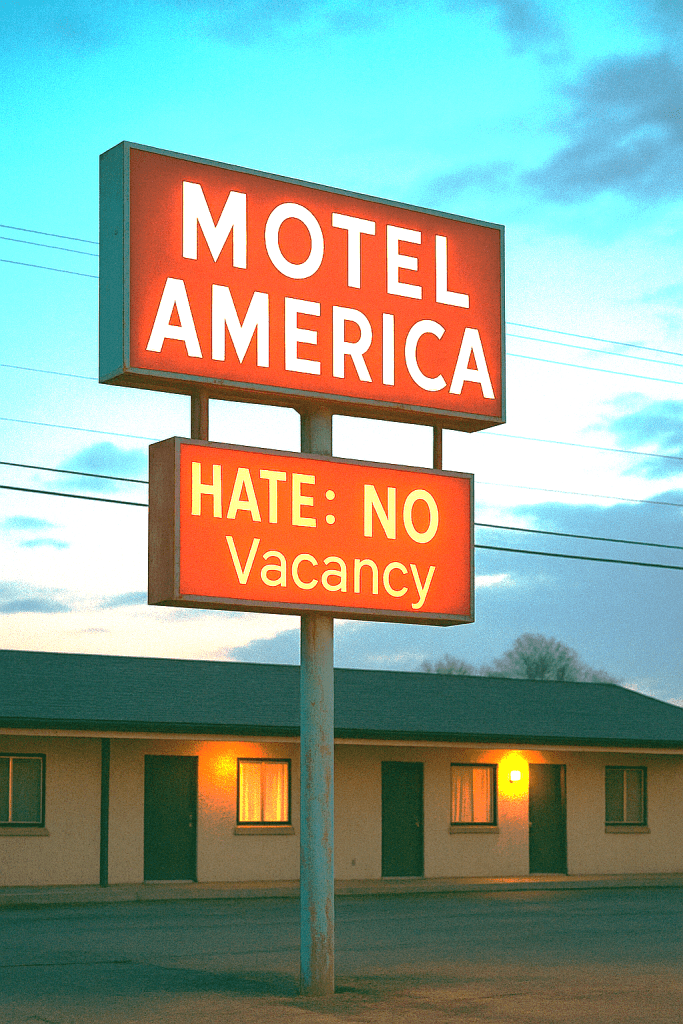
No Place for Hate—Not Here

There is no room for Hate…NONE

There is no place for hate in our homes, our faiths, or our government—none. The grievances of Palestinians, Ukrainians, and displaced peoples around the world may be deep and justifiable—and may very well usher in generational hate. But we Americans have no excuse to let hate in. Not in our hearts, our homes, our places of worship—and definitely not in our policies.

Yet hate has become almost reflexive—normalized, even celebrated. It’s hoisted like a banner, waved by those clinging to lost causes and imagined enemies. It grows in minds and festers in rhetoric, often without genuine cause—and with no end goal beyond destruction and domination.

Those who lead or campaign on hate do so to divide, not to solve. Hate is a wedge—driven between communities to create illusionary superiority and incite rage. It doesn’t clarify; it confuses. It doesn’t elevate; it manipulates. When leaders resort to hate, they expose their inability to persuade, to unify, or to understand. Their bluster masks weakness. Their venom reveals fear. They seek the power of the mob, not the strength of dialogue or the courage of compromise.

Listen carefully: hate speech is no longer fringe. The denigration of individuals—by race, gender, belief, political group, or origin—has become a strategy. Its purpose is not discourse, but dominance. Not freedom, but control.

This country cannot be governed by contempt. We must reject those who exploit division. Hate has no place in a nation built on liberty—and none in a future worth striving for. America is stronger because of our diversity, not despite it. We are more mature—intellectually and emotionally—because of our historic willingness to understand and compromise.

Look neither backwards with anger nor forward with hate. Don’t give hate any space. Not here. Not now. Not tomorrow.

For Every Problem...A Solution...
Lap Around the Sun: Daily Steps Forward
Joy in Alzheimer’s: My Mom’s Brave Walk into Dementia’s Abyss