Posted in Current Events

Accountability Gunned Down

and Credibility Mortally Wounded…..
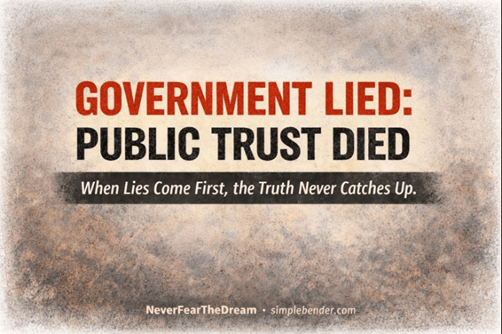
The first videos weren’t clear. They were chaotic—grainy clips, partial frames, shouting without context. But the official messaging arrived before evidence was gathered, witnesses interviewed, or a timeline stitched together, the verdict was delivered. Heroic officers. Clear self-defense. Thwarted mass terror. The dead were “deranged domestic terrorists,” and the valiant officers had barely survived and saved many.

That’s narrative warfare—not investigation.

This is the modern media playbook: speak first, speak loudly, and force everyone else to prove you wrong. Flood the zone with ‘certainty,’ half-facts, and righteous adjectives. Let supporters do the rest. If later evidence complicates the story, it won’t matter; the first impression has already been welded into identity. And if you can manufacture images, clips, or “context” with AI, you can make doubt look like proof while you stall, bury, and obscure the real record.

What makes the lie persuasive is that it rides on a few fragments of truth. A legal concealed-carry permit becomes a justification for killing. A photo of a holstered firearm becomes “brandishing.” A moment of chaos becomes “attempted assassination.” A tender snapshot of agents “helping” a frightened child becomes moral cover for whatever came before or happens after. The lifestyle of one is used to instill moral judgment and question motive. Just enough ‘truth’ to make the rest feel plausible to the true believers.

We’re told to relax. Trust the regime and its process. Wait for the facts they want to show us. The rest of the facts arrive late and edited—while the narrative sprints ahead, unchallenged and amplified by officials who treat accountability as optional.

There’s a deeper fatal wound: credibility. Bullets may have killed Renee Good and Alex Pretti, but the words that followed targeted something larger—the public’s ability to discern what is real. When institutions train citizens to doubt their eyes and distrust every correction as “spin,” they aren’t governing; they’re conditioning. They are self-serving protectionists maximizing propaganda’s bullhorn.

So we should ask, without hysteria or naiveté: Was a five-year-old used as bait or as a shield? Was Good’s death justified or convenient? Was Pretti killed because he believed in the 2nd Amendment or because zealous masked bullies lost control of themselves? If we can be pushed to accept a finished story before an investigation even begins, what else have we been trained to swallow—about elections, wars, enemies, or the files that power keeps sealed? Move along, citizen. Nothing to see here.   NeverFeartheDream   simplebender.com

Joy in Alzheimer’s
W.C. Barron
Lap Around the Sun
Daily Steps Forward — W.C. Barron
Posted in Current Events

Manufactured Scarcity as a Strategy

scarcity for some abundance for others...manufacturing distractions.....simplebender.com

We are told the world is running out of everything: security, dignity, opportunity, patience. The message is constant—there is not enough to go around. And when people believe there is not enough, they do what humans have always done under threat: they turn on whoever is closest, whoever they think has what they should have.

This is manufactured scarcity—not a natural shortage, but a strategic one. The point is not merely to frighten us. The point is to redirect our fear sideways.

Horizontal hostility is far more useful to those in power than unity ever could be. If we are busy resenting each other, we are not examining the hands holding the power strings and who declared the scarcity to begin with.

Consider who benefits when workers distrust workers, when rural communities distrust urban ones, when generations resent each other, when racial and ethnic groups fight over scraps. At the same time, the banquet table is dragged into a gilded private room. The beneficiaries are not hard to identify. They are the ones who remain untouched by the conflict they provoke. They are the ones who used the distraction to fleece for their benefit.

Manufactured scarcity is a form of quiet governance. It makes control self-enforcing. No police state is needed when citizens police each other, when communities fracture themselves, when people become suspicious by default. But this civil fracture is used as an excuse to declare manufactured emergencies to seize more power.

But scarcity is not just political—it is psychological. Once trust is gone, every interaction becomes expensive. Friendship takes caution. Cooperation takes courage. Even hope feels dangerous. The fringe takes stronger hold as the masses in the middle scan the horizon for hope, while looking back in fear of cowardly aggression.

And yet, trust is not rebuilt by argument or persuasion. Ideology is a divider. No ideology has ever restored a broken community. Trust is rebuilt the oldest way humans have ever known: by doing things together, understanding that the most potent joining agents are dreams and suffering, not ideology.

When we work side-by-side—repairing a fence line, running a volunteer shift, restoring a riverbank, organizing a childcare co-op—we rebuild something deeper than agreement. We rebuild interdependence. We remember, through action, that we rely on one another to live.

This is the part those who profit from division fear most. They do not fear protest slogans. They do not fear outrage. They fear cooperation and communication.

Because cooperation makes scarcity visible for what it is: a story someone told us. A story that has authors and agents who have their own agenda.

The significant problems are only solved when the small ones are solved first. We do not need to solve the world’s problems before the nation’s, or the nation’s before we solve the ones on our street. We do not need to fix society before we rebuild the block we stand on. We don’t need to tear down the building to fix the windows.

When we choose to stand together and challenge the narrative, the manufactured scarcity loses its power. The illusion breaks. The wedge loses its edge. And the architects of division suddenly find themselves standing alone. Let’s start by turning away from face-to-face conflict toward shoulder-to-shoulder and side-by-side cooperation and community growth. #NeverFearTheDream simplebender.com

First Published in Bend Bulletin 12/2/25

For Every Problem...A Solution...
Lap Around the Sun: Daily Steps Forward
Joy in Alzheimer’s: My Mom’s Brave Walk into Dementia’s Abyss

Posted in Philosophy

Credibility: The Fragile Currency of Character

Credibility is a delicate characteristic — slow to earn, swift to lose, and nearly impossible to fully restore. It’s like a crystal goblet: clear, strong in purpose, yet so easily fractured by careless acts. Once shattered, even after the best repair, the cracks remain visible and weak, and the goblet, once pristine, is forever damaged. Those who’ve tried to rebuild their chalice of credibility know the haunting truth — it becomes easier to break again, and probably will. Credibility doesn’t erode overnight; it erodes through capitulation, excuses, and the convenience of shifting with the wind.

There was a time when credibility was among our highest personal currencies and a source of pride. A person’s word was their bond. Their handshake was a contract. Their consistency was a mirror of their moral compass. Their willingness to admit mistakes and change positions in light of new information was seen as extreme emotional maturity and self-confidence. Perfection doesn’t—and didn’t—earn credibility, but integrity does. A visible, demonstrated alignment between belief, speech, and action. Today, that alignment is bent under the weight of expediency and twisted for target audiences.

The credibility of leaders — political, pulpit, legal, law enforcement, academic, athletic — has become collateral in the age of populism and applause metrics. When polls become the goal, truth becomes negotiable. When power is the aim, credibility is an afterthought, and diversion and deceit are the tools of choice. The words ‘I promise’ and ‘trust me’ become code for watch your back. We see it in leaders who flip their stances to appease whichever crowd can give them more leverage. They conveniently forget that credibility is built through conviction and compromise—not appeasement. It’s not the stance itself that matters most; it’s the steadiness of principle that gives credibility its meaning.

In this swirling chaos of contradiction and convenience, we, and the world, have grown cynical. Our long-standing allies no longer trust our national commitments. Those who stand ‘against us’ leverage our lack of credibility to their advantage.

We no longer trust what’s said, only what’s repeated—and if a lie is told often enough and loud enough, some believe it to be a truth—but it’s not, it’s still a lie—with or without a sprinkle of truth to placate the gullible. And, unfortunately, when the truth is actually told, we are all skeptical, uncertain, with no clear way to confirm or deny—so, everything feels like a lie, or a hybrid truth.

We no longer follow those who lead — we watch to see if they’re trending. We analyze ten-second snippets or AI-generated memes designed to slander and divide, not unify. In doing so, we participate in the erosion we claim to despise—we, the people, become willing players in the deceit and the shattering of credibility.

We need to stop outsourcing integrity and credibility. Stop waiting for heroes to save us, saints to guide us, or perfect voices to speak for us. The world doesn’t need any more idols, demigods, or people placed upon false pedestals. It needs individuals who live as examples — quietly, calmly, patiently, consistently, courageously.

Let’s stop looking for heroes and start being credible ones — with every choice and every word you make every day. #NeverFearTheDream

For Every Problem...A Solution...
Lap Around the Sun: Daily Steps Forward
Joy in Alzheimer’s: My Mom’s Brave Walk into Dementia’s Abyss

Posted in Political

Deconstructing Democracy by Design

A ‘what-if’ thought experiment….or is it….

When federal agencies are defunded, are the states prepared to bear the burden? What if they falter, fail, and unravel under the weight? What if the unraveling of local governance isn’t a consequence of poor planning—but a feature of executive design?

Imagine a government waving the banner of “smaller federalism—drain the swamp,” slashing national programs in the name of efficiency and state empowerment. Medicaid becomes a block grant. Public housing and food subsidies are cut. Regulation and environmental oversight rolls back. Disaster relief is “restructured.” Methodically, the burden shifts to state and county governments, which are already stretched thin. Local taxes rise, services crumble, and local bureaucracies balloon in a vain attempt to compensate.

One town staffs its clinics. The next can’t keep its water clean. Some mandate gun control, others abortions, and others endorse sex work and gambling to increase state revenue. Air quality fluctuates by zip code. One region welcomes immigrants, the next sponsors agents for deportation. Resulting in dysfunctionality, geographical injustice, and discontinuity. The news media is mistrusted and declared ‘enemies of the State’. City, County, and State governments begin to crumble and fail under the weight of their new obligations.

Resentment festers—as inconsistency breeds inequity and confusion. Citizens demand relief, but help doesn’t come from local government, only more indecisive directives. Citizen uncertainty, polarization, and outrage against the policy void yield unrest. Not everywhere—but in enough places to make the headlines—just enough to be used as an excuse.

We’re already seeing a preview. Federal troops were deployed to California—not for disaster relief, but to enforce immigration policy, overriding the state’s will. FEMA faces cuts while climate disasters rise. Communities are left broken, ripe for corruption and manipulation.

And as the ground shifts, so do the guardrails. The Department of Justice leans in, and the Court tilts the scales. Recent rulings—many of which were urged by the Executive—have expanded presidential power by disregarding or reinterpreting laws passed by Congress and previous court decisions. Scholars once warned of an “imperial presidency.” It’s no longer theory—it’s precedent. The President need not wait for Congress. The office can act—or undo—with little more than a pen and a thin legal pretext.

And so, the same hand that dropped the burden returns—not as a partner, but as a “protector.” Protests are reframed as threats. Dissent becomes disorder. Disorder becomes insurrection.

Elections are postponed “for public safety.” Ballots are secured behind walls and counted by select administrators. Local authority is preempted. Emergency declarations morph into permanent policy.

Federal power consolidates—not with a coup, but with a shrug, and tacit approval, marked by deafening silence.

This isn’t prophecy—but it’s no longer just a thought experiment. It is no longer just possible it is verging on probable. It’s unfolding. If federal power can be withdrawn at will and restored at gunpoint—backed by a court with no limits—what does democracy even mean?

If this is the road ahead, it’s not the failure of states we should fear most. It’s the success of the plan—and our failure to notice.

Posted in NeverFeartheDream

Never Fear the Dream…

Beware of those who promise glory without the effort it requires. In nature and life, sudden transformation is a myth. How you handle small setbacks reveals how you will face true adversity. Don’t avoid the truth because it’s unpleasant—face it because it’s necessary. 25.07.1

For Every Problem...A Solution...
Lap Around the Sun: Daily Steps Forward
Joy in Alzheimer’s: My Mom’s Brave Walk into Dementia’s Abyss