Posted in Philosophy

Sanctity for Survival: Weaponizing Religion

Religion has always walked a knife-edge between faith and power. Religion is best when it brings comfort and worst when it becomes a tool of politics. Within our lifetime, there are two salient examples of the twisting of religion and state power: Iran and Russia. Two very different nations illustrate how this symbiotic relationship unfolds and precisely why our founders wisely established a separation between the church and the state. Spoiler alert—the walls are crumbling.

Iran: Mosque as State—Under the Shah, Iran’s clerics were suppressed, their influence diminished as the monarchy rushed to modernize. In 1979, the pendulum swung violently back. Ayatollah Khomeini and the mosque became the state itself. For decades, sermons dictated law, dissent was heresy, and the Revolutionary Guard enforced both politics and piety. Religion achieved supremacy at the cost of freedom.

Today, Iran’s youth — connected, progressive, impatient — are no longer persuaded by clerical authority. Protests after the death of Mahsa Amini revealed the fracture: religion wielded as control is no longer seen as sacred. The bargain that once restored the mosque’s power has hardened into a straitjacket, hollowing faith even as its institutions endure.

Russia: Saints for Soldiers—For most of the 20th century, the Russian Orthodox Church was brutalized under communism. Priests executed, cathedrals destroyed, believers silenced. When the Soviet Union collapsed, the Church sought revival — but revival required allies. Putin offered protection, prestige, and funding. In return, Patriarch Kirill and his bishops sanctified not only his rule, but his wars. Each branch of the Russian military is assigned a patron saint, and these are displayed as soldiers march—icons and rifles in hand. And mosaics of saints standing beside tanks and missiles—faith stitched into firepower.

It is a mutual, parasite-host alliance for survival. The Church props up the empire; the empire props up the Church. Orthodoxy regains prestige after decades of persecution, while the Kremlin secures sacred legitimacy for its conquests.

United States: Are Pulpits the Next Podiums?—Judeo-Christianity has influenced our national culture from its founding. Currently, church attendance is shrinking, younger generations walk away, scandals erode credibility, and the religiously unaffiliated approaches 30% of the population (PRRI). We are evolving into a secular nation of diverse beliefs. In this decline and transition, political power has become a lifeline for some of the more radical to guard against the nightmare of irrelevance becomes a reality.

Some fringe religious leaders now align with vocal politicians who promise to “fight for them,” to restore an age and influence gone by. In exchange, some of their pulpits have become podiums. Political leaders boast, “I hate my enemies,” and vow to “beat the hell out of them,” these words juxtaposed to:” do good to those who hate you, bless those who curse you, pray for those who mistreat you.” The contrast is crisp —aggressive pulpits now espouse vengeance rather than pleading for understanding. Rhetoric that contradicts the very teachings once held sacrosanct. The threat of pulpits becoming podiums is a genuine concern.

Lessons: Learn the Lessons—The parallels are clear. In Iran, religion became the state. In Russia, the Church promotes the empire for its own security. In America, the mainstream is often overshadowed by extremists who cling to authoritarian strongmen for cultural relevance and power—trading faith’s essence for influence.

When religion becomes a weapon of politics, the backlash is not revival but rebellion. These bargains may preserve institutions for a generation, but they ultimately lead to decay.

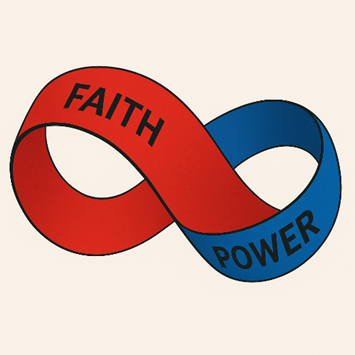
Like a Möbius strip, the inside and outside of faith and power continuously trade places, with no true end and no certainty. The loop is endless, the inversion unending — a path where faith loses its soul and nations lose their way, twisting around and around until revolt. The American founders understood this and wisely built institutional walls between state and church to prevent their blighted bonding, but now the walls are crumbling.

First published in Bend Bulletin 10/29/25

For Every Problem...A Solution...
Lap Around the Sun: Daily Steps Forward
Joy in Alzheimer’s: My Mom’s Brave Walk into Dementia’s Abyss

Posted in Philosophy

Escape the Prison of Reflection: A Parable of Ego and Humility

An older man, with an air of superiority, left his opulent, gilded house and strolled into a bustling marketplace surrounded by his fawning, obedient minions. He proudly carried a polished, reflective, framed glass. His head held high, he admired his own reflection as he weaved through the crowd. The crowd could see him, but he could only see himself, and he was thoroughly pleased. He barely noticed those on either side of him as his minions pushed them aside out of his view. When he did catch a fleeting glimpse, he compared himself to them—the merchants, the homeless, the travelers, the artists, and the minorities—with his arrogance, ignorance, and bombast on full display, he declared, “I am far superior to them all, and they should be forbidden from saying otherwise.”

But as the day wore on, dust gathered on the glass. His reflection grew dim and distorted. He frowned, exclaimed how unfair and unacceptable the conditions were. He lifted his feeble arm and wiped it with his soiled sleeve. Raising it again, he loudly demanded that the crowd see him as he saw himself, even through the grime. Some ignored him, some laughed, and the braver, at great peril, mocked him. His anger rose, and his threats of retaliation grew robust and offensive.

At last, an old immigrant woman left the row of unpicked crops and approached him, offering nothing but silence in her weary eyes. With her weathered hands, she took the glass gently from his manicured fingers, turned it around, and asked, “What do you see now?” The mirrored glass, once a tool for self-admiration, now became a symbol of understanding and empathy as he viewed the world rather than himself.

The old man was initially taken aback but remained self-absorbed. In the mirror was no longer his own face, but the faces of the people around him—each one bearing burdens, scars, joys, and pride of their own which he had never truly seen or bothered to comprehend.

The old woman’s voice was a gentle, refreshing breeze: “The glass is not for self-worship but for understanding. Turn it outward and you’ll see the truth: you are not the center, only a small part. Your ego makes the glass a prison; humility makes it a window.” Her words carried a profound truth that seemed to resonate in the old man’s heart.

The old man, humbled by her wisdom, lowered his head. For the first time, the marketplace seemed vast and vibrant, filled not just with his own reflection but with the dreams of real people. He left the market, dusty and disheveled, and a question lingered for all who watched: Will he remember what the mirror revealed, or will he brush away the dust of human humility and return to the prison of his own reflection? As the old woman returned to the field, she turned and said: “We should all look into our own reflective glass and ask ourselves, how much of him are we?”

For Every Problem...A Solution...
Lap Around the Sun: Daily Steps Forward
Joy in Alzheimer’s: My Mom’s Brave Walk into Dementia’s Abyss

Posted in Current Events, Political

Vilifier to Victim Cycle

Vilification is not an innocent weapon — it’s a destructive one. It takes little effort to sling insults, caricature opponents, or cast entire groups as villains. But like a boomerang, what you hurl often returns. The sharper the words, the more likely they cut you on the rebound. This cycle of destruction is something we must recognize — and break.

When you vilify, you don’t invite reasoned debate but reactionary hate. Anger rarely absorbs anger; it mirrors it. History shows escalation is almost inevitable: one stone cast is met with another, one torch answered with fire. In that spiral of hostility, the target shifts. Today’s accuser becomes tomorrow’s accused. The vilifier becomes the victim.

History offers painful lessons. Denunciation fueled the French Revolution, each faction outshouting and out-purging the last. Robespierre, once the loudest voice condemning “enemies of the revolution,” soon faced the guillotine he praised. Hate and retribution have no loyalty — they devour their own.

Modern politics echoes the same pattern. Leaders, activists, and media figures who stoke division often find themselves caught in the very fires they lit. Hate has no brake; once unleashed, it runs its own course.

Vilification is seductive. It feels like strength — drawing bold lines, protecting your tribe, mobilizing energy. But human nature is wired for reciprocity: what we project comes back. To weaponize hate is to release a force you cannot control. Your gender, race, faith, politics, or power won’t shield you — the backlash spares no one — you reap what you sow.

This is not a call for naïve pacifism but for clarity. To vilify is to plant the seed of retribution. To demonize is to risk becoming the demon in another’s story. History is merciless to those who think they can ride the tiger of hate and not be eaten.

When there is no room for counter-opinion, there is no compromise. Without compromise, polarity hardens into conflict. And conflict, left unchecked, leads to violence — and death. But there is hope. We should call for understanding, not for “beating the hell out of” those we oppose. Listening can reveal common ground. Words can wound, but they can also heal. If we speak to persuade rather than to poison, we stand a chance of escaping the boomerang’s return flight. Vilification may win the moment, but it never secures a peaceful future. 

For Every Problem...A Solution...
Lap Around the Sun: Daily Steps Forward
Joy in Alzheimer’s: My Mom’s Brave Walk into Dementia’s Abyss

Posted in Current Events

The Logic Trap of “Choice”: But Whose Choice?

Some communities insist no one has the right to tell you what goes into your body. Vaccine mandates for children? Eliminated. Parents, they say, should decide. Yet the same lawmakers ban abortion, declaring the state must dictate what goes into—or comes out of—a woman’s body. One breath they champion autonomy—“your body, your choice.” The next, they revoke it. That is the hypocrisy of their own making: a logic trap.

This is hubris—elevating choice above consequence until the reckoning arrives. By enthroning autonomy in one case and crushing it in another, political positions collapse under their own contradictions.

The deeper problem is not hypocrisy alone, but the refusal to face consequences. If a sick, unvaccinated child infects another and death follows, is that so different from a parent choosing to end a pregnancy? Both are questions of prevention—or its absence. Both end in the loss of life. Stripped of rhetoric, the moral arithmetic is the same.

Plato’s Ship of State reminds us that freedom without shared responsibility is not freedom but chaos. To let each untrained helmsman steer as he pleases is to wreck the vessel and drown all aboard. Vaccine “freedom” follows the same course: individual choice unmoored from collective duty imperils the innocent.

Abortion bans claim to “protect life.” Yet removing vaccine safeguards erodes the very protections that preserve the living. Both paths, meant to uphold life, may instead hasten its loss. Vaccination is not solely a personal decision; it is an act of care for the vulnerable child who cannot choose. To shrug it off is to clearly echo and exclaim the denial: “I am not my brother’s keeper.” That is tragedy—outcome born of blindness to consequence.

If morality is to mean anything, it cannot be applied with one hand and denied with the other. If a child who is unable to be vaccinated dies from exposure, who bears responsibility? The parents of the unvaccinated infecting child? The government that stripped safeguards? The community that endorsed it? Those who hold women accountable for abortion, especially those who are rape victims, cannot escape this parallel dilemma. Freedom framed as virtue but practiced as refusal to protect another is no virtue at all. Either the body is inviolable, or it is not. Either life is sacred in all forms, or it is not. Pretending otherwise is meant to satisfy a political base, but it cannot withstand the test of reason—or history.

For Every Problem...A Solution...
Lap Around the Sun: Daily Steps Forward
Joy in Alzheimer’s: My Mom’s Brave Walk into Dementia’s Abyss

Posted in Philosophy

No Place for Hate—Not Here

There is no room for Hate…NONE

There is no place for hate in our homes, our faiths, or our government—none. The grievances of Palestinians, Ukrainians, and displaced peoples around the world may be deep and justifiable—and may very well usher in generational hate. But we Americans have no excuse to let hate in. Not in our hearts, our homes, our places of worship—and definitely not in our policies.

Yet hate has become almost reflexive—normalized, even celebrated. It’s hoisted like a banner, waved by those clinging to lost causes and imagined enemies. It grows in minds and festers in rhetoric, often without genuine cause—and with no end goal beyond destruction and domination.

Those who lead or campaign on hate do so to divide, not to solve. Hate is a wedge—driven between communities to create illusionary superiority and incite rage. It doesn’t clarify; it confuses. It doesn’t elevate; it manipulates. When leaders resort to hate, they expose their inability to persuade, to unify, or to understand. Their bluster masks weakness. Their venom reveals fear. They seek the power of the mob, not the strength of dialogue or the courage of compromise.

Listen carefully: hate speech is no longer fringe. The denigration of individuals—by race, gender, belief, political group, or origin—has become a strategy. Its purpose is not discourse, but dominance. Not freedom, but control.

This country cannot be governed by contempt. We must reject those who exploit division. Hate has no place in a nation built on liberty—and none in a future worth striving for. America is stronger because of our diversity, not despite it. We are more mature—intellectually and emotionally—because of our historic willingness to understand and compromise.

Look neither backwards with anger nor forward with hate. Don’t give hate any space. Not here. Not now. Not tomorrow.

For Every Problem...A Solution...
Lap Around the Sun: Daily Steps Forward
Joy in Alzheimer’s: My Mom’s Brave Walk into Dementia’s Abyss