Posted in NeverFeartheDream

NeverFearTheDream…

Our lives rarely follow the path our ego imagines. Accept and embrace where you are, release the burden of disappointment, and move forward, always forward. 26.09.03

NeverFearTheDream W. C. Barron simplebender.com

Posted in Philosophy

A Republic of Appearances

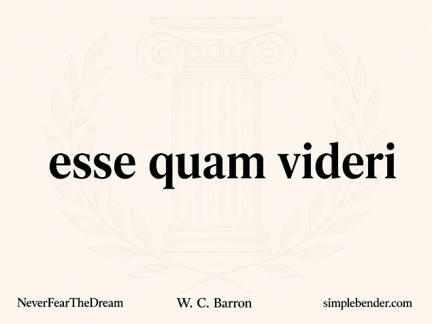
W. C. Barron esse quam videri

Betrayal should hurt. It should burn a little, especially when it is a betrayal of what we once believed ourselves to be.

Somewhere along the way, we began mistaking the appearance of greatness for greatness itself. We wrapped ourselves in gilded tapestry, built elaborate spectacles, polished the veneer—and hoped no one would notice the tarnish and rust beneath. Our national buildings, institutions, and monuments have been altered, renamed, and draped in political imagery, as their historic meaning increasingly competes with the personality of the moment.

Public money, public space, and presidential attention continue flowing toward spectacle—troops in the capital, cage fights on the White House lawn, the capital’s streets converted for racing, monuments, banners, and ceremonies. The White House increasingly resembles a gilded monument to personal taste rather than the temporary residence of the republic’s leader. Meanwhile, the betrayal: citizens struggle with persistent costs and rising interest rates, the return of preventable diseases, strained global alliances, and global ego-driven conflicts, while families still struggle to build their own small version of the American dream.

Pomp is not power. Pageantry is not leadership. Personal glorification is neither national greatness nor patriotism.

The warning is hardly new. Nearly 2,500 years ago, Aeschylus drew a distinction between being and merely seeming. The Romans later distilled the idea into three enduring words:

Esse quam videri            Be rather than appear.

Something feels almost too fitting about confronting a 2,500-year-old warning as America celebrates its 250th anniversary. At ten times the age of our republic, humanity has long understood the temptation—and danger—of confusing appearance with character. 

A great nation does not need to continually proclaim its greatness. It demonstrates greatness by what it builds, whom it protects, how it governs, and whether its institutions remain larger than the people who temporarily occupy them.

Ceremony has its place. Nations need symbols, celebrations, monuments, and moments of shared pride. But spectacle becomes dangerous when it stops honoring the country and starts honoring the individual. When institutions become props, public spaces become stages, and governance becomes performance, appearance slowly supplants substance.

Perhaps ‘esse quam videri’ should become more than an old motto—a national reminder and the corrective we need.

We should strive to be the leaders, thinkers, innovators, creators, and builders we claim to be—not merely appear to be them. Bluster is a thin veil, and the world is perfectly capable of seeing through it.

We are better than a gilded façade. It is better to show the scars and the resolve behind them than to cover them with gold leaf and ceremony.

America can still put on an impressive show. The hard question is whether, at 250, we still remember or care about the difference between looking great and being great.

Understand: when you build shrines to your own glory, they share your mortality. When you build them for ideals, they endure as long as someone believes.

NeverFearTheDream   W. C. Barron   simplebender.com

. … … . / –.- ..- .- — / …- .. -.. . .-. ..


Lap Around the Sun: Daily Steps Forward
by WCBarron

Buy at Amazon Buy at Barnes & Noble Buy at Books2Read

Joy in Alzheimer’s: My Mom’s Brave Walk into Dementia’s Abyss
by WCBarron

Buy at Amazon Buy at Barnes & Noble Buy at Books2Read
Posted in NeverFeartheDream

Never Fear The Dream…

Your Dreams should be chased not feared.....
NeverFearTheDream  simplebender.com

When not based on ego or anger, genuine compassion is a fearless emotion. 26.01.2

Joy in Alzheimer’s
W.C. Barron
Lap Around the Sun
Daily Steps Forward — W.C. Barron
Posted in Political

Parable: When King’s Divide—People Unite

Chairs of absent kings trying to divide while the people join hands and unite
NeverFearTheDream   simplebender.com

In weary corners of the world, three elder kings sat in their gilded castles, polishing medals they’d never earned. Their peasants staggered through hunger, cheap drugs, and endless funerals, but the kings were busy with more important matters—like drawing new lines on old maps and wallowing in opulence.

One dark, cold winter, the kings gathered at a marble table and decided that ruling their own crumbling kingdoms wasn’t enough. They would divide the whole world into “areas of influence,” like carving a roast they hadn’t paid for. Each slice came with rights: to plunder, to threaten, to “stabilize” by force. Responsibilities, however, were deemed inefficient. One would gain the Orient, one would be allowed, unfettered, to restore their former Empire, and the last would gain a vast Western Hemisphere. They embraced, shook hands, winked, made the deal, and secretly crossed their fingers behind their backs.

Their longtime allies—small kingdoms that had stood by them through storms and wars—were called into the throne rooms and, in ungracious tones, scolded; they were now “on their own.” It was dressed up as tough love, of course. “You must learn to defend yourselves. You must be strong, not weak,” the kings said, while quietly moving their troops, their money, and their promises elsewhere.

The peasants, meanwhile, noticed something awkward: the kings always seemed richest after a war, and safest after a crisis. So the villages began whispering across borders. Farmers traded grain instead of insults. Healers crossed checkpoints to treat strangers. Workers in different lands realized they were all being squeezed by the same velvet-gloved hands.

Soon, small alliances of towns and regions formed—not to conquer, but to refuse. They refused to buy the king’s fear, refused to send their sons and daughters to die for “influence,” and declined to hate people who were just as tired and broke as they were.

When the three kings tried to enforce their New World Order, they found something inconvenient: the world had quietly ordered itself, not into empires, but into bonds of mutual survival. They found that the sovereigns they had harassed and attacked, out of vanity and spite, had aligned against them. The small sovereignties had forged strength by joining together. The weakened kings found that by trying to be dominant, they had become feeble and irrelevant. And then, to their horror, each discovered the other king had made secret trade deals and alliances outside their spheres. Each cheated on the other because they thought they could get away with it.

It turns out, when rulers isolate and divide, the people eventually learn the oldest truth of all: if we don’t lift each other, no one is coming to save us. It turns out that failing, deceptive, greedy kings cannot divvy up the world and forge a lasting new world order. They lie, cheat, and steal for their own prosperity, not the betterment of the people, and the people finally know the truth. NeverFearTheDream simplebender.com

For Every Problem...A Solution...
Lap Around the Sun: Daily Steps Forward
Joy in Alzheimer’s: My Mom’s Brave Walk into Dementia’s Abyss

Posted in NeverFeartheDream

Never Fear The Dream…

Defend your right to choose your path. Don’t hand it over to rituals, prophecies, or the crowd. Let your mind and imagination lead—not your ego. 25.11.1.1

For Every Problem...A Solution...
Lap Around the Sun: Daily Steps Forward
Joy in Alzheimer’s: My Mom’s Brave Walk into Dementia’s Abyss

Posted in NeverFeartheDream

Never Fear The Dream…

Ego—your delusional self-inflation—is both your greatest danger and your most profound weakness. Your biggest obstacle in life is yourself. Conquer your ego and your surrender to imagined limitations—daily. 25.11.1

For Every Problem...A Solution...
Lap Around the Sun: Daily Steps Forward
Joy in Alzheimer’s: My Mom’s Brave Walk into Dementia’s Abyss

Posted in Philosophy

Escape the Prison of Reflection: A Parable of Ego and Humility

An older man, with an air of superiority, left his opulent, gilded house and strolled into a bustling marketplace surrounded by his fawning, obedient minions. He proudly carried a polished, reflective, framed glass. His head held high, he admired his own reflection as he weaved through the crowd. The crowd could see him, but he could only see himself, and he was thoroughly pleased. He barely noticed those on either side of him as his minions pushed them aside out of his view. When he did catch a fleeting glimpse, he compared himself to them—the merchants, the homeless, the travelers, the artists, and the minorities—with his arrogance, ignorance, and bombast on full display, he declared, “I am far superior to them all, and they should be forbidden from saying otherwise.”

But as the day wore on, dust gathered on the glass. His reflection grew dim and distorted. He frowned, exclaimed how unfair and unacceptable the conditions were. He lifted his feeble arm and wiped it with his soiled sleeve. Raising it again, he loudly demanded that the crowd see him as he saw himself, even through the grime. Some ignored him, some laughed, and the braver, at great peril, mocked him. His anger rose, and his threats of retaliation grew robust and offensive.

At last, an old immigrant woman left the row of unpicked crops and approached him, offering nothing but silence in her weary eyes. With her weathered hands, she took the glass gently from his manicured fingers, turned it around, and asked, “What do you see now?” The mirrored glass, once a tool for self-admiration, now became a symbol of understanding and empathy as he viewed the world rather than himself.

The old man was initially taken aback but remained self-absorbed. In the mirror was no longer his own face, but the faces of the people around him—each one bearing burdens, scars, joys, and pride of their own which he had never truly seen or bothered to comprehend.

The old woman’s voice was a gentle, refreshing breeze: “The glass is not for self-worship but for understanding. Turn it outward and you’ll see the truth: you are not the center, only a small part. Your ego makes the glass a prison; humility makes it a window.” Her words carried a profound truth that seemed to resonate in the old man’s heart.

The old man, humbled by her wisdom, lowered his head. For the first time, the marketplace seemed vast and vibrant, filled not just with his own reflection but with the dreams of real people. He left the market, dusty and disheveled, and a question lingered for all who watched: Will he remember what the mirror revealed, or will he brush away the dust of human humility and return to the prison of his own reflection? As the old woman returned to the field, she turned and said: “We should all look into our own reflective glass and ask ourselves, how much of him are we?” #NeverFearTheDream

For Every Problem...A Solution...
Lap Around the Sun: Daily Steps Forward
Joy in Alzheimer’s: My Mom’s Brave Walk into Dementia’s Abyss

Posted in NeverFeartheDream

Never Fear The Dream…..

Don’t hold your ideas too superior or too sure. Challenge them. In reflection, some of the last century’s great truths are mocked today as ridiculous and shallow. Just as our thoughts and ideas will be a century hence. As hard as it is to hear, the world doesn’t revolve around you, regardless of your self-conceived worth. And yet, each of us has a part in how the world unfolds.  25.11

NeverFearTheDream simplebender.com @simplebender.bsky.social Mundus sine ceasaribus