A ‘what-if’ thought experiment….or is it….
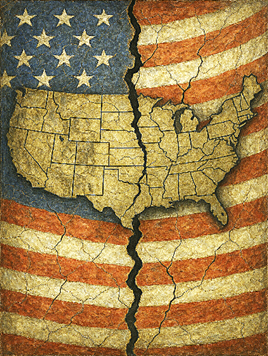
When federal agencies are defunded, are the states prepared to bear the burden? What if they falter, fail, and unravel under the weight? What if the unraveling of local governance isn’t a consequence of poor planning—but a feature of executive design?
Imagine a government waving the banner of “smaller federalism—drain the swamp,” slashing national programs in the name of efficiency and state empowerment. Medicaid becomes a block grant. Public housing and food subsidies are cut. Regulation and environmental oversight rolls back. Disaster relief is “restructured.” Methodically, the burden shifts to state and county governments, which are already stretched thin. Local taxes rise, services crumble, and local bureaucracies balloon in a vain attempt to compensate.
One town staffs its clinics. The next can’t keep its water clean. Some mandate gun control, others abortions, and others endorse sex work and gambling to increase state revenue. Air quality fluctuates by zip code. One region welcomes immigrants, the next sponsors agents for deportation. Resulting in dysfunctionality, geographical injustice, and discontinuity. The news media is mistrusted and declared ‘enemies of the State’. City, County, and State governments begin to crumble and fail under the weight of their new obligations.
Resentment festers—as inconsistency breeds inequity and confusion. Citizens demand relief, but help doesn’t come from local government, only more indecisive directives. Citizen uncertainty, polarization, and outrage against the policy void yield unrest. Not everywhere—but in enough places to make the headlines—just enough to be used as an excuse.
We’re already seeing a preview. Federal troops were deployed to California—not for disaster relief, but to enforce immigration policy, overriding the state’s will. FEMA faces cuts while climate disasters rise. Communities are left broken, ripe for corruption and manipulation.
And as the ground shifts, so do the guardrails. The Department of Justice leans in, and the Court tilts the scales. Recent rulings—many of which were urged by the Executive—have expanded presidential power by disregarding or reinterpreting laws passed by Congress and previous court decisions. Scholars once warned of an “imperial presidency.” It’s no longer theory—it’s precedent. The President need not wait for Congress. The office can act—or undo—with little more than a pen and a thin legal pretext.
And so, the same hand that dropped the burden returns—not as a partner, but as a “protector.” Protests are reframed as threats. Dissent becomes disorder. Disorder becomes insurrection.
Elections are postponed “for public safety.” Ballots are secured behind walls and counted by select administrators. Local authority is preempted. Emergency declarations morph into permanent policy.
Federal power consolidates—not with a coup, but with a shrug, and tacit approval, marked by deafening silence.
This isn’t prophecy—but it’s no longer just a thought experiment. It is no longer just possible it is verging on probable. It’s unfolding. If federal power can be withdrawn at will and restored at gunpoint—backed by a court with no limits—what does democracy even mean?
If this is the road ahead, it’s not the failure of states we should fear most. It’s the success of the plan—and our failure to notice.

 SimpleBender.....wcb