Voting should be easier for everyone, not harder.
Voting in a healthy republic should become easier as citizenship becomes clearer, broader, and more secure. Instead, America appears to be drifting toward a system in which voting increasingly depends not on citizenship itself but on the continuity and perfection of one’s paper trail.
We’ve all seen the ads. You need an ID for travel and even for dinner; so obviously you should need one to vote, right?. But what now counts as an ID is changing in subtle yet substantial ways. Supporters of the SAVE Act present it as a measure to ensure election integrity. Yet its structure and likely impact suggest something larger and more complicated.
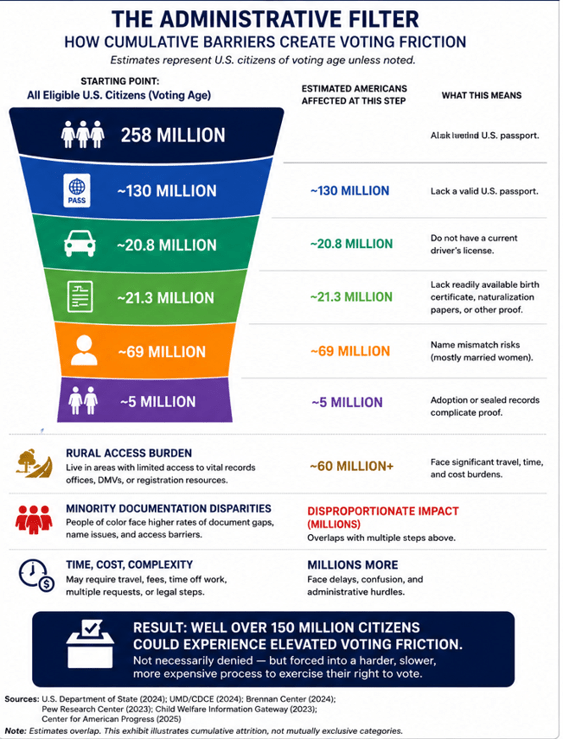
Nearly 170 million valid U.S. passports are in circulation, meaning roughly half the country does not hold one.[1] More than 21 million voting-age citizens reportedly lack ready access to citizenship documents.[2] Millions of married women have legal names that may not match their birth certificates.[3] Millions of adoptees navigate sealed or amended records.[4] Rural Americans may live far from the offices that maintain vital records, while many urban residents have built entire lives without ever needing a driver’s license.[5]
None of these people are “illegal voters.” They are citizens living ordinary American lives, and lives can be complicated.
That observation shifts the frame. Traditional election-security efforts should isolate fraud as narrowly as possible while minimizing burdens on lawful voters. The SAVE Act appears to move in the opposite direction, creating a broader administrative filter that disproportionately affects citizens whose lives are complex: marriage, divorce, adoption, relocation, poverty, aging, rural isolation, inconsistent records, or bureaucratic gaps.
The burden does not fall evenly because American life is not evenly documented. The burdens differ, but the results are the same: voter disenfranchisement and suppression.
Every political tribe eventually succumbs to the temptation of selective friction. Not necessarily banning votes outright, but making participation slower, harder, more uncertain, and more exhausting for populations deemed politically unreliable. One missing document. One mismatch. One courthouse trip. One workday lost. One bureaucratic loop too many.
History suggests that rights are rarely removed in a single dramatic moment. More often, they are narrowed through layers of procedure that seem reasonable individually but restrictive collectively. And don’t put it past any current or future administration to find ways to justify removing your right to have the ‘approved’ form of ID. There are currently many ways to revoke a passport which would impede your ability to travel and now vote.
Once citizenship rights become contingent on continuous bureaucratic verification, the government gradually shifts from presuming citizenship to administering verification. It becomes: “Citizen, show me your papers.”
The irony is hard to ignore. A political movement deeply skeptical of federal power now seems comfortable building one of the largest federal identity-verification frameworks in modern voting history.
A republic confident in its citizens removes unnecessary barriers. A republic uncertain of its citizens builds walls. NeverFearTheDream simplebender.com
…- — – . // …- — – . // …- — – .
-. — / ..-. . .- .-. / -. — / … .. .-.. . -. -.-. .
NeverFearTheDream simplebender.com Stand For Truth
Please consider following simplebender, you’re reading makes my writing more fun..…
Comments and thoughts are always welcome and feel free to re-post …..

