Posted in Current Events

The Cost of Walking Away Without a Plan

Pressure is the ability to impose costs; leverage is the ability to secure results.

A fundamental difference separates winning a confrontation from achieving an objective. Governments often mistake their capacity to punish an adversary for their ability to change its behavior. The current conflict with Iran illustrates the consequences of that confusion and the cost of abandoning a strategy without a credible alternative.

In May 2018, the United States unilaterally withdrew from the Joint Comprehensive Plan of Action (JCPOA), an internationally negotiated agreement that restricted Iran’s nuclear enrichment and provided enhanced international oversight. The agreement wasn’t perfect, but it was functioning within its nuclear mandate. Rather than securing a stronger replacement, the U.S. 45th President imposed a maximum-pressure sanctions campaign. Iran subsequently expanded its nuclear capabilities and curtailed international monitoring. The result was an increasingly dangerous confrontation, marked by diminishing transparency and a slow-burning fuse.¹

The United States bears responsibility for abandoning a diplomatic instrument without securing an effective alternative. Iran bears responsibility for its reactions, including its regional activities and nuclear expansion. Their reactions should not have been surprising and should have been anticipated. The escalating confrontation was foreseeable, and given the players involved, an eventual conflict was almost inevitable.

The Middle East and the United States are once again embroiled in conflict, with consequences extending well beyond the region. Three questions merit further consideration.

First, what was the functional alternative in 2018? One possibility was to remain in the JCPOA while negotiating supplementary agreements on ballistic missiles and regional security. Whether politically achievable is debatable, but withdrawing without an enforceable replacement surrendered existing constraints in pursuit of uncertain concessions.

Second, why did the U.S. expect sanctions to achieve what negotiated restrictions already provided? Economic pressure certainly harmed Iran, but it failed to produce the broader agreement that was earnestly sought. Meanwhile, Iranian enrichment advanced, and oversight diminished.² Pressure is the ability to impose costs; leverage is the ability to secure results. They are not the same.

Third, what is the strategic objective today? Preventing an Iranian nuclear weapon, eliminating enrichment, weakening regional military capabilities, changing Iran’s government, and/or establishing lasting regional stability? These are distinct objectives and may not be interdependent. Success in one does not guarantee success in another. Without clearly defined objectives, how can we measure success, recognize failure, or assess the value of restraint?

The JCPOA had legitimate shortcomings, including provisions that expired over time and its limited treatment of ballistic missiles and Iran’s regional activities. Preserving it would have reduced one risk while leaving others unresolved. But does abandoning an imperfect agreement make sense when the alternative offers fewer constraints, less visibility, and greater uncertainty?

The subsequent chain of events offers a cautionary lesson. An international agreement is unilaterally canceled. Sanctions failed to secure a replacement agreement. Nuclear restrictions eroded. Diplomatic trust deteriorated. Military force increasingly replaced negotiation, and each escalation brought new consequences and fewer obvious ways out. The path was neither automatic nor solely America’s making, yet its risks were hardly unimaginable.³

Before taking the first step, the U.S. should have heeded its allies’ concerns and confronted a simple question: Then what? That question remains relevant after every subsequent decision, especially when military success is mistaken for a sustainable political outcome.

We cannot undo the withdrawal or the decisions that followed. We can, however, demand coherent objectives, realistic measures of success, and an exit strategy that acknowledges the limits of coercion. Pride and punishment are poor substitutes for policy, and military superiority does not guarantee political success.

Even after being told countless times that we have won. If we cannot explain what comes after the confrontation, how can we claim to know what winning looks like?

-.. — / -. — – / .– .- .-.. -.- / .- .– .- -.–

NeverFearTheDream………. W. C. Barron………. simplebender.com……….keystonecompact.org


Lap Around the Sun: Daily Steps Forward
by WCBarron

Buy at Amazon Buy at Barnes & Noble Buy at Books2Read

Joy in Alzheimer’s: My Mom’s Brave Walk into Dementia’s Abyss
by WCBarron

Buy at Amazon Buy at Barnes & Noble Buy at Books2Read

Sources

  1. International Atomic Energy Agency (IAEA), Verification and Monitoring in the Islamic Republic of Iran in Light of United Nations Security Council Resolution 2231 (2015), September 2025. Documents the May 2018 U.S. withdrawal and the progressive deterioration of Iran’s compliance and monitoring arrangements beginning in 2019.
  2. Congressional Research Service, Iran’s Nuclear Program and 2025 UN Sanctions Reimposition, updated October 13, 2026. Documents the breakdown of JCPOA restrictions, diminished monitoring, reimposed UN sanctions, and continuing uncertainty concerning Iran’s nuclear capabilities.
  3. Reuters, Iran Says It Will Reply to U.S. Response on Hormuz Proposal Once Review Over, October 12, 2026. Documents the continuing conflict and unresolved disagreement over nuclear negotiations and regional maritime security.

Posted in NeverFeartheDream

Never Fear The Dream…

Our free will empowers us to choose—right or wrong—and it is our conscience that rewards or punishes us. 26.04.04

-. . …- . .-. ..-. . .- .-. – …. . -.. .-. . .- —

Posted in Favoites

When Bonds Become Bondage

the soft wood bridge building bonds turn to chains of bondage quickly....simplebender.com

Bonds are built on trust and shared purpose. What begins as social alignment can harden into dependency and quiet surrender. We’re encouraged to join teams, tribes, and causes—to belong. But what happens when those bonds start to dictate not just our identity, but also what we’re permitted to think?

Healthy bonds help us carry burdens, share experiences, and grow. They give us identity, protection, and the comfort of not standing alone. Long, strong bonds take effort: listening, repair, and the freedom to disagree without being cast out.

Yet the same bond that holds us up can also hold us down. It becomes bondage when internal disagreement feels like betrayal and outside questions feel like an attack. When you sense that leaving—or even doubting—will cost you your status, your income, your family, or your place at the table, you’re no longer just bonded. You’re being managed.

This innocuous type of bondage isn’t so bold as handcuffs. It seeps in through reward and punishment. Praise for loyalty. Shame for dissent. Fear of exile. Our “independence muscle” atrophies, not only because we stop using it, but because the systems around us—media, parties, teams, neighborhoods, companies, even congregations—profit from our reflexive defense of the group. We start repeating talking points. We don’t think or challenge; we begin to become puppets. Their script becomes our voice.

And yet, people don’t choose this only out of weakness or neglect. Tight bonds promise safety in a chaotic world. They offer clear enemies, simple answers, and the warmth of “us.” Sometimes bondage feels much better than isolation.

That’s why we need quiet tests of our own chains. When was the last time you openly challenged your group’s beliefs, and how did they respond? If you walked away tomorrow, what would you truly lose—and what might you gain?

Society survives through bonds—and through resisting the slide into silent obedience. So yes, build bonds. But also actively seek out and connect with those who think differently, and to those your group teaches you to fear or mock. Cross-group ties don’t erase convictions; they loosen the hidden shackles of certainty.

Stand with others, not under a thumb or behind a shield. Bonds are necessary—bondage is optional and may not be escapable. NeverFearTheDream   simplebender.com

For Every Problem...A Solution...
Lap Around the Sun: Daily Steps Forward
Joy in Alzheimer’s: My Mom’s Brave Walk into Dementia’s Abyss

Posted in Favoites

Rabbits’ Revenge: A Fable of Hidden Strength

Protesting 'Rabbits' Ain't No Fun When the Rabbit's Got the Gun

King Wannabe stood before the crowd of people, his back hunched, too feeble to be erect, his greying, bushy eyebrows raised, his face twisted in contempt. The people would not chant his name nor bow to his image. “Rabbits,” he scoffed. “Nothing but rabbits. They eat, they breed, they exist for my pleasure. Especially the young ones—for my pleasure. Everyone must love Wannabe, everyone, especially these rabbits.” His entourage knelt in obedience, fearful of his rage.

One brave advisor dared to whisper, “But sir, no one is loved by everyone, and they are more than rabbits. They are people, with minds, with hopes and dreams.” In a buffoonish manner, Wannabe waved the thought aside, clutching a handful of pamphlets. “Look at these. Lies! All lies! Their words are filth. Take their paper and their pens. Silence them, cancel their culture.” He signed an Order, and the dutiful minions obeyed, seizing what they could.

Yet the words did not stop. Thought traveled without ink. Discontent spread without parchment. And so Wannabe tightened his grip. In a tyrannical rage, he yelled, “We will control the news. We will make them pay to speak. We will force them to listen. We will tell them what books to read. We will be their favorite, the one they love; they will love Wannabe.” Again, with trepidation, the advisor leaned close: “But sir, even without paper, they have found their voices. They still have minds. And even rabbits, when cornered, will bite. Not today, perhaps—but one day the rabbits will bite. Remember this if you remember nothing at all. And heed the hunter’s satire.” The Wannabe dismissed him with a bitter laugh and a sneer. “Nonsense. They are only rabbits. They are for my pleasure; their only care is to eat and breed.” He arrogantly sneered. “And as to the satirical, I hate comics: ‘ain’t no fun when the rabbit’s got the gun’ is just silly. It’s for the weak and timid; not for Wannabe because Wannabe controls all and fears nothing.” He laughed, but his laugh was uneasy, and the silence from his minions was unmistakable and deafening.

Seasons passed. The whisper and wisdom of the sage advisor lingered. The people—mocked as useless, underestimated lagomorphs—grew weary of abuse and felt more cornered yet bolder. The self-serving advisors, sensing doom, scurried away with whatever spoils they could steal. At last, Wannabe stood alone, his armies and decrees powerless against a multitude no longer afraid, but resolute and united.

And from the crowd, like sparks catching fire, came the clamorous chants:

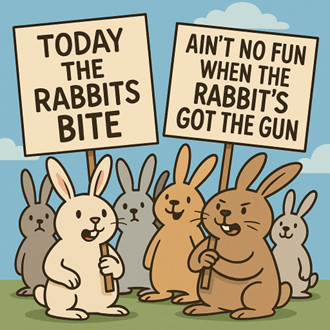
“Today the rabbits bite.”
“Ain’t no fun when the rabbit’s got the gun.”

Protesting against authoritarianism

The chants rolled through the streets, half warning, half laughter, but all serious. It was no threat of violence, but a proverb of irony. These people, these ‘rabbits’, had never needed literal guns because they had found something much more lethal—strength in their numbers, in their unified ideas, in their memory, dreams, and words, and now in their collective refusal to bow. The chant was their laughter, their truth, their declaration that the world had turned and change was in the offing. And the wise sage smiled a subtle, small, sly smile, always knowing and anticipating the power of their unity.

Civil society thrives only when none are treated as beasts, but as human beings with voices, hopes, and dreams. Wise leaders understand that thought is stronger than chains and the pen is stronger than the sword. The silencing of truth and thought control is always temporary; revolt begins the moment words are stifled, and action follows when endurance breaks.

If you have a gun—put it down, and put it away, we rabbits don’t need them.

Instead, pick up your pen and write your thoughts and dreams. Raise your voice and speak your mind. Open your ears and listen to others. Kings, Emperors, and wannabes are mortal. But thoughts endure. Words endure. And yours are essential. #NeverFearTheDream #Ain’tNoFun #RabbitsBite

For Every Problem...A Solution...
Lap Around the Sun: Daily Steps Forward
Joy in Alzheimer’s: My Mom’s Brave Walk into Dementia’s Abyss