Posted in Philosophy

Horizon’s Calm

Regardless of the calamity crashing onto the shore, the horizon always seems calm.

The headlines confronting us every day are inescapable. World events spill into ordinary life with reckless abandon. Add our own worries, obligations, and frustrations, and it becomes easy to feel that everything is happening at once—and that we control almost none of it.

So we put our heads down to focus on every step we take, and that is all we think we control.

We watch for the exposed rocks, the tidal pools, and the creeping surge of the surf. We concentrate so intently on keeping our feet dry that we miss the gulls skimming the waves, the eagles soaring overhead, the pelican’s wonderfully gangly dive, and, if we look further out, maybe, just maybe, a breaching whale.

Most of all, we miss the horizon. We don’t even look up, out of fear.

Trauma, conflict, and drama lie at our feet. Some of it is real and deserves our attention. The waves may indeed be growing larger. We should not pretend otherwise. But the closer we stand to the crashing surf, the more each wave can consume us.

Our breathing shortens. Frustration rises. Helplessness creeps in. Eventually, the thing directly in front of us begins to feel like the whole world. But it rarely is, and it rarely is as big as it appears.

Lift your head and look beyond the wave breaking at your feet. The horizon offers perspective—not because it promises everything will be fine, but because it reminds us that this moment, however difficult, is only part of a much larger landscape.

Today matters. What is crashing around us matters. But neither is everything.

That doesn’t mean ignoring the surf. Brace for what may come. Watch for the sneaker wave. Step back when wisdom and experience tell you to. Deal with the rocks beneath your feet. But we do not have to fight every wave or avoid every stone.

Perhaps calm begins with remembering the difference between what demands our focused attention and what deserves our entire field of vision. The shore may be chaotic, noisy, even frightening. So look up. Look beyond the breaking waves and see that the horizon remains calm; so should we.

Look up Horizon

Calamitous shore waves break

Horizon placid

NeverFearTheDream…W. C. Barron…simplebender.com

.-.. — — -.- / ..- .–. / …. — .-. .. –.. — -.


Lap Around the Sun: Daily Steps Forward
by WCBarron

Buy at Amazon Buy at Barnes & Noble Buy at Books2Read

Joy in Alzheimer’s: My Mom’s Brave Walk into Dementia’s Abyss
by WCBarron

Buy at Amazon Buy at Barnes & Noble Buy at Books2Read
Posted in Philosophy

Wisdom In The Pause

The pause isn’t empty time; it’s where life prepares for what comes next, before regret.

Nature rarely operates in a continuous state. It oscillates. It moves, rests, gathers itself, then moves again. Between action and reaction lies a quiet transition—a pause. Perhaps there is wisdom in that rhythm. Perhaps we should make room for our own rhythm; our own pause.

The ocean offers one of nature’s clearest examples. Between high and low tide, slack water occurs, and the currents grow remarkably still before reversing direction. Even waves pause for the briefest instant at their crest before surrendering to gravity and reforming into something new.

The heavens follow their own pattern. Twilight gently separates day from night, and dawn does the same for night and day. The moon seems to linger near its full and new phases before its changing face becomes obvious again. A pendulum momentarily stops at the top of each swing as kinetic energy yields to potential energy, then begins its return.

Our own bodies follow the same cadence. There is a pause between each inhalation and exhalation. At rest, the heart spends more time relaxing and filling than contracting. We interrupt our vision thousands of times each day with a blink. Even the neurons that carry our thoughts require refractory periods before they can fire again.

These pauses are not interruptions; they are intentional.

Movement creates change. Pause provides definition. Without slack water, the transition between ebb and flood would be abrupt. Without the brief pause between breaths, breathing would be impossible. Without diastole, the heart could never refill, and life’s most dependable pump would fail.

Nature seems to grasp something we often resist: sustained effort is rarely sustainable. Yet we celebrate constant activity. We answer emails at dinner, fill every silence with noise, and wear exhaustion almost like a badge of honor. We confuse motion with progress and busyness with purpose. In doing so, we often sacrifice the very moments that allow us to think clearly.

Nature has endured billions of years by embracing rhythms rather than resisting them. Perhaps our greatest wisdom lies in knowing when to pause long enough to choose our next step wisely. The next time conflict arises, pause before responding. When someone finishes speaking, let a moment of silence honor both their words and your understanding of them. Pause before changing course, and before refusing to change course.

The pause is where reflection lives. It is where emotion settles enough for reason to catch up. It is where we discover whether the path we’re on still aligns with the one we intended to follow. Decisions made after a thoughtful pause are rarely perfect, but they are often wiser than those made in perpetual motion. Pausa et Reflecte…Pause and Reflect…Before Regret.  Embrace a pause; no time to rush.  NeverFearTheDream  simplebender.com

.–. .- … ..- … .- / . – / .-. . ..-. .-.. . -.-. – .


Lap Around the Sun: Daily Steps Forward
by WCBarron

Buy at Amazon Buy at Barnes & Noble Buy at Books2Read

Joy in Alzheimer’s: My Mom’s Brave Walk into Dementia’s Abyss
by WCBarron

Buy at Amazon Buy at Barnes & Noble Buy at Books2Read
Posted in Current Events, Philosophy

Kodachrome America on US2


Road Tripping along US2- Our Northern Most Highway Mirror

Traveling US2 reminded me of some things easily forgotten from a couch, a cable-news chair, or the algorithmic cave we now mistake for public discourse and life.

America is Kodachrome, not monochrome.

It is not one color, story, tribe, flag, grievance, joy, anger, or one carefully rehearsed slogan. It is a long, uneven road running through farm fields, forests, high plains, small towns, county seats, and metropolises. Yet, US2 barely touches political power at all, which feels about right for a road more interested in citizens than rulers. It touches the Great Lakes and crosses the Rocky Mountains. It passes poverty, pride, fresh paint, boarded windows, new diners, old dreams, and people trying to get through the day without losing their minds, humor, decency, or pride.

US2 is not polished America. It is not brochure America. It is not the America politicians sell when they need applause. It is better than that. It is real.

There were simple homes and extravagant ones. Fancy shopping centers and flea markets. New businesses with flashing banners announcing someone’s fresh shot at the American dream. And there were uncountable hollowed-out buildings, closed storefronts, ruined signs, tattered flags, and boarded windows reminding us that not every dream survives. Hope and wreckage share the same street.

The road itself seemed honest to. US2 shifted from single-lane “take your turn” stretches to four-lane, divided-lane confidence, from rough, rutted pavement to smooth sailing. That felt about right. America has always been part pothole, part promise.

Along the way, diversity was not a slogan. It was simply present. Greeted, helped, waved at, and politely served by people of multiple races, genders, orientations, accents, and backgrounds—Black, Native American, Hispanic, Asian, white, and everyone in between. Fellow campers and travelers chatted without demanding a political affidavit or proof of citizenship. People waved because waving still works. They smiled because not every human exchange has to be a tribal transaction.

Near one town, modern tricked-out equipment rolled through the same landscape where Amish oxen plows tilled the soil, and family carriages filled with four to five family members trotted toward Sunday evening service. Every face seemed eager to wave. Modern machinery and horse-drawn faith shared the road, not as enemies, not as symbols in someone else’s culture war, but as neighbors moving through the same evening light. That is America when we let it breathe.

And yes, the American ego rode along too. Somewhere in North Dakota, a place without a hospital, advertised world-class spinal services. Every mascot of every team in every town was the ‘world’s best; go figure. And, every other town seemed to claim world-class pancakes. I cannot say whether any other country makes pancakes, but we have apparently perfected them nine hundred times between the Great Lakes and the Rockies. This country may be divided, but no one has surrendered our breakfast supremacy.

Then came the names: Pleasant, Superior, and others that sounded less like towns and more like national therapeutic goals. Maybe we need more Pleasant in our politics and lives, and a little less self-declared Superior in and from our leaders. A country does not heal by shouting louder. It heals when enough ordinary people decide the neighbor is not the enemy, the stranger is not a threat, and disagreement is not treason.

One of the most refreshing parts of the route was how pleasantly devoid it was of cult political banners and flags. Not devoid of belief. Not devoid of opinion. Just free from the need to turn every porch, truck, fence, and field into a loyalty test. After years of national shouting, quiet felt amazingly patriotic.

The warm evening, outside an Irish pub, blues and alternative rock shared the stage at a block party. People smiled and danced. No one checking party registration or citizenship before tapping a foot and having a beer. For a few hours, the country remembered that rhythm is older and better than ideology.

US2 showed me real America in all its diversity—not singularity, not uniformity, not forced sameness. Maybe that is what makes us great, and shows us how and when we are great.

Not our boastfulness. Not our need to be the world’s overlord or policeman. Maybe America’s better role is partner, not ruler. Maybe being “number two” would not be humiliation. Maybe it would teach us to try harder, listen better, brag less, and build more, back to our roots and strength.

US2 gave me hope. Not naive hope. Hope with rust on it. Hope with a cracked windshield, a Dollar General at every crossroads, and every state somehow claiming Sasquatch as a local resident. But hope nonetheless.

Because beneath the noise, most people were doing what people have always done: working, serving, driving, cooking, repairing, praying, camping, building, failing, starting again, and trying to keep their families safe and well.

That is the America worth defending.

Not monochrome America. Not purified America. Not a fantasy where everyone thinks, looks, votes, worships, or eats pancakes alike. But, a Kodachrome America. Bright, faded, scratched, beautiful, uneven, funny, heartbreaking, generous, stubborn, and still—despite everything—moving forward together even when we agree to disagree. NeverFearTheDream simplebender.com

-.- — -.. .- -.-. …. .-. — — . / .- — . .-. .. -.-. .-


Lap Around the Sun: Daily Steps Forward
by WCBarron

Buy at Amazon Buy at Barnes & Noble Buy at Books2Read

Joy in Alzheimer’s: My Mom’s Brave Walk into Dementia’s Abyss
by WCBarron

Buy at Amazon Buy at Barnes & Noble Buy at Books2Read
Posted in NeverFeartheDream

Never Fear The Dream…

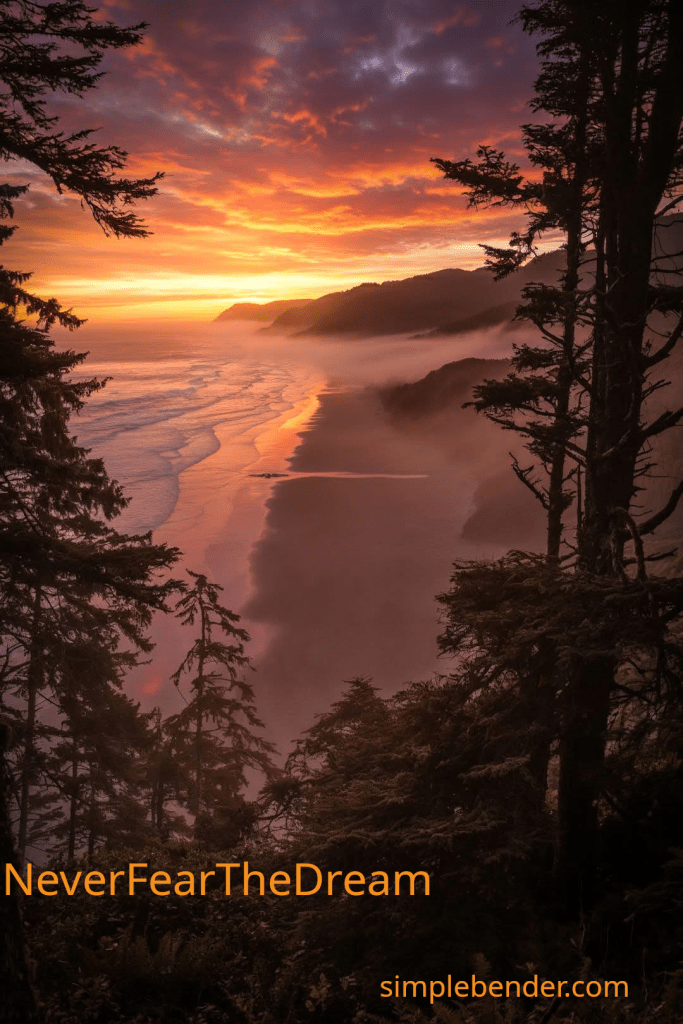
Sit quietly and listen for your inner voice that whispers, “Be quieter”—then let the stress melt away. 26.06.06

.–. . .- -.-. .