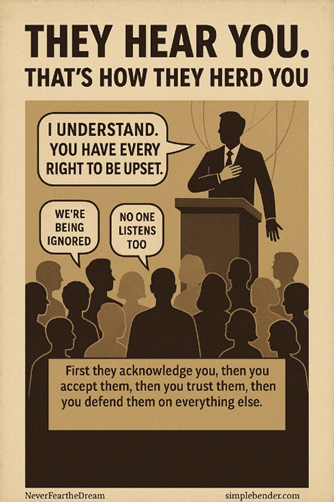
We like to think facts, arguments, and data persuade us. But we are fooling ourselves. We are moved by something much simpler and more primitive: being seen —being acknowledged.
When someone with power looks out at a frustrated crowd and says, “You’ve been ignored, dismissed, and lied to—and you’re right to be angry,” they’ve already won half the battle and most of the crowd. No policy yet, no cost, no trade-offs. Just an acknowledgement. And for people who feel they have been treated as invisible for years, those words are not just drunk, but we bathe in them.
This is the benevolent side of acknowledgment. It’s the foundation of honest dialogue. When people feel genuinely heard, they experience a sense of dignity and respect. They can tolerate imperfect outcomes if they trust the process and believe their concerns are genuinely recognized. Acknowledgment restores a sense of worth: I exist in this system. I matter.
The subsequent step is where things get murky and sticky. First comes acceptance: “At least this one is listening.” Then, subconsciously, we yield our trust: “If they hear me on this, they must be on my side in general.” Give it a little more time and constant repetition, and that trust quietly turns into loyalty. Not because the leader has delivered, but because the follower feels psychologically indebted: “Everyone else ignored us; this one didn’t. This one understands us, believes in us. We owe them a chance.” That shift is dangerous—moving from judging leaders based upon results to unquestioningly defending them because they once made us feel heard and important. This is precisely where healthy acknowledgement can harden into uncritical allegiance. Your ego has been played.
Once someone in authority is branded as “the only one who really understands us,” they can cash that emotional credit almost anywhere. They can stay vague on solutions. They can peddle simple stories for complex problems. Anything can be solved on ‘day one.’ Leaders may use hollow acknowledgment to manipulate, shifting blame and redirecting anger while still being applauded—because they’ve anchored themselves to identity, not performance. Questioning becomes essential to avoid falling for theater rather than reality.
At this point, the line between leadership and chicanery gets very thin and easily crossed. The leader doesn’t need to heal the wound; they need to keep poking it, refusing to let it heal, wanting it to fester. Keep naming the grievance, keep feeding the resentment, keep pointing at new enemies. Distracting you from seeing what is really happening. The followers’ loyalty is no longer about what’s actually being done; it’s about who stands with “people like us.”
Suppose the feeling of being acknowledged matters more to us than the reality of what is actually being done on our behalf. How long will it be before we become willing accomplices in our own manipulation, or have we already crossed that bridge?
Whenever a leader spends far more time jabberwocking and mirroring your pain than functionally measuring their results, don’t be flattered that they “see you”—check your wallet, your rights, and your future. NeverFearTheDream simplebender.com
NeverFearTheDream simplebender.com Stand For Truth
Please consider following simplebender, you’re reading makes my writing more fun..…
Comments and thoughts are always welcome and feel free to re-post …..



 SimpleBender.....wcb