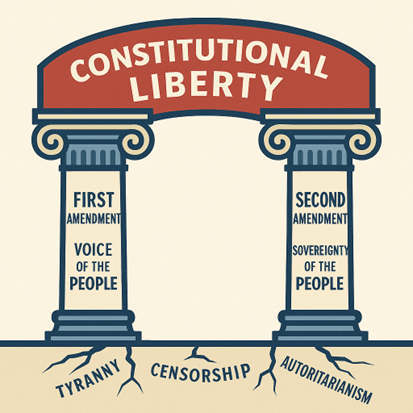
A society serious about liberty must protect rights. A society serious about life must also prevent dangerous misuse. These are not opposing duties; they are symbiotic.
The previous essay defended restraint in government’s approach to intimate medical decisions. Category IV begins with a different constitutional boundary but applies the same governing test: can the country protect a right and acknowledge that responsibility is not an infringement?
The gun debate is often framed as a forced choice. Either every regulation is tyranny, or every firearm owner is a latent threat. One side treats the mere existence of a rule as proof of conspiratorial
confiscation. The other treats the mere presence of a gun as proof of danger. Both positions spare their advocates the harder work of distinguishing lawful ownership from dangerous misuse.
The Keystone Compact affirms responsible citizens’ constitutional right to own firearms and defend themselves. That right is not a favor granted by whichever party controls government. It belongs within the same framework as speech, privacy, property, due process, and personal autonomy: a liberty that cannot be withdrawn merely because its exercise makes others uncomfortable.
Rights and responsibility must travel together.
Responsibility begins before a crisis. Firearm owners should understand safe handling, secure storage, the consequences of negligent access, and the laws governing possession and use. Safety education should be widely available, and voluntary training incentives should reward competence without making lawful ownership a privilege accessible only to those with money, time, or political approval.
Storage matters most where children, vulnerable adults, or unauthorized users may gain access. A firearm kept for protection but left accessible to a curious child or a person in crisis constitutes reckless conduct. The law should set clear expectations for reckless access while respecting lawful owners’ practical need to protect themselves.
Background checks should be effective, timely, accurate, and tied to lawful disqualifiers. A system that fails to identify dangerous people fails public safety. A system that delays or denies eligible citizens without explanation fails due process. The objective is not a backdoor prohibition. It is a competent screen that distinguishes the prohibited purchaser from the responsible one.
Enforcement should focus on where the danger is real: gun crime, trafficking, straw purchases, illegal possession, theft, and violent offenders. Symbolic rules that burden compliant citizens while prosecutors and agencies neglect criminal networks is regulation theater and not serious safety policy.
Credible threats require a delicate and difficult balance. Temporary firearm removal may be justified when specific evidence shows an imminent danger to the person or others. But such orders must be evidence-based, time-limited, promptly reviewed, appealable, and subject to meaningful consequences for false or abusive petitions. Emergency authority without a rapid path to challenge becomes punishment before judgment.
Mental health and crisis response also belong in the discussion, but not as a convenient way to label every person with a diagnosis as dangerous. Most people experiencing mental illness are not violent. The policy need is practical capacity: families who know where to call, clinicians who can respond, law enforcement trained for crises, and a process that can intervene before warning signs escalate into a catastrophe.
No single statute can replace competent institutions. A school that ignores threats, an agency that fails to transmit disqualifying records, a court that cannot hold a prompt hearing, or a community with no crisis response cannot repair its failures by announcing another broad prohibition after a tragedy.
The political tribes favor absolutes because they are easier to market. Gun-rights absolutists speak as though any duty attached to ownership destroys the right. Gun-control absolutists speak as though public safety begins only when ownership becomes difficult, stigmatized, or rare. Both turn citizens and rights into symbols and policy into a loyalty test.
Local proof is less theatrical. It is the parent teaching safe handling, the owner locking a firearm away from children, the dealer refusing a suspicious transaction, the officer pursuing a trafficker, the family seeking help for someone in crisis, and the court protecting public safety and due process. Public safety is built through thousands of responsible decisions and institutions that do their jobs.
Responsible gun ownership is not the enemy of public safety; it is part of it.
The Keystone standard is neither indifference nor prohibition. Protect the right. Attach clear duties to dangerous misuse. Enforce the laws that matter. Intervene in response to credible threats, with due process. Build crisis capacity before the emergency.
The final question is not whether a policy sounds tough to one tribe or compassionate to the other. It is whether the policy protects responsible citizens while making it harder for violent, reckless, or demonstrably dangerous individuals to cause harm.
Firearms are only one part of public safety. The next essay broadens the test: whether the government can protect neighborhoods from violence and disorder without making constitutional rights collateral damage.
Next in Category IV: Order and Rights Are Not Enemies
–. ..- -. / -.-. — -. – .-. — .-.. / .. … / .. — .–. — .-. – .- -. –
NeverFearTheDream………. W. C. Barron………. simplebender.com……….keystonecompact.org
-. — / ..-. . .- .-. / -. — / … .. .-.. . -. -.-. .
NeverFearTheDream simplebender.com Stand For Truth
Please consider following simplebender, you’re reading makes my writing more fun..…
Comments and thoughts are always welcome and feel free to re-post …..