Posted in Current Events, Political

Guardrails Against the Authoritarianism Storm

Columns supporting our Constitutional Liberties

Article first published in the Bend Bulletin 9/27/25

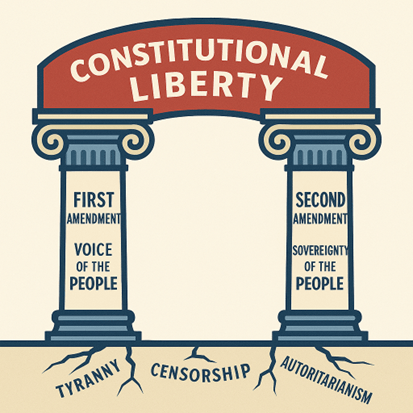
The Bill of Rights was not a mere document, but a product of the founders’ deep suspicion of concentrated power. They had witnessed the crushing of liberties under a monarchy and feared that even a republican government might someday drift toward authoritarianism. The First Amendment enshrines freedoms of mind and voice; the Second Amendment ensures the citizenry will never be entirely powerless should those freedoms come under assault. This foresight of the founders enlightens us about the historical context of the Bill of Rights, giving us a deeper understanding of our constitutional rights.

History was their teacher. British suppression of colonial assemblies, censorship of dissenting press, and the Intolerable Acts were enforced not with argument but with troops. The Revolution began not at a printing press, but when local militias clashed with regular soldiers at Lexington and Concord (1775) to resist the seizure of their weapons. It was this combination—ideas in pamphlets like Common Sense (1776) and the willingness to defend them—that secured independence.

James Madison (Federalist 46) envisioned an armed citizenry as the ultimate check on federal overreach, noting that “the advantage of being armed” would deter encroachments on liberty. Alexander Hamilton (Federalist 29), though skeptical of full-time militias, conceded that a people capable of bearing arms would make any tyranny costly. Later commentators, such as St. George Tucker (1803), referred to the Second Amendment as the “true palladium of liberty,” a final barrier against usurpation (Tucker, Blackstone’s Commentaries).

The framers did not celebrate rebellion, and neither should we. They built a republic designed to settle disputes through institutions—legislatures, courts, and elections—not through insurrection. The Second Amendment was less an invitation to revolt than a final constitutional guardrail, a reminder to government that the people remain sovereign. It was meant to make authoritarian control—whether through censorship, suppression of dissent, or militarized governance—impractical.

“The Second defends the First,” captures part of this truth but misses the deeper genius of the American design. Our first line of defense for free expression is institutional: the separation of powers, judicial independence, and a free press that is able to hold the government accountable. An armed citizenry is the last resort, the failsafe that ensures no regime can permanently silence the governed, providing a sense of security about our rights.

Even in polarized times, the resilience of this framework is remarkable. Courts still strike down attempts at censorship, legislators still debate fiercely, and citizens continue to speak, publish, assemble, and worship according to their conscience. With some legislators seeming to yield to the mob or bend a knee for their own political survival, our Constitution has withstood civil war, economic depression, McCarthyism, and demagoguery precisely because its protections are layered—legal, institutional, and cultural. The greatest defense of liberty is not fear of armed resistance but the enduring resolve of citizens who insist on their right to speak and be heard. When we do not defend the first, we risk the second, the fourteenth, the fifteenth, and the nineteenth. When we defend free speech, preserve checks and balances, and reject authoritarian shortcuts and fragile egos—whether from the left or the right—we prove that the American experiment remains not only viable but vital. This reiteration of the importance of defending free speech should empower you and make you feel responsible for upholding your rights, instilling a sense of duty and empowerment in you. # NeverFearTheDream # Stand for Truth # Stand with Pride # Stand with Spine

For Every Problem...A Solution...
Lap Around the Sun: Daily Steps Forward
Joy in Alzheimer’s: My Mom’s Brave Walk into Dementia’s Abyss

Posted in Current Events

Uniquely American: Civil Discord and Disobedience

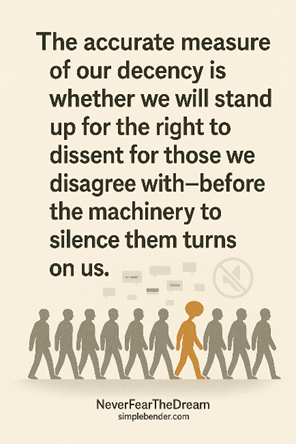
Ideas can wound more deeply than fists—their scars often outlast bruises. But dissent isn’t treason; it’s the American expectation. The audacity to voice a contrarian view without fear of punishment was once a defining feature of our national character. That freedom, that courage, is slipping.

A fundamental right is to stand, speak, write, or peacefully protest what you believe is wrong. It’s a moral responsibility at the core of our civic being. It is how we started. As Americans, it is who we are.

Yes, this right has been repeatedly abused and suppressed: during the Civil Rights Movement, LGBTQ advocacy, and Black Lives Matter protests. These weren’t our proudest moments—they were our failures. And yet, we are better than those moments. And we are better because of them. Just as we should be better than today’s attempts to silence pro-Palestinian and pro-Ukrainian voices, or to weaponize immigration enforcement.

Yes, public safety matters. And yes, misinformation can be dangerous, especially when weaponized at scale. But the line between protection and suppression is perilously thin. When fear becomes a rationale for silencing protest, we drift toward authoritarianism under the guise of security.

But let me be honest. I write this as someone of privilege—a white male in the dominant race and gender. I’ve never feared for my safety when expressing my views. I’ve never had to calculate the cost of speaking out to simply be heard. That insulation is not universal. And acknowledging that it is the least I can do.

The truly brave are those who speak anyway, knowing the risks. Minorities are demanding the rights that this country claims to guarantee. Immigrants who were escaping violence and chasing a future are thrust back into violence. And yet, their domestic complicit employers are not subject to the heavy hand of the law. The Pro-Palestinian voices speaking into the silence of global indifference as their homeland, their homeland of generations, is taken and broken, and their families are indiscriminately killed and starved. And even those supporting Ukraine as it fiercely defends its children and its homeland from slaughter by an invading army.

They are the ones carrying this nation’s conscience forward. They take the blows, not for fame or ideology, but for survival and dignity. The road to a better America is paved by those who get off the couch and speak out through civil dialogue, discord, and yes, disobedience.

This country grows not by force, but by engagement. We will be stronger when those in power trade masks and riot gear for open conversation—and when fabricated, non-existent, dystopian, national “emergencies” are no longer used to justify suppression. When we are afraid to speak out, the words of others fill the void, becoming all that is heard. When those of us who can speak don’t, we become complicit in the decay. The slide is ours to stop; or ours to be held accountable.

For Every Problem...A Solution...
Lap Around the Sun: Daily Steps Forward
Joy in Alzheimer’s: My Mom’s Brave Walk into Dementia’s Abyss