
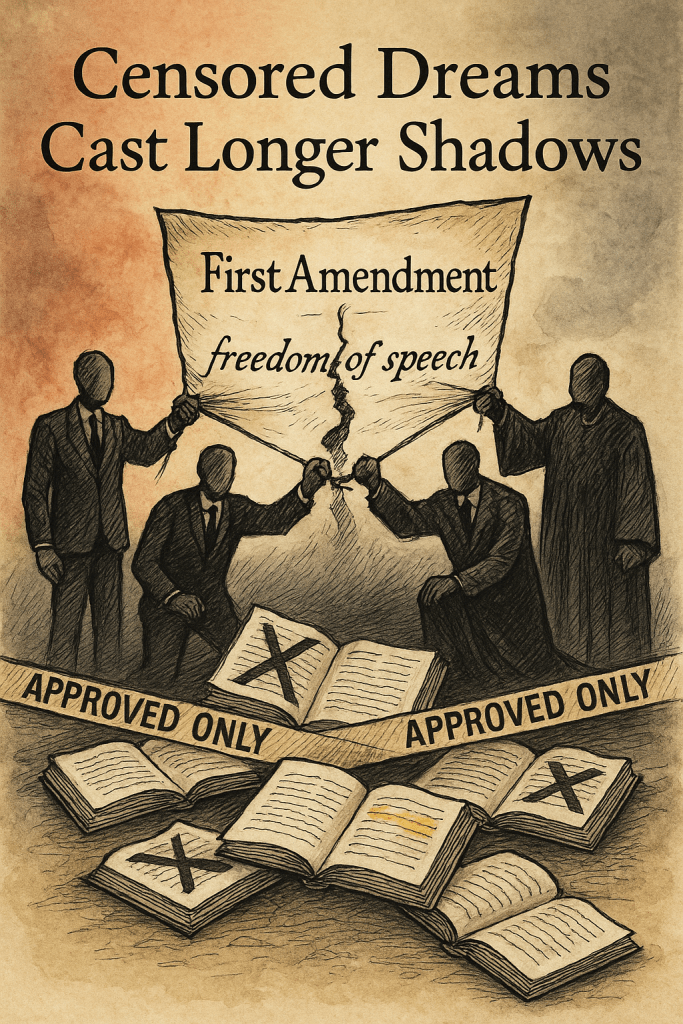
Isn’t the difference of opinion the very thing that built this country?
We weren’t founded on sameness—but on dissent. The thirteen colonies didn’t rise up because they agreed with the power, but because they dared to question it. That impulse—audacious, messy, courageous—is what the First Amendment was written to protect. And yet, here we are again, toying with the dangerous idea that some speech is more tolerable than others. That some viewpoints belong, and others must be silenced and erased.
Shouldn’t that make us uncomfortable?
When tax-funded public institutions—schools, libraries, boards—begin removing books because someone doesn’t like what they say, that’s not preservation of order. That’s viewpoint discrimination. It’s not protecting children. It’s insulating and cuddling weak ideologies. And it’s a blade that ultimately cuts both ways.
You may cheer today when a book you dislike is banned. But what happens tomorrow, when the next board turns its gaze toward the ones you cherish? What makes you think your shelves won’t be next?
We have been here before. In the 1950s, it was Communists. In the 1930s, it was Jews, dissidents, and “degenerates.” Ideas were labeled threats. Libraries were sanitized. People fell silent. Is that the direction we want to revisit?
And what of free speech? Have we forgotten that the First Amendment isn’t just the right to speak, but the right to receive, to read, to explore—especially the uncomfortable truths?
A candidate who once shouted from podiums about the sanctity of the First Amendment, to get elected, now wields it like a partisan tool—defending it when it serves him, abandoning it when it doesn’t, and threatening retaliation, retribution, revoking citizenship, and deportation. Isn’t that the ultimate hypocrisy? To claim allegiance to liberty, but only on your terms, isn’t democracy; it is authoritarianism.
Let’s ask plainly: If a public school or library removes a book about a Muslim child exploring faith, or an LGBTQ teen navigating identity, or a historical critique of systemic injustice—while allowing others that affirm dominant religious or political norms—can that possibly be considered neutral? Can it promote learning diversity and inclusion, or only foster selfish isolation and the illusion of greatness?
And if the government—through policy, threat, or performance—signals what speech is safe and what is not, can we still call ourselves a free people?
Pluralism is not about liking every voice. It’s about letting them speak. It’s about understanding that in a nation where taxes are paid by atheists and Baptists, Muslims, Mormons, and immigrants, the public square must be open to all—or none.
If one religion is given space in a publicly funded institution, then all must be. If one ideology is allowed to teach, then all must have a place at the table. If one set of values is protected, then all must be. Or else what we are protecting is not freedom—but control.
So, we must ask ourselves: Do we still believe in a country where debate is encouraged, not silenced? Where a library or a school is a place of discovery, not conformity? Where the power of ideas—not the fear of them—leads us? Because if not, then we are no longer the land of the free—we are simply the land of the approved, bowing to fragile egos. We, and the world, have been there before and rejected viewpoint discrimination; we can, have, and must do better.
NeverFearTheDream simplebender.com @simplebender.bsky.social Stand For Truth
If you’re looking for daily thoughts and insights you will want to start the morning with:

If you know someone who is facing any facet of Alzheimer’s they might gain some insight from:

Please consider following simplebender, you’re reading makes my writing more fun..…
Comments and thoughts are always welcome and feel free to re-post …..


 simplebender