Posted in Political

Parable: When King’s Divide—People Unite

Chairs of absent kings trying to divide while the people join hands and unite
NeverFearTheDream   simplebender.com

In weary corners of the world, three elder kings sat in their gilded castles, polishing medals they’d never earned. Their peasants staggered through hunger, cheap drugs, and endless funerals, but the kings were busy with more important matters—like drawing new lines on old maps and wallowing in opulence.

One dark, cold winter, the kings gathered at a marble table and decided that ruling their own crumbling kingdoms wasn’t enough. They would divide the whole world into “areas of influence,” like carving a roast they hadn’t paid for. Each slice came with rights: to plunder, to threaten, to “stabilize” by force. Responsibilities, however, were deemed inefficient. One would gain the Orient, one would be allowed, unfettered, to restore their former Empire, and the last would gain a vast Western Hemisphere. They embraced, shook hands, winked, made the deal, and secretly crossed their fingers behind their backs.

Their longtime allies—small kingdoms that had stood by them through storms and wars—were called into the throne rooms and, in ungracious tones, scolded; they were now “on their own.” It was dressed up as tough love, of course. “You must learn to defend yourselves. You must be strong, not weak,” the kings said, while quietly moving their troops, their money, and their promises elsewhere.

The peasants, meanwhile, noticed something awkward: the kings always seemed richest after a war, and safest after a crisis. So the villages began whispering across borders. Farmers traded grain instead of insults. Healers crossed checkpoints to treat strangers. Workers in different lands realized they were all being squeezed by the same velvet-gloved hands.

Soon, small alliances of towns and regions formed—not to conquer, but to refuse. They refused to buy the king’s fear, refused to send their sons and daughters to die for “influence,” and declined to hate people who were just as tired and broke as they were.

When the three kings tried to enforce their New World Order, they found something inconvenient: the world had quietly ordered itself, not into empires, but into bonds of mutual survival. They found that the sovereigns they had harassed and attacked, out of vanity and spite, had aligned against them. The small sovereignties had forged strength by joining together. The weakened kings found that by trying to be dominant, they had become feeble and irrelevant. And then, to their horror, each discovered the other king had made secret trade deals and alliances outside their spheres. Each cheated on the other because they thought they could get away with it.

It turns out, when rulers isolate and divide, the people eventually learn the oldest truth of all: if we don’t lift each other, no one is coming to save us. It turns out that failing, deceptive, greedy kings cannot divvy up the world and forge a lasting new world order. They lie, cheat, and steal for their own prosperity, not the betterment of the people, and the people finally know the truth. NeverFearTheDream simplebender.com

For Every Problem...A Solution...
Lap Around the Sun: Daily Steps Forward
Joy in Alzheimer’s: My Mom’s Brave Walk into Dementia’s Abyss

Posted in Current Events, Political

Our Future or Present: Authoritarianism and Transactional Leadership: Reprinted…..for a Reason

No Kings, slash through blood dripping crown

This was first published 8/29/22; yes 2022. It seems unfortunately appropriate that I republish it recognizing the events in which we currently find ourselves and the world

_________________________________________________________________________________________

Our grand experiment of Democracy is dramatically different than every social norm, every other system of leadership, governance, and social fabric with which we live. It’s little wonder our system is always under attack and slowly yielding to authoritarianism. We must stay committed to our representative republic and the triad balance of power. If not, we too will slip into a transactional authoritarian government.

Social norms in our family, religion, business, and most world governments, have a strong bias toward authoritarianism. This is what we grew up with. A family structure which requires the adult(s) to be responsible and accountable. Youth are rewarded for following instructions and guidelines. In world religions, there is the priest, pastor, imam, grandmaster, or lama. Each controlling the message. All imposing authority over their flock. Grooming them for the future of the leader, ‘church’, or cult. At its worst this level of uncontrolled authority leads to mass suicides and child abuse. In business, unless you are self-employed, we all have supervisors. Authorities giving us assignments, judging our performance, and controlling our wages. This is when we truly begin to feel the influence and practice of transactional leadership. When decisions are made, not necessarily on the merits of the problem but on how the results can affect individuals and organizations. Globally, very few countries have histories other than dictator, monarchy, warlord, or czar. Their culture and history are rooted in non-democratic leadership. The plague of transactional leadership is the most dangerous in governments. Casting long term policy aside for near term benefit of themselves, their cronies, and minions. To be clear, there is a difference between transactions for self interest and those for policy advancement.

Fledgling democracies of the former Soviet Union and the countries which blossomed during the Arab Spring have fallen back to authoritarian governments where transactions are key to survival. Russia and China have changed their constitutions allowing Putin and Xi to be leaders for life, returning to the time of Stalin and Mao. Are we on the same precipice? We’ve seen the original basis of triad balance of power eroded as the executive branch has usurped congressional powers. Methodically, creating a ‘strong’ executive branch and thereby a weak, neutered, dysfunctional legislature. Boisterous, self-absorbed, ‘leaders’ don’t really care about your cause, only your money and your vote. In exchange, they will act as your advocate and protector. Disparage, insult, and harass those whom you believe are a threat, especially minorities, in exchange for your support. They will play the victim, if they think they can tug at your heart so you will tug at your wallet. Candidates pandering for their endorsement want it only to gain your support. They fear the zealous wrath at the polls so, as chameleons, will enthusiastically espouse whatever the loudest want to hear. Everything is a transaction. More ‘perfect’ phone calls. No long-term policy and direction considered. It boils down to: Put me in power today, keep me in power tomorrow and I’ll do your bidding, to hell with what’s right.

How do we arrest the accelerating demise of our democracy? We should re-establish the balance of power. The triad must be equal and accountable to each other. Executive orders should have sunsets and if not codified by Congress should expire. Restore and strengthen Congressional subpoena power. Reign in Executive Privilege; it’s a shield for deceit. Institute term limits on Supreme Court Justices and require the Senate to act immediately on nominations. Institute Congressional term limits and dismantle the seniority power structure. The Electoral College process should be updated, ensuring the count based on the people’s vote not the State’s politicized legislature.

Our democracy has matured over time, and we must be wary of the pendulum swing toward authoritarian transactional leadership. Once there, the fight to climb back up the moral pedestal will be very hard. We don’t need protectors. We need calm, stable, policy driven leadership. We need to declare allegiance to the Constitution not any party or person.

Posted in Political

Rabbits’ Revenge: A Fable of Hidden Strength

Protesting 'Rabbits' Ain't No Fun When the Rabbit's Got the Gun

King Wannabe stood before the crowd of people, his back hunched, too feeble to be erect, his greying, bushy eyebrows raised, his face twisted in contempt. The people would not chant his name nor bow to his image. “Rabbits,” he scoffed. “Nothing but rabbits. They eat, they breed, they exist for my pleasure. Especially the young ones—for my pleasure. Everyone must love Wannabe, everyone, especially these rabbits.” His entourage knelt in obedience, fearful of his rage.

One brave advisor dared to whisper, “But sir, no one is loved by everyone, and they are more than rabbits. They are people, with minds, with hopes and dreams.” In a buffoonish manner, Wannabe waved the thought aside, clutching a handful of pamphlets. “Look at these. Lies! All lies! Their words are filth. Take their paper and their pens. Silence them, cancel their culture.” He signed an Order, and the dutiful minions obeyed, seizing what they could.

Yet the words did not stop. Thought traveled without ink. Discontent spread without parchment. And so Wannabe tightened his grip. In a tyrannical rage, he yelled, “We will control the news. We will make them pay to speak. We will force them to listen. We will tell them what books to read. We will be their favorite, the one they love; they will love Wannabe.” Again, with trepidation, the advisor leaned close: “But sir, even without paper, they have found their voices. They still have minds. And even rabbits, when cornered, will bite. Not today, perhaps—but one day the rabbits will bite. Remember this if you remember nothing at all. And heed the hunter’s satire.” The Wannabe dismissed him with a bitter laugh and a sneer. “Nonsense. They are only rabbits. They are for my pleasure; their only care is to eat and breed.” He arrogantly sneered. “And as to the satirical, I hate comics: ‘ain’t no fun when the rabbit’s got the gun’ is just silly. It’s for the weak and timid; not for Wannabe because Wannabe controls all and fears nothing.” He laughed, but his laugh was uneasy, and the silence from his minions was unmistakable and deafening.

Seasons passed. The whisper and wisdom of the sage advisor lingered. The people—mocked as useless, underestimated lagomorphs—grew weary of abuse and felt more cornered yet bolder. The self-serving advisors, sensing doom, scurried away with whatever spoils they could steal. At last, Wannabe stood alone, his armies and decrees powerless against a multitude no longer afraid, but resolute and united.

And from the crowd, like sparks catching fire, came the clamorous chants:

“Today the rabbits bite.”
“Ain’t no fun when the rabbit’s got the gun.”

Protesting against authoritarianism

The chants rolled through the streets, half warning, half laughter, but all serious. It was no threat of violence, but a proverb of irony. These people, these ‘rabbits’, had never needed literal guns because they had found something much more lethal—strength in their numbers, in their unified ideas, in their memory, dreams, and words, and now in their collective refusal to bow. The chant was their laughter, their truth, their declaration that the world had turned and change was in the offing. And the wise sage smiled a subtle, small, sly smile, always knowing and anticipating the power of their unity.

Civil society thrives only when none are treated as beasts, but as human beings with voices, hopes, and dreams. Wise leaders understand that thought is stronger than chains and the pen is stronger than the sword. The silencing of truth and thought control is always temporary; revolt begins the moment words are stifled, and action follows when endurance breaks.

If you have a gun—put it down, and put it away, we rabbits don’t need them.

Instead, pick up your pen and write your thoughts and dreams. Raise your voice and speak your mind. Open your ears and listen to others. Kings, Emperors, and wannabes are mortal. But thoughts endure. Words endure. And yours are essential. #Ain’tNoFun

For Every Problem...A Solution...
Lap Around the Sun: Daily Steps Forward
Joy in Alzheimer’s: My Mom’s Brave Walk into Dementia’s Abyss

Posted in Current Events, Political

Guardrails Against the Authoritarianism Storm

Columns supporting our Constitutional Liberties

Article first published in the Bend Bulletin 9/27/25

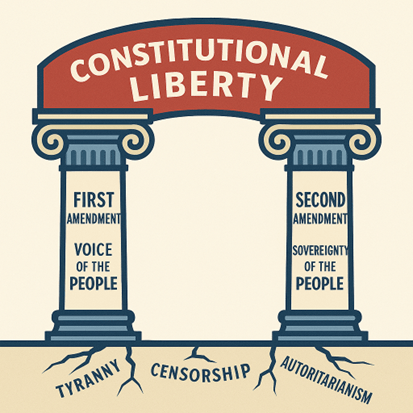
The Bill of Rights was not a mere document, but a product of the founders’ deep suspicion of concentrated power. They had witnessed the crushing of liberties under a monarchy and feared that even a republican government might someday drift toward authoritarianism. The First Amendment enshrines freedoms of mind and voice; the Second Amendment ensures the citizenry will never be entirely powerless should those freedoms come under assault. This foresight of the founders enlightens us about the historical context of the Bill of Rights, giving us a deeper understanding of our constitutional rights.

History was their teacher. British suppression of colonial assemblies, censorship of dissenting press, and the Intolerable Acts were enforced not with argument but with troops. The Revolution began not at a printing press, but when local militias clashed with regular soldiers at Lexington and Concord (1775) to resist the seizure of their weapons. It was this combination—ideas in pamphlets like Common Sense (1776) and the willingness to defend them—that secured independence.

James Madison (Federalist 46) envisioned an armed citizenry as the ultimate check on federal overreach, noting that “the advantage of being armed” would deter encroachments on liberty. Alexander Hamilton (Federalist 29), though skeptical of full-time militias, conceded that a people capable of bearing arms would make any tyranny costly. Later commentators, such as St. George Tucker (1803), referred to the Second Amendment as the “true palladium of liberty,” a final barrier against usurpation (Tucker, Blackstone’s Commentaries).

The framers did not celebrate rebellion, and neither should we. They built a republic designed to settle disputes through institutions—legislatures, courts, and elections—not through insurrection. The Second Amendment was less an invitation to revolt than a final constitutional guardrail, a reminder to government that the people remain sovereign. It was meant to make authoritarian control—whether through censorship, suppression of dissent, or militarized governance—impractical.

“The Second defends the First,” captures part of this truth but misses the deeper genius of the American design. Our first line of defense for free expression is institutional: the separation of powers, judicial independence, and a free press that is able to hold the government accountable. An armed citizenry is the last resort, the failsafe that ensures no regime can permanently silence the governed, providing a sense of security about our rights.

Even in polarized times, the resilience of this framework is remarkable. Courts still strike down attempts at censorship, legislators still debate fiercely, and citizens continue to speak, publish, assemble, and worship according to their conscience. With some legislators seeming to yield to the mob or bend a knee for their own political survival, our Constitution has withstood civil war, economic depression, McCarthyism, and demagoguery precisely because its protections are layered—legal, institutional, and cultural. The greatest defense of liberty is not fear of armed resistance but the enduring resolve of citizens who insist on their right to speak and be heard. When we do not defend the first, we risk the second, the fourteenth, the fifteenth, and the nineteenth. When we defend free speech, preserve checks and balances, and reject authoritarian shortcuts and fragile egos—whether from the left or the right—we prove that the American experiment remains not only viable but vital. This reiteration of the importance of defending free speech should empower you and make you feel responsible for upholding your rights, instilling a sense of duty and empowerment in you. # NeverFearTheDream # Stand for Truth # Stand with Pride # Stand with Spine

For Every Problem...A Solution...
Lap Around the Sun: Daily Steps Forward
Joy in Alzheimer’s: My Mom’s Brave Walk into Dementia’s Abyss

Posted in Political

Update: Corroborating News–Extortion: Foreign and Domestic

9/25: Disney/ABC/Nexstar choose profit over principle. By silencing a comedian, they protected the impending merger of Nexstar and Tenga, which requires FCC approval. They are bending to the FCC’s threats to withhold merger approval and review of their broadcast license.

Extortion: Foreign and Domestic

No one can control you if you don’t owe them anything. But more importantly, just because someone owes you doesn’t give you the right to try to control them. This control and unwanted influence is nothing more than extortion. We have seen extortion repeated numerous times in recent weeks and expect to see more. We watch as federal funds are restricted for personal vendettas and agendas. We have seen financial aid used as a tool to coerce and meddle in the policies of other nations, as a superpower attempts to influence a different sovereign’s internal affairs. The idea that if the government gives or grants you aid, you are obligated to do their bidding or succumb to their ideas of moral direction is itself immoral. The tariffs aren’t about trade imbalances. They are examples of abusive dominant position and extortion.

The ability to invoke fear and illicit reactions can be through hard or soft power. Hard power is the use of military or economic coercion, while soft power is the use of cultural or ideological influence. As a superpower and stalworth of freedom of choice and independence, we should stand on higher ground. We should help guide and support rather than threaten financial and social ruin if our direction isn’t followed. We should never judge another sovereign with our isolated provincial views without understanding their cultural underpinnings and environmental conditions. Our greatest strength does not come from fists or extortion but from example. We are a country of plenty, and our moral teachings and practices have been to share. To be witnessed as an example, not demanding compliance or sitting in judgment. The importance of standing on higher ground and maintaining our integrity cannot be overstated. We have just as many faults as those who we are attempting to extort, bully, and bend to our will and ways. The pedestal we once placed ourselves upon is crumbling by the weight of our ego, bigotry, and hypocrisy. Some believe they have found their political messiah, and some have found the courage to cowardly hide behind masks so their identity might not be known, but they cannot conceal their intent.

Greatness is demonstrated in many ways, and extortion isn’t one of them. The consequences of extortion are severe. It leads to distrust, resentment, and, ultimately, isolation. Just know that when you push someone too far, they will eventually turn against you regardless of what they owe you. They will join the others you’ve extorted and bullied. You will stand alone in isolation as your once friends collude and align with your old enemies for your destruction. Your greatness diminished and tarnished as you become the pariah rather than the advisor and steady ally.

We have lived through dark times before, and there will be more. We will get through them by understanding that we exist within a global community, and we don’t control it. The power of the purse has a double edge, and we certainly would object to those we owe telling us what to do. Don’t confuse wealth with worth; we witness the wealthy and powerful transform into worthless bullies, not great leaders. The gravity of these consequences should make us all pause and reflect on the path we are treading. 

simplebender.com @simplebender.bsky.social

Posted in Current Events, Political

Vilifier to Victim Cycle

Vilification is not an innocent weapon — it’s a destructive one. It takes little effort to sling insults, caricature opponents, or cast entire groups as villains. But like a boomerang, what you hurl often returns. The sharper the words, the more likely they cut you on the rebound. This cycle of destruction is something we must recognize — and break.

When you vilify, you don’t invite reasoned debate but reactionary hate. Anger rarely absorbs anger; it mirrors it. History shows escalation is almost inevitable: one stone cast is met with another, one torch answered with fire. In that spiral of hostility, the target shifts. Today’s accuser becomes tomorrow’s accused. The vilifier becomes the victim.

History offers painful lessons. Denunciation fueled the French Revolution, each faction outshouting and out-purging the last. Robespierre, once the loudest voice condemning “enemies of the revolution,” soon faced the guillotine he praised. Hate and retribution have no loyalty — they devour their own.

Modern politics echoes the same pattern. Leaders, activists, and media figures who stoke division often find themselves caught in the very fires they lit. Hate has no brake; once unleashed, it runs its own course.

Vilification is seductive. It feels like strength — drawing bold lines, protecting your tribe, mobilizing energy. But human nature is wired for reciprocity: what we project comes back. To weaponize hate is to release a force you cannot control. Your gender, race, faith, politics, or power won’t shield you — the backlash spares no one — you reap what you sow.

This is not a call for naïve pacifism but for clarity. To vilify is to plant the seed of retribution. To demonize is to risk becoming the demon in another’s story. History is merciless to those who think they can ride the tiger of hate and not be eaten.

When there is no room for counter-opinion, there is no compromise. Without compromise, polarity hardens into conflict. And conflict, left unchecked, leads to violence — and death. But there is hope. We should call for understanding, not for “beating the hell out of” those we oppose. Listening can reveal common ground. Words can wound, but they can also heal. If we speak to persuade rather than to poison, we stand a chance of escaping the boomerang’s return flight. Vilification may win the moment, but it never secures a peaceful future. 

For Every Problem...A Solution...
Lap Around the Sun: Daily Steps Forward
Joy in Alzheimer’s: My Mom’s Brave Walk into Dementia’s Abyss

Posted in Political

Deconstructing Democracy by Design

A ‘what-if’ thought experiment….or is it….

When federal agencies are defunded, are the states prepared to bear the burden? What if they falter, fail, and unravel under the weight? What if the unraveling of local governance isn’t a consequence of poor planning—but a feature of executive design?

Imagine a government waving the banner of “smaller federalism—drain the swamp,” slashing national programs in the name of efficiency and state empowerment. Medicaid becomes a block grant. Public housing and food subsidies are cut. Regulation and environmental oversight rolls back. Disaster relief is “restructured.” Methodically, the burden shifts to state and county governments, which are already stretched thin. Local taxes rise, services crumble, and local bureaucracies balloon in a vain attempt to compensate.

One town staffs its clinics. The next can’t keep its water clean. Some mandate gun control, others abortions, and others endorse sex work and gambling to increase state revenue. Air quality fluctuates by zip code. One region welcomes immigrants, the next sponsors agents for deportation. Resulting in dysfunctionality, geographical injustice, and discontinuity. The news media is mistrusted and declared ‘enemies of the State’. City, County, and State governments begin to crumble and fail under the weight of their new obligations.

Resentment festers—as inconsistency breeds inequity and confusion. Citizens demand relief, but help doesn’t come from local government, only more indecisive directives. Citizen uncertainty, polarization, and outrage against the policy void yield unrest. Not everywhere—but in enough places to make the headlines—just enough to be used as an excuse.

We’re already seeing a preview. Federal troops were deployed to California—not for disaster relief, but to enforce immigration policy, overriding the state’s will. FEMA faces cuts while climate disasters rise. Communities are left broken, ripe for corruption and manipulation.

And as the ground shifts, so do the guardrails. The Department of Justice leans in, and the Court tilts the scales. Recent rulings—many of which were urged by the Executive—have expanded presidential power by disregarding or reinterpreting laws passed by Congress and previous court decisions. Scholars once warned of an “imperial presidency.” It’s no longer theory—it’s precedent. The President need not wait for Congress. The office can act—or undo—with little more than a pen and a thin legal pretext.

And so, the same hand that dropped the burden returns—not as a partner, but as a “protector.” Protests are reframed as threats. Dissent becomes disorder. Disorder becomes insurrection.

Elections are postponed “for public safety.” Ballots are secured behind walls and counted by select administrators. Local authority is preempted. Emergency declarations morph into permanent policy.

Federal power consolidates—not with a coup, but with a shrug, and tacit approval, marked by deafening silence.

This isn’t prophecy—but it’s no longer just a thought experiment. It is no longer just possible it is verging on probable. It’s unfolding. If federal power can be withdrawn at will and restored at gunpoint—backed by a court with no limits—what does democracy even mean?

If this is the road ahead, it’s not the failure of states we should fear most. It’s the success of the plan—and our failure to notice.

Posted in Political

Due Process…..

“No free man shall be seized or imprisoned, or stripped of his rights or possessions, or outlawed or exiled, or in any way destroyed, except by the lawful judgment of his equals or by the law of the land.” — Magna Carta, 1215 (Clause 39)

Our nation’s history is a testament to the struggle against arbitrary rule. The great-grandfathers of our Founding Fathers experienced the terror of being forcibly removed from their homes and imprisoned under the whims of King John. Four centuries later, England again endured authoritarian rule during the reign of Charles I, who’s infamous “Star Chamber” court was notorious for arbitrary decisions and the absence of due process. His absolutism led to civil war, the rise of Parliamentarian power, and, eventually, his execution. This historical context is crucial to understanding the risks of eroding due process.

Today, we risk repeating history. The principle of “innocent until proven guilty” is eroding, replaced by guilt by association.

Our Founders—and the generations before and after them—fought for Due Process: the simple but powerful idea that no one should be punished solely for their beliefs, associations, or background. Yes, every group has bad actors, and they must be held accountable. But not everyone in that group deserves blanket suspicion or punishment.

Many people flee violence in their countries—or even in our neighborhoods—because they were coerced into associations they didn’t choose. These individuals deserve to be judged by their actions today, not by the group they once belonged to. Not every gang member is a felon—but if we apply collective guilt to some groups, shouldn’t we apply it to others? To organizations with histories of abuse? To law enforcement agencies where some officers have abused their authority? Or what about political protests? Some individuals turned otherwise peaceful movements—like Black Lives Matter or the January 6th rally—into scenes of violence. However, the majority who showed up did so to express their beliefs, not to break the law. Likewise, social media platforms have hosted harmful or hateful content, but they’ve also become places of education, connection, and free speech. Do we judge the entire protest or platform by the actions and posting of its ‘worst’ participants?

Most of us are, or have been, part of groups where some members acted in ways we reject. We shouldn’t be punished for their choices.

This country is built on the foundation of individual rights, not collective guilt. When we lose sight of this, we don’t just lose due process—we lose the very essence of liberty. This is when we start down the path of political purges and authoritarianism, as seen in Nazi Germany, Stalinist Russia, and Maoist China. Our republic was designed to prevent exactly that, and it’s up to each of us to defend our individual rights.

If someone has committed a crime, let them be arrested, tried, and convicted—individually and fairly by a jury. But mass detentions, deportations, or punishments without due process undermine the very freedoms that protect all of us.

These rights are not just for someone else’s protection-they are for your protection too. It’s time to stand up, speak up, and defend them. Your voice matters, and your actions can make a difference in preserving the due process and individual rights that are the cornerstone of our society. Speak up—Stand up—Defend it –Or Lose it and maybe yourself.

NeverFearTheDream simplebender.com @simplebender.bsky.social Mundus sine ceasaribus

Posted in Political

Polycephalic Government

For a government to survive and flourish, it should master the art of being polycephalic—a two-headed entity. It must be tactical, firm, and transactional in its dealings with other nations and major corporations, while remaining empathetic and responsive when building relationships with its citizens. One side is necessarily transactional; the other is inherently relational.

To earn respect from other countries and corporations, a government must take clear, principled stands while staying flexible in negotiations. To gain the respect and support of its citizens, people need to feel heard and valued—not just managed or pacified. They want to believe their leaders take their concerns seriously and act in their interest. A true relationship between the government and the population is based on trust and mutual respect, not mere management.

Foreign powers—whether allies or adversaries—respond to displays of strength and resolve. They respect governments that honor agreements and defend their positions. While negotiation, brinkmanship, and strategic posturing are part of diplomacy, other nations quickly recognize empty gestures and adjust their strategies accordingly. Effective foreign policy demands both strength and strategic adaptability, even when it creates friction with allies and adversaries alike.

Domestic governance, however, requires a fundamentally different approach. In a representative republic, leadership is not about dominance or control. Governing a diverse society requires building long-term relationships, showing mutual trust, and pursuing shared goals and values—even when none are apparent. The government representative must remember they work for the people. The people are their clients. Not the other way around. Success comes through compromise and persuasion, not threats or coercion. Citizens want to feel important and respected. They expect their representatives to act on their behalf, not at the behest of outside forces. A representative government fails when it resorts to force or manipulation to control its people, as coercion undermines democratic principles and personal freedom. A polycephalic government must function with both “heads” in harmony. It should not treat citizens like foreign powers or corporations in transactional terms. At the same time, it must seek to improve the lives of all citizens—not just those who elected them. Domestic and foreign policy are distinct realms requiring different strategies. Confusing them invites conflict and dysfunction.

NeverFearTheDream simplebender.com @simplebender.bsky.social Tollite mundum ceasaribus

Posted in NeverFeartheDream, Political

Never Fear The Dream…

You honor your cause, even a lost cause, by ardently defending it with integrity. You dishonor and cheapen it when resorting to threats, intimidation, coercion, extortion, or extradition. 25.11.1

NeverFearTheDream simplebender.com @simplebender.bsky.social Tollite mundum ceasaribus