ponderings on the world we live in…….Nothing is known to be absolute…some thoughts may touch you others may not…take what is useful and ponder the rest …..Never Fear The Dream
Author: simplebender
William C. Barron is a published author of numerous technical articles and a regular guest columnist in regional news outlets. This blog (simplebender.com) has garnered an international readership across the United States, Canada, Europe, and Asia.
Graduating from The University of Texas and now a retired petroleum engineer, William brings decades of global experience, having worked professionally on three continents—above the Arctic Circle and below the Equator. His career has spanned roles from offshore roustabout to engineer, operations manager, and senior corporate executive. He also served as Director of the Oil and Gas Division for the State of Alaska. Currently, he is the Principal of Trispectrum Consulting. He is a co-holder of several patents and has provided expert testimony before state legislatures and at numerous public forums.
Outside of his professional achievements, William is a seasoned endurance athlete. He has represented Team USA at multiple ITU Duathlon World Championships, completed the Boston Marathon, and finished numerous half-Ironman and Ironman events.
....always seeking... always learning....
Be Bold.....Never Fear the Dream.....Stand for Truth
Milestones measure your past. The future is unmarked and uncharted; so, set your own rhythm, cadence, and pace—it’s your journey, not anyone else’s. A journey in which you alone are accountable. There’s no one else to blame—or to credit. Above all else—relish every step. 25.10.1
NeverFearTheDream simplebender.comStand For Truth
If you’re looking for daily thoughts and insights you will want to start the morning with:
Lap Around the Sun: Daily Steps Forward
If you know someone who is facing any facet of Alzheimer’s they might gain some insight from:
Joy in Alzheimer’s: My Mom’s Brave Walk into Dementia’s Abyss
Please consider following simplebender, you’re reading makes my writing more fun..…
Comments and thoughts are always welcome and feel free to re-post …..
Article first published in the Bend Bulletin 9/27/25
The Bill of Rights was not a mere document, but a product of the founders’ deep suspicion of concentrated power. They had witnessed the crushing of liberties under a monarchy and feared that even a republican government might someday drift toward authoritarianism. The First Amendment enshrines freedoms of mind and voice; the Second Amendment ensures the citizenry will never be entirely powerless should those freedoms come under assault. This foresight of the founders enlightens us about the historical context of the Bill of Rights, giving us a deeper understanding of our constitutional rights.
History was their teacher. British suppression of colonial assemblies, censorship of dissenting press, and the Intolerable Acts were enforced not with argument but with troops. The Revolution began not at a printing press, but when local militias clashed with regular soldiers at Lexington and Concord (1775) to resist the seizure of their weapons. It was this combination—ideas in pamphlets like Common Sense (1776) and the willingness to defend them—that secured independence.
James Madison (Federalist 46) envisioned an armed citizenry as the ultimate check on federal overreach, noting that “the advantage of being armed” would deter encroachments on liberty. Alexander Hamilton (Federalist 29), though skeptical of full-time militias, conceded that a people capable of bearing arms would make any tyranny costly. Later commentators, such as St. George Tucker (1803), referred to the Second Amendment as the “true palladium of liberty,” a final barrier against usurpation (Tucker, Blackstone’s Commentaries).
The framers did not celebrate rebellion, and neither should we. They built a republic designed to settle disputes through institutions—legislatures, courts, and elections—not through insurrection. The Second Amendment was less an invitation to revolt than a final constitutional guardrail, a reminder to government that the people remain sovereign. It was meant to make authoritarian control—whether through censorship, suppression of dissent, or militarized governance—impractical.
“The Second defends the First,” captures part of this truth but misses the deeper genius of the American design. Our first line of defense for free expression is institutional: the separation of powers, judicial independence, and a free press that is able to hold the government accountable. An armed citizenry is the last resort, the failsafe that ensures no regime can permanently silence the governed, providing a sense of security about our rights.
Even in polarized times, the resilience of this framework is remarkable. Courts still strike down attempts at censorship, legislators still debate fiercely, and citizens continue to speak, publish, assemble, and worship according to their conscience. With some legislators seeming to yield to the mob or bend a knee for their own political survival, our Constitution has withstood civil war, economic depression, McCarthyism, and demagoguery precisely because its protections are layered—legal, institutional, and cultural. The greatest defense of liberty is not fear of armed resistance but the enduring resolve of citizens who insist on their right to speak and be heard. When we do not defend the first, we risk the second, the fourteenth, the fifteenth, and the nineteenth. When we defend free speech, preserve checks and balances, and reject authoritarian shortcuts and fragile egos—whether from the left or the right—we prove that the American experiment remains not only viable but vital. This reiteration of the importance of defending free speech should empower you and make you feel responsible for upholding your rights, instilling a sense of duty and empowerment in you. # NeverFearTheDream # Stand for Truth # Stand with Pride # Stand with Spine
Always feel free to re-post—anywhere, anytime, to anyone—share freely.
NeverFearTheDream simplebender.comStand For Truth
If you’re looking for daily thoughts and insights you will want to start the morning with:
Lap Around the Sun: Daily Steps Forward
If you know someone who is facing any facet of Alzheimer’s they might gain some insight from:
Joy in Alzheimer’s: My Mom’s Brave Walk into Dementia’s Abyss
Please consider following simplebender, you’re reading makes my writing more fun..…
Comments and thoughts are always welcome and feel free to re-post …..
Strip the politics and twisted morality from the equation and look at the ledger. Detain-and-deport is a bad deal, a bad business model. It is a capital-intensive, low-yield operation that consumes cash upfront and erases future revenue streams. ICE’s reports estimate 2024 detention at ~$152 per person per day, and Alternatives to Detention (ATD/ISAP) run less than $4.20/day. With an average detention time of ~47 days, costs are roughly $7,100 before airfare or litigation. The ATD analogue costs approximately $200. The ATD option is significantly more cost-effective. No operator would choose a bloated workflow over one that accomplishes the compliance goals, unless driven by ideology. [1][2][3]
What are the “savings” from deportation? They are mostly phantom fiction. Undocumented immigrants are largely ineligible for means-tested benefits (Medicare & SNAP) but do pay taxes—$96.7 billion in 2022. Every removal wave eliminates the systematic recurring cash flow to Social Security, Medicare, and state/local treasuries. That’s not ideology; it’s real revenue loss, which U.S. taxpayers must now cover. [4]
Scale it to policy. FY2024 removals: 271,484. Apply the per-diem and dwell time above, and you’re in multi-billion direct outlays—before transport—plus foregone taxes compounding each year that workers would have remained employed. The CBO is explicit and clear: higher immigration raises revenues faster than outlays and lowers deficits over the 2024–2034 period—those are good things. Shrinking the workforce via deportation pushes the other way—those are bad things. [5][6][7]
Now consider and add the 2025 capex binge. Florida’s “Alligator Alcatraz” chomped up $245M+ in contracts, faces $15–$20M in immediate shutdown costs, and could leave taxpayers with approximately $218M if closure holds. In Texas, the Fort Bliss complex is a $1.2–$1.26B build for a 5,000-bed camp. None of this produces tradable output; it locks in fixed costs for an already established inferior business model. [8][9][10][11]
Deportation supporters claim enforcement frees jobs for U.S. citizens. Reality check: key sectors (agriculture, construction, and manufacturing) depend on immigrant labor. In agriculture, roughly 42% of hired crop workers lack work authorization. Remove that labor at harvest and you don’t get higher yields; you get unpicked fields and lost revenue—exactly what state-level crackdowns have shown. Construction and parts of manufacturing tell similar stories: persistent vacancies and delayed projects don’t resolve themselves without labor—but look, ICE just booked another flight. [12]
Crucially, there’s a proven substitute. Case-management ATD programs deliver 97–99% court-appearance compliance at a fraction of detention costs. If the goal is rule-of-law compliance, ATD wins on both price and performance. Detention should be the exception for demonstrably high-risk cases. [13][14][15]
If you’re genuinely fiscally conservative, the decision tree is simple. Each detained-then-deported worker carries:
a high acquisition cost (detention, transport, litigation, facilities),
negative NPV from lost tax receipts, and
sector-level output losses when crops aren’t picked or projects slip.
In contrast, ATD + lawful work authorization during proceedings flips the script:
minimal custody costs,
(2) continued tax payments, and
(3) fewer supply-side shocks.
Even hard-line models concede that mass deportation shrinks GDP by the trillions. The Penn Wharton Budget Model, a conservative economic model, concedes that mass deportation shrinks GDP by trillions—that’s a bad thing—and projects primary deficits of approximately $862–$987B over 10 years under mass deportation scenarios. That’s the destruction of U.S. shareholder value.[16][17]
If this were optimizing a business, you’d terminate detention first, scale case management ATD, and reserve deportation for the narrow slice where public safety benefits justify the expenditure. Anything else is a bad deal and taxpayer-subsidized ideology—that’s not a good thing. #NeverFearTheDream
Footnotes
[1] U.S. Immigration and Customs Enforcement, “Alternatives to Detention (ATD)” — < $4.20/day ATD vs ~$152/day detention. ICE [2] ICE, Fiscal Year 2024 Annual Report — average length of stay 46.9 days. (PDF) ICE [3] American Immigration Council, “Alternatives to Immigration Detention: An Overview.” American Immigration Council+1 [4] Institute on Taxation and Economic Policy (ITEP), “Tax Payments by Undocumented Immigrants” — $96.7B in 2022. ITEP [5] ICE news release (Dec. 20, 2024): 271,484 removals in FY2024. ICE [6] Congressional Budget Office, “Effects of the Immigration Surge on the Federal Budget and the Economy” — higher immigration lowers deficits via revenues > outlays. Congressional Budget Office+1 [7] ICE, “FY2024 Annual Report” companion release. ICE [8] AP News, “Florida may lose $218M on empty ‘Alligator Alcatraz’ as judge orders shutdown.” AP News+1 [9] CBS Miami, “Florida taxpayers could be on the hook for $218 million … ‘Alligator Alcatraz.’” CBS News+1 [10] Yahoo News round-ups on court-ordered shutdown and wind-down. Yahoo+1 [11] The Texas Tribune, “Feds plan to build nation’s biggest migrant detention center at Fort Bliss” — $1.26B, 5,000 beds. The Texas Tribune [12] U.S. Dept. of Labor, NAWS 2021–2022 (Report No. 17) — ~42% of hired crop workers lack work authorization; summary page. DOL+1 [13] Human Rights First, “Proven Alternatives to Mass Incarceration of Families” — programs with ~97% appearance; cost far below detention. (PDF/brief) Human Rights First+1 [14] Women’s Refugee Commission, Family Case Management Program — ~99% compliance with ICE and court. (Report/summary) Women’s Refugee Commission+1 [15] National Immigrant Justice Center, “The Real Alternatives to Detention.” (Policy brief) National Immigrant Justice Center [16] American Action Forum, “The Budgetary and Economic Costs of Addressing Unauthorized Immigration” & “A Costly Immigration Policy” — $400–$600B federal cost; −$1.6T GDP. AAF+1 [17] Penn Wharton Budget Model, “Mass Deportation of Unauthorized Immigrants: Fiscal and Economic Effects” — revenues −$300.4B (2025–2034); primary deficits +$862B pre-feedback, +$987B with feedback. (Brief & PDF) Penn Wharton Budget Model+1
Always feel free to re-post—anywhere, anytime, to anyone—share freely.
NeverFearTheDream simplebender.comStand For Truth
If you’re looking for daily thoughts and insights you will want to start the morning with:
Lap Around the Sun: Daily Steps Forward
If you know someone who is facing any facet of Alzheimer’s they might gain some insight from:
Joy in Alzheimer’s: My Mom’s Brave Walk into Dementia’s Abyss
Please consider following simplebender, you’re reading makes my writing more fun..…
Comments and thoughts are always welcome and feel free to re-post …..
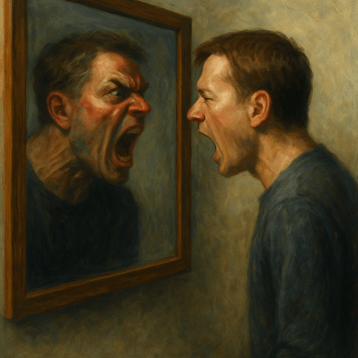
An older man, with an air of superiority, left his opulent, gilded house and strolled into a bustling marketplace surrounded by his fawning, obedient minions. He proudly carried a polished, reflective, framed glass. His head held high, he admired his own reflection as he weaved through the crowd. The crowd could see him, but he could only see himself, and he was thoroughly pleased. He barely noticed those on either side of him as his minions pushed them aside out of his view. When he did catch a fleeting glimpse, he compared himself to them—the merchants, the homeless, the travelers, the artists, and the minorities—with his arrogance, ignorance, and bombast on full display, he declared, “I am far superior to them all, and they should be forbidden from saying otherwise.”
But as the day wore on, dust gathered on the glass. His reflection grew dim and distorted. He frowned, exclaimed how unfair and unacceptable the conditions were. He lifted his feeble arm and wiped it with his soiled sleeve. Raising it again, he loudly demanded that the crowd see him as he saw himself, even through the grime. Some ignored him, some laughed, and the braver, at great peril, mocked him. His anger rose, and his threats of retaliation grew robust and offensive.
At last, an old immigrant woman left the row of unpicked crops and approached him, offering nothing but silence in her weary eyes. With her weathered hands, she took the glass gently from his manicured fingers, turned it around, and asked, “What do you see now?” The mirrored glass, once a tool for self-admiration, now became a symbol of understanding and empathy as he viewed the world rather than himself.
The old man was initially taken aback but remained self-absorbed. In the mirror was no longer his own face, but the faces of the people around him—each one bearing burdens, scars, joys, and pride of their own which he had never truly seen or bothered to comprehend.
The old woman’s voice was a gentle, refreshing breeze: “The glass is not for self-worship but for understanding. Turn it outward and you’ll see the truth: you are not the center, only a small part. Your ego makes the glass a prison; humility makes it a window.” Her words carried a profound truth that seemed to resonate in the old man’s heart.
The old man, humbled by her wisdom, lowered his head. For the first time, the marketplace seemed vast and vibrant, filled not just with his own reflection but with the dreams of real people. He left the market, dusty and disheveled, and a question lingered for all who watched: Will he remember what the mirror revealed, or will he brush away the dust of human humility and return to the prison of his own reflection? As the old woman returned to the field, she turned and said: “We should all look into our own reflective glass and ask ourselves, how much of him are we?” #NeverFearTheDream
Always feel free to re-post—anywhere, anytime, to anyone—share freely.
NeverFearTheDream simplebender.comStand For Truth
If you’re looking for daily thoughts and insights you will want to start the morning with:
Lap Around the Sun: Daily Steps Forward
If you know someone who is facing any facet of Alzheimer’s they might gain some insight from:
Joy in Alzheimer’s: My Mom’s Brave Walk into Dementia’s Abyss
Please consider following simplebender, you’re reading makes my writing more fun..…
Comments and thoughts are always welcome and feel free to re-post …..
9/25: Disney/ABC/Nexstar choose profit over principle. By silencing a comedian, they protected the impending merger of Nexstar and Tenga, which requires FCC approval. They are bending to the FCC’s threats to withhold merger approval and review of their broadcast license.
Extortion: Foreign and Domestic
No one can control you if you don’t owe them anything. But more importantly, just because someone owes you doesn’t give you the right to try to control them. This control and unwanted influence is nothing more than extortion. We have seen extortion repeated numerous times in recent weeks and expect to see more. We watch as federal funds are restricted for personal vendettas and agendas. We have seen financial aid used as a tool to coerce and meddle in the policies of other nations, as a superpower attempts to influence a different sovereign’s internal affairs. The idea that if the government gives or grants you aid, you are obligated to do their bidding or succumb to their ideas of moral direction is itself immoral. The tariffs aren’t about trade imbalances. They are examples of abusive dominant position and extortion.
The ability to invoke fear and illicit reactions can be through hard or soft power. Hard power is the use of military or economic coercion, while soft power is the use of cultural or ideological influence. As a superpower and stalworth of freedom of choice and independence, we should stand on higher ground. We should help guide and support rather than threaten financial and social ruin if our direction isn’t followed. We should never judge another sovereign with our isolated provincial views without understanding their cultural underpinnings and environmental conditions. Our greatest strength does not come from fists or extortion but from example. We are a country of plenty, and our moral teachings and practices have been to share. To be witnessed as an example, not demanding compliance or sitting in judgment. The importance of standing on higher ground and maintaining our integrity cannot be overstated. We have just as many faults as those who we are attempting to extort, bully, and bend to our will and ways. The pedestal we once placed ourselves upon is crumbling by the weight of our ego, bigotry, and hypocrisy. Some believe they have found their political messiah, and some have found the courage to cowardly hide behind masks so their identity might not be known, but they cannot conceal their intent.
Greatness is demonstrated in many ways, and extortion isn’t one of them. The consequences of extortion are severe. It leads to distrust, resentment, and, ultimately, isolation. Just know that when you push someone too far, they will eventually turn against you regardless of what they owe you. They will join the others you’ve extorted and bullied. You will stand alone in isolation as your once friends collude and align with your old enemies for your destruction. Your greatness diminished and tarnished as you become the pariah rather than the advisor and steady ally.
We have lived through dark times before, and there will be more. We will get through them by understanding that we exist within a global community, and we don’t control it. The power of the purse has a double edge, and we certainly would object to those we owe telling us what to do. Don’t confuse wealth with worth; we witness the wealthy and powerful transform into worthless bullies, not great leaders. The gravity of these consequences should make us all pause and reflect on the path we are treading.
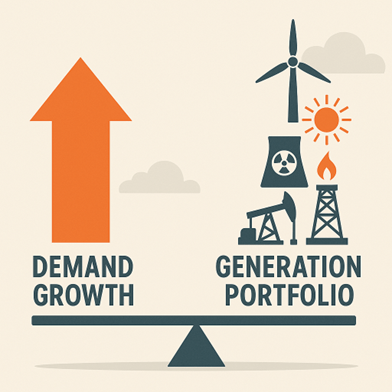
The era of power limitations and rationing may be knocking on our door. Without a portfolio of power generation, the reality of July heat waves and January cold snaps causing rolling blackouts can be expected. Driven by data centers, the focus on household electrification, and a population that expects 24/7 plug-and-play power, the demand for electricity in the U.S. is increasing. Yet, the national discourse is veering towards reducing or even eliminating key alternatives—wind, solar, nuclear—and increasing reliance primarily on a finite resource; hydrocarbons. This is likely a shortsighted policy choice.
It is a potentially dangerous gamble. Our current fleet of natural-gas plants already runs near record levels, and petroleum generation is a rounding error in national totals. The Department of Energy (DOE) warns that by 2030, more than 100 GW of firm capacity will retire, while only 20GW of the planned new capacity is firm, dispatchable power. This type of power, which can be relied upon to meet demand at any time, is crucial for maintaining a stable and reliable grid. Even if we invested in new gas turbines today, it would take years to finance, permit, build, and connect them. Transmission projects face decade-long lead times even with streamlined regulations. In the meantime, demand does not politely wait—it climbs relentlessly, pressing the grid ever closer to its limits and breaking point.
And when, not if, the grid fails, the pain will not be evenly distributed. Households near and below the poverty line will suffer the most. For them, a prolonged outage in the middle of a heat dome or a polar vortex is not just uncomfortable—it is life-threatening. Wealthier households can afford generators, home batteries, or even leave town, but the poor cannot. Businesses will be forced to close, adversely affecting commerce. The cascading effects will stress public safety, and security risks will magnify as communications, traffic systems, and emergency response falter. This isn’t a dystopian forecast but a reasonable scenario to expect, or at least plan for.
The capital cost of replacing all lost alternatives with new gas is daunting, and would expose consumers to fuel price volatility and emissions penalties. More importantly, it overlooks the reliability and diversity that a balanced portfolio brings. A grid built on a single fuel is fragile—one pipeline outage, one price spike, one extended heavy load event away from disaster. Just like your personal finances, a balanced portfolio is more stable and outperforms all others. By diversifying our energy sources, we can build a more resilient and reliable grid, providing all of us with reassurance.
A more prudent path forward is to accelerate what works: finish stalled renewable projects, extend nuclear plant lifetimes, and streamline permitting for clean firm capacity. Oil and gas should remain the dependable floor—the baseload anchor, providing a consistent level of power—but not the sole pillar holding up the house. Meeting demand is possible, but only if we stop dismantling the roof while the storm clouds are gathering. My life has been in the oil and gas industry—but we must recognize that wind farms aren’t inherently evil; solar energy has its place in many regions, nuclear power should always be an option, and battery technology is essential. The choice is between planning now and positioning for the future. Spiking energy costs and rolling blackouts should not be acceptable options; they should be considered national failures. #NeverFearTheDream
Always feel free to re-post—anywhere, anytime, to anyone—share freely.
NeverFearTheDream simplebender.comStand For Truth
If you’re looking for daily thoughts and insights you will want to start the morning with:
Lap Around the Sun: Daily Steps Forward
If you know someone who is facing any facet of Alzheimer’s they might gain some insight from:
Joy in Alzheimer’s: My Mom’s Brave Walk into Dementia’s Abyss
Please consider following simplebender, you’re reading makes my writing more fun..…
Comments and thoughts are always welcome and feel free to re-post …..
A shared vision and a sound strategy can shape that change.
Everyone must help make a difference.
No one is free of responsibilities.
Re-read those slowly. These truths have outlived generations because they work—alone or together. Like people, they stand stronger when connected.
Change is never still. It may be welcome or feared, but it will come. When we craft a common vision and act with purpose, change can be shaped instead of endured. That means leaning in—not leaving the work to “them,” whoever they are, nor just to yourself. Those who only watch from the sidelines end up resenting the outcome. Those excluded will also be resentful and work to sabotage the effort. Find a way to have a shared vision or the vision will eventually fail.
Being part of change means being accountable: creating, planning, and carrying some of the weight yourself. If everyone contributes, no one is left out—and no one is left behind.
The work never truly ends. When one change is complete, we pause, assess, and begin again. Done well, change builds its own momentum and draws people forward. Done poorly, it collapses under its own weight—because one or more of these truths was ignored or broken.
Bring everyone along. Let everyone contribute to their capacity. Share both the burden and the credit, but never the blame, that’s on you—and then—and only then will you change more than you ever imagined. #NeverFearTheDream
Always feel free to re-post—anywhere, anytime, to anyone—share freely.
NeverFearTheDream simplebender.comStand For Truth
If you’re looking for daily thoughts and insights you will want to start the morning with:
Lap Around the Sun: Daily Steps Forward
If you know someone who is facing any facet of Alzheimer’s they might gain some insight from:
Joy in Alzheimer’s: My Mom’s Brave Walk into Dementia’s Abyss
Please consider following simplebender, you’re reading makes my writing more fun..…
Comments and thoughts are always welcome and feel free to re-post …..
Vilification is not an innocent weapon — it’s a destructive one. It takes little effort to sling insults, caricature opponents, or cast entire groups as villains. But like a boomerang, what you hurl often returns. The sharper the words, the more likely they cut you on the rebound. This cycle of destruction is something we must recognize — and break.
When you vilify, you don’t invite reasoned debate but reactionary hate. Anger rarely absorbs anger; it mirrors it. History shows escalation is almost inevitable: one stone cast is met with another, one torch answered with fire. In that spiral of hostility, the target shifts. Today’s accuser becomes tomorrow’s accused. The vilifier becomes the victim.
History offers painful lessons. Denunciation fueled the French Revolution, each faction outshouting and out-purging the last. Robespierre, once the loudest voice condemning “enemies of the revolution,” soon faced the guillotine he praised. Hate and retribution have no loyalty — they devour their own.
Modern politics echoes the same pattern. Leaders, activists, and media figures who stoke division often find themselves caught in the very fires they lit. Hate has no brake; once unleashed, it runs its own course.
Vilification is seductive. It feels like strength — drawing bold lines, protecting your tribe, mobilizing energy. But human nature is wired for reciprocity: what we project comes back. To weaponize hate is to release a force you cannot control. Your gender, race, faith, politics, or power won’t shield you — the backlash spares no one — you reap what you sow.
This is not a call for naïve pacifism but for clarity. To vilify is to plant the seed of retribution. To demonize is to risk becoming the demon in another’s story. History is merciless to those who think they can ride the tiger of hate and not be eaten.
When there is no room for counter-opinion, there is no compromise. Without compromise, polarity hardens into conflict. And conflict, left unchecked, leads to violence — and death. But there is hope. We should call for understanding, not for “beating the hell out of” those we oppose. Listening can reveal common ground. Words can wound, but they can also heal. If we speak to persuade rather than to poison, we stand a chance of escaping the boomerang’s return flight. Vilification may win the moment, but it never secures a peaceful future. #NeverFearTheDream
NeverFearTheDream simplebender.comStand For Truth
If you’re looking for daily thoughts and insights you will want to start the morning with:
Lap Around the Sun: Daily Steps Forward
If you know someone who is facing any facet of Alzheimer’s they might gain some insight from:
Joy in Alzheimer’s: My Mom’s Brave Walk into Dementia’s Abyss
Please consider following simplebender, you’re reading makes my writing more fun..…
Comments and thoughts are always welcome and feel free to re-post …..






 simplebender