ponderings on the world we live in…….Nothing is known to be absolute…some thoughts may touch you others may not…take what is useful and ponder the rest …..Never Fear The Dream
Author: simplebender
William C. Barron is a published author of numerous technical articles and a regular guest columnist in regional news outlets. This blog (simplebender.com) has garnered an international readership across the United States, Canada, Europe, and Asia.
Graduating from The University of Texas and now a retired petroleum engineer, William brings decades of global experience, having worked professionally on three continents—above the Arctic Circle and below the Equator. His career has spanned roles from offshore roustabout to engineer, operations manager, and senior corporate executive. He also served as Director of the Oil and Gas Division for the State of Alaska. Currently, he is the Principal of Trispectrum Consulting. He is a co-holder of several patents and has provided expert testimony before state legislatures and at numerous public forums.
Outside of his professional achievements, William is a seasoned endurance athlete. He has represented Team USA at multiple ITU Duathlon World Championships, completed the Boston Marathon, and finished numerous half-Ironman and Ironman events.
....always seeking... always learning....
Be Bold.....Never Fear the Dream.....Stand for Truth
Long-term solutions evolve through compromise, and short-term ones evolve through conflict. Yours isn’t the only viable opinion, and maybe you are more wrong than right. 25.11.4
NeverFearTheDream simplebender.comStand For Truth
If you’re looking for daily thoughts and insights you will want to start the morning with:
Lap Around the Sun: Daily Steps Forward
If you know someone who is facing any facet of Alzheimer’s they might gain some insight from:
Joy in Alzheimer’s: My Mom’s Brave Walk into Dementia’s Abyss
Please consider following simplebender, you’re reading makes my writing more fun..…
Comments and thoughts are always welcome and feel free to re-post …..
Every person ages, though few like to admit it. We prefer the glow of our youth—when everything felt strong, certain, and inevitable—we recoil from the mirror’s reflection that tells a harsher truth. The United States is now, as an aging adult, staring down its own midlife crisis: restless, nostalgic, anxious about declining vitality, and unsure of its purpose. And like any midlife crisis, it is largely self-inflicted.
As a fledgling republic, we leaned heavily on foreign counsel and support, learning to stand upright on principles whose ink was still wet. We quarreled with the empire that birthed us, a restless adolescent convinced that independence alone equaled maturity. In our late teens, our Manifest Destiny carried us across a continent—eager, energized, and careless. We violated Indigenous sovereignty, claimed vast stretches of land, and seldom paused long enough to reflect on the cost—youth rarely do.
Then came the moment we stepped beyond our borders to confront tyranny abroad. Isolation gave way to global responsibility, and in defeating fascism, we crowned ourselves “leader of the free world.” That era—the Greatest Generation era—became our cultural mythology of peak performance. In economic terms, we hit our stride: strong, wealthy, ambitious, so confident we assumed the world wanted our model replicated everywhere.
Adulthood matured us further. We recognized injustices at home and, imperfectly, pushed to correct them. We abolished poll taxes, dismantled legal segregation, expanded civil rights, and reached for gender equality—though we famously stumbled in ratifying the ERA. Still, we dreamed big. We mapped the ocean floor and walked the lunar surface. We believed no frontier was beyond reach.
But adulthood also revealed strain. Our swagger dimmed through a string of grinding foreign conflicts where overwhelming force could not overcome local pride or nationalist resolve. Regime change efforts faltered. Confidence thinned. The armor dulled. The steps slowed. The world noticed.
Now we resemble a nation in midlife denial. We want the prowess of our youth without the discipline, unity, or sacrifice that once produced it. We have become too large, internally conflicted, and politically stiff to move with the nimble decisiveness we admire in our own past. Instead of planning the next horizon, we rummage through the attic of lost greatness and flirt with symbolic trappings of monarchy—strongman fantasies, grievance crowds, and performative nationalism. These are not signs of renewed vigor; they are early symptoms of institutional cognitive decline and are affected by it.
The irony is painful: past generations always knew our shared mission. We debated the path but rarely the direction. Today, the direction itself is disputed, diluted, or abandoned. A country without a horizon behaves like a retiree with no hobbies—restless, resentful, and tempted by delusion.
Yet midlife crises can be turning points if met with humility and long-view statesmanship. Older nations that endure do so by learning from their past without worshipping it, by building for the grandchildren rather than reconstructing their own adolescence. The future is not reclaimed by nostalgia but by vision. Let’s not just look back; let’s learn from our past, reflect on it, and use it to shape our future.
So let us do what adults do at their best: acknowledge our age, accept our limitations, but not be defined by them, and chart a path worthy of those who will inherit this place. Square our shoulders, and focus forward—not back. Our midlife crisis can be a descent or a rebirth. We choose which. Collectively, with a common focus, let’s reject the polarizing radical positions of the extreme amongst us. Let’s encourage the great masses of the middle to lead us forward toward new goals and our next horizon. Let’s remember, we are all in this together, and it’s our shared responsibility to shape the future of our nation. #NeverFearTheDrem simplebender.com
NeverFearTheDream simplebender.comStand For Truth
If you’re looking for daily thoughts and insights you will want to start the morning with:
Lap Around the Sun: Daily Steps Forward
If you know someone who is facing any facet of Alzheimer’s they might gain some insight from:
Joy in Alzheimer’s: My Mom’s Brave Walk into Dementia’s Abyss
Please consider following simplebender, you’re reading makes my writing more fun..…
Comments and thoughts are always welcome and feel free to re-post …..
Gender roles are socially constructed limits. Maybe once they served for communal survival—but now they’re used to demean, divide, and uphold a gender caste system. Acceptance is a radical act of self-liberation. 25.11.3
NeverFearTheDream simplebender.comStand For Truth
If you’re looking for daily thoughts and insights you will want to start the morning with:
Lap Around the Sun: Daily Steps Forward
If you know someone who is facing any facet of Alzheimer’s they might gain some insight from:
Joy in Alzheimer’s: My Mom’s Brave Walk into Dementia’s Abyss
Please consider following simplebender, you’re reading makes my writing more fun..…
Comments and thoughts are always welcome and feel free to re-post …..
Credibility is a delicate characteristic — slow to earn, swift to lose, and nearly impossible to fully restore. It’s like a crystal goblet: clear, strong in purpose, yet so easily fractured by careless acts. Once shattered, even after the best repair, the cracks remain visible and weak, and the goblet, once pristine, is forever damaged. Those who’ve tried to rebuild their chalice of credibility know the haunting truth — it becomes easier to break again, and probably will. Credibility doesn’t erode overnight; it erodes through capitulation, excuses, and the convenience of shifting with the wind.
There was a time when credibility was among our highest personal currencies and a source of pride. A person’s word was their bond. Their handshake was a contract. Their consistency was a mirror of their moral compass. Their willingness to admit mistakes and change positions in light of new information was seen as extreme emotional maturity and self-confidence. Perfection doesn’t—and didn’t—earn credibility, but integrity does. A visible, demonstrated alignment between belief, speech, and action. Today, that alignment is bent under the weight of expediency and twisted for target audiences.
The credibility of leaders — political, pulpit, legal, law enforcement, academic, athletic — has become collateral in the age of populism and applause metrics. When polls become the goal, truth becomes negotiable. When power is the aim, credibility is an afterthought, and diversion and deceit are the tools of choice. The words ‘I promise’ and ‘trust me’ become code for watch your back. We see it in leaders who flip their stances to appease whichever crowd can give them more leverage. They conveniently forget that credibility is built through conviction and compromise—not appeasement. It’s not the stance itself that matters most; it’s the steadiness of principle that gives credibility its meaning.
In this swirling chaos of contradiction and convenience, we, and the world, have grown cynical. Our long-standing allies no longer trust our national commitments. Those who stand ‘against us’ leverage our lack of credibility to their advantage.
We no longer trust what’s said, only what’s repeated—and if a lie is told often enough and loud enough, some believe it to be a truth—but it’s not, it’s still a lie—with or without a sprinkle of truth to placate the gullible. And, unfortunately, when the truth is actually told, we are all skeptical, uncertain, with no clear way to confirm or deny—so, everything feels like a lie, or a hybrid truth.
We no longer follow those who lead — we watch to see if they’re trending. We analyze ten-second snippets or AI-generated memes designed to slander and divide, not unify. In doing so, we participate in the erosion we claim to despise—we, the people, become willing players in the deceit and the shattering of credibility.
We need to stop outsourcing integrity and credibility. Stop waiting for heroes to save us, saints to guide us, or perfect voices to speak for us. The world doesn’t need any more idols, demigods, or people placed upon false pedestals. It needs individuals who live as examples — quietly, calmly, patiently, consistently, courageously.
Let’s stop looking for heroes and start being credible ones — with every choice and every word you make every day. #NeverFearTheDream
NeverFearTheDream simplebender.comStand For Truth
If you’re looking for daily thoughts and insights you will want to start the morning with:
Lap Around the Sun: Daily Steps Forward
If you know someone who is facing any facet of Alzheimer’s they might gain some insight from:
Joy in Alzheimer’s: My Mom’s Brave Walk into Dementia’s Abyss
Please consider following simplebender, you’re reading makes my writing more fun..…
Comments and thoughts are always welcome and feel free to re-post …..
Compete to grow. Winning is nice—but losing, now and then, is more valuable in the long run. Don’t act when consumed by emotions. The longer you wait, the stronger, calmer, and clearer your response will be. 25.11.2
NeverFearTheDream simplebender.comStand For Truth
If you’re looking for daily thoughts and insights you will want to start the morning with:
Lap Around the Sun: Daily Steps Forward
If you know someone who is facing any facet of Alzheimer’s they might gain some insight from:
Joy in Alzheimer’s: My Mom’s Brave Walk into Dementia’s Abyss
Please consider following simplebender, you’re reading makes my writing more fun..…
Comments and thoughts are always welcome and feel free to re-post …..
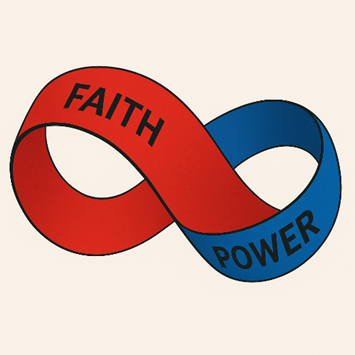
Religion has always walked a knife-edge between faith and power. Religion is best when it brings comfort and worst when it becomes a tool of politics. Within our lifetime, there are two salient examples of the twisting of religion and state power: Iran and Russia. Two very different nations illustrate how this symbiotic relationship unfolds and precisely why our founders wisely established a separation between the church and the state. Spoiler alert—the walls are crumbling.
Iran: Mosque as State—Under the Shah, Iran’s clerics were suppressed, their influence diminished as the monarchy rushed to modernize. In 1979, the pendulum swung violently back. Ayatollah Khomeini and the mosque became the state itself. For decades, sermons dictated law, dissent was heresy, and the Revolutionary Guard enforced both politics and piety. Religion achieved supremacy at the cost of freedom.
Today, Iran’s youth — connected, progressive, impatient — are no longer persuaded by clerical authority. Protests after the death of Mahsa Amini revealed the fracture: religion wielded as control is no longer seen as sacred. The bargain that once restored the mosque’s power has hardened into a straitjacket, hollowing faith even as its institutions endure.
Russia: Saints for Soldiers—For most of the 20th century, the Russian Orthodox Church was brutalized under communism. Priests executed, cathedrals destroyed, believers silenced. When the Soviet Union collapsed, the Church sought revival — but revival required allies. Putin offered protection, prestige, and funding. In return, Patriarch Kirill and his bishops sanctified not only his rule, but his wars. Each branch of the Russian military is assigned a patron saint, and these are displayed as soldiers march—icons and rifles in hand. And mosaics of saints standing beside tanks and missiles—faith stitched into firepower.
It is a mutual, parasite-host alliance for survival. The Church props up the empire; the empire props up the Church. Orthodoxy regains prestige after decades of persecution, while the Kremlin secures sacred legitimacy for its conquests.
United States: Are Pulpits the Next Podiums?—Judeo-Christianity has influenced our national culture from its founding. Currently, church attendance is shrinking, younger generations walk away, scandals erode credibility, and the religiously unaffiliated approaches 30% of the population (PRRI). We are evolving into a secular nation of diverse beliefs. In this decline and transition, political power has become a lifeline for some of the more radical to guard against the nightmare of irrelevance becomes a reality.
Some fringe religious leaders now align with vocal politicians who promise to “fight for them,” to restore an age and influence gone by. In exchange, some of their pulpits have become podiums. Political leaders boast, “I hate my enemies,” and vow to “beat the hell out of them,” these words juxtaposed to:” do good to those who hate you, bless those who curse you, pray for those who mistreat you.” The contrast is crisp —aggressive pulpits now espouse vengeance rather than pleading for understanding. Rhetoric that contradicts the very teachings once held sacrosanct. The threat of pulpits becoming podiums is a genuine concern.
Lessons: Learn the Lessons—The parallels are clear. In Iran, religion became the state. In Russia, the Church promotes the empire for its own security. In America, the mainstream is often overshadowed by extremists who cling to authoritarian strongmen for cultural relevance and power—trading faith’s essence for influence.
When religion becomes a weapon of politics, the backlash is not revival but rebellion. These bargains may preserve institutions for a generation, but they ultimately lead to decay.
Like a Möbius strip, the inside and outside of faith and power continuously trade places, with no true end and no certainty. The loop is endless, the inversion unending — a path where faith loses its soul and nations lose their way, twisting around and around until revolt. The American founders understood this and wisely built institutional walls between state and church to prevent their blighted bonding, but now the walls are crumbling. #NeverFearTheDream
First published in Bend Bulletin 10/29/25
Always feel free to re-post—anywhere, anytime, to anyone—share freely.
NeverFearTheDream simplebender.comStand For Truth
If you’re looking for daily thoughts and insights you will want to start the morning with:
Lap Around the Sun: Daily Steps Forward
If you know someone who is facing any facet of Alzheimer’s they might gain some insight from:
Joy in Alzheimer’s: My Mom’s Brave Walk into Dementia’s Abyss
Please consider following simplebender, you’re reading makes my writing more fun..…
Comments and thoughts are always welcome and feel free to re-post …..
Defend your right to choose your path. Don’t hand it over to rituals, prophecies, or the crowd. Let your mind and imagination lead—not your ego. 25.11.1.1
NeverFearTheDream simplebender.comStand For Truth
If you’re looking for daily thoughts and insights you will want to start the morning with:
Lap Around the Sun: Daily Steps Forward
If you know someone who is facing any facet of Alzheimer’s they might gain some insight from:
Joy in Alzheimer’s: My Mom’s Brave Walk into Dementia’s Abyss
Please consider following simplebender, you’re reading makes my writing more fun..…
Comments and thoughts are always welcome and feel free to re-post …..
Ego—your delusional self-inflation—is both your greatest danger and your most profound weakness. Your biggest obstacle in life is yourself. Conquer your ego and your surrender to imagined limitations—daily. 25.11.1
NeverFearTheDream simplebender.comStand For Truth
If you’re looking for daily thoughts and insights you will want to start the morning with:
Lap Around the Sun: Daily Steps Forward
If you know someone who is facing any facet of Alzheimer’s they might gain some insight from:
Joy in Alzheimer’s: My Mom’s Brave Walk into Dementia’s Abyss
Please consider following simplebender, you’re reading makes my writing more fun..…
Comments and thoughts are always welcome and feel free to re-post …..
The old man sat on the porch, the autumn wind stirring the fallen leaves. His grandson, an impatient teen, leaned against the rail and sighed heavily.
“Opportunity for everyone—what a joke,” the boy muttered. “Not for us anymore. Maybe for someone else—they’ve taken everything.”
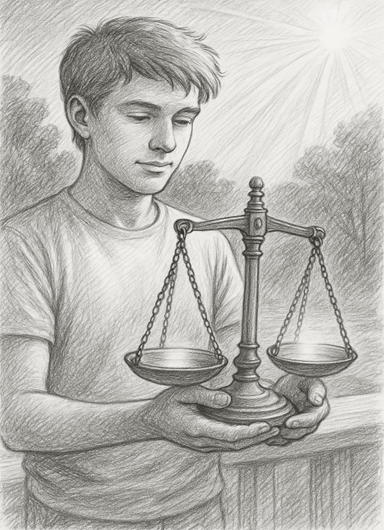
The grandfather didn’t answer. He reached for a small, rusted balance scale on the railing—an heirloom from his own father.
“You know this scale?” he asked. “Your great-grandad was a miner. He used it to weigh ore, but he said it measured something greater than metal—justice. Not everything weighs the same, but a good scale makes sure the measure is fair.”
He dropped a pebble on one pan. “This is what you think you’ve lost.” Then another. “And this, what someone else gained.”
The boy watched, his arms crossed, curiosity overtaking his frustration.
The old man added a third pebble, heavier than the rest. “This one’s the story you were told—that if their side rises, yours must fall. That story was sold by the same people who bent the beam and called it balance.”
The boy frowned. “What do you mean?”
“When I was your age,” said the grandfather, “we believed hard work guaranteed the climb. For a while, it did. Then markets changed and factories closed, machines got smarter, and those who owned the levers of money built taller ladders while the rest of us argued over who deserved the bottom rung. Now they feed you anger because angry men don’t notice the hands at the top pressing on the scale. They treat us like puppets—because too many dance when they pull the strings.”
He flipped the scale over; the pebbles scattered. The arms hung limp, like broken marionettes. “They’ve convinced you the problem is the person climbing beside you. But look closer—the scale isn’t even anchored to the ground anymore. The fight isn’t for equal weight; it’s for honest measure. Equity means measuring every stone’s, every person’s, its true worth.”
The boy’s jaw tightened. “So what do I do with that?”
The grandfather smiled. “Simple. Stop counting other people’s pebbles and start measuring their worth. Fix the scale. Learn, build, vote, speak, stand—not for the side you were born on, but for the fairness your great-grandad believed in. Opportunity isn’t gone, son. It’s just been disguised by those who need you too angry to see the game.”
The boy turned the scale in his hands. It felt lighter than he’d imagined—and suddenly, so did he. He set it on the railing, and as the arms found their balance, the old man said softly, “Remember, life’s not meant to be equal—it’s meant to be just.”#NeverFearTheDream
Equality assumes sameness, but nature has never been equal. No two stones weigh alike, no two lives start level. Equity is the art of fair measure — adjusting the balance so that justice, not uniformity, prevails. It asks that we see worth in context, not in comparison. The world doesn’t need everyone to carry the same load; it requires each of us to bear our share with integrity and pride. The lesson of the scale is simple: fairness isn’t about equal weight, but about honest measure — the foundation of any just and enduring society.
54% of Black men born in the bottom income quintile remain there as adults, compared to 22% of White men.1
Hispanic children are more likely than Black children but less likely than White children to move up from the bottom 20% into the middle or top 40%.2
Black boys earn less than White boys in 99% of U.S. neighborhoods.1
Among children from low-income households, only 17% of White children remain in the bottom decile as adults versus 42% of Black children.3
Between cohorts born in 1978 and 1992, the racial mobility gap shrank by about 27%, yet Black men and Native Americans remain twice as likely as White men to experience downward mobility.4
1:(Brookings, 2018; Chetty et al., Opportunity Insights, 2018)
2:(Chicago Fed, 2023; Opportunity Insights, 2018)
3:(Equitable Growth, 2022; Pew Research Center, 2022)
4: (Equitable Growth, 2023; U.S. Census Bureau, 2024)
Always feel free to re-post—anywhere, anytime, to anyone—share freely.
NeverFearTheDream simplebender.comStand For Truth
If you’re looking for daily thoughts and insights you will want to start the morning with:
Lap Around the Sun: Daily Steps Forward
If you know someone who is facing any facet of Alzheimer’s they might gain some insight from:
Joy in Alzheimer’s: My Mom’s Brave Walk into Dementia’s Abyss
Please consider following simplebender, you’re reading makes my writing more fun..…
Comments and thoughts are always welcome and feel free to re-post …..
When presented with facts, we accept them, like them or not. People are facts, and so are you—accept them and yourself. Everyone has a bright and a dark side. Controlling your dark while enjoying their light takes practice. Showing your light while exposing their darkness comes naturally, but it should be avoided. 25.10.5
NeverFearTheDream simplebender.comStand For Truth
If you’re looking for daily thoughts and insights you will want to start the morning with:
Lap Around the Sun: Daily Steps Forward
If you know someone who is facing any facet of Alzheimer’s they might gain some insight from:
Joy in Alzheimer’s: My Mom’s Brave Walk into Dementia’s Abyss
Please consider following simplebender, you’re reading makes my writing more fun..…
Comments and thoughts are always welcome and feel free to re-post …..



 simplebender