Posted in NeverFeartheDream

Never Fear The Dream…

Being present has only one concept of time—the now—not dwelling on the past or worrying about the future, simply experiencing this moment. 26.11.02

NeverFearTheDream………. W. C. Barron………. simplebender.com……….keystonecompact.org

Posted in Keystone

Keep the Promise—Fix the Math

A lifetime of promises to workers should never be a campaign prop. But arithmetic isn’t a rumor, either.

The health-care debate reveals what happens when cost, access, responsibility, and trust drift apart. Social Security and Medicare pose the same danger on a national scale. They are not abstract entries in a budget. Retirees and workers have organized their lives around decades of decisions based on the expectation that these promises will be kept.

For current retirees, Social Security income and Medicare coverage are woven into housing, healthcare, food, transportation, and family plans. Near-retirees have too little time to rebuild an entire financial life if the government abruptly changes the rules. Protecting those citizens is not a political weakness. It is respect for reliance built on public policy over a lifetime.

But respect for the promise cannot mean silence about the system’s long-term obligations. Younger workers are also entitled to honesty. They should not be required to contribute for decades while political leaders defend the programs in speeches and neglect them in the budget. Pretending the math does not matter is a betrayal in itself.

The Keystone Compact’s rule is simple: protect current beneficiaries and near-retirees, phase in changes gradually for younger workers, and make the financial reality visible.

That visibility should begin with plain-language accounting. Workers should be able to see what they and their employers have contributed, what benefits current law projects, how those benefits are financed, what long-term gaps remain, and what delay will cost. Public trust cannot be rebuilt by annual notices that describe benefits without explaining the underlying obligation.

Reform should begin with measures that do not require breaking the core promise: stronger fraud prevention, administrative efficiency, better coordination, and honest scrutiny of payments that deliver little public value. Medicare should reward primary care, prevention, price transparency, and chronic disease management because avoiding a preventable crisis benefits patients and is usually less costly for the system.

Longer workforce participation may be part of the answer for people who are healthy, willing, and able to continue working. But the policy cannot be designed as though every occupation ages the same way. A desk worker and a roofer do not reach sixty-five with the same physical capabilities. Any change in retirement age should be gradual, prospective, and attentive to disability, health, and the realities of physical labor and mental health.

Prospective means-testing for future high-income retirees may also merit serious discussion if it helps preserve the core promise for lower- and middle-income workers, but it must also account for and recognize their historic contribution. That conversation should be honest about what is being changed, when, and why. It should not quietly transform a broad social-insurance commitment after citizens have already planned around it.

Personal responsibility belongs in the framework, but it must be applied carefully. We should recognize that Social Security should be a safety net, not the sole source of retirement income. People should be encouraged to save, plan, stay healthy where possible, and work longer where practical. Prevention and responsible choices can reduce strain. But no serious policy should pretend that wages, disability, caregiving, illness, market losses, or longevity are entirely within an individual’s control. Responsibility is not a substitute for the promise, nor is the promise a substitute for responsibility.

Both political tribes exploit the issue because fear is easier than reform. One side warns that any change is an attack on seniors, while the other speaks of fiscal discipline without acknowledging that abrupt cuts would destabilize people who cannot return to the workforce. Each uses retirees as campaign props while leaving younger workers to shoulder the mounting cost of delay.

A responsible transition requires time. Announce changes affecting younger workers early enough to allow for different savings and retirement decisions. Rules should be stable enough to plan around. The public should see the trade-offs: contributions, eligibility, benefit formulas, means-testing, health costs, and the consequences of postponement. No combination is painless, and leaders who promise one are selling another form of debt and deceit.

The local proof is found around kitchen tables. A retiree decides whether a prescription or a repair can wait. A middle-aged worker supports children and aging parents while trying to save. A younger employee sees deductions on every paycheck but hears no credible explanation of what the system will provide decades later. Each deserves more than slogans.

Keep the promise. Fix the math. Encourage responsibility. Stop lying to the next generation.

The final question is whether the country is truly preserving Social Security and Medicare or merely delaying the reckoning until reform becomes more severe, choices become more limited, and trust becomes harder to restore.

This essay concerns public promises built over a working life. The next concerns the opposite boundary: deeply personal medical and moral decisions, where government should exercise humility rather than claim ownership.

Next in Category III: Personal Decisions Are Not Political Trophies

… .- ..-. . – -.– / -. . –

NeverFearTheDream………. W. C. Barron………. simplebender.com……….keystonecompact.org


Lap Around the Sun: Daily Steps Forward
by WCBarron

Buy at Amazon Buy at Barnes & Noble Buy at Books2Read

Joy in Alzheimer’s: My Mom’s Brave Walk into Dementia’s Abyss
by WCBarron

Buy at Amazon Buy at Barnes & Noble Buy at Books2Read
Posted in Current Events

The Cost of Walking Away Without a Plan

Pressure is the ability to impose costs; leverage is the ability to secure results.

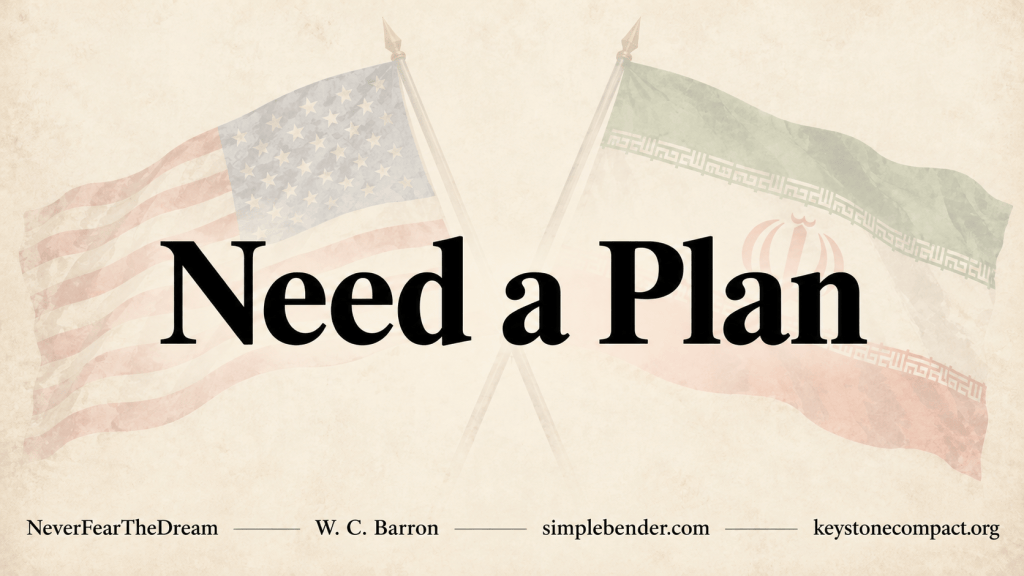
A fundamental difference separates winning a confrontation from achieving an objective. Governments often mistake their capacity to punish an adversary for their ability to change its behavior. The current conflict with Iran illustrates the consequences of that confusion and the cost of abandoning a strategy without a credible alternative.

In May 2018, the United States unilaterally withdrew from the Joint Comprehensive Plan of Action (JCPOA), an internationally negotiated agreement that restricted Iran’s nuclear enrichment and provided enhanced international oversight. The agreement wasn’t perfect, but it was functioning within its nuclear mandate. Rather than securing a stronger replacement, the U.S. 45th President imposed a maximum-pressure sanctions campaign. Iran subsequently expanded its nuclear capabilities and curtailed international monitoring. The result was an increasingly dangerous confrontation, marked by diminishing transparency and a slow-burning fuse.¹

The United States bears responsibility for abandoning a diplomatic instrument without securing an effective alternative. Iran bears responsibility for its reactions, including its regional activities and nuclear expansion. Their reactions should not have been surprising and should have been anticipated. The escalating confrontation was foreseeable, and given the players involved, an eventual conflict was almost inevitable.

The Middle East and the United States are once again embroiled in conflict, with consequences extending well beyond the region. Three questions merit further consideration.

First, what was the functional alternative in 2018? One possibility was to remain in the JCPOA while negotiating supplementary agreements on ballistic missiles and regional security. Whether politically achievable is debatable, but withdrawing without an enforceable replacement surrendered existing constraints in pursuit of uncertain concessions.

Second, why did the U.S. expect sanctions to achieve what negotiated restrictions already provided? Economic pressure certainly harmed Iran, but it failed to produce the broader agreement that was earnestly sought. Meanwhile, Iranian enrichment advanced, and oversight diminished.² Pressure is the ability to impose costs; leverage is the ability to secure results. They are not the same.

Third, what is the strategic objective today? Preventing an Iranian nuclear weapon, eliminating enrichment, weakening regional military capabilities, changing Iran’s government, and/or establishing lasting regional stability? These are distinct objectives and may not be interdependent. Success in one does not guarantee success in another. Without clearly defined objectives, how can we measure success, recognize failure, or assess the value of restraint?

The JCPOA had legitimate shortcomings, including provisions that expired over time and its limited treatment of ballistic missiles and Iran’s regional activities. Preserving it would have reduced one risk while leaving others unresolved. But does abandoning an imperfect agreement make sense when the alternative offers fewer constraints, less visibility, and greater uncertainty?

The subsequent chain of events offers a cautionary lesson. An international agreement is unilaterally canceled. Sanctions failed to secure a replacement agreement. Nuclear restrictions eroded. Diplomatic trust deteriorated. Military force increasingly replaced negotiation, and each escalation brought new consequences and fewer obvious ways out. The path was neither automatic nor solely America’s making, yet its risks were hardly unimaginable.³

Before taking the first step, the U.S. should have heeded its allies’ concerns and confronted a simple question: Then what? That question remains relevant after every subsequent decision, especially when military success is mistaken for a sustainable political outcome.

We cannot undo the withdrawal or the decisions that followed. We can, however, demand coherent objectives, realistic measures of success, and an exit strategy that acknowledges the limits of coercion. Pride and punishment are poor substitutes for policy, and military superiority does not guarantee political success.

Even after being told countless times that we have won. If we cannot explain what comes after the confrontation, how can we claim to know what winning looks like?

-.. — / -. — – / .– .- .-.. -.- / .- .– .- -.–

NeverFearTheDream………. W. C. Barron………. simplebender.com……….keystonecompact.org


Lap Around the Sun: Daily Steps Forward
by WCBarron

Buy at Amazon Buy at Barnes & Noble Buy at Books2Read

Joy in Alzheimer’s: My Mom’s Brave Walk into Dementia’s Abyss
by WCBarron

Buy at Amazon Buy at Barnes & Noble Buy at Books2Read

Sources

  1. International Atomic Energy Agency (IAEA), Verification and Monitoring in the Islamic Republic of Iran in Light of United Nations Security Council Resolution 2231 (2015), September 2025. Documents the May 2018 U.S. withdrawal and the progressive deterioration of Iran’s compliance and monitoring arrangements beginning in 2019.
  2. Congressional Research Service, Iran’s Nuclear Program and 2025 UN Sanctions Reimposition, updated October 13, 2026. Documents the breakdown of JCPOA restrictions, diminished monitoring, reimposed UN sanctions, and continuing uncertainty concerning Iran’s nuclear capabilities.
  3. Reuters, Iran Says It Will Reply to U.S. Response on Hormuz Proposal Once Review Over, October 12, 2026. Documents the continuing conflict and unresolved disagreement over nuclear negotiations and regional maritime security.
Posted in Keystone

Health Care Should Not Be a Maze

Families shouldn’t need a lawyer or an accountant to understand a medical bill.

The previous essay contended that public assistance should help people regain stability rather than trapping them in a system. Health care poses the same test, but more harshly. People are told to make responsible choices while prices, networks, coverage rules, and even what the bill means and when it will arrive remain hidden surprises.

Medical services and bills shouldn’t require a lawyer, an accountant, and a translator before a family knows what’s happening. Yet that is how the system often feels. A patient enters through one door, receives care from several professionals, and later discovers that each provider may have a different price, contract, billing code, or insurance status. The family may not know what was covered, what was denied, what was negotiated, or what remains owed until weeks after the decision could have been made.

The absurdity is not merely administrative. Hidden prices undermine personal responsibility by preventing people from weighing options they can’t see. Narrow networks can turn continuity of care into a guessing game. Delayed approvals can turn routine conditions into emergencies. Rural communities may have no meaningful choice when the nearest clinic, specialist, pharmacy, or mental health provider is hours away.

Keystone Compact’s goal is practical: more understandable choices, clearer pricing, stronger primary care, protection from catastrophic loss, and responsibility without coercion.

Price transparency should be central. Before scheduled care, patients deserve to know the expected cost of a service, what insurance will pay, what the patient will likely owe, and when the bill will likely be due. Hospitals, physicians, insurers, pharmacies, and intermediaries should not hide behind billing language designed primarily for them or their accounting departments.

Transparency alone is not a cure. In an emergency, a person cannot shop around; time is of the essence. A patient with cancer, a complicated pregnancy, a chronic disease, or a rare condition may have few options and little bargaining power. Preexisting conditions, catastrophic events, and expensive long-term illnesses must be addressed directly because no serious health policy can pretend that every medical cost is predictable or voluntary.

The system should strengthen primary care and preventive measures before problems become crises. It should support rural access, telehealth where clinically appropriate, mental health treatment, faster access to safe generic medicines, and, where possible, competition among providers and insurers. Health savings flexibility and catastrophic coverage can give some families more control, but they are tools, not universal solutions.

Prevention also matters. Better nutrition, physical activity, vaccinations, early screening, addiction treatment, and chronic disease management can reduce suffering and long-term costs. Policy can encourage those choices through information, incentives, access, and reduced barriers. It should not turn health into moral surveillance or punish people for age, genetics, disability, poverty, dangerous work, or circumstances beyond their reasonable control.

Personal responsibility requires accessible information and realistic choices. It cannot be demanded after the system has concealed both.

The political debate usually offers two abstractions. One side assumes that another government program can organize complexity into fairness. The other assumes that a market label will produce competition even when patients are frightened, information is unequal, and local options are scarce. Government-only complexity and market-only indifference can both leave the patient standing at the same locked door.

A disciplined government has a legitimate role: to enforce clear rules, prevent fraud, protect patients from deceptive billing, preserve access for serious conditions, encourage competition, and make public obligations financially visible. But government should not multiply mandates and reporting systems merely to demonstrate activity. The test is whether care becomes more accessible, understandable, and effective, not whether the regulatory binder grows thicker.

The local evidence is painfully ordinary. A family postpones care because it cannot estimate the bill. A small employer watches premiums rise faster than wages. A rural resident drives half a day to see a specialist. A physician spends scarce time negotiating with an insurer rather than treating a patient. A retiree receives several statements that appear to describe the same visit but disagree on the amount owed.

These are not signs that Americans are incapable of making health decisions. They are signs that the system often withholds the conditions necessary for responsible decision-making.

No one should need an IT expert to access their medical portal.

The human test is straightforward: can an ordinary family access their portal and understand the care, expected cost, available options, and financial risk before the bill arrives? If any answer is no, the system has mistaken complexity for sophistication and shifted its failures onto the patient.

Health care also directly addresses the country’s largest promises to workers and retirees. Social Security and Medicare cannot be protected by rhetoric alone. They require the same combination of trust, transparency, gradual reform, and honest arithmetic.

Next in Category III: Keep the Promise. Fix the Math.

— . -.. .. -.-. .- .-.. / …. . .-.. .–. / … …. — ..- .-.. -.. / -… . / . .- … -.–

NeverFearTheDream………. W. C. Barron………. simplebender.com……….keystonecompact.org


Lap Around the Sun: Daily Steps Forward
by WCBarron

Buy at Amazon Buy at Barnes & Noble Buy at Books2Read

Joy in Alzheimer’s: My Mom’s Brave Walk into Dementia’s Abyss
by WCBarron

Buy at Amazon Buy at Barnes & Noble Buy at Books2Read
Posted in Political

The Subsidized U.S. Free Market

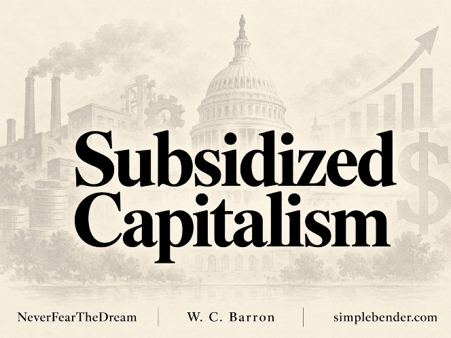
America champions a free market while quietly and substantially subsidizing industries it considers too important to leave entirely to the free market.

America likes to describe itself as the world’s shining light of capitalism: open markets, private enterprise, risk and reward, and competition. We contrast that system with socialist economies and communist rivals. Those governments supposedly pick winners, support favored industries, and distort markets. Yet our own system routinely does many of the same things. We simply use different language to describe, hide, and justify them.

The United States remains a capitalist economy because businesses and productive assets are overwhelmingly privately owned. But calling it an open free-market economy requires turning a blind eye to and overlooking how the government routinely alters outcomes. We subsidize agriculture, protect industries with tariffs, finance strategic technologies, underwrite private risk, provide tax preferences, and occasionally rescue companies considered too important or too big to fail. America’s argument with state-directed economies is therefore less about whether government intervenes but about when, where, for whom, and how transparently.

Energy, steel, and automobiles offer revealing examples. The federal government supports energy through tax preferences, direct grants, research funding, and loan guarantees; the Energy Information Administration counted roughly $30 billion in energy-specific federal subsidies and support in fiscal 2022 alone. Steel receives protection not only through tariffs and Buy America requirements but also through direct investment. In August 2026, the Department of Energy awarded $500 million toward a $1 billion modernization of Cleveland-Cliffs’ Ohio steelworks. This investment came even after the company concluded that the original project lacked a sufficient commercial case. The automobile industry has likewise benefited from government-directed demand and investment; federal clean-vehicle credits subsidized qualifying purchases by as much as $7,500 for passenger vehicles and $40,000 for larger commercial vehicles. At the same time, federal policy supported battery charging infrastructure, along with battery and vehicle manufacturing.

Consider agriculture. Although farmers and ranchers are suffering from high diesel costs and a downstream market they don’t control, the industry remains historically subsidized. The USDA forecasts $47.4 billion in direct government payments to them in 2026, excluding crop-insurance indemnities and USDA loans. In 2022, federal crop insurance alone cost taxpayers $17.3 billion, including about $12 billion in subsidies for farmers’ premiums. On average, the government paid 62 percent of those premiums. Agriculture may be privately owned, but some of its risk clearly is not. The federal government still pays landowners to remove millions of acres from agricultural production through conservation programs. In contrast, separate commodity and crop-insurance programs protect farm income against falling prices, revenue losses, and even prevented planting.

Then there are industries we consider strategically important. Semiconductor manufacturing has received billions in federal incentives because America decided that excessive reliance on foreign chip production poses economic and national-security vulnerabilities. As of July 2026, the Commerce Department had funded dozens of semiconductor projects through federal incentive programs. Energy has received similar treatment, with tens of billions directed toward infrastructure, power generation, and emerging energy technologies.

Some of this may be justified. Food security matters. Semiconductor independence matters. Energy security matters. Governments sometimes pay for benefits that markets cannot adequately price. But if that is the argument, we should at least be honest about what we are doing: this is not unfettered capitalism. It is a managed market in which public policy, and public money, deliberately alters risk, return, and competition.

The tax code reinforces the point. The Congressional Budget Office estimates that federal tax expenditures—credits, deductions, exclusions, and other preferences—will total about $2.6 trillion in 2026, roughly 8 percent of GDP. Not all of those provisions subsidize corporations or industries, but the scale shows how routinely the government uses taxation to encourage some activities and discourage others.

Meanwhile, we criticize China and other state-directed competitors for supporting industries, protecting strategic sectors, and influencing capital allocation. The differences are real, particularly in ownership, political control, and individual economic freedom, but the economic mechanisms can look surprisingly similar. We condemn their subsidies while defending ours as incentives, credits, guarantees, strategic investments, or national priorities.

Perhaps America doesn’t really have a capitalism-versus-socialism argument. Maybe we have an argument over whose capitalism gets subsidized.

That raises a tougher question than the slogan admits: if an industry can’t compete without government support, are taxpayers protecting the national interest—or just someone else’s profits? We pay our taxes for their benefit, only to pay an elevated price for a product they produced with our money; well, that seems totally fair.

NeverFearTheDream………. W. C. Barron………. simplebender.com……….keystonecompact.org

… …. — .– / — . / – …. . / — — -. . -.–


Lap Around the Sun: Daily Steps Forward
by WCBarron

Buy at Amazon Buy at Barnes & Noble Buy at Books2Read

Joy in Alzheimer’s: My Mom’s Brave Walk into Dementia’s Abyss
by WCBarron

Buy at Amazon Buy at Barnes & Noble Buy at Books2Read
Posted in Keystone

Compassion Should Help People Stand

A safety net should catch people when they fall, not become a hammock no one wants to leave.

The fiscal category ended with a defense of markets that reward value rather than political connections. But even honest markets cannot prevent every illness, layoff, disability, family crisis, or season of bad luck. A free society still has to decide what it owes people when life knocks them down.

The first half of that sentence matters as much as the second. A decent country does not abandon a hungry child, a worker who has lost a job, a family overwhelmed by illness, an older adult who can no longer meet basic needs, or a citizen whose disability limits the work that can reasonably be done. Fiscal discipline without humanity becomes cruelty.

Public assistance should restore stability, preserve dignity, and, wherever possible, provide a practical path to independence. Compassion without discipline can become a system that protects the program more than the person it serves.

The Keystone Compact balances compassion with math, assistance with agency, and protection from ruin with a path back to standing.

That balance begins with refusing to treat dissimilar circumstances as the same policy problem. Children are not able-bodied adults. Permanent disability is not temporary unemployment. A full-time caregiver is not someone who rejects every opportunity to work. An elderly citizen with limited options is not a young worker between jobs. Fairness requires distinctions because responsibility depends on actual capacity.

For people who can work, assistance should reinforce the path back: useful training, job placement, transportation, childcare, treatment, and temporary support that does not end the instant a person accepts more hours or a modest raise. Benefit cliffs can punish progress by leaving a family poorer after earning slightly more. A program that creates that trap may be well-intentioned, but it is poorly designed.

For people who cannot reasonably become self-supporting, the standard is different. Stability, humane administration, protection from exploitation, and dependable care may be the appropriate measures of success. Personal responsibility is not a slogan to be used against disability, age, childhood, or circumstances beyond an individual’s control. Apply it with judgment rather than suspicion.

Compassion should not quietly teach people to kneel forever.

That line is not an accusation against people receiving help. It is a warning to institutions. Programs can become organized around eligibility files, annual budgets, and political constituencies rather than around restored lives. Bureaucracies often count how many people they process because it is easier than measuring whether families become safer, healthier, more employable, or less dependent on emergency aid.

Fraud should be prevented and punished because public money is a public trust. But fraud control should not become a source of bureaucratic humiliation for anyone seeking help. People facing eviction, hunger, illness, or job loss should not have to surrender dignity to prove hardship. Administration can be firm without being demeaning and humane without becoming careless.

Local flexibility matters because barriers to independence vary by location. A rural worker may need transportation or broadband access. A city parent may need childcare and a predictable schedule. A recovering addict may need treatment before job training. A displaced worker may need a credential that employers recognize. National standards can promote and protect equal treatment, but local communities are often better positioned to identify what is preventing a person from moving forward.

The two political tribes usually offer an incomplete choice. One speaks of discipline as though hardship were evidence of moral failure. The other speaks of compassion as though expectations, limits, and outcomes were insults. The Keystone Compact challenges both. People should not be abandoned when they fall, nor should they be managed indefinitely when they can stand on their own.

The local tests aren’t complex. Does the program provide a bridge through crisis, or build a maze around it? Does it reward work whenever possible? Does it protect those who truly cannot work? Does it reduce fraud without treating every applicant as a suspect? Does it leave a person with more control over their life, or merely a permanent file number?

The measure of compassion is not how many people remain within a system. It is whether people are safer, steadier, and more capable because the system exists.

The final question is not whether government helped. It is whether the help allowed a person to stand taller or merely kept that person down.

That same tension- compassion, cost, access, choice, and responsibility- becomes even more personal in health care. A system meant to heal should not force families to navigate a financial and administrative obstacle course before they can understand their care.

Next in Category III: Health Care Should Not Be a Maze

… .- ..-. . – -.– / -. . –

NeverFearTheDream………. W. C. Barron………. simplebender.com……….keystonecompact.org


Lap Around the Sun: Daily Steps Forward
by WCBarron

Buy at Amazon Buy at Barnes & Noble Buy at Books2Read

Joy in Alzheimer’s: My Mom’s Brave Walk into Dementia’s Abyss
by WCBarron

Buy at Amazon Buy at Barnes & Noble Buy at Books2Read
Posted in Keystone

Capitalism Needs Rules, Not Cronyism

Being pro-business is easy; being pro-market means defending competition, even when insiders oppose it.

The last essay argued that a tax code should raise necessary revenue without becoming a warehouse for political favors. That principle extends beyond taxation. Economic freedom cannot survive when government embeds private advantages in public rules.

Capitalism and corporate favoritism are often treated as the same system, but they are not. Free enterprise depends on people being able to create, invest, work, trade, compete, fail, and try again under rules that are understandable and reasonably equal. Crony capitalism begins when success depends less on the value created than on purchased access.

Healthy markets require rules. Contracts must be enforceable, property rights must be secure, and accounting must be honest. Fraud, theft, coercion, and monopoly abuse must carry consequences. Workers must be able to move, customers must be able to choose, and new competitors must be able to enter without first seeking permission from firms already in the market.

Markets without rules do not remain free. They become hunting grounds for those with the most information, leverage, or political protection.

Government can distort competition in many familiar ways: subsidies for favored firms, bailouts that shield decision-makers from the consequences of failure, regulatory carveouts, licensing barriers unrelated to public safety, procurement written around a preferred bidder, monopoly protections, donor favors, and agencies effectively governed by the industries they regulate. Each advantage is defended as temporary, strategic, necessary, or too technical for ordinary citizens to question.

The cost is widely distributed, making it easy to hide. Entrepreneurs face higher barriers. Small firms absorb compliance costs that large competitors spread across entire departments. Ratepayers and customers pay more. As markets consolidate, workers lose options. Taxpayers finance the rescue while executives and investors retain the upside. Political influence becomes an economic asset.

Pro-business is not the same as pro-market.

The Keystone Compact supports capitalism because decentralized enterprise, voluntary exchange, investment, and competition create opportunities that government cannot command into existence. It opposes crony capitalism because political favoritism corrupts those strengths and turns public authority into private insulation.

That means the government should establish fair rules, punish fraud, enforce contracts, protect property, scrutinize monopolistic abuse, and resist the temptation to pick winners. It should not guarantee every business a profit or every worker a particular outcome. Failure is part of a functioning market. But failure must not be reserved for small firms while politically connected institutions receive rescue packages and revised rules.

Both parties compromise this principle in different ways. Populists often defend favored corporations as though every corporate demand were a defense of capitalism. Progressives often build regulatory and subsidy systems that reward approved industries, institutions, or social objectives, then call the resulting favoritism justice. One side protects incumbents through deference, while the other protects them through bureaucracy. Either way, competition, and the consumer, loses.

Economic stewardship requires more than cheering on growth statistics. It asks where opportunity begins, who bears risk, who receives protection, and whether rules reward productive value or political proximity. A booming sector built on permanent subsidies, captured regulation, or suppressed competition may enrich insiders while leaving the broader economy less resilient.

The local evidence is usually clearer than the national rhetoric. A contractor watches a public bid go to a larger competitor. A farmer sees a program designed for the scale of corporate agriculture. A neighborhood business spends scarce hours complying with rules that a national chain handles automatically. A worker remains in a poor job because licensing barriers make moving costly. The public is falsely told that tariffs burden a nondescript foreign importer, when in fact domestic businesses and the consumer are ultimately responsible. Another hidden tax. These are not abstract market failures. They are the daily price of connections becoming more valuable than competence.

The Government should not be anti-business. It should be anti-favoritism. It should welcome enterprise, reduce needless barriers, protect competition, and apply consequences consistently. The standard must be grounded in equal rules: no private immunity based on corporate size, no public punishment for political disfavor, and no hidden thumb on the scale.

The market test is simple: does policy reward value created or connections bought?

That question closes the fiscal category and opens the next. A free economy will still produce hardship, disruption, illness, disability, and bad luck. The challenge is not whether a decent society should help. It is whether assistance restores agency or quietly becomes another system organized around dependency and political management.

Next in Category III: Compassion Should Help People Stand

NeverFearTheDream………. W. C. Barron………. simplebender.com……….keystonecompact.org


Lap Around the Sun: Daily Steps Forward
by WCBarron

Buy at Amazon Buy at Barnes & Noble Buy at Books2Read

Joy in Alzheimer’s: My Mom’s Brave Walk into Dementia’s Abyss
by WCBarron

Buy at Amazon Buy at Barnes & Noble Buy at Books2Read
Posted in Political

OMG…They’re Passing Us…

Have you ever noticed what happens when a passing lane opens on a two-lane highway? You pull out to pass the slower vehicle, and suddenly they discover the accelerator. You speed up because the lane is ending. They speed up. Apparently, we now have a race neither of us agreed to enter.

They probably aren’t playing a game. Research suggests that some drivers accelerate when another vehicle passes them, influenced by attention, comparison, and nearby drivers’ behavior. We become comfortable on the country’s highways and byways, admiring the scenery, or simply disappearing into ourselves being self-reflective and absorbed. Then someone tries to pass us, and suddenly we are paying attention.

Perhaps we realize we were driving slower than intended. Perhaps competitive instinct flickers. Perhaps yielding the position simply feels uncomfortable. Whatever the mix, something that wasn’t a crisis ten seconds earlier begins to feel vaguely like one. The other driver hasn’t threatened us; they merely took advantage of an opportunity we gave them.

We judge ourselves by comparison: I’m being left behind. I’m losing ground. They’re getting ahead. We can be perfectly comfortable until someone beside us seems to be doing better. Their advancement becomes evidence of our decline, even when little about our actual condition has changed.

That is where politics becomes interesting. Loss aversion and status threat are powerful forces, and politicians, movements, and activists know how to use them. A rival nation advances. Another demographic grows. A cultural movement gains influence. Someone who once occupied the center of the road suddenly feels crowded toward the shoulder and being left behind.

The rhetoric follows easily: They’re cutting ahead. They’re replacing us. They’re taking what’s ours. They’re destroying our values.

Sometimes the threat is real and warrants a response. Sometimes change genuinely creates winners and losers. But perceived loss can be exaggerated and exploited because frightened people are easier to mobilize than thoughtful ones. A passing car can trigger acceleration. A rising nation can trigger militarization. A growing movement can provoke suppression. Demographic change can frighten a formerly dominant population. The circumstances differ, but the emotional rhythm is familiar: they are gaining; therefore, we must be losing.

Political theater thrives in the space between movement and meaning. Keep enough people staring at the car beside them, and they may stop looking at the road ahead. A calm population asks, “What is true?” An aroused one asks, “Who’s winning?” and then, “How did they cheat?”

Eventually, the passing lane ends. Someone has to yield, but yielding is not necessarily a defeat. It may be a compromise, a recognition that the other driver is moving faster, or the uncomfortable realization that we had become self-absorbed and distracted.

Eventually, everyone has to stop for fuel. Perhaps that pause is the equalizer: check the gauges, fuel up, check the tires, remember where you were headed, and stop treating every passing car as a threat.

This really isn’t a race. It only became one when we woke up to find someone passing us.

NeverFearTheDream………. W. C. Barron………. simplebender.com……….keystonecompact.org


Lap Around the Sun: Daily Steps Forward
by WCBarron

Buy at Amazon Buy at Barnes & Noble Buy at Books2Read

Joy in Alzheimer’s: My Mom’s Brave Walk into Dementia’s Abyss
by WCBarron

Buy at Amazon Buy at Barnes & Noble Buy at Books2Read
Posted in Keystone

A Flat Tax Without Spending Discipline Is Just Cleaner Paperwork

Tax reform should make life simpler for citizens, not make poor budgeting easier for politicians.

The Keystone budget standard is straightforward: every promise should show the bill, and both spending increases and tax cuts must be held to the same standard. With that discipline in place, tax reform can be discussed honestly rather than sold as a way to avoid difficult choices.

The American tax code is not merely complicated. Its complexity distributes power. Ordinary wage earners, pensioners, and small-business owners face forms, classifications, deadlines, phaseouts, and rules their representatives may not understand or even have read. Large institutions hire specialists to navigate the maze, lobbyists to reshape it, and lawyers to preserve exceptions. Complexity becomes a toll exacted from those with the least time and leverage.

That is the appeal of a flatter, simpler tax system. Fewer rates, fewer carveouts, clearer treatment of income, and lower compliance costs could reward work, saving, investment, and enterprise. Citizens should be able to understand what they owe and why. Similar income should be treated similarly. Political influence should not determine which dollar is taxed and which dollar receives a private escape route.

But the word “flat” can obscure as much as it clarifies. A tax system can be simple yet still unfair. It can lower the headline rate while shifting burdens onto working families, retirees, or small businesses. It can reward certain forms of income while taxing others more heavily. It can eliminate deductions that ordinary households rely on while preserving less obvious advantages for sophisticated interests.

The Keystone Compact therefore supports flatter taxation, with fiscal and distributional guardrails.

A serious reform should protect lower-income households from punitive burdens, avoid hidden tax increases on retirees and working families, reduce compliance costs, treat similar incomes similarly, and end most politically favored deductions. A generous personal exemption or comparable protection should preserve the principle that no citizen should be taxed into poverty. The system should encourage domestic investment and enterprise without turning every favored industry into a special category.

These safeguards are not concessions to complexity. They are part of honest design. Simplicity is valuable because it limits manipulation and makes the rules visible. It is not valuable if it merely shifts the unfairness into a cleaner column.

The greater danger is fiscal fantasy. A government cannot simplify its way out of overspending. If a flatter tax reduces revenue without corresponding spending discipline, the deficit does not disappear. It is merely renamed. The tax form becomes cleaner, while the national balance sheet weakens.

A flat tax without spending discipline is deficit laundering.

Tax and spending reform must go hand in hand. Programs should undergo sunset reviews. Waste, duplication, failed subsidies, corporate welfare, emergency-spending abuse, and benefits directed to households or companies that do not need them should be targeted first. Long-term obligations should be made visible. Tax preferences should be judged by public value rather than by political sponsorship.

This matters most outside the lobbying districts. A small-business owner should not need an accounting department to determine whether hiring one more worker is affordable. A retiree should not discover that simplification quietly changed how savings accumulated under older rules are treated. A family should not spend hours proving it qualifies for a benefit designed to offset a burden imposed elsewhere in the same code.

The tax code should raise the revenue required for legitimate government with the least distortion, coercion, and favoritism, consistent with what is reasonably possible. It should not be used as a shadow appropriations process in which Congress rewards constituencies without acknowledging that it is spending through exceptions.

Simpler taxes are good. Honest taxes are better.

The ultimate test is not whether a return fits on a postcard. It is whether citizens can see the burden, whether it is fairly shared, and whether government has disciplined spending that created the need.

Once the tax code stops serving as a warehouse for political favors, another distinction becomes unavoidable. A free market is not the same as a government-protected marketplace reserved for insiders.

Next in Category II: Capitalism Needs Rules, Not Cronyism

NeverFearTheDream………. W. C. Barron………. simplebender.com……….keystonecompact.org

..-. .-.. .- – – . -. / – …. . / -.-. — -.. .


Lap Around the Sun: Daily Steps Forward
by WCBarron

Buy at Amazon Buy at Barnes & Noble Buy at Books2Read

Joy in Alzheimer’s: My Mom’s Brave Walk into Dementia’s Abyss
by WCBarron

Buy at Amazon Buy at Barnes & Noble Buy at Books2Read
Posted in Keystone

If Politicians Promise It, They Must Show the Bill

Every politician can find a microphone for a promise. The real question is where has the invoice been hidden?

The previous essay contended that debt is deferred responsibility: political comfort bought today and passed on to citizens tomorrow. That diagnosis yields a practical rule. Before the government promises more or collects less, it should disclose the cost, the trade-off, and the plan to the public.

Campaign math is built around sequence. Voters hear the benefit first. The cost arrives later, usually after the applause, after the vote, or after the official estimate has been narrowed to the most convenient window. The trade-off may never be stated aloud. A new program is described by the people it will help. A tax cut is described by the money citizens will keep. Both may be defensible. Neither is honest until the other side of the ledger is visible.

Fiscal honesty requires both sides of the ledger.

The Keystone Compact applies the same standard to spending increases and tax cuts. New spending requires a credible pay-for, a defined priority, or an identified reduction elsewhere. Tax cuts require spending discipline sufficient to ensure the promised relief does not become additional debt. A party cannot call itself fiscally responsible merely because it prefers one route to the deficit.

This is where both parties become evasive. The progressive habit is to hide cost behind compassion: the need is urgent, the beneficiaries are sympathetic, and therefore the price becomes morally impolite to discuss. The conservative habit is to hide cost behind growth: lower taxes will unleash enough activity to postpone difficult spending choices again. One side treats arithmetic as cruelty. The other treats optimism as arithmetic.

A responsible budget framework should ensure that ordinary legislation lives within ordinary means. Emergency exceptions should be narrow and clearly defined: war, major disaster, or acute national crisis. An emergency should not be a routine policy preference wearing a flashing light. If every priority becomes urgent, urgency becomes a loophole.

Major legislation should also include a plain-language fiscal impact statement. Citizens deserve more than a headline number. They should be told the near-term cost, the long-term obligation, the likely debt-service burden, the assumptions behind the estimate, and which households, industries, or future taxpayers will bear the burden. Entitlement obligations and permanent tax changes should not fall outside the standard budget window simply because the calendar makes the politics easier.

This is not spreadsheet-style governance. It is democratic respect.

Citizens are routinely told that public finance is too complicated for them. Yet families compare mortgages, insurance, tuition, medical bills, and retirement options. Small businesses decide whether to hire a new employee or buy equipment. School boards and county commissions face crowded rooms where residents demand services, lower taxes, and explanations. People understand trade-offs when leaders stop hiding them.

Transparency will not produce universal agreement. It will produce something more useful: informed disagreement. A voter may support a program after seeing its cost. Another may accept a tax cut after seeing the necessary spending cuts. A community may choose to pay more for a service it values. Self-government does not require painless choices. It requires visible ones.

A balanced-budget framework must therefore be more than a ceremonial amendment or a promise deferred until conditions improve. It should establish enforceable habits: pay-for rules, honest definitions of emergencies, public accounting for long-term liabilities, sunset reviews of major programs, and regular scrutiny of waste, duplication, failed subsidies, corporate welfare, and bureaucratic expansion. The Executive branch should abide by the Legislature’s financial priorities and budget, and both should be held accountable.

The purpose is not to freeze government in place. It is to force priorities. Good programs should justify their costs. Necessary taxes should be stated plainly. Failed programs should not survive because their beneficiaries are organized and their costs are dispersed. Public money is a public trust, not a partisan inheritance.

No promise without a price tag.

That standard raises the next debate. Tax reform can make the system simpler and fairer, but simplicity alone cannot rescue a government determined to overspend. A cleaner tax form attached to the same deficits is not fiscal reform.

Next in Category II: A Flat Tax Without Spending Discipline Is Just Cleaner Paperwork

NeverFearTheDream………. W. C. Barron………. simplebender.com……….keystonecompact.org

… …. — .– / – …. . / -.-. — … –


Lap Around the Sun: Daily Steps Forward
by WCBarron

Buy at Amazon Buy at Barnes & Noble Buy at Books2Read

Joy in Alzheimer’s: My Mom’s Brave Walk into Dementia’s Abyss
by WCBarron

Buy at Amazon Buy at Barnes & Noble Buy at Books2Read